OCCUPATIONAL HEALTH
STANDARDS
Diploma in OSH Course
Lecturer: Tay Kay Chuang (Msc in OSH, USA)
Learning Objectives
1. Definition of Occupational Health
Standards
2. Learn about Permissible Exposure Limits
(PEL) and Threshold Limit Values (TLV)
3. Understand the limitations of Occupational
Health standards
Introduction
 Use of hygiene limits (Occupational health standards) – though not a
foolproof system, is an important strategy for the protection of workers at
work.
 Many of these standards are based on health effects. If not enough is
known about the health hazard of a substance, the hygiene limit set is
based on what can reasonably be achieved.
 “No exposure” limit is the best possible hygiene strategy for carcinogenic
substances.
 Occupational exposure limits (OELs) are set to control the absorption
into the body of harmful airborne contaminants following inhalation..
 Hygiene control is based on the concept of controlling risk by reduced
time exposure to the contaminants.
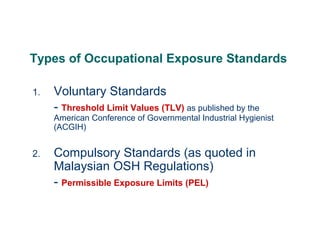
Types of Occupational Exposure Standards
1. Voluntary Standards
- Threshold Limit Values (TLV) as published by the
American Conference of Governmental Industrial Hygienist
(ACGIH)
2. Compulsory Standards (as quoted in
Malaysian OSH Regulations)
- Permissible Exposure Limits (PEL)
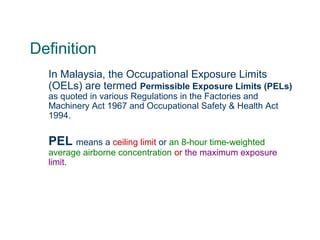
Definition
In Malaysia, the Occupational Exposure Limits
(OELs) are termed Permissible Exposure Limits (PELs)
as quoted in various Regulations in the Factories and
Machinery Act 1967 and Occupational Safety & Health Act
1994.
PEL means a ceiling limit or an 8-hour time-weighted
average airborne concentration or the maximum exposure
limit.
6
Definition
1. TWA Limit
 The time-weighted average airborne concentration of a
contaminant for a normal eight-hour workday to which
nearly all workers may be repeatedly exposed, day after
day, without any adverse health effect.
2. Ceiling Limit
 The airborne concentration that should not be exceeded
during any part of the working day.
3. Maximum Exposure Limit
 A fifteen-minute time-weighted average airborne
concentration which is three times the 8-hour TWA
airborne concentration of a contaminant.
7
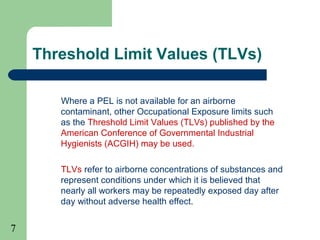
Threshold Limit Values (TLVs)
Where a PEL is not available for an airborne
contaminant, other Occupational Exposure limits such
as the Threshold Limit Values (TLVs) published by the
American Conference of Governmental Industrial
Hygienists (ACGIH) may be used.
TLVs refer to airborne concentrations of substances and
represent conditions under which it is believed that
nearly all workers may be repeatedly exposed day after
day without adverse health effect.
8
Categories of TLV
1. TLV-TWA (Threshold Limit Value - Time Weighted Average)
• The time-weighted average concentration for a normal 8 hour
work day and a 40 hour work week, to which nearly all workers
may be repeatedly exposed, day after day, without adverse effect.
2. TLV-C (Threshold Limit Value – Ceiling)
The concentration that should not be exceeded during any part of
the working exposure. (Most substances designated with a C value tend to be
irritants.)
Categories of TLV
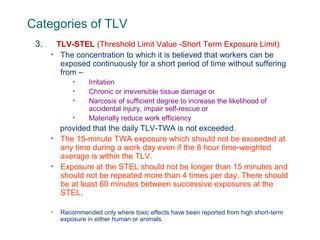
3. TLV-STEL (Threshold Limit Value -Short Term Exposure Limit)
• The concentration to which it is believed that workers can be
exposed continuously for a short period of time without suffering
from –
• Irritation
• Chronic or irreversible tissue damage or
• Narcosis of sufficient degree to increase the likelihood of
accidental injury, impair self-rescue or
• Materially reduce work efficiency
provided that the daily TLV-TWA is not exceeded.
• The 15-minute TWA exposure which should not be exceeded at
any time during a work day even if the 8 hour time-weighted
average is within the TLV.
• Exposure at the STEL should not be longer than 15 minutes and
should not be repeated more than 4 times per day. There should
be at least 60 minutes between successive exposures at the
STEL.
• Recommended only where toxic effects have been reported from high short-term
exposure in either human or animals.
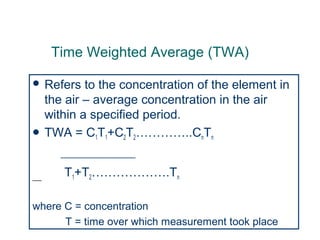
Time Weighted Average (TWA)
 Refers to the concentration of the element in
the air – average concentration in the air
within a specified period.
 TWA = C1T1+C2T2…………..CnTn
------------------------------------------------------
____ T1+T2……………….Tn
where C = concentration
T = time over which measurement took place
11
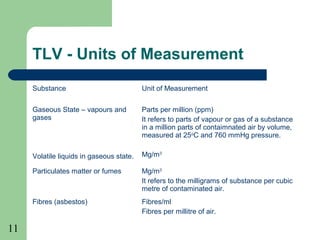
TLV - Units of Measurement
Substance Unit of Measurement
Gaseous State – vapours and
gases
Volatile liquids in gaseous state.
Parts per million (ppm)
It refers to parts of vapour or gas of a substance
in a million parts of contaimnated air by volume,
measured at 25o
C and 760 mmHg pressure.
Mg/m3
Particulates matter or fumes Mg/m3
It refers to the milligrams of substance per cubic
metre of contaminated air.
Fibres (asbestos) Fibres/ml
Fibres per millitre of air.
12
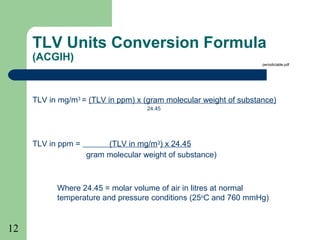
TLV Units Conversion Formula
(ACGIH)
TLV in mg/m3
= (TLV in ppm) x (gram molecular weight of substance)
24.45
TLV in ppm = (TLV in mg/m3
) x 24.45
gram molecular weight of substance)
Where 24.45 = molar volume of air in litres at normal
temperature and pressure conditions (25o
C and 760 mmHg)
periodictable.pdf
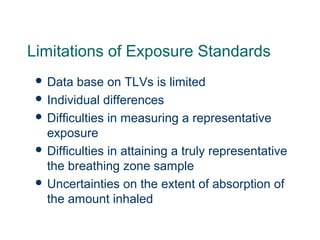
Limitations of Exposure Standards
 Data base on TLVs is limited
 Individual differences
 Difficulties in measuring a representative
exposure
 Difficulties in attaining a truly representative
the breathing zone sample
 Uncertainties on the extent of absorption of
the amount inhaled
Carcinogen
ACGIH defines a carcinogen as follows:
 A1 - Confirmed human carcinogen
 A2 - Suspected human carcinogen
 A3 - Proven on animals
 A4 - Not classifiable as a human carcinogen
 A5 - Not suspected as a human carcinogen.
NB: Exposure to A1 carcinogen should be kept as low as
reasonably practicable (ALARP).
Duration of Exposure
 Expressed as a Time weighted average (TWA) – exposure
standards for air pollution.
 TWA exposures permit excursions above the exposure
standards provided they are compensated for by equivalent
excursions below the standard during the working day.
 Permissible variations in the exposure standards upon expert
advice are influenced by factors such as acute effects and
accumulation and excretion of metabolite.
 Factors that require expert attention need to be taken into
consideration in changes or reviews of exposure standards.
Biological Standards
Analysis of biological samples (e.g. urine or blood) obtained from
exposed workers .
Examples of analysis:
Body fluids and tissue for lead, arsenic or mercury
Analysis of metabolite (urine phenol for benzene exposure)
Analysis of serum to determine the levels of enzyme or
biochemical substance (decreased cholinesterase level due to
exposure to organic phosphate compounds)
 Breath analysis for volatile solvents and ketones.
Malaysian Occupational Exposure
Standards
 Factories and Machinery Act 1967
– Factories and Machinery (Lead) Regulations 1984
– Factories and Machinery (Asbestos Process)
Regulations 1986
– Factories and Machinery (Mineral Dust) Regulations
1989
– Factories and Machinery (Noise Exposure)
Regulations 1989
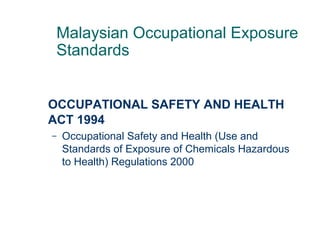
OCCUPATIONAL SAFETY AND HEALTH
ACT 1994
– Occupational Safety and Health (Use and
Standards of Exposure of Chemicals Hazardous
to Health) Regulations 2000
Malaysian Occupational Exposure
Standards
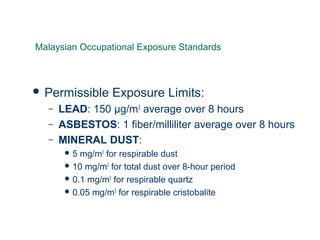
 Permissible Exposure Limits:
– LEAD: 150 μg/m3
average over 8 hours
– ASBESTOS: 1 fiber/milliliter average over 8 hours
– MINERAL DUST:
 5 mg/m3
for respirable dust
 10 mg/m3
for total dust over 8-hour period
 0.1 mg/m3
for respirable quartz
 0.05 mg/m3
for respirable cristobalite
Malaysian Occupational Exposure Standards
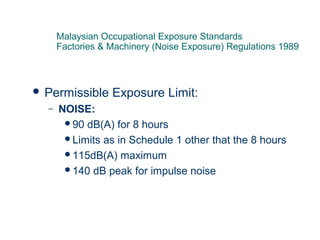
 Permissible Exposure Limit:
– NOISE:
90 dB(A) for 8 hours
Limits as in Schedule 1 other that the 8 hours
115dB(A) maximum
140 dB peak for impulse noise
Malaysian Occupational Exposure Standards
Factories & Machinery (Noise Exposure) Regulations 1989
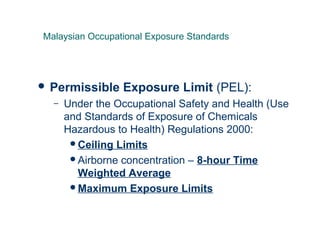
 Permissible Exposure Limit (PEL):
– Under the Occupational Safety and Health (Use
and Standards of Exposure of Chemicals
Hazardous to Health) Regulations 2000:
Ceiling Limits
Airborne concentration – 8-hour Time
Weighted Average
Maximum Exposure Limits
Malaysian Occupational Exposure Standards
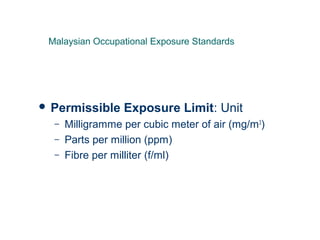
 Permissible Exposure Limit: Unit
– Milligramme per cubic meter of air (mg/m3
)
– Parts per million (ppm)
– Fibre per milliter (f/ml)
Malaysian Occupational Exposure Standards
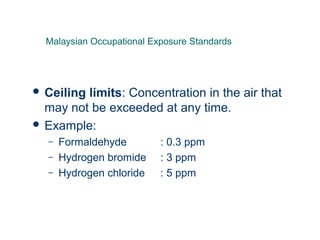
 Ceiling limits: Concentration in the air that
may not be exceeded at any time.
 Example:
– Formaldehyde : 0.3 ppm
– Hydrogen bromide : 3 ppm
– Hydrogen chloride : 5 ppm
Malaysian Occupational Exposure Standards
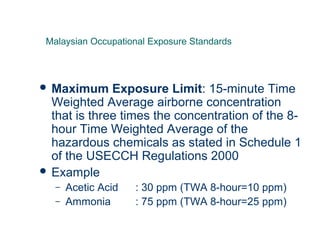
 Maximum Exposure Limit: 15-minute Time
Weighted Average airborne concentration
that is three times the concentration of the 8-
hour Time Weighted Average of the
hazardous chemicals as stated in Schedule 1
of the USECCH Regulations 2000
 Example
– Acetic Acid : 30 ppm (TWA 8-hour=10 ppm)
– Ammonia : 75 ppm (TWA 8-hour=25 ppm)
Malaysian Occupational Exposure Standards
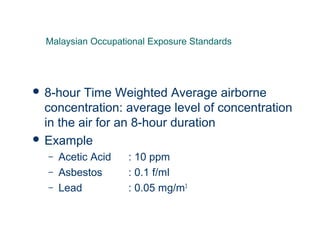
 8-hour Time Weighted Average airborne
concentration: average level of concentration
in the air for an 8-hour duration
 Example
– Acetic Acid : 10 ppm
– Asbestos : 0.1 f/ml
– Lead : 0.05 mg/m3
Malaysian Occupational Exposure Standards
26
Skin Notation
 Skin notation (“skin”) refers to the potential significant
contribution to the overall exposure by the cutaneous route,
including mucous membranes and the eyes, either by contact
with vapour or, more so by direct skin contact with the
substance.
 Materials having a low dermal LD50 (1000mg/kg body weight or
less) would be given a skin notation.
 Skin notation is also considered for chemicals with easy skin
penetration property and causes increased systemic effects.
27
Sensitizer Notation
 “SEN” notation refers to the potential for an agent to produce
sensitization. This notation is meant to protect workers from
induction of this effect.
 Sensitisation is an immunological response to a foreign
substance. Initially, there may be little or no response to a
sensitising agent. However, after a person is sensitized,
subsequent exposure may cause intense responses, even at
low exposure concentration (well below the TLV0. These
reactions may be life-threatening and may have an immediate
or delayed onset.
28
Biological Exposure Indices (BEIs)
 Biological monitoring (= an indicator of the uptake of a
substance) should be instituted for such substances to evaluate
the total exposure and health risk to workers from all sources,
including dermal, ingestion or non-occupational.
 The BEI determinant can be –
– The chemical itself
– One or more metabolites
 Most commonest specimen used for biological monitoring is
urine, blood, or exhaled air.
 Biologicla monotoring serves as a complement to exposure
assessment by air sampling.

4 occupational health standards DOSH

  • 1.
    OCCUPATIONAL HEALTH STANDARDS Diploma inOSH Course Lecturer: Tay Kay Chuang (Msc in OSH, USA)
  • 2.
    Learning Objectives 1. Definitionof Occupational Health Standards 2. Learn about Permissible Exposure Limits (PEL) and Threshold Limit Values (TLV) 3. Understand the limitations of Occupational Health standards
  • 3.
    Introduction  Use ofhygiene limits (Occupational health standards) – though not a foolproof system, is an important strategy for the protection of workers at work.  Many of these standards are based on health effects. If not enough is known about the health hazard of a substance, the hygiene limit set is based on what can reasonably be achieved.  “No exposure” limit is the best possible hygiene strategy for carcinogenic substances.  Occupational exposure limits (OELs) are set to control the absorption into the body of harmful airborne contaminants following inhalation..  Hygiene control is based on the concept of controlling risk by reduced time exposure to the contaminants.
  • 4.
    Types of OccupationalExposure Standards 1. Voluntary Standards - Threshold Limit Values (TLV) as published by the American Conference of Governmental Industrial Hygienist (ACGIH) 2. Compulsory Standards (as quoted in Malaysian OSH Regulations) - Permissible Exposure Limits (PEL)
  • 5.
    Definition In Malaysia, theOccupational Exposure Limits (OELs) are termed Permissible Exposure Limits (PELs) as quoted in various Regulations in the Factories and Machinery Act 1967 and Occupational Safety & Health Act 1994. PEL means a ceiling limit or an 8-hour time-weighted average airborne concentration or the maximum exposure limit.
  • 6.
    6 Definition 1. TWA Limit The time-weighted average airborne concentration of a contaminant for a normal eight-hour workday to which nearly all workers may be repeatedly exposed, day after day, without any adverse health effect. 2. Ceiling Limit  The airborne concentration that should not be exceeded during any part of the working day. 3. Maximum Exposure Limit  A fifteen-minute time-weighted average airborne concentration which is three times the 8-hour TWA airborne concentration of a contaminant.
  • 7.
    7 Threshold Limit Values(TLVs) Where a PEL is not available for an airborne contaminant, other Occupational Exposure limits such as the Threshold Limit Values (TLVs) published by the American Conference of Governmental Industrial Hygienists (ACGIH) may be used. TLVs refer to airborne concentrations of substances and represent conditions under which it is believed that nearly all workers may be repeatedly exposed day after day without adverse health effect.
  • 8.
    8 Categories of TLV 1.TLV-TWA (Threshold Limit Value - Time Weighted Average) • The time-weighted average concentration for a normal 8 hour work day and a 40 hour work week, to which nearly all workers may be repeatedly exposed, day after day, without adverse effect. 2. TLV-C (Threshold Limit Value – Ceiling) The concentration that should not be exceeded during any part of the working exposure. (Most substances designated with a C value tend to be irritants.)
  • 9.
    Categories of TLV 3.TLV-STEL (Threshold Limit Value -Short Term Exposure Limit) • The concentration to which it is believed that workers can be exposed continuously for a short period of time without suffering from – • Irritation • Chronic or irreversible tissue damage or • Narcosis of sufficient degree to increase the likelihood of accidental injury, impair self-rescue or • Materially reduce work efficiency provided that the daily TLV-TWA is not exceeded. • The 15-minute TWA exposure which should not be exceeded at any time during a work day even if the 8 hour time-weighted average is within the TLV. • Exposure at the STEL should not be longer than 15 minutes and should not be repeated more than 4 times per day. There should be at least 60 minutes between successive exposures at the STEL. • Recommended only where toxic effects have been reported from high short-term exposure in either human or animals.
  • 10.
    Time Weighted Average(TWA)  Refers to the concentration of the element in the air – average concentration in the air within a specified period.  TWA = C1T1+C2T2…………..CnTn ------------------------------------------------------ ____ T1+T2……………….Tn where C = concentration T = time over which measurement took place
  • 11.
    11 TLV - Unitsof Measurement Substance Unit of Measurement Gaseous State – vapours and gases Volatile liquids in gaseous state. Parts per million (ppm) It refers to parts of vapour or gas of a substance in a million parts of contaimnated air by volume, measured at 25o C and 760 mmHg pressure. Mg/m3 Particulates matter or fumes Mg/m3 It refers to the milligrams of substance per cubic metre of contaminated air. Fibres (asbestos) Fibres/ml Fibres per millitre of air.
  • 12.
    12 TLV Units ConversionFormula (ACGIH) TLV in mg/m3 = (TLV in ppm) x (gram molecular weight of substance) 24.45 TLV in ppm = (TLV in mg/m3 ) x 24.45 gram molecular weight of substance) Where 24.45 = molar volume of air in litres at normal temperature and pressure conditions (25o C and 760 mmHg) periodictable.pdf
  • 13.
    Limitations of ExposureStandards  Data base on TLVs is limited  Individual differences  Difficulties in measuring a representative exposure  Difficulties in attaining a truly representative the breathing zone sample  Uncertainties on the extent of absorption of the amount inhaled
  • 14.
    Carcinogen ACGIH defines acarcinogen as follows:  A1 - Confirmed human carcinogen  A2 - Suspected human carcinogen  A3 - Proven on animals  A4 - Not classifiable as a human carcinogen  A5 - Not suspected as a human carcinogen. NB: Exposure to A1 carcinogen should be kept as low as reasonably practicable (ALARP).
  • 15.
    Duration of Exposure Expressed as a Time weighted average (TWA) – exposure standards for air pollution.  TWA exposures permit excursions above the exposure standards provided they are compensated for by equivalent excursions below the standard during the working day.  Permissible variations in the exposure standards upon expert advice are influenced by factors such as acute effects and accumulation and excretion of metabolite.  Factors that require expert attention need to be taken into consideration in changes or reviews of exposure standards.
  • 16.
    Biological Standards Analysis ofbiological samples (e.g. urine or blood) obtained from exposed workers . Examples of analysis: Body fluids and tissue for lead, arsenic or mercury Analysis of metabolite (urine phenol for benzene exposure) Analysis of serum to determine the levels of enzyme or biochemical substance (decreased cholinesterase level due to exposure to organic phosphate compounds)  Breath analysis for volatile solvents and ketones.
  • 17.
    Malaysian Occupational Exposure Standards Factories and Machinery Act 1967 – Factories and Machinery (Lead) Regulations 1984 – Factories and Machinery (Asbestos Process) Regulations 1986 – Factories and Machinery (Mineral Dust) Regulations 1989 – Factories and Machinery (Noise Exposure) Regulations 1989
  • 18.
    OCCUPATIONAL SAFETY ANDHEALTH ACT 1994 – Occupational Safety and Health (Use and Standards of Exposure of Chemicals Hazardous to Health) Regulations 2000 Malaysian Occupational Exposure Standards
  • 19.
     Permissible ExposureLimits: – LEAD: 150 μg/m3 average over 8 hours – ASBESTOS: 1 fiber/milliliter average over 8 hours – MINERAL DUST:  5 mg/m3 for respirable dust  10 mg/m3 for total dust over 8-hour period  0.1 mg/m3 for respirable quartz  0.05 mg/m3 for respirable cristobalite Malaysian Occupational Exposure Standards
  • 20.
     Permissible ExposureLimit: – NOISE: 90 dB(A) for 8 hours Limits as in Schedule 1 other that the 8 hours 115dB(A) maximum 140 dB peak for impulse noise Malaysian Occupational Exposure Standards Factories & Machinery (Noise Exposure) Regulations 1989
  • 21.
     Permissible ExposureLimit (PEL): – Under the Occupational Safety and Health (Use and Standards of Exposure of Chemicals Hazardous to Health) Regulations 2000: Ceiling Limits Airborne concentration – 8-hour Time Weighted Average Maximum Exposure Limits Malaysian Occupational Exposure Standards
  • 22.
     Permissible ExposureLimit: Unit – Milligramme per cubic meter of air (mg/m3 ) – Parts per million (ppm) – Fibre per milliter (f/ml) Malaysian Occupational Exposure Standards
  • 23.
     Ceiling limits:Concentration in the air that may not be exceeded at any time.  Example: – Formaldehyde : 0.3 ppm – Hydrogen bromide : 3 ppm – Hydrogen chloride : 5 ppm Malaysian Occupational Exposure Standards
  • 24.
     Maximum ExposureLimit: 15-minute Time Weighted Average airborne concentration that is three times the concentration of the 8- hour Time Weighted Average of the hazardous chemicals as stated in Schedule 1 of the USECCH Regulations 2000  Example – Acetic Acid : 30 ppm (TWA 8-hour=10 ppm) – Ammonia : 75 ppm (TWA 8-hour=25 ppm) Malaysian Occupational Exposure Standards
  • 25.
     8-hour TimeWeighted Average airborne concentration: average level of concentration in the air for an 8-hour duration  Example – Acetic Acid : 10 ppm – Asbestos : 0.1 f/ml – Lead : 0.05 mg/m3 Malaysian Occupational Exposure Standards
  • 26.
    26 Skin Notation  Skinnotation (“skin”) refers to the potential significant contribution to the overall exposure by the cutaneous route, including mucous membranes and the eyes, either by contact with vapour or, more so by direct skin contact with the substance.  Materials having a low dermal LD50 (1000mg/kg body weight or less) would be given a skin notation.  Skin notation is also considered for chemicals with easy skin penetration property and causes increased systemic effects.
  • 27.
    27 Sensitizer Notation  “SEN”notation refers to the potential for an agent to produce sensitization. This notation is meant to protect workers from induction of this effect.  Sensitisation is an immunological response to a foreign substance. Initially, there may be little or no response to a sensitising agent. However, after a person is sensitized, subsequent exposure may cause intense responses, even at low exposure concentration (well below the TLV0. These reactions may be life-threatening and may have an immediate or delayed onset.
  • 28.
    28 Biological Exposure Indices(BEIs)  Biological monitoring (= an indicator of the uptake of a substance) should be instituted for such substances to evaluate the total exposure and health risk to workers from all sources, including dermal, ingestion or non-occupational.  The BEI determinant can be – – The chemical itself – One or more metabolites  Most commonest specimen used for biological monitoring is urine, blood, or exhaled air.  Biologicla monotoring serves as a complement to exposure assessment by air sampling.