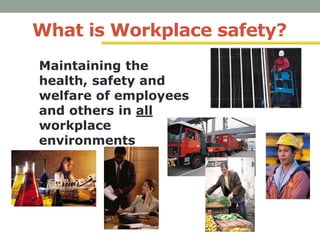
What is Workplace safety?
Maintaining the
health, safety and
welfare of employees
and others in all
workplace
environments
On successful completion of this unit
you will be able to
Recognise and report any workplace hazard
Comply with procedures to assess and control
risks
Follow workplace procedures in emergencies
Contribute to safety in the workplace through
consultation with employers, employees, OHS
representatives.
OHS has a long history
OHS was recognised in the late 1700’s in Britain.
Nothing meaningful was done about it.
During the 1800’s and through the depression
years of the early 1900’s and through the years of
WW 1, WW 2, there were many people who were
out of work and desperately took whatever work
could be found no matter what the conditions.
Is the workplace hazardous
worldwide?
The World Health
Organization estimates
• 250 million accidents
occur each year
• 330,000 deaths
• 160 million occupational
diseases
Accidents and Injuries can be costly
Lost production
Absenteeism
Medical bills
Increased
WorkCover or
insurance premiums
Unwanted publicity
Replacement or repair
of damaged equipment
Training of new or
casual staff
Poor company image
Fines or prison!
What are some typical work-related
injuries?
Bad backs (lifting)
Lung diseases
(breathing toxic
chemicals)
Burns
(hot machinery parts)
Hearing loss
(noisy machinery)
Cuts (sharp construction
tools)
Crushing injuries
(moving objects)
Skin diseases (irritating
substances)
Broken bones (falling)
WorkCover Authority of NSW
The statutory authority that administers OHS
legislation in NSW
Provides advice on rights and responsibilities
concerning OHS, rehabilitation and workers
compensation
Investigates causes of accidents, injuries and
illnesses
Issues licenses for hazardous
operations, eg. for the handling of dangerous
chemicals
What is the National
Occupational Health Safety
Committee?
Federal authority that considers the laws,
regulations and procedures covering health and
safety to all workers.
Whose responsibility is
workplace safety?
Employers
and
Employees
are both responsible
Employer’s Responsibilities
EMPLOYERS have a ‘duty of care’ (by law) to provide
a safe workplace.
 Managers and supervisors MUST help
employers meet this responsibility.
 Consult with employees on OHS matters
 Assess likely hazards
 Control and minimise hazard risks
 Provide information to workers
Employer’s Responsibility con’t
 Consult with workers (through OHS reps
and committees)
 Organise safe work systems
 Improve understanding (by
instruction/training)
 Provide protective clothing and
equipment
Employer’s Responsibility con’t
• Ensure tools/equipment/machines are safe
• Supervise inexperienced workers
• Monitor the workplace
• Keep records of inspections and injuries
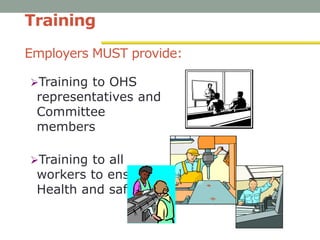
Training
Employers MUST provide:
Training to OHS
representatives and
Committee
members
Training to all
workers to ensure
Health and safety
Employee’s responsibility
• EMPLOYEES (YOU) must take care of your own
safety and that of others who may be affected by
your actions. You MUST co-operate with your
employer.
Work/behave in a safe way
Take care not to endanger the safety of others
Follow employer instructions
Operate equipment safely and only for the
intended purpose
Use personal protective equipment
Employee’s responsibility con’t
Cooperate with your employer
Do not willfully/recklessly interfere or
misuse equipment
Ensure you are not affected by alcohol or
drugs
Report hazards
Report work-related injuries, near misses
RECOGNISE AND
REPORT
WORKPLACE
HAZARDS
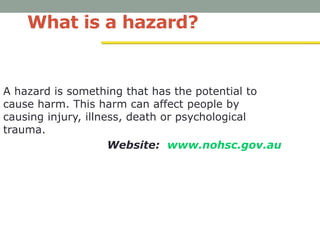
What is a hazard?
A hazard is something that has the potential to
cause harm. This harm can affect people by
causing injury, illness, death or psychological
trauma.
Website: www.nohsc.gov.au
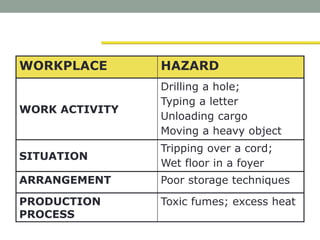
WORKPLACE HAZARD
WORK ACTIVITY
Drilling a hole;
Typing a letter
Unloading cargo
Moving a heavy object
SITUATION
Tripping over a cord;
Wet floor in a foyer
ARRANGEMENT Poor storage techniques
PRODUCTION
PROCESS
Toxic fumes; excess heat
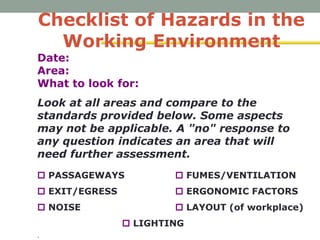
Checklist of Hazards in the
Working Environment
Date:
Area:
What to look for:
Look at all areas and compare to the
standards provided below. Some aspects
may not be applicable. A "no" response to
any question indicates an area that will
need further assessment.
 PASSAGEWAYS  FUMES/VENTILATION
 EXIT/EGRESS  ERGONOMIC FACTORS
 NOISE  LAYOUT (of workplace)
 LIGHTING
.
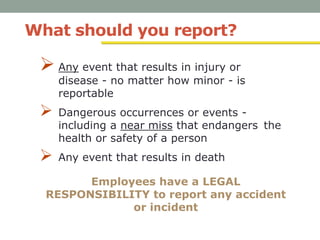
What should you report?
 Any event that results in injury or
disease - no matter how minor - is
reportable
 Dangerous occurrences or events -
including a near miss that endangers the
health or safety of a person
 Any event that results in death
Employees have a LEGAL
RESPONSIBILITY to report any accident
or incident
Who do you Report Hazards to?
Your Supervisor
Supervises New Employees
Coaches and mentors team
members
Communicates between
senior management and
workgroups
OHS Committee
 Formal body that resolves OHS
issues
 Reviews OHS measures
 Investigates OHS matters
 Solves OHS problems
 Develops OHS policies,
procedures and programs
 Comprises both employees and
employer representatives
Must be established when >20
employees
Who do you report hazards to?
OHS Representative
 Elected to represent designated workgroups
 Review OHS measures
 Conduct inspections
 Accompany an OHS inspector
 Provide input into development of OHS systems
and emergency preparedness procedures
 Know about particular hazards
 Keep up-to-date with information injuries and
health
 Communicate with management/workers about
changes
 Make recommendations about training
Must be elected even if requested by only one
employee
COMPLY WITH
PROCEDURES TO ASSESS
AND CONTROL RISKS
In an Office Environment
Hazard Categories
The FOUR categories of hazards we will look
at are:
1. Physical Hazards, eg OOS, posture
2. Manual Handling hazard, eg lifting
3. Chemical Hazard, eg Toxic substances
4. Psychosocial Hazard, eg Stress
What are the FOUR steps to
identify and control a hazard
 Identify the hazard – what is it
 Assess the risks – what is likely to
happen
 Control the risks – preventative
measures
 Evaluate the solutions –
were the preventative measures:
 appropriate
 successful
Let’s take a closer look at
Occupational Overuse Syndrome
 What is it?
oOOS relates to the repetitive use of the
same muscles over an extended period of
time
 What does it affect?
oMuscles
oTendons
oSoft tissues in the neck, back, shoulders,
hands, fingers, wrists, elbows
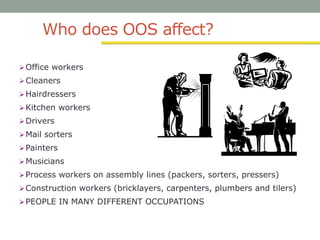
Who does OOS affect?
Office workers
Cleaners
Hairdressers
Kitchen workers
Drivers
Mail sorters
Painters
Musicians
Process workers on assembly lines (packers, sorters, pressers)
Construction workers (bricklayers, carpenters, plumbers and tilers)
PEOPLE IN MANY DIFFERENT OCCUPATIONS
What are OOS symptoms?
• Soreness/Swelling
• Muscle discomfort
• Stiffness
• Numbing and tingling
• Fatigue
• Burning sensation
• Aches and pains
• Weakness
How can you prevent OOS?
Adjust your workstation layout
Adjust furniture
Maintain correct posture
Exercise to stimulate blood flow
Reduce repetitive tasks
Take regular breaks
Rotate the work tasks
REPORT any signs of OOS immediately
What happens when new
equipment is installed
When a new computer is
installed
 Ergonomically sound
office design layout
 Ergonomic office
furniture installed
 Training on the new
equipment provided by
employer
 OHS training (safe work
habits)
If you experience any wrist
soreness
 You would report problem
to supervisor
 An OHS rep would inspect
workstation and write a
report
 You would consult a doctor
and obtain report
 You would be transferred
to alternative duties,
temporarily or permanently
 Employer would closely
monitor your progress
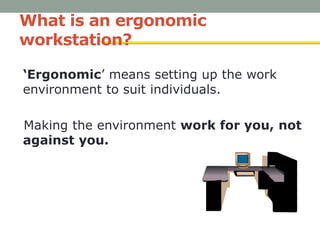
What is an ergonomic
workstation?
‘Ergonomic’ means setting up the work
environment to suit individuals.
Making the environment work for you, not
against you.
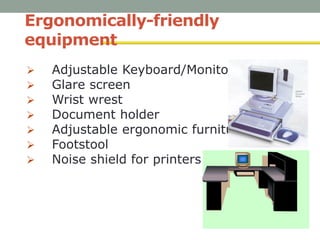
Ergonomically-friendly
equipment
 Adjustable Keyboard/Monitor
 Glare screen
 Wrist wrest
 Document holder
 Adjustable ergonomic furniture
 Footstool
 Noise shield for printers
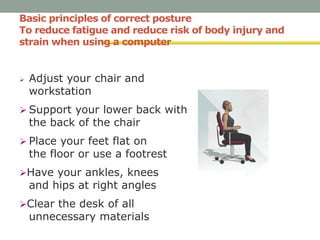
Basic principles of correct posture
To reduce fatigue and reduce risk of body injury and
strain when using a computer
 Adjust your chair and
workstation
 Support your lower back with
the back of the chair
 Place your feet flat on
the floor or use a footrest
Have your ankles, knees
and hips at right angles
Clear the desk of all
unnecessary materials
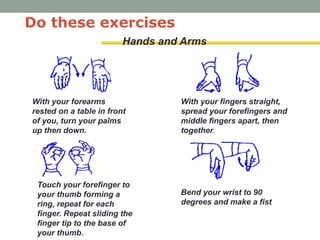
Hands and Arms
Do these exercises
With your forearms
rested on a table in front
of you, turn your palms
up then down.
With your fingers straight,
spread your forefingers and
middle fingers apart, then
together.
Touch your forefinger to
your thumb forming a
ring, repeat for each
finger. Repeat sliding the
finger tip to the base of
your thumb.
Bend your wrist to 90
degrees and make a fist
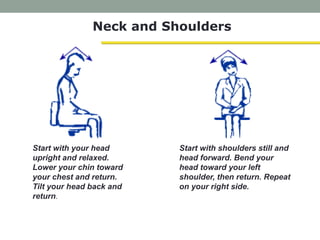
Neck and Shoulders
Start with your head
upright and relaxed.
Lower your chin toward
your chest and return.
Tilt your head back and
return.
Start with shoulders still and
head forward. Bend your
head toward your left
shoulder, then return. Repeat
on your right side.
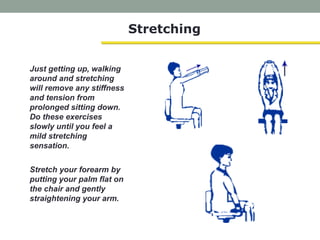
Stretching
Just getting up, walking
around and stretching
will remove any stiffness
and tension from
prolonged sitting down.
Do these exercises
slowly until you feel a
mild stretching
sensation.
Stretch your forearm by
putting your palm flat on
the chair and gently
straightening your arm.
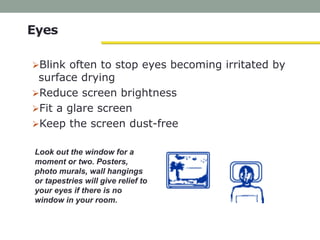
Look out the window for a
moment or two. Posters,
photo murals, wall hangings
or tapestries will give relief to
your eyes if there is no
window in your room.
Eyes
Blink often to stop eyes becoming irritated by
surface drying
Reduce screen brightness
Fit a glare screen
Keep the screen dust-free
Let’s take a closer look at
Manual Handling
Any activity which
involves
• Pulling
• Pushing
• Raising or lowering
• Lifting
• Holding
• Carrying
For Example:
• Carrying files
• Lifting books
• Placing items on
shelves
• Moving chairs
CAN YOU THINK
OF SOME MORE?
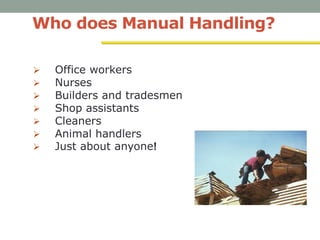
Who does Manual Handling?
 Office workers
 Nurses
 Builders and tradesmen
 Shop assistants
 Cleaners
 Animal handlers
 Just about anyone!
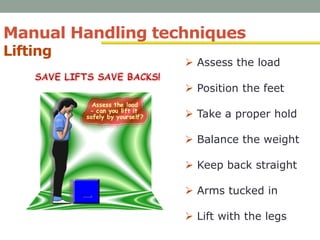
Manual Handling techniques
Lifting
•
 Assess the load
 Position the feet
 Take a proper hold
 Balance the weight
 Keep back straight
 Arms tucked in
 Lift with the legs
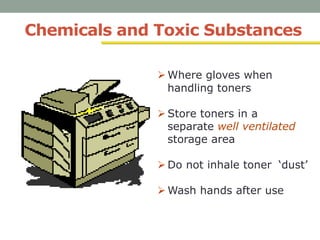
Chemicals and Toxic Substances
 Where gloves when
handling toners
 Store toners in a
separate well ventilated
storage area
 Do not inhale toner ‘dust’
 Wash hands after use
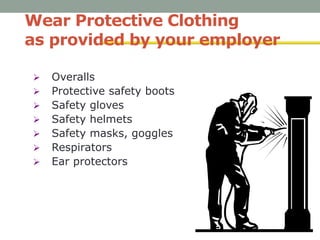
Wear Protective Clothing
as provided by your employer
 Overalls
 Protective safety boots
 Safety gloves
 Safety helmets
 Safety masks, goggles
 Respirators
 Ear protectors
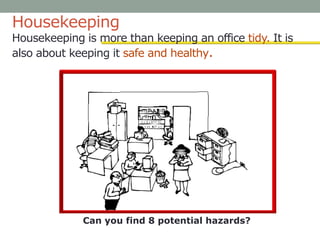
Housekeeping
Housekeeping is more than keeping an office tidy. It is
also about keeping it safe and healthy.
Can you find 8 potential hazards?
Psychosocial Hazards
Stress
 Work related psychosocial injuries cost five times
more than work-related physical injuries
 Psychosocial hazards are often called stress.
 Stress is the physical, mental and emotional
reaction to demands made upon us as individuals
 Psychosocial hazards are difficult to identify and
their affects may not appear for some time.
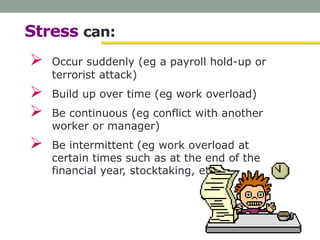
Stress can:
 Occur suddenly (eg a payroll hold-up or
terrorist attack)
 Build up over time (eg work overload)
 Be continuous (eg conflict with another
worker or manager)
 Be intermittent (eg work overload at
certain times such as at the end of the
financial year, stocktaking, etc).
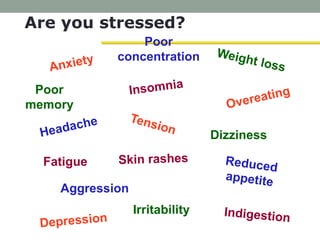
Are you stressed?
Fatigue
Aggression
Irritability
Dizziness
Poor
concentration
Poor
memory
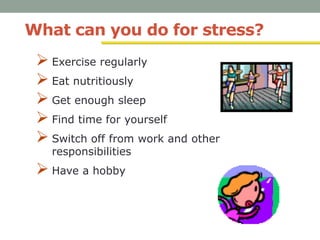
What can you do for stress?
 Exercise regularly
 Eat nutritiously
 Get enough sleep
 Find time for yourself
 Switch off from work and other
responsibilities
 Have a hobby
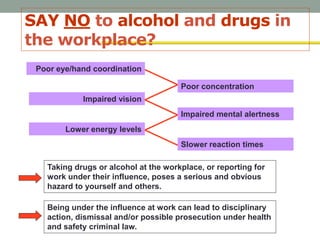
SAY NO to alcohol and drugs in
the workplace?
Poor eye/hand coordination
Poor concentration
Impaired vision
Impaired mental alertness
Lower energy levels
Slower reaction times
Taking drugs or alcohol at the workplace, or reporting for
work under their influence, poses a serious and obvious
hazard to yourself and others.
Being under the influence at work can lead to disciplinary
action, dismissal and/or possible prosecution under health
and safety criminal law.
FOLLOW WORKPLACE
PROCEDURES IN
EMERGENCIES
What could be classed as an
emergency?
 Fire
 Explosion
 Holdup or attack
 Serious accident
 Asphyxiation (suffocation due to
lack of oxygen)
 Spills
Emergencies - YOU must be
aware of:
 How to report an accident, illness or emergency
 Where the first aid services and facilities are located
 Who are the first aid officers
 The first aid procedures
 Where fire extinguishers are located
 Raising the alarm in a n emergency
 The evacuation procedure
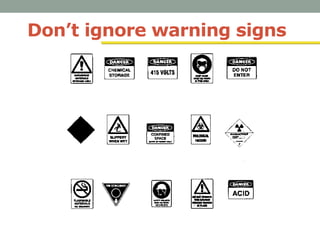
Don’t ignore warning signs
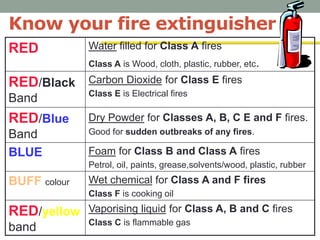
Know your fire extinguisher
RED Water filled for Class A fires
Class A is Wood, cloth, plastic, rubber, etc.
RED/Black
Band
Carbon Dioxide for Class E fires
Class E is Electrical fires
RED/Blue
Band
Dry Powder for Classes A, B, C E and F fires.
Good for sudden outbreaks of any fires.
BLUE Foam for Class B and Class A fires
Petrol, oil, paints, grease,solvents/wood, plastic, rubber
BUFF colour Wet chemical for Class A and F fires
Class F is cooking oil
RED/yellow
band
Vaporising liquid for Class A, B and C fires
Class C is flammable gas
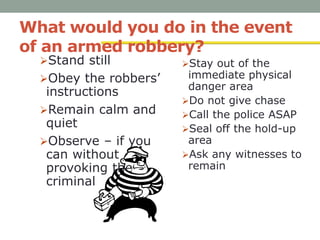
What would you do in the event
of an armed robbery?
Stand still
Obey the robbers’
instructions
Remain calm and
quiet
Observe – if you
can without
provoking the
criminal
Stay out of the
immediate physical
danger area
Do not give chase
Call the police ASAP
Seal off the hold-up
area
Ask any witnesses to
remain
139045996145352.OS

139045996145352.OS

  • 1.
    What is Workplacesafety? Maintaining the health, safety and welfare of employees and others in all workplace environments
  • 2.
    On successful completionof this unit you will be able to Recognise and report any workplace hazard Comply with procedures to assess and control risks Follow workplace procedures in emergencies Contribute to safety in the workplace through consultation with employers, employees, OHS representatives.
  • 3.
    OHS has along history OHS was recognised in the late 1700’s in Britain. Nothing meaningful was done about it. During the 1800’s and through the depression years of the early 1900’s and through the years of WW 1, WW 2, there were many people who were out of work and desperately took whatever work could be found no matter what the conditions.
  • 4.
    Is the workplacehazardous worldwide? The World Health Organization estimates • 250 million accidents occur each year • 330,000 deaths • 160 million occupational diseases
  • 5.
    Accidents and Injuriescan be costly Lost production Absenteeism Medical bills Increased WorkCover or insurance premiums Unwanted publicity Replacement or repair of damaged equipment Training of new or casual staff Poor company image Fines or prison!
  • 6.
    What are sometypical work-related injuries? Bad backs (lifting) Lung diseases (breathing toxic chemicals) Burns (hot machinery parts) Hearing loss (noisy machinery) Cuts (sharp construction tools) Crushing injuries (moving objects) Skin diseases (irritating substances) Broken bones (falling)
  • 7.
    WorkCover Authority ofNSW The statutory authority that administers OHS legislation in NSW Provides advice on rights and responsibilities concerning OHS, rehabilitation and workers compensation Investigates causes of accidents, injuries and illnesses Issues licenses for hazardous operations, eg. for the handling of dangerous chemicals
  • 8.
    What is theNational Occupational Health Safety Committee? Federal authority that considers the laws, regulations and procedures covering health and safety to all workers.
  • 9.
    Whose responsibility is workplacesafety? Employers and Employees are both responsible
  • 10.
    Employer’s Responsibilities EMPLOYERS havea ‘duty of care’ (by law) to provide a safe workplace.  Managers and supervisors MUST help employers meet this responsibility.  Consult with employees on OHS matters  Assess likely hazards  Control and minimise hazard risks  Provide information to workers
  • 11.
    Employer’s Responsibility con’t Consult with workers (through OHS reps and committees)  Organise safe work systems  Improve understanding (by instruction/training)  Provide protective clothing and equipment
  • 12.
    Employer’s Responsibility con’t •Ensure tools/equipment/machines are safe • Supervise inexperienced workers • Monitor the workplace • Keep records of inspections and injuries
  • 13.
    Training Employers MUST provide: Trainingto OHS representatives and Committee members Training to all workers to ensure Health and safety
  • 14.
    Employee’s responsibility • EMPLOYEES(YOU) must take care of your own safety and that of others who may be affected by your actions. You MUST co-operate with your employer. Work/behave in a safe way Take care not to endanger the safety of others Follow employer instructions Operate equipment safely and only for the intended purpose Use personal protective equipment
  • 15.
    Employee’s responsibility con’t Cooperatewith your employer Do not willfully/recklessly interfere or misuse equipment Ensure you are not affected by alcohol or drugs Report hazards Report work-related injuries, near misses
  • 16.
  • 17.
    What is ahazard? A hazard is something that has the potential to cause harm. This harm can affect people by causing injury, illness, death or psychological trauma. Website: www.nohsc.gov.au
  • 18.
    WORKPLACE HAZARD WORK ACTIVITY Drillinga hole; Typing a letter Unloading cargo Moving a heavy object SITUATION Tripping over a cord; Wet floor in a foyer ARRANGEMENT Poor storage techniques PRODUCTION PROCESS Toxic fumes; excess heat
  • 19.
    Checklist of Hazardsin the Working Environment Date: Area: What to look for: Look at all areas and compare to the standards provided below. Some aspects may not be applicable. A "no" response to any question indicates an area that will need further assessment.  PASSAGEWAYS  FUMES/VENTILATION  EXIT/EGRESS  ERGONOMIC FACTORS  NOISE  LAYOUT (of workplace)  LIGHTING .
  • 20.
    What should youreport?  Any event that results in injury or disease - no matter how minor - is reportable  Dangerous occurrences or events - including a near miss that endangers the health or safety of a person  Any event that results in death Employees have a LEGAL RESPONSIBILITY to report any accident or incident
  • 21.
    Who do youReport Hazards to? Your Supervisor Supervises New Employees Coaches and mentors team members Communicates between senior management and workgroups OHS Committee  Formal body that resolves OHS issues  Reviews OHS measures  Investigates OHS matters  Solves OHS problems  Develops OHS policies, procedures and programs  Comprises both employees and employer representatives Must be established when >20 employees
  • 22.
    Who do youreport hazards to? OHS Representative  Elected to represent designated workgroups  Review OHS measures  Conduct inspections  Accompany an OHS inspector  Provide input into development of OHS systems and emergency preparedness procedures  Know about particular hazards  Keep up-to-date with information injuries and health  Communicate with management/workers about changes  Make recommendations about training Must be elected even if requested by only one employee
  • 23.
    COMPLY WITH PROCEDURES TOASSESS AND CONTROL RISKS In an Office Environment
  • 24.
    Hazard Categories The FOURcategories of hazards we will look at are: 1. Physical Hazards, eg OOS, posture 2. Manual Handling hazard, eg lifting 3. Chemical Hazard, eg Toxic substances 4. Psychosocial Hazard, eg Stress
  • 25.
    What are theFOUR steps to identify and control a hazard  Identify the hazard – what is it  Assess the risks – what is likely to happen  Control the risks – preventative measures  Evaluate the solutions – were the preventative measures:  appropriate  successful
  • 26.
    Let’s take acloser look at Occupational Overuse Syndrome  What is it? oOOS relates to the repetitive use of the same muscles over an extended period of time  What does it affect? oMuscles oTendons oSoft tissues in the neck, back, shoulders, hands, fingers, wrists, elbows
  • 27.
    Who does OOSaffect? Office workers Cleaners Hairdressers Kitchen workers Drivers Mail sorters Painters Musicians Process workers on assembly lines (packers, sorters, pressers) Construction workers (bricklayers, carpenters, plumbers and tilers) PEOPLE IN MANY DIFFERENT OCCUPATIONS
  • 28.
    What are OOSsymptoms? • Soreness/Swelling • Muscle discomfort • Stiffness • Numbing and tingling • Fatigue • Burning sensation • Aches and pains • Weakness
  • 29.
    How can youprevent OOS? Adjust your workstation layout Adjust furniture Maintain correct posture Exercise to stimulate blood flow Reduce repetitive tasks Take regular breaks Rotate the work tasks REPORT any signs of OOS immediately
  • 30.
    What happens whennew equipment is installed When a new computer is installed  Ergonomically sound office design layout  Ergonomic office furniture installed  Training on the new equipment provided by employer  OHS training (safe work habits) If you experience any wrist soreness  You would report problem to supervisor  An OHS rep would inspect workstation and write a report  You would consult a doctor and obtain report  You would be transferred to alternative duties, temporarily or permanently  Employer would closely monitor your progress
  • 31.
    What is anergonomic workstation? ‘Ergonomic’ means setting up the work environment to suit individuals. Making the environment work for you, not against you.
  • 32.
    Ergonomically-friendly equipment  Adjustable Keyboard/Monitor Glare screen  Wrist wrest  Document holder  Adjustable ergonomic furniture  Footstool  Noise shield for printers
  • 33.
    Basic principles ofcorrect posture To reduce fatigue and reduce risk of body injury and strain when using a computer  Adjust your chair and workstation  Support your lower back with the back of the chair  Place your feet flat on the floor or use a footrest Have your ankles, knees and hips at right angles Clear the desk of all unnecessary materials
  • 34.
    Hands and Arms Dothese exercises With your forearms rested on a table in front of you, turn your palms up then down. With your fingers straight, spread your forefingers and middle fingers apart, then together. Touch your forefinger to your thumb forming a ring, repeat for each finger. Repeat sliding the finger tip to the base of your thumb. Bend your wrist to 90 degrees and make a fist
  • 35.
    Neck and Shoulders Startwith your head upright and relaxed. Lower your chin toward your chest and return. Tilt your head back and return. Start with shoulders still and head forward. Bend your head toward your left shoulder, then return. Repeat on your right side.
  • 36.
    Stretching Just getting up,walking around and stretching will remove any stiffness and tension from prolonged sitting down. Do these exercises slowly until you feel a mild stretching sensation. Stretch your forearm by putting your palm flat on the chair and gently straightening your arm.
  • 37.
    Look out thewindow for a moment or two. Posters, photo murals, wall hangings or tapestries will give relief to your eyes if there is no window in your room. Eyes Blink often to stop eyes becoming irritated by surface drying Reduce screen brightness Fit a glare screen Keep the screen dust-free
  • 38.
    Let’s take acloser look at Manual Handling Any activity which involves • Pulling • Pushing • Raising or lowering • Lifting • Holding • Carrying For Example: • Carrying files • Lifting books • Placing items on shelves • Moving chairs CAN YOU THINK OF SOME MORE?
  • 39.
    Who does ManualHandling?  Office workers  Nurses  Builders and tradesmen  Shop assistants  Cleaners  Animal handlers  Just about anyone!
  • 40.
    Manual Handling techniques Lifting • Assess the load  Position the feet  Take a proper hold  Balance the weight  Keep back straight  Arms tucked in  Lift with the legs
  • 41.
    Chemicals and ToxicSubstances  Where gloves when handling toners  Store toners in a separate well ventilated storage area  Do not inhale toner ‘dust’  Wash hands after use
  • 42.
    Wear Protective Clothing asprovided by your employer  Overalls  Protective safety boots  Safety gloves  Safety helmets  Safety masks, goggles  Respirators  Ear protectors
  • 43.
    Housekeeping Housekeeping is morethan keeping an office tidy. It is also about keeping it safe and healthy. Can you find 8 potential hazards?
  • 44.
    Psychosocial Hazards Stress  Workrelated psychosocial injuries cost five times more than work-related physical injuries  Psychosocial hazards are often called stress.  Stress is the physical, mental and emotional reaction to demands made upon us as individuals  Psychosocial hazards are difficult to identify and their affects may not appear for some time.
  • 45.
    Stress can:  Occursuddenly (eg a payroll hold-up or terrorist attack)  Build up over time (eg work overload)  Be continuous (eg conflict with another worker or manager)  Be intermittent (eg work overload at certain times such as at the end of the financial year, stocktaking, etc).
  • 46.
  • 47.
    What can youdo for stress?  Exercise regularly  Eat nutritiously  Get enough sleep  Find time for yourself  Switch off from work and other responsibilities  Have a hobby
  • 48.
    SAY NO toalcohol and drugs in the workplace? Poor eye/hand coordination Poor concentration Impaired vision Impaired mental alertness Lower energy levels Slower reaction times Taking drugs or alcohol at the workplace, or reporting for work under their influence, poses a serious and obvious hazard to yourself and others. Being under the influence at work can lead to disciplinary action, dismissal and/or possible prosecution under health and safety criminal law.
  • 49.
  • 50.
    What could beclassed as an emergency?  Fire  Explosion  Holdup or attack  Serious accident  Asphyxiation (suffocation due to lack of oxygen)  Spills
  • 51.
    Emergencies - YOUmust be aware of:  How to report an accident, illness or emergency  Where the first aid services and facilities are located  Who are the first aid officers  The first aid procedures  Where fire extinguishers are located  Raising the alarm in a n emergency  The evacuation procedure
  • 52.
  • 53.
    Know your fireextinguisher RED Water filled for Class A fires Class A is Wood, cloth, plastic, rubber, etc. RED/Black Band Carbon Dioxide for Class E fires Class E is Electrical fires RED/Blue Band Dry Powder for Classes A, B, C E and F fires. Good for sudden outbreaks of any fires. BLUE Foam for Class B and Class A fires Petrol, oil, paints, grease,solvents/wood, plastic, rubber BUFF colour Wet chemical for Class A and F fires Class F is cooking oil RED/yellow band Vaporising liquid for Class A, B and C fires Class C is flammable gas
  • 54.
    What would youdo in the event of an armed robbery? Stand still Obey the robbers’ instructions Remain calm and quiet Observe – if you can without provoking the criminal Stay out of the immediate physical danger area Do not give chase Call the police ASAP Seal off the hold-up area Ask any witnesses to remain