Human Organ Systems
(Four System has been represented)
1.Nervous System
2. Respiratory System
3. Excretory System
4.Circulatory System
NERVOUS SYSTEM
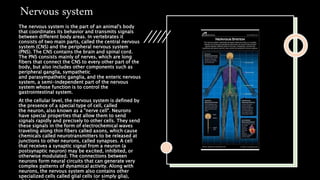
Nervous system
The nervous system is the part of an animal's body
that coordinates its behavior and transmits signals
between different body areas. In vertebrates it
consists of two main parts, called the central nervous
system (CNS) and the peripheral nervous system
(PNS). The CNS contains the brain and spinal cord.
The PNS consists mainly of nerves, which are long
fibers that connect the CNS to every other part of the
body, but also includes other components such as
peripheral ganglia, sympathetic
and parasympathetic ganglia, and the enteric nervous
system, a semi-independent part of the nervous
system whose function is to control the
gastrointestinal system.
At the cellular level, the nervous system is defined by
the presence of a special type of cell, called
the neuron, also known as a "nerve cell". Neurons
have special properties that allow them to send
signals rapidly and precisely to other cells. They send
these signals in the form of electrochemical waves
traveling along thin fibers called axons, which cause
chemicals called neurotransmitters to be released at
junctions to other neurons, called synapses. A cell
that receives a synaptic signal from a neuron (a
postsynaptic neuron) may be excited, inhibited, or
otherwise modulated. The connections between
neurons form neural circuits that can generate very
complex patterns of dynamical activity. Along with
neurons, the nervous system also contains other
specialized cells called glial cells (or simply glia),
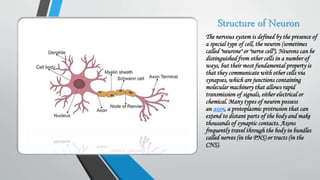
Structure of Neuron
The nervous system is defined by the presence of
a special type of cell, the neuron (sometimes
called "neurone" or "nerve cell"). Neurons can be
distinguished from other cells in a number of
ways, but their most fundamental property is
that they communicate with other cells via
synapses, which are junctions containing
molecular machinery that allows rapid
transmission of signals, either electrical or
chemical. Many types of neuron possess
an axon, a protoplasmic protrusion that can
extend to distant parts of the body and make
thousands of synaptic contacts. Axons
frequently travel through the body in bundles
called nerves (in the PNS) or tracts (in the
CNS).
FUNCTIONS OF NERVOUS SYSTEM
 The ultimate function of the nervous system is to control the body, especially
its movement in the environment. It does this by extracting information from
the environment using sensory receptors, sending signals that encode this
information into the central nervous system, processing the information to
determine an appropriate response, and sending output signals to muscles or
glands to activate the response.
 At the most basic level, the nervous system sends signals from one cell to
others, or from one part of the body to others. There are multiple ways that a
cell can send signals to other cells. One is by releasing chemicals called
hormones into the internal circulation, so that they can diffuse to distant sites.
In contrast to this "broadcast" mode of signaling, the nervous system provides
"point-to-point" signals — neurons project their axons to specific target areas
and make synaptic connections with specific target cells. Thus, neural signaling
is capable of a much higher level of specificity than hormonal signaling. It is
also much faster: the fastest nerve signals travel at speeds that exceed 100
meters per second.
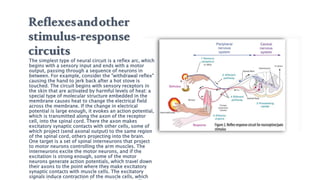
Reflexesandother
stimulus-response
circuits
The simplest type of neural circuit is a reflex arc, which
begins with a sensory input and ends with a motor
output, passing through a sequence of neurons in
between. For example, consider the "withdrawal reflex"
causing the hand to jerk back after a hot stove is
touched. The circuit begins with sensory receptors in
the skin that are activated by harmful levels of heat: a
special type of molecular structure embedded in the
membrane causes heat to change the electrical field
across the membrane. If the change in electrical
potential is large enough, it evokes an action potential,
which is transmitted along the axon of the receptor
cell, into the spinal cord. There the axon makes
excitatory synaptic contacts with other cells, some of
which project (send axonal output) to the same region
of the spinal cord, others projecting into the brain.
One target is a set of spinal interneurons that project
to motor neurons controlling the arm muscles. The
interneurons excite the motor neurons, and if the
excitation is strong enough, some of the motor
neurons generate action potentials, which travel down
their axons to the point where they make excitatory
synaptic contacts with muscle cells. The excitatory
signals induce contraction of the muscle cells, which
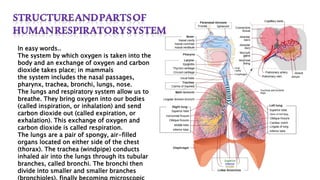
Respiratory System in
Humans
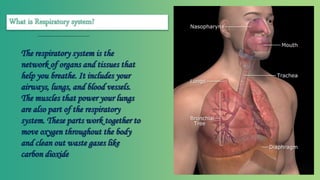
The respiratory system is the
network of organs and tissues that
help you breathe. It includes your
airways, lungs, and blood vessels.
The muscles that power your lungs
are also part of the respiratory
system. These parts work together to
move oxygen throughout the body
and clean out waste gases like
carbon dioxide
In easy words..
The system by which oxygen is taken into the
body and an exchange of oxygen and carbon
dioxide takes place; in mammals
the system includes the nasal passages,
pharynx, trachea, bronchi, lungs, nose.
The lungs and respiratory system allow us to
breathe. They bring oxygen into our bodies
(called inspiration, or inhalation) and send
carbon dioxide out (called expiration, or
exhalation). This exchange of oxygen and
carbon dioxide is called respiration.
The lungs are a pair of spongy, air-filled
organs located on either side of the chest
(thorax). The trachea (windpipe) conducts
inhaled air into the lungs through its tubular
branches, called bronchi. The bronchi then
divide into smaller and smaller branches
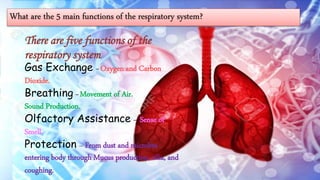
What are the 5 main functions of the respiratory system?
There are five functions of the
respiratory system.
Gas Exchange – Oxygen and Carbon
Dioxide.
Breathing – Movement of Air.
Sound Production.
Olfactory Assistance – Sense of
Smell.
Protection – From dust and microbes
entering body through Mucus production, cilia, and
coughing.
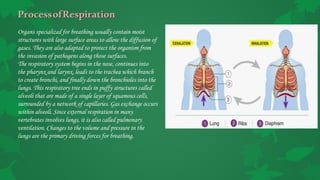
ProcessofRespiration
Organs specialized for breathing usually contain moist
structures with large surface areas to allow the diffusion of
gases. They are also adapted to protect the organism from
the invasion of pathogens along those surfaces.
The respiratory system begins in the nose, continues into
the pharynx and larynx, leads to the trachea which branch
to create bronchi, and finally down the bronchioles into the
lungs. This respiratory tree ends in puffy structures called
alveoli that are made of a single layer of squamous cells,
surrounded by a network of capillaries. Gas exchange occurs
within alveoli. Since external respiration in many
vertebrates involves lungs, it is also called pulmonary
ventilation. Changes to the volume and pressure in the
lungs are the primary driving forces for breathing.
Human Excretory System
Structureand
PartsofExcretory
System
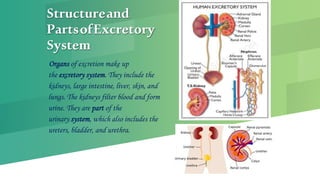
Organs of excretion make up
the excretory system. They include the
kidneys, large intestine, liver, skin, and
lungs. The kidneys filter blood and form
urine. They are part of the
urinary system, which also includes the
ureters, bladder, and urethra.
Function And Process of Excretory System
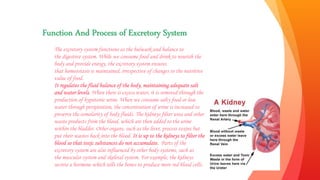
The excretory system functions as the bulwark and balance to
the digestive system. While we consume food and drink to nourish the
body and provide energy, the excretory system ensures
that homeostasis is maintained, irrespective of changes to the nutritive
value of food.
It regulates the fluid balance of the body, maintaining adequate salt
and water levels. When there is excess water, it is removed through the
production of hypotonic urine. When we consume salty food or lose
water through perspiration, the concentration of urine is increased to
preserve the osmolarity of body fluids. The kidneys filter urea and other
waste products from the blood, which are then added to the urine
within the bladder. Other organs, such as the liver, process toxins but
put their wastes back into the blood. It is up to the kidneys to filter the
blood so that toxic substances do not accumulate. Parts of the
excretory system are also influenced by other body systems, such as
the muscular system and skeletal system. For example, the kidneys
secrete a hormone which tells the bones to produce more red blood cells.
Other Important functions of the Urinary
System!
 Maintain blood volume and
composition.
 Excrete nitrogenous waste.
 Urine formation.
 Hormone production.
HUMAN
CIRCULATORY
SYSTEM
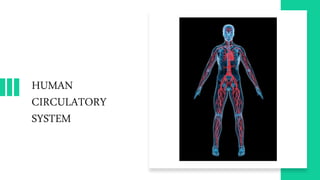
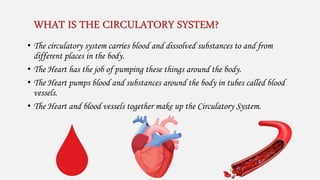
WHAT IS THE CIRCULATORY SYSTEM?
• The circulatory system carries blood and dissolved substances to and from
different places in the body.
• The Heart has the job of pumping these things around the body.
• The Heart pumps blood and substances around the body in tubes called blood
vessels.
• The Heart and blood vessels together make up the Circulatory System.
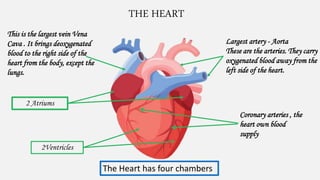
THE HEART
This is the largest vein Vena
Cava . It brings deoxygenated
blood to the right side of the
heart from the body, except the
lungs.
Largest artery - Aorta
These are the arteries. They carry
oxygenated blood away from the
left side of the heart.
Coronary arteries , the
heart own blood
supply
2 Atriums
2Ventricles
The Heart has four chambers
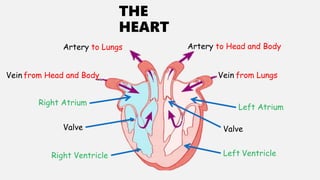
THE
HEART
Artery to Head and Body
Vein from Lungs
Left Atrium
Valve
Left Ventricle
Vein from Head and Body
Right Atrium
Valve
Right Ventricle
Artery to Lungs
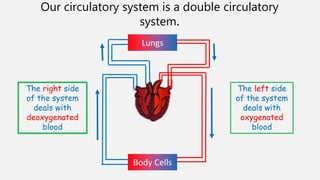
Our circulatory system is a double circulatory
system.
Lungs
Body Cells
The right side
of the system
deals with
deoxygenated
blood
The left side
of the system
deals with
oxygenated
blood
Surprise! ...
 You lose a lot of water just by breathing....
 Some people can hold their breath for more than 20 minutes. ...
 The common cold can be caused by hundreds of different viruses.
 When our brain senses a shortage of oxygen, it triggers us to take a long deep breath or to YAWN.
 The human bladder can stretch to hold about 400ml of urine.
 All the blood in our body is filtered 400 times through the kidneys every day
 Each kidney is about the size of your fist. ...
 There is a nervous system for controlling the body at rest
 Your nervous system can be hacked
 The circulatory system in the human body stretches 66,000 miles, more than two and a half times the
circumference of the Earth.
 Each second, we lose about 3 million red blood cells only to be replaced by the same number produced in
the bone marrow.
 The heart beats 2.5 billion times during the life of a 75-year-old.
Biology project (Organ system)

Biology project (Organ system)

  • 1.
    Human Organ Systems (FourSystem has been represented) 1.Nervous System 2. Respiratory System 3. Excretory System 4.Circulatory System
  • 2.
  • 3.
    Nervous system The nervoussystem is the part of an animal's body that coordinates its behavior and transmits signals between different body areas. In vertebrates it consists of two main parts, called the central nervous system (CNS) and the peripheral nervous system (PNS). The CNS contains the brain and spinal cord. The PNS consists mainly of nerves, which are long fibers that connect the CNS to every other part of the body, but also includes other components such as peripheral ganglia, sympathetic and parasympathetic ganglia, and the enteric nervous system, a semi-independent part of the nervous system whose function is to control the gastrointestinal system. At the cellular level, the nervous system is defined by the presence of a special type of cell, called the neuron, also known as a "nerve cell". Neurons have special properties that allow them to send signals rapidly and precisely to other cells. They send these signals in the form of electrochemical waves traveling along thin fibers called axons, which cause chemicals called neurotransmitters to be released at junctions to other neurons, called synapses. A cell that receives a synaptic signal from a neuron (a postsynaptic neuron) may be excited, inhibited, or otherwise modulated. The connections between neurons form neural circuits that can generate very complex patterns of dynamical activity. Along with neurons, the nervous system also contains other specialized cells called glial cells (or simply glia),
  • 4.
    Structure of Neuron Thenervous system is defined by the presence of a special type of cell, the neuron (sometimes called "neurone" or "nerve cell"). Neurons can be distinguished from other cells in a number of ways, but their most fundamental property is that they communicate with other cells via synapses, which are junctions containing molecular machinery that allows rapid transmission of signals, either electrical or chemical. Many types of neuron possess an axon, a protoplasmic protrusion that can extend to distant parts of the body and make thousands of synaptic contacts. Axons frequently travel through the body in bundles called nerves (in the PNS) or tracts (in the CNS).
  • 5.
    FUNCTIONS OF NERVOUSSYSTEM  The ultimate function of the nervous system is to control the body, especially its movement in the environment. It does this by extracting information from the environment using sensory receptors, sending signals that encode this information into the central nervous system, processing the information to determine an appropriate response, and sending output signals to muscles or glands to activate the response.  At the most basic level, the nervous system sends signals from one cell to others, or from one part of the body to others. There are multiple ways that a cell can send signals to other cells. One is by releasing chemicals called hormones into the internal circulation, so that they can diffuse to distant sites. In contrast to this "broadcast" mode of signaling, the nervous system provides "point-to-point" signals — neurons project their axons to specific target areas and make synaptic connections with specific target cells. Thus, neural signaling is capable of a much higher level of specificity than hormonal signaling. It is also much faster: the fastest nerve signals travel at speeds that exceed 100 meters per second.
  • 6.
    Reflexesandother stimulus-response circuits The simplest typeof neural circuit is a reflex arc, which begins with a sensory input and ends with a motor output, passing through a sequence of neurons in between. For example, consider the "withdrawal reflex" causing the hand to jerk back after a hot stove is touched. The circuit begins with sensory receptors in the skin that are activated by harmful levels of heat: a special type of molecular structure embedded in the membrane causes heat to change the electrical field across the membrane. If the change in electrical potential is large enough, it evokes an action potential, which is transmitted along the axon of the receptor cell, into the spinal cord. There the axon makes excitatory synaptic contacts with other cells, some of which project (send axonal output) to the same region of the spinal cord, others projecting into the brain. One target is a set of spinal interneurons that project to motor neurons controlling the arm muscles. The interneurons excite the motor neurons, and if the excitation is strong enough, some of the motor neurons generate action potentials, which travel down their axons to the point where they make excitatory synaptic contacts with muscle cells. The excitatory signals induce contraction of the muscle cells, which
  • 7.
  • 8.
    The respiratory systemis the network of organs and tissues that help you breathe. It includes your airways, lungs, and blood vessels. The muscles that power your lungs are also part of the respiratory system. These parts work together to move oxygen throughout the body and clean out waste gases like carbon dioxide
  • 9.
    In easy words.. Thesystem by which oxygen is taken into the body and an exchange of oxygen and carbon dioxide takes place; in mammals the system includes the nasal passages, pharynx, trachea, bronchi, lungs, nose. The lungs and respiratory system allow us to breathe. They bring oxygen into our bodies (called inspiration, or inhalation) and send carbon dioxide out (called expiration, or exhalation). This exchange of oxygen and carbon dioxide is called respiration. The lungs are a pair of spongy, air-filled organs located on either side of the chest (thorax). The trachea (windpipe) conducts inhaled air into the lungs through its tubular branches, called bronchi. The bronchi then divide into smaller and smaller branches
  • 10.
    What are the5 main functions of the respiratory system? There are five functions of the respiratory system. Gas Exchange – Oxygen and Carbon Dioxide. Breathing – Movement of Air. Sound Production. Olfactory Assistance – Sense of Smell. Protection – From dust and microbes entering body through Mucus production, cilia, and coughing.
  • 11.
    ProcessofRespiration Organs specialized forbreathing usually contain moist structures with large surface areas to allow the diffusion of gases. They are also adapted to protect the organism from the invasion of pathogens along those surfaces. The respiratory system begins in the nose, continues into the pharynx and larynx, leads to the trachea which branch to create bronchi, and finally down the bronchioles into the lungs. This respiratory tree ends in puffy structures called alveoli that are made of a single layer of squamous cells, surrounded by a network of capillaries. Gas exchange occurs within alveoli. Since external respiration in many vertebrates involves lungs, it is also called pulmonary ventilation. Changes to the volume and pressure in the lungs are the primary driving forces for breathing.
  • 12.
  • 13.
    Structureand PartsofExcretory System Organs of excretionmake up the excretory system. They include the kidneys, large intestine, liver, skin, and lungs. The kidneys filter blood and form urine. They are part of the urinary system, which also includes the ureters, bladder, and urethra.
  • 14.
    Function And Processof Excretory System The excretory system functions as the bulwark and balance to the digestive system. While we consume food and drink to nourish the body and provide energy, the excretory system ensures that homeostasis is maintained, irrespective of changes to the nutritive value of food. It regulates the fluid balance of the body, maintaining adequate salt and water levels. When there is excess water, it is removed through the production of hypotonic urine. When we consume salty food or lose water through perspiration, the concentration of urine is increased to preserve the osmolarity of body fluids. The kidneys filter urea and other waste products from the blood, which are then added to the urine within the bladder. Other organs, such as the liver, process toxins but put their wastes back into the blood. It is up to the kidneys to filter the blood so that toxic substances do not accumulate. Parts of the excretory system are also influenced by other body systems, such as the muscular system and skeletal system. For example, the kidneys secrete a hormone which tells the bones to produce more red blood cells.
  • 15.
    Other Important functionsof the Urinary System!  Maintain blood volume and composition.  Excrete nitrogenous waste.  Urine formation.  Hormone production.
  • 16.
  • 17.
    WHAT IS THECIRCULATORY SYSTEM? • The circulatory system carries blood and dissolved substances to and from different places in the body. • The Heart has the job of pumping these things around the body. • The Heart pumps blood and substances around the body in tubes called blood vessels. • The Heart and blood vessels together make up the Circulatory System.
  • 18.
    THE HEART This isthe largest vein Vena Cava . It brings deoxygenated blood to the right side of the heart from the body, except the lungs. Largest artery - Aorta These are the arteries. They carry oxygenated blood away from the left side of the heart. Coronary arteries , the heart own blood supply 2 Atriums 2Ventricles The Heart has four chambers
  • 19.
    THE HEART Artery to Headand Body Vein from Lungs Left Atrium Valve Left Ventricle Vein from Head and Body Right Atrium Valve Right Ventricle Artery to Lungs
  • 20.
    Our circulatory systemis a double circulatory system. Lungs Body Cells The right side of the system deals with deoxygenated blood The left side of the system deals with oxygenated blood
  • 21.
    Surprise! ...  Youlose a lot of water just by breathing....  Some people can hold their breath for more than 20 minutes. ...  The common cold can be caused by hundreds of different viruses.  When our brain senses a shortage of oxygen, it triggers us to take a long deep breath or to YAWN.  The human bladder can stretch to hold about 400ml of urine.  All the blood in our body is filtered 400 times through the kidneys every day  Each kidney is about the size of your fist. ...  There is a nervous system for controlling the body at rest  Your nervous system can be hacked  The circulatory system in the human body stretches 66,000 miles, more than two and a half times the circumference of the Earth.  Each second, we lose about 3 million red blood cells only to be replaced by the same number produced in the bone marrow.  The heart beats 2.5 billion times during the life of a 75-year-old.