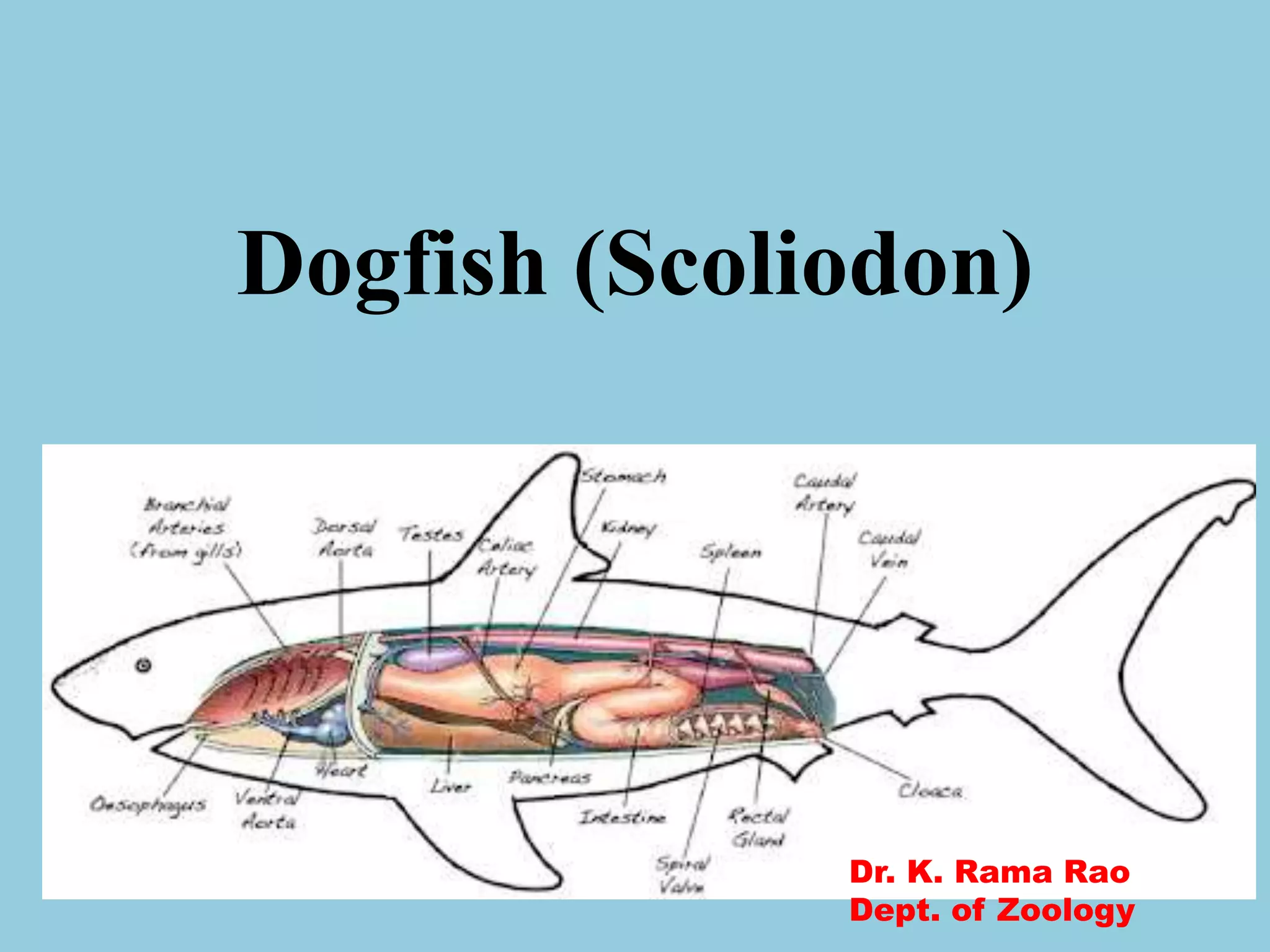
Dogfish (Scoliodon)
Dr. K. Rama Rao
Dept. of Zoology
Alimentary Canal:
The alimentary canal of Scoliodon
comprises:
the mouth,
buccal cavity,
pharynx,
oesophagus,
stomach,
intestine and
rectum opening in the cloaca through
anus.
a. Mouth:
It is a ventral crescentic opening guarded
by upper and lower lips which are folds of
integument.
b. Buccal Cavity:
The mouth leads into a spacious dorso-
ventrally compressed buccal cavity. It is
bordered with jaws. The buccal cavity is
lined with a thick mucous membrane.
Denticles are all alike in shape,
homodont, and are borne in several
parallel rows on the inner margin of the
upper and lower jaws.
c. Pharynx:
The buccal cavity merges posteriorly
with the large pharynx lined by
endoderm.
The cavity of pharynx is lined with
mucous membrane containing numerous
dermal denticles.
d. Oesophagus:
The pharynx narrows posteriorly to
form the short and wide oesophagus.
The oesophagus has thick muscular
walls with an internal lining of
mucous membrane raised into
longitudinal folds.
e. Stomach:
The oesophagus widens posteriorly to
form the large muscular stomach.
The stomach is bent on itself and forms
a J-shaped organ, the long, wider
distensible proximal limb which is called
the cardiac stomach, while the short
narrow distal limb is called the pyloric
stomach.
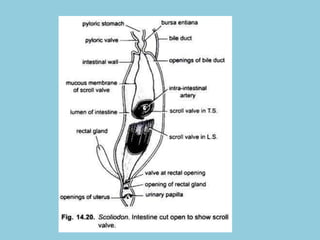
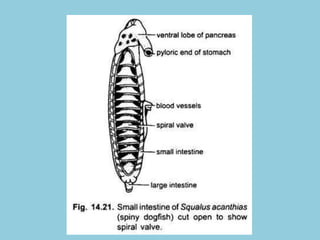
f. Intestine:
The bursa entiana continues into the
intestine. The intestine is a wide tube
running straight backwards into
abdominal cavity and its middle region is
like cardiac stomach in diameter.
Its narrow anterior part receives the bile
and pancreatic ducts.
g. Rectum:
The short and narrow rectum is the last
part of the alimentary canal. The
tubular rectal (caecal) gland opens
dorsally into the rectum.
Its function is not known. The rectum
opens into the cloaca through anus. Into
the cloaca also open the urinogenital
ducts.
Glands of the Alimentary Canal:
a. Liver, Rectal Gland, and Spleen:
The liver is an elongated yellowish gland,
consisting of two lobes which extend back
along the greater part of the abdominal
cavity.
The liver produces bile, stores glycogen and
fat. It also destroys worn-out red blood
corpuscles since Kupffer cells are present.
The gall bladder, which stores the bile
secreted by the liver.
b. Pancreas:
The pancreas is a compact bilobed gland
situated in the angle between the cardiac
and pyloric stomach.
The pancreatic duct opens into the
intestine just opposite to the opening of
the bile-duct
c. Rectal Gland:
The rectal or caecal gland is a short thick
hollow diverticulum arising from the
dorsal wall of the rectum.
It is richly vascularised and formed of
lymphoid tissue.
d. Spleen:
It is a large lymphoid organ attached
with the cardiac and pyloric stomach.
It produced lymphocytes and, thus,
has no physiological relation with the
alimentary canal.
Food and Physiology of Digestion:
Scoliodon is carnivorous and feeder. The
digestion starts only in the cardiac
stomach. The cardiac stomach secretes
the gastric juice which contains pepsin
and hydrochloric acid that converts
proteins into proteoses and peptones.
The gastric juice is not able to digest
chitin.
The pancreas secretes trypsin, amylopsin,
and lipase. As the semi-digested food
enters the intestine it is acted upon “by
the bile and the pancreatic juice.
The bile makes the food alkaline and,
thus, helps the action of pancreatic juice.
The trypsin acts on the remaining
proteins, the amylopsin converts starch
into sugar and lipase turns fats into fatty
acids.
The digested food is absorbed into
the blood over the extensive
surfaces of the intestine and scroll-
valve.
Respiratory System of Scoliodon
The respiration is aquatic. It breathes
by means of gills borne in a series of
gill-pouches on either lateral side of the
pharynx.
Water enters the mouth and after
passing through the buccal cavity,
pharynx, gill- pouches bearing gill-
lamallae, goes out through the external
gill-slits after bathing the gills.
Respiratory Organs:
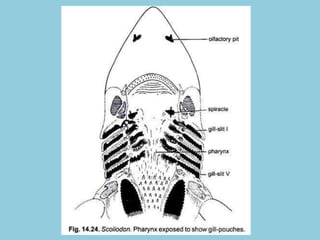
There are five pairs of gill- pouches
bearing gills, arranged in a series
behind the hyoid arch in the lateral
walls of the pharynx.
Each gill-pouch has two sets of gill-
lamellae. The branchial lamellae have
a rich blood supply.
Mechanism of Respiration:
1. Inspiration:
The floor of the buccopharyngeal
cavity is depressed by the contraction
of hypobranchial (hypoglossal) muscles
due to which the visceral arches expand
the wall of the pharynx.
2. Expiration:
During expiration the mouth becomes
closed by the action of adductor muscle.
The respiratory movements are caused
by pharyngeal muscles which are
innervated by V, VII, IX and X cranial
nerves and the hypoglossal spinal nerve.
Physiology of Respiration:
the highest concentration of oxygen and
the lowest of carbon dioxide, thus, an
efficient exchange of oxygen and carbon
dioxide takes place between the blood
and sea-water.
The oxygen of the water passes by endosmosis
through the thin capillary walls into the
blood, and at the same time the carbon
dioxide of the blood passes into the water by a
process of exosmosis.
The oxygen is conveyed by the blood to all the
parts of the body, while carbon dioxide
brought to the gills in the venous blood is
eliminated by the water of the outgoing
respiratory current.
Structure and Function
of Heart
Heart:
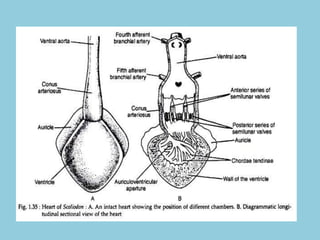
Heart is a bent muscular tube and
consists of the receiving parts,
comprising of a sinus venosus and a
dorsally placed auricle and the
forwarding parts, consisting of a
ventricle and a conus arteriosus.
The heart is situated on the ventral
side of the body between two series of
gill pouches.
The auricle is a large, triangular and
thin walled chamber situated dorsal to
the ventricle but in front of the sinus
venosus.
The auricle communicates with the
ventricle through a slit-like auriculo-
ventricular aperture guarded by two
lipped valves.
The receiving chambers (sinus venosus and
auricle) receive the venous blood from all
parts of the body.
The function of the heart is to receive the
deoxygenated blood from all parts of the body
and to pump it for aeration to the gills.
Such a type of heart is designated as the
venous or branchial heart, because only the
deoxygenated blood circulates through it.
The nervous system of Scoliodon
includes:
(i) The central nervous system,
(ii) The peripheral nervous system, and
(iii) The autonomous nervous system.
(i) Central nervous system:
The central nervous system consists of
brain and the spinal cord.
(a) Brain:
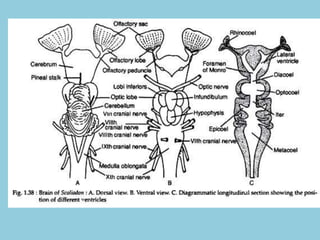
Brain is highly organised and shows
many advancements over that of the
agnathans.
The brain is divided into three
primary parts:
(a) The forebrain or prosencephalon,
(b) The midbrain or mesencephalon
(c) The hindbrain or rhomben-
cephalon.
1. The forebrain consists of a
massive undivided cerebral
hemisphere. The cerebral
hemisphere is relatively larger than
that of other fishes.
From the anterior end of cerebral
hemisphere arise two stout olfactory
peduncles; each terminates into a
large bilobed olfactory lobe
The olfactory lobes lie close to the olfactory
capsules. Each olfactory nerve is composed of
many bundles of nerve fibres.
The surface of the cerebrum is smooth and the
walls are thick. A small opening on the mid-
ventral surface of the cerebrum.
The posterior part of forebrain (diencephalon)
is very short. The roof of the diencephalon is
thin, non-nervous and contains the anterior
choroid plexus.
2. The mid-brain is large and consists of
two round optic lobes. The optic lobes are
situated behind the diencephalon.
3. The hindbrain consists of a highly
developed cerebellum and a medulla
oblongata.
The cerebellum is divided into three lobes
by two well-marked transverse furrows.
The medulla oblongata is triangular
and the anterior end gives a pair of
hollow corpora restiformia with trace
of convolutions in adults. The
medulla controls respiration.
The hind- brain controls swimming
movements. The cerebellum is
divided into three lobes by two well-
marked transverse furrows.
(b) Spinal cord:
The spinal cord in Scoliodon shows
definite advancement towards the
plan of higher vertebrates. The grey
matter is arranged into the dorsal
and the ventral horns. The dorsal
horns are united to form a single
broad region; as a result the grey
matter assumes a shape of an
inverted ‘T’.
(ii) Peripheral nervous system:
The peripheral nervous system
includes the cranial nerves and spinal
nerves.
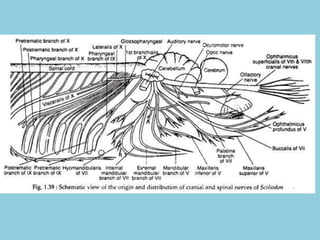
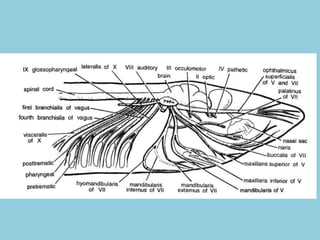
(a) Cranial nerves:
There are ten pairs of cranial nerves
in all the fishes.
The first pair of cranial nerves is the
olfactory nerves which originate from
the olfactory lobes and innervate the
olfactory sacs.
The second pair of cranial nerves is the
optic nerves which, after the origin from
the optic thalami, form the optic chiasma
and supply the eyes.
The third cranial nerve is called
oculomotor nerve which originates from
the ventral surface of the mesencephalon
and supplies the anterior, superior and
inferior recti and the inferior oblique
muscles of each eye ball.
The fourth cranial nerve is called
trochlear or pathetic nerve which
arises from the dorsolateral surface
of the midbrain and supplies the
superior oblique eye muscle.
The fifth cranial nerve is the
trigeminal which has three branches:
(1) Ophthalmicus superficial which
supplies to the skin of the snout.
(2) The maxillaris which is divided
into maxillaris superior supplying
nerves to the skin of the upper jaw
and maxillaris inferior innervating
the posterior part of the upper jaw.
(3) The mandibularis innervating the
muscles of the lower jaw.
Another nerve called ophthalmicus
pro-fundus becomes secondarily
associated with the trigeminal to
supply nerves to the eye ball and the
dorsal surface of the snout
The sixth cranial nerve is the
abducens which supplies the
posterior rectus muscle of the eye
ball.
The seventh cranial nerve is known
as facial which divides into two
branches:
(1) The ophthalmicus superficialis
branch like that of the fifth cranial
nerve.
(2) A bundle of mixed nerves which
subdivides into three routes:
The eighth cranial nerve is called auditory
which gives the vestibular and saccular
branches to the internal ear.
The ninth cranial nerve is the glosso-
pharyngeal which, in the region of the first
gill cleft, divides into a small pretrematic
nerve and a large post-trematic nerve.
These nerves supply branches to the
pharynx, pharyngeal muscles and the
mucous membrane surrounding the
first gill slit.
The tenth cranial nerve is the vagus
which arises by multiple roots and
gives off many branches.
(b) Spinal nerves:
The spinal nerves arise from the
spinal cord. Each has one dorsal and
one ventral root. The dorsal root
bears a ganglionic swelling.
After emerging out through the
vertebral column, the dorsal and the
ventral roots unite to form a common
mixed nerve.

Scoliodon

  • 1.
    Dogfish (Scoliodon) Dr. K.Rama Rao Dept. of Zoology
  • 2.
    Alimentary Canal: The alimentarycanal of Scoliodon comprises: the mouth, buccal cavity, pharynx, oesophagus, stomach, intestine and rectum opening in the cloaca through anus.
  • 4.
    a. Mouth: It isa ventral crescentic opening guarded by upper and lower lips which are folds of integument. b. Buccal Cavity: The mouth leads into a spacious dorso- ventrally compressed buccal cavity. It is bordered with jaws. The buccal cavity is lined with a thick mucous membrane.
  • 5.
    Denticles are allalike in shape, homodont, and are borne in several parallel rows on the inner margin of the upper and lower jaws. c. Pharynx: The buccal cavity merges posteriorly with the large pharynx lined by endoderm. The cavity of pharynx is lined with mucous membrane containing numerous dermal denticles.
  • 6.
    d. Oesophagus: The pharynxnarrows posteriorly to form the short and wide oesophagus. The oesophagus has thick muscular walls with an internal lining of mucous membrane raised into longitudinal folds.
  • 7.
    e. Stomach: The oesophaguswidens posteriorly to form the large muscular stomach. The stomach is bent on itself and forms a J-shaped organ, the long, wider distensible proximal limb which is called the cardiac stomach, while the short narrow distal limb is called the pyloric stomach.
  • 9.
    f. Intestine: The bursaentiana continues into the intestine. The intestine is a wide tube running straight backwards into abdominal cavity and its middle region is like cardiac stomach in diameter. Its narrow anterior part receives the bile and pancreatic ducts.
  • 11.
    g. Rectum: The shortand narrow rectum is the last part of the alimentary canal. The tubular rectal (caecal) gland opens dorsally into the rectum. Its function is not known. The rectum opens into the cloaca through anus. Into the cloaca also open the urinogenital ducts.
  • 12.
    Glands of theAlimentary Canal: a. Liver, Rectal Gland, and Spleen: The liver is an elongated yellowish gland, consisting of two lobes which extend back along the greater part of the abdominal cavity. The liver produces bile, stores glycogen and fat. It also destroys worn-out red blood corpuscles since Kupffer cells are present. The gall bladder, which stores the bile secreted by the liver.
  • 13.
    b. Pancreas: The pancreasis a compact bilobed gland situated in the angle between the cardiac and pyloric stomach. The pancreatic duct opens into the intestine just opposite to the opening of the bile-duct
  • 14.
    c. Rectal Gland: Therectal or caecal gland is a short thick hollow diverticulum arising from the dorsal wall of the rectum. It is richly vascularised and formed of lymphoid tissue.
  • 15.
    d. Spleen: It isa large lymphoid organ attached with the cardiac and pyloric stomach. It produced lymphocytes and, thus, has no physiological relation with the alimentary canal.
  • 16.
    Food and Physiologyof Digestion: Scoliodon is carnivorous and feeder. The digestion starts only in the cardiac stomach. The cardiac stomach secretes the gastric juice which contains pepsin and hydrochloric acid that converts proteins into proteoses and peptones. The gastric juice is not able to digest chitin.
  • 17.
    The pancreas secretestrypsin, amylopsin, and lipase. As the semi-digested food enters the intestine it is acted upon “by the bile and the pancreatic juice. The bile makes the food alkaline and, thus, helps the action of pancreatic juice. The trypsin acts on the remaining proteins, the amylopsin converts starch into sugar and lipase turns fats into fatty acids.
  • 18.
    The digested foodis absorbed into the blood over the extensive surfaces of the intestine and scroll- valve.
  • 19.
  • 20.
    The respiration isaquatic. It breathes by means of gills borne in a series of gill-pouches on either lateral side of the pharynx. Water enters the mouth and after passing through the buccal cavity, pharynx, gill- pouches bearing gill- lamallae, goes out through the external gill-slits after bathing the gills.
  • 22.
    Respiratory Organs: There arefive pairs of gill- pouches bearing gills, arranged in a series behind the hyoid arch in the lateral walls of the pharynx. Each gill-pouch has two sets of gill- lamellae. The branchial lamellae have a rich blood supply.
  • 23.
    Mechanism of Respiration: 1.Inspiration: The floor of the buccopharyngeal cavity is depressed by the contraction of hypobranchial (hypoglossal) muscles due to which the visceral arches expand the wall of the pharynx.
  • 24.
    2. Expiration: During expirationthe mouth becomes closed by the action of adductor muscle. The respiratory movements are caused by pharyngeal muscles which are innervated by V, VII, IX and X cranial nerves and the hypoglossal spinal nerve.
  • 25.
    Physiology of Respiration: thehighest concentration of oxygen and the lowest of carbon dioxide, thus, an efficient exchange of oxygen and carbon dioxide takes place between the blood and sea-water.
  • 26.
    The oxygen ofthe water passes by endosmosis through the thin capillary walls into the blood, and at the same time the carbon dioxide of the blood passes into the water by a process of exosmosis. The oxygen is conveyed by the blood to all the parts of the body, while carbon dioxide brought to the gills in the venous blood is eliminated by the water of the outgoing respiratory current.
  • 27.
  • 28.
    Heart: Heart is abent muscular tube and consists of the receiving parts, comprising of a sinus venosus and a dorsally placed auricle and the forwarding parts, consisting of a ventricle and a conus arteriosus. The heart is situated on the ventral side of the body between two series of gill pouches.
  • 30.
    The auricle isa large, triangular and thin walled chamber situated dorsal to the ventricle but in front of the sinus venosus. The auricle communicates with the ventricle through a slit-like auriculo- ventricular aperture guarded by two lipped valves.
  • 31.
    The receiving chambers(sinus venosus and auricle) receive the venous blood from all parts of the body. The function of the heart is to receive the deoxygenated blood from all parts of the body and to pump it for aeration to the gills. Such a type of heart is designated as the venous or branchial heart, because only the deoxygenated blood circulates through it.
  • 32.
    The nervous systemof Scoliodon
  • 33.
    The nervous systemof Scoliodon includes: (i) The central nervous system, (ii) The peripheral nervous system, and (iii) The autonomous nervous system. (i) Central nervous system: The central nervous system consists of brain and the spinal cord. (a) Brain:
  • 34.
    Brain is highlyorganised and shows many advancements over that of the agnathans. The brain is divided into three primary parts: (a) The forebrain or prosencephalon, (b) The midbrain or mesencephalon (c) The hindbrain or rhomben- cephalon.
  • 36.
    1. The forebrainconsists of a massive undivided cerebral hemisphere. The cerebral hemisphere is relatively larger than that of other fishes. From the anterior end of cerebral hemisphere arise two stout olfactory peduncles; each terminates into a large bilobed olfactory lobe
  • 37.
    The olfactory lobeslie close to the olfactory capsules. Each olfactory nerve is composed of many bundles of nerve fibres. The surface of the cerebrum is smooth and the walls are thick. A small opening on the mid- ventral surface of the cerebrum. The posterior part of forebrain (diencephalon) is very short. The roof of the diencephalon is thin, non-nervous and contains the anterior choroid plexus.
  • 38.
    2. The mid-brainis large and consists of two round optic lobes. The optic lobes are situated behind the diencephalon. 3. The hindbrain consists of a highly developed cerebellum and a medulla oblongata. The cerebellum is divided into three lobes by two well-marked transverse furrows.
  • 39.
    The medulla oblongatais triangular and the anterior end gives a pair of hollow corpora restiformia with trace of convolutions in adults. The medulla controls respiration. The hind- brain controls swimming movements. The cerebellum is divided into three lobes by two well- marked transverse furrows.
  • 40.
    (b) Spinal cord: Thespinal cord in Scoliodon shows definite advancement towards the plan of higher vertebrates. The grey matter is arranged into the dorsal and the ventral horns. The dorsal horns are united to form a single broad region; as a result the grey matter assumes a shape of an inverted ‘T’.
  • 41.
    (ii) Peripheral nervoussystem: The peripheral nervous system includes the cranial nerves and spinal nerves. (a) Cranial nerves: There are ten pairs of cranial nerves in all the fishes. The first pair of cranial nerves is the olfactory nerves which originate from the olfactory lobes and innervate the olfactory sacs.
  • 42.
    The second pairof cranial nerves is the optic nerves which, after the origin from the optic thalami, form the optic chiasma and supply the eyes. The third cranial nerve is called oculomotor nerve which originates from the ventral surface of the mesencephalon and supplies the anterior, superior and inferior recti and the inferior oblique muscles of each eye ball.
  • 43.
    The fourth cranialnerve is called trochlear or pathetic nerve which arises from the dorsolateral surface of the midbrain and supplies the superior oblique eye muscle.
  • 44.
    The fifth cranialnerve is the trigeminal which has three branches: (1) Ophthalmicus superficial which supplies to the skin of the snout. (2) The maxillaris which is divided into maxillaris superior supplying nerves to the skin of the upper jaw and maxillaris inferior innervating the posterior part of the upper jaw.
  • 47.
    (3) The mandibularisinnervating the muscles of the lower jaw. Another nerve called ophthalmicus pro-fundus becomes secondarily associated with the trigeminal to supply nerves to the eye ball and the dorsal surface of the snout
  • 48.
    The sixth cranialnerve is the abducens which supplies the posterior rectus muscle of the eye ball. The seventh cranial nerve is known as facial which divides into two branches: (1) The ophthalmicus superficialis branch like that of the fifth cranial nerve.
  • 49.
    (2) A bundleof mixed nerves which subdivides into three routes: The eighth cranial nerve is called auditory which gives the vestibular and saccular branches to the internal ear. The ninth cranial nerve is the glosso- pharyngeal which, in the region of the first gill cleft, divides into a small pretrematic nerve and a large post-trematic nerve.
  • 50.
    These nerves supplybranches to the pharynx, pharyngeal muscles and the mucous membrane surrounding the first gill slit. The tenth cranial nerve is the vagus which arises by multiple roots and gives off many branches.
  • 51.
    (b) Spinal nerves: Thespinal nerves arise from the spinal cord. Each has one dorsal and one ventral root. The dorsal root bears a ganglionic swelling. After emerging out through the vertebral column, the dorsal and the ventral roots unite to form a common mixed nerve.