Construction Activities
Hazards and Control
1
2
3
Construction Activities
Learning outcomes:
1. Identify the main hazards of construction and demolition work
and outline the general principles to control them;
2. Identify the hazards of work above ground level and outline the
general requirements necessary to control them;
3. Describe the safe working practices for common forms of access
equipment;
4. Identify the hazards of excavations and outline the general
requirements necessary to control them; and
5. Identify the hazards to health commonly encountered in small
construction activities and explain how risks might be reduced
4
Construction Activities
General
1. Scope
2. Stacking and storage
– Stacked goods
– Storage - general
– Storage of flammable and combustibles
5
(Stacked goods)
 Kept as small as is practical, adequate
space, and should be vertical.
 Kept away from walls and off the floor by
using pallets.
 Should not block light, obstruct fire detection
and control equipment or block drains.
 Separate stack for different types of
containers.
6
(Storage – general)
 Should not be used for other work activities.
 Adequate space for movement (access and egress).
 Kept clean and tidy.
 Mixed storage :
 materials should be separated for easy location and
access.
 Incompatible materials should not be stored
together.
7
(Storage – general)
 Warning signs for any special danger or any
special precautions measure.
 Adequate fire protection.
 Should not permit public access.
8
(Storage of flammable and
combustibles)
“Require special storage arrangements”
Additional requirements:
 Should not be stored with other materials,
separate stores for liquids, solids and gases,
oxygen cylinder stored separately away.
 External open-air store (fenced)– 3 meters
from other buildings or activity.
9
(Storage of flammable and
combustibles)
 Internal stores – of fire resistant material with good
level of ventilation.
 At least 2 exit for fire escape and shut / locked when
not in use.
 Marked with hazards and precautions information.
 Fire risk activities should not be carried out close to
storage area unless with suitable PPE.
10
(Storage of flammable and
combustibles)
 Electrical equipment in store must not be a
potential source of ignition.
 Fire fighting equipment and system must be
in good condition.
 Inspected regularly, planned maintenance,
and good housekeeping.
11
Construction Activities Risk
factors and risk activities
Main hazards and controls
1. Machinery and vehicles
2. Site security
3. Electricity
4. Slips, trips and falls
12
1. Machinery and vehicles
 Machinery hazard: Contact with moving parts, dust,
noise, vibration.
 Control: Warning signs, guards, segregate areas,PPE.
 Vehicle hazard: toppling over, collision with pedestrian,
other vehicle, structures-collapse.
 Control:
 Keep people and vehicle separate (sites & building
entrance)
 Traffic routes
 Visibility
 Stationery vehicle safety procedure.
13
2. Site security
 Site Hazards: Public access, vandals, thieves, children.
 Control:
 Entrances locked.
 Fencing – 2 meters high.
 Other protection measures:
 Not leaving ladders lying around.
 Disabling equipment.
 Covering excavations.
 Securely locking tools and hazardous substances at
night.
 Provide security staff, cctv, lighting and alarm.14
3. Electricity
 Electrical Hazards: trailing cables, live wires exposed,
unsafe equipment, overhead power lines, buried cables.
 Control:
 Identify buried cable position.
 Provide guards
 Segregate areas
 Equipment properly maintained
 Incorporate circuit breaker on equipment
 Use low voltage circuit
 Substitution other form of power (eg: compressed air)
15
4. Slips, trips and falls
(working at height and excavation)
 Hazards: Uneven & muddy floor, trailing
wire, holes, falling items.
 Control:
 Proper manual handling
 PPE
16
Management Controls
 Planning for Health and Safety
 Documentation
 Selection of Contractors
 Control of Contractors on Site
17
Construction Activities
Working above ground level (Over 2 metres)
Basic Hazards:
1. Roof (fragile roof- use roof ladder/crawling boards)
2. Deterioration of Materials
3. Unprotected Edges
4. Unstable Access Equipment
5. Weather
6. Falling Materials
18
Construction Activities
Main precautions to prevent fall and falling
material:
1. Guard rails, fencing and toe boards
2. Working platforms
3. Ladder hoops
4. Fall arrest equipment
5. Protection against falling materials
19
1. Guard rails, fencing and toe boards
Mid rail
missing
Toe boards
20
2. Working platforms
Basic Requirements:
 Sufficiently wide.
 Capable of bearing loads.
 Supporting framework should be stable.
 Closely boarded to prevent gaps.
21
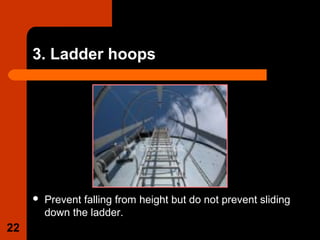
3. Ladder hoops
 Prevent falling from height but do not prevent sliding
down the ladder.
22
4. Fall arrest equipment
Boatswain’s Chair
- Light short term work
Safety Harness
-Use when approaching open
edges
23
Protection against falling materials
 Not stacking materials near edges.
 Close boarding of working platforms.
 Using hoist to lift or lowering down materials.
or (protect people)
 Covered walkways.
 Sheeting across scaffold.
 Netting to catch falling material.
 Designated exclusion zone.
24
Safe Working Practices for Access
Equipment
 Independent Tied Scaffolds
 Mobile Towers
 Mobile Elevating Work Platforms (MWEP)
 Ladders
 Cradles
25
Independent Tied Scaffolds
 Scaffolding basic components:
 Standards
 Ledgers
 Transoms
 Designed to carry its own mass, material load,
and workers load (use of base plates).
 Tied to a building for stability.
 Bracing is used to stiffen scaffold framework.
(eg: Façade bracing & Ledger bracing)
26
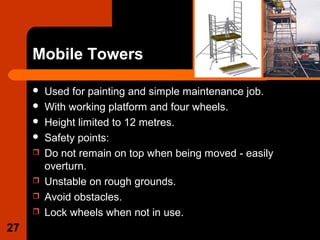
Mobile Towers
 Used for painting and simple maintenance job.
 With working platform and four wheels.
 Height limited to 12 metres.
 Safety points:
 Do not remain on top when being moved - easily
overturn.
 Unstable on rough grounds.
 Avoid obstacles.
 Lock wheels when not in use.
27
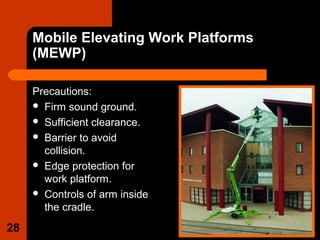
Mobile Elevating Work Platforms
(MEWP)
Precautions:
 Firm sound ground.
 Sufficient clearance.
 Barrier to avoid
collision.
 Edge protection for
work platform.
 Controls of arm inside
the cradle.
28
Ladders
 Grade 1 – light work
 Grade 2 – medium use
 Grade 3 – heavy duty work
 Metal ladders not be used near unprotected live
electrical circuits
 Must be set on solid flat base
 Angle 75 degree
 Top rest against solid support.
 Only one person climb the ladder at a time
 Nothing should be carried while climbing
29
Inspection of Scaffolds
 Inspect at regular intervals (once per week).
 Inspect when first erect.
 Things to check:
 Tying and bracing
 Edge protection
 Ground condition
 Access
 Loading
30
Construction Activities
Excavations hazards
1. Falling in
2. Collapse
3. Buried services
4. Flooding
5. Hazardous
substances
31
Construction Activities
Excavation precautions/ controls
1. Battering and shoring
2. Barriers
3. Access ladders
4. Crossing points (gangways)
5. Lighting and warning signs (prevent people falling)
6. PPE
7. Check for buried services
8. Proximity of vehicles (exclusion zone: barrier,warning
signs,lights)
9. Inspections (daily)
32
Construction Activities
Related health hazards
1. Noise and vibration
2. Dust
3. Asbestos
4. Cement
5. Solvents
6. Cleaners
33
Construction Activities
Summary and revision
34
Revision Question
1. What are the requirements for mixed store?
2. What are the requirements for the internal
storage of flammable materials?
3. What are the safe method of working on
fragile roof?
4. What are the main hazards of using
ladders?
5. What measures should be taken to prevent
materials from falling from a height?35
Revision Question
6. In respect of scaffolding:
 What is the difference between standards,
ledgers and transoms?
 What is the difference between tying and
bracing?
7. State the safety precautions which need to
be taken when mobile elevating work
platforms are in use.
8. What is the angle at which ladders should
be positioned?
9. When should scaffolding be inspected?36
Revision Question
10. Identify the main hazards associated with
excavation work.
11. What is battering?
12. What are the key elements of shoring?
13. Identify the requirements for crossing
points.
14. How can the hazards of buried services be
avoided?
15. When must excavations be inspected?37

Construction Activities Hazards and Control 138001441427235.OS

  • 1.
  • 2.
  • 3.
  • 4.
    Construction Activities Learning outcomes: 1.Identify the main hazards of construction and demolition work and outline the general principles to control them; 2. Identify the hazards of work above ground level and outline the general requirements necessary to control them; 3. Describe the safe working practices for common forms of access equipment; 4. Identify the hazards of excavations and outline the general requirements necessary to control them; and 5. Identify the hazards to health commonly encountered in small construction activities and explain how risks might be reduced 4
  • 5.
    Construction Activities General 1. Scope 2.Stacking and storage – Stacked goods – Storage - general – Storage of flammable and combustibles 5
  • 6.
    (Stacked goods)  Keptas small as is practical, adequate space, and should be vertical.  Kept away from walls and off the floor by using pallets.  Should not block light, obstruct fire detection and control equipment or block drains.  Separate stack for different types of containers. 6
  • 7.
    (Storage – general) Should not be used for other work activities.  Adequate space for movement (access and egress).  Kept clean and tidy.  Mixed storage :  materials should be separated for easy location and access.  Incompatible materials should not be stored together. 7
  • 8.
    (Storage – general) Warning signs for any special danger or any special precautions measure.  Adequate fire protection.  Should not permit public access. 8
  • 9.
    (Storage of flammableand combustibles) “Require special storage arrangements” Additional requirements:  Should not be stored with other materials, separate stores for liquids, solids and gases, oxygen cylinder stored separately away.  External open-air store (fenced)– 3 meters from other buildings or activity. 9
  • 10.
    (Storage of flammableand combustibles)  Internal stores – of fire resistant material with good level of ventilation.  At least 2 exit for fire escape and shut / locked when not in use.  Marked with hazards and precautions information.  Fire risk activities should not be carried out close to storage area unless with suitable PPE. 10
  • 11.
    (Storage of flammableand combustibles)  Electrical equipment in store must not be a potential source of ignition.  Fire fighting equipment and system must be in good condition.  Inspected regularly, planned maintenance, and good housekeeping. 11
  • 12.
    Construction Activities Risk factorsand risk activities Main hazards and controls 1. Machinery and vehicles 2. Site security 3. Electricity 4. Slips, trips and falls 12
  • 13.
    1. Machinery andvehicles  Machinery hazard: Contact with moving parts, dust, noise, vibration.  Control: Warning signs, guards, segregate areas,PPE.  Vehicle hazard: toppling over, collision with pedestrian, other vehicle, structures-collapse.  Control:  Keep people and vehicle separate (sites & building entrance)  Traffic routes  Visibility  Stationery vehicle safety procedure. 13
  • 14.
    2. Site security Site Hazards: Public access, vandals, thieves, children.  Control:  Entrances locked.  Fencing – 2 meters high.  Other protection measures:  Not leaving ladders lying around.  Disabling equipment.  Covering excavations.  Securely locking tools and hazardous substances at night.  Provide security staff, cctv, lighting and alarm.14
  • 15.
    3. Electricity  ElectricalHazards: trailing cables, live wires exposed, unsafe equipment, overhead power lines, buried cables.  Control:  Identify buried cable position.  Provide guards  Segregate areas  Equipment properly maintained  Incorporate circuit breaker on equipment  Use low voltage circuit  Substitution other form of power (eg: compressed air) 15
  • 16.
    4. Slips, tripsand falls (working at height and excavation)  Hazards: Uneven & muddy floor, trailing wire, holes, falling items.  Control:  Proper manual handling  PPE 16
  • 17.
    Management Controls  Planningfor Health and Safety  Documentation  Selection of Contractors  Control of Contractors on Site 17
  • 18.
    Construction Activities Working aboveground level (Over 2 metres) Basic Hazards: 1. Roof (fragile roof- use roof ladder/crawling boards) 2. Deterioration of Materials 3. Unprotected Edges 4. Unstable Access Equipment 5. Weather 6. Falling Materials 18
  • 19.
    Construction Activities Main precautionsto prevent fall and falling material: 1. Guard rails, fencing and toe boards 2. Working platforms 3. Ladder hoops 4. Fall arrest equipment 5. Protection against falling materials 19
  • 20.
    1. Guard rails,fencing and toe boards Mid rail missing Toe boards 20
  • 21.
    2. Working platforms BasicRequirements:  Sufficiently wide.  Capable of bearing loads.  Supporting framework should be stable.  Closely boarded to prevent gaps. 21
  • 22.
    3. Ladder hoops Prevent falling from height but do not prevent sliding down the ladder. 22
  • 23.
    4. Fall arrestequipment Boatswain’s Chair - Light short term work Safety Harness -Use when approaching open edges 23
  • 24.
    Protection against fallingmaterials  Not stacking materials near edges.  Close boarding of working platforms.  Using hoist to lift or lowering down materials. or (protect people)  Covered walkways.  Sheeting across scaffold.  Netting to catch falling material.  Designated exclusion zone. 24
  • 25.
    Safe Working Practicesfor Access Equipment  Independent Tied Scaffolds  Mobile Towers  Mobile Elevating Work Platforms (MWEP)  Ladders  Cradles 25
  • 26.
    Independent Tied Scaffolds Scaffolding basic components:  Standards  Ledgers  Transoms  Designed to carry its own mass, material load, and workers load (use of base plates).  Tied to a building for stability.  Bracing is used to stiffen scaffold framework. (eg: Façade bracing & Ledger bracing) 26
  • 27.
    Mobile Towers  Usedfor painting and simple maintenance job.  With working platform and four wheels.  Height limited to 12 metres.  Safety points:  Do not remain on top when being moved - easily overturn.  Unstable on rough grounds.  Avoid obstacles.  Lock wheels when not in use. 27
  • 28.
    Mobile Elevating WorkPlatforms (MEWP) Precautions:  Firm sound ground.  Sufficient clearance.  Barrier to avoid collision.  Edge protection for work platform.  Controls of arm inside the cradle. 28
  • 29.
    Ladders  Grade 1– light work  Grade 2 – medium use  Grade 3 – heavy duty work  Metal ladders not be used near unprotected live electrical circuits  Must be set on solid flat base  Angle 75 degree  Top rest against solid support.  Only one person climb the ladder at a time  Nothing should be carried while climbing 29
  • 30.
    Inspection of Scaffolds Inspect at regular intervals (once per week).  Inspect when first erect.  Things to check:  Tying and bracing  Edge protection  Ground condition  Access  Loading 30
  • 31.
    Construction Activities Excavations hazards 1.Falling in 2. Collapse 3. Buried services 4. Flooding 5. Hazardous substances 31
  • 32.
    Construction Activities Excavation precautions/controls 1. Battering and shoring 2. Barriers 3. Access ladders 4. Crossing points (gangways) 5. Lighting and warning signs (prevent people falling) 6. PPE 7. Check for buried services 8. Proximity of vehicles (exclusion zone: barrier,warning signs,lights) 9. Inspections (daily) 32
  • 33.
    Construction Activities Related healthhazards 1. Noise and vibration 2. Dust 3. Asbestos 4. Cement 5. Solvents 6. Cleaners 33
  • 34.
  • 35.
    Revision Question 1. Whatare the requirements for mixed store? 2. What are the requirements for the internal storage of flammable materials? 3. What are the safe method of working on fragile roof? 4. What are the main hazards of using ladders? 5. What measures should be taken to prevent materials from falling from a height?35
  • 36.
    Revision Question 6. Inrespect of scaffolding:  What is the difference between standards, ledgers and transoms?  What is the difference between tying and bracing? 7. State the safety precautions which need to be taken when mobile elevating work platforms are in use. 8. What is the angle at which ladders should be positioned? 9. When should scaffolding be inspected?36
  • 37.
    Revision Question 10. Identifythe main hazards associated with excavation work. 11. What is battering? 12. What are the key elements of shoring? 13. Identify the requirements for crossing points. 14. How can the hazards of buried services be avoided? 15. When must excavations be inspected?37