THE RESPIRATORY
SYSTEM OF GOAT
Submitted to
Dr Zeeshan Akbar
Submitted by:
PMAS 14-Arid-2022
FAISAL SHAHZAD SOMROO
14-Arid-2032
14-Arid-2025
Introduction
Respiration is the process of
inhaling and exhaling air, including
oxygen and carbon dioxide.
Oxygen is the most critical
requirement of life support for an
animal, which can only survive a
few minutes without it.
Major functions of the respiratory
system:
• Providing oxygen to tissues and
cells;
• Removing carbon dioxide from the
body;
• Controlling body temperature;
• Eliminating water (as vapor); and
• Aiding in voice production.
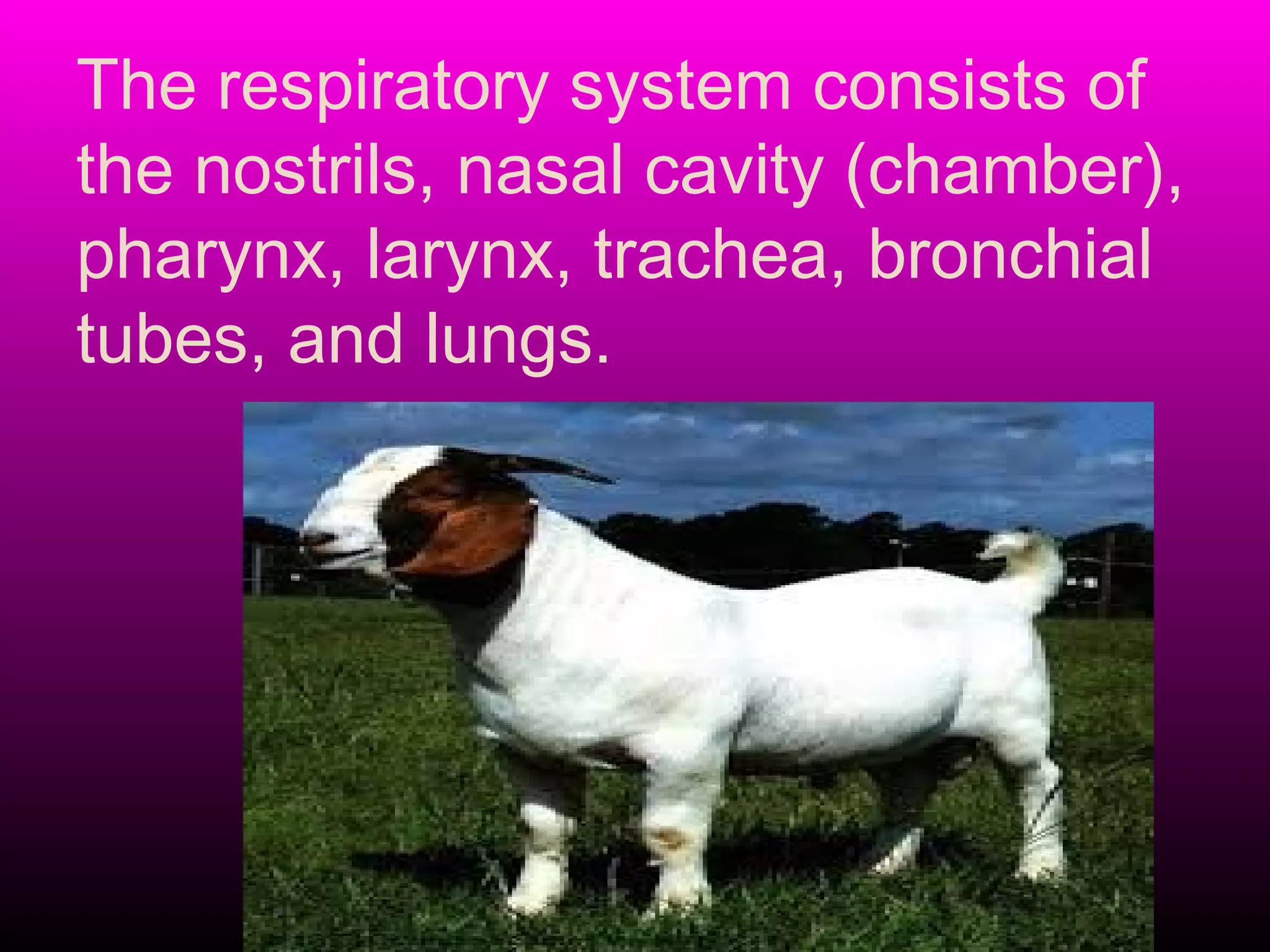
The respiratory system consists of
the nostrils, nasal cavity (chamber),
pharynx, larynx, trachea, bronchial
tubes, and lungs.
Anatomy of the
Respiratory System
The organs of the respiratory system
are divided into two parts:
• Upper respiratory tract - extends
from the nasal opening to the
pharynx, and
• Lower respiratory tract - extends
from the larynx to the lungs.
Upper Respiratory Tract
The upper respiratory tract includes
the nostrils, nasal cavity, and pharynx.
The muzzle, which holds the
nostrils, is made up of the nose
and lips on most domestic animals.
The nostrils are the external
openings of the respiratory tract
through which air passes during
the breathing process.
Cattle and sheep muzzles do not
contain oil glands, but do contain
sweat glands.
Cattle with dry muzzles are often
feverish.
Photo by M. Jasek.
A hard palate and a soft palate
separate the nasal cavity from the
mouth.
The nasal cavity is divided into two
halves by cartilage and connects
the nostrils to the pharynx.
The nasal passages are lined with a
membrane of epithelial cells which
are covered by thousands of cilia.
Mucous coats the epithelial cells
and cilia to create an air-filtering
system that also moistens and
warms the air to protect the other
respiratory structures.
The nasal passages contain olfactory
receptors in the turbinate bones.
These olfactory receptors are
involved with the sense of smell.
Sinuses, which are air-filled cavities
in the forehead bones, are connected
to the nasal cavity.
The frontal sinuses extend to the
horn cores in cattle and may become
exposed to the atmosphere when
mature cattle are dehorned.
If foreign materials fall into these
openings, sinus infections may occur.
Air flows from the nasal cavity to
the pharynx, which is a short,
funnel-shaped tube.
The nasal cavity, mouth, eustachian
tubes (from middle ear), esophagus
and larynx empty into the pharynx,
which is lined with a mucous
membrane and ciliated cells.
Both food and air pass through the
pharynx, but the epiglottis keeps
them from passing through at the
same time.
The epiglottis is a valve-like flap of
tissue, above the trachea, that
closes the air passage when the
animal swallows feed or water to
prevent them from entering the
trachea and lungs.
Lower Respiratory Tract
The lower
respiratory
tract includes
the larynx,
trachea,
bronchial
tubes, and
lungs.
The larynx, commonly known as
the “voice box,” is responsible for
voice production, control of
breathing, and preventing
inhalation of foreign objects into
the lungs.
The larynx is composed of five
cartilage structures.
The parts of the larynx are:
• Thyroid cartilage – commonly
called the “Adam’s Apple,”
• Arytenoid cartilages – two
cartilages that assist in closing the
epiglottis and control the pitch of
the voice by tightening or loosening
the vocal chords, and
• Cricoid cartilage – helps maintain
shape of the larynx and is a site of
muscle attachment.
The trachea (windpipe) is a tube
composed of a series of adjacent
cartilage rings, which are rigid to
prevent collapsing of the trachea.
As a single tube, the trachea goes
from the larynx to a level just above
the base of the heart.
The trachea divides into two branches
called the primary bronchi.
Each bronchi passes into a lung,
where they branch out even further
into bronchioles.
The trachea, bronchi, and the first few
bronchioles, lined with mucous
membranes and ciliated cells,
contribute to cleansing the passing air.
The bronchioles divide many more
times into smaller branches called
intralobular bronchioles, terminal
bronchioles, and respiratory
bronchioles.
The respiratory bronchioles end
with the smallest and final air
passageways of the respiratory
system, the alveoli.
Alveoli are tiny air sacs surrounded by
capillaries (tiny blood vessels of the
circulatory system).
Oxygen and carbon dioxide move
through the walls of the alveoli and
capillaries via a process called
diffusion.
Diffusion is also responsible for the
exchange of oxygen and carbon
dioxide between the body cells and
Diffusion is a process of passive
transport, whereby particles or
molecules move from areas of high
concentration to areas of low
concentration.
Inhaled air has a high concentration of
oxygen (O2) and a lower concentration
of carbon dioxide (CO2), while the blood
in the capillaries around the alveoli has
high CO2 and low O2 concentrations.
O2 diffuses from the alveoli into the
capillaries and attaches to the
hemoglobin in red blood cells.
CO2 diffuses from the blood into the
alveoli.
Illustration by Patrick Lynch courtesy of Wikipedia.
Mammals’ lungs are made of
elastic, spongy material that greatly
expands when filled with air.
Lungs are cone-shaped and
incompletely divided into lobes.
The bronchi, pulmonary artery,
pulmonary vein, nerves, and lymph
vessels connect to the lungs at the
same location.
When lungs are expanded to total
capacity, they completely fill the
thoracic (chest) cavity.
Once an animal takes its first breath,
the lungs will never completely
collapse and will float in water.
If a newborn’s lungs sink, it was
born dead.
Physiology of the
Respiratory System
The primary function of the lungs is
the exchange of gases, O2 and CO2.
The exchange of gases between the
alveoli and capillaries is called
external respiration because it
occurs outside the animal’s body.
The exchange of gases between
the capillaries and the body cells is
called internal respiration because
it occurs inside the animal’s body.
Inspiration is the inhaling of air.
When the diaphragm contracts
and the thoracic cavity enlarges,
a vacuum is created that expands
the lungs and draws in air.
Quiet respiration, which is also
called abdominal or diaphragmatic
respiration, occurs mainly as a
result of the diaphragm contracting
to pull in air.
Labored respiration involves the
contraction of the external
intercostal (rib) muscles, which
increases the capacity of the
thorax.
When carbon monoxide is
inhaled, it bonds with the iron in
hemoglobin and prevents the
transport of oxygen.
This carbon monoxide “poisoning”
results in death, caused by the
lack of oxygen.
Nitrates, chlorates, cyanide, and
prussic acid are other chemicals
that interfere with respiration.
Artificial respiration might be
helpful, if breathing stops,
especially in cases of newborns,
animals struck by lightening, or
animals overdosed with
anesthetics or tranquilizers.
Artificial respiration can be
performed by applying rhythmic
pressure on the chest cavity.
Expiration, or exhaling of air, is
accomplished by the relaxation of the
diaphragm muscles and contraction
of the internal intercostal muscles.
The upward movement of the viscera
(due to diaphragm relaxing) and the
down and inward movement of the
ribs (due to intercostals contracting)
reduces the size of the thoracic cavity
and forces air out of the lungs.
Nerve cells in the medulla control
respiratory rates.
The inspiratory nerves stimulate
muscle contraction for inspiration
or inhaling.
The expiratory nerves stimulates
relaxation of the muscles for
expiration or exhaling.
The pneumotaxic nerves are
stimulated by the inspiratory center
during inspiration and, in turn,
stimulate the expiratory center to
cause expiration.
Several factors influence the rate at
which the brain stimulates
breathing, including:
• Carbon dioxide content of the
blood,
• Body temperature, and
• Messages from other parts of
the brain.
An increase in the concentrations
of carbon dioxide increases the
acidity of the blood, which causes
the respiration rate to increase.
An increase in body temperature
triggers the respiration rate to
increase.
Respiratory system of goat

Respiratory system of goat

  • 1.
    THE RESPIRATORY SYSTEM OFGOAT Submitted to Dr Zeeshan Akbar Submitted by: PMAS 14-Arid-2022 FAISAL SHAHZAD SOMROO 14-Arid-2032 14-Arid-2025
  • 2.
    Introduction Respiration is theprocess of inhaling and exhaling air, including oxygen and carbon dioxide. Oxygen is the most critical requirement of life support for an animal, which can only survive a few minutes without it.
  • 3.
    Major functions ofthe respiratory system: • Providing oxygen to tissues and cells; • Removing carbon dioxide from the body; • Controlling body temperature; • Eliminating water (as vapor); and • Aiding in voice production.
  • 4.
    The respiratory systemconsists of the nostrils, nasal cavity (chamber), pharynx, larynx, trachea, bronchial tubes, and lungs.
  • 5.
    Anatomy of the RespiratorySystem The organs of the respiratory system are divided into two parts: • Upper respiratory tract - extends from the nasal opening to the pharynx, and • Lower respiratory tract - extends from the larynx to the lungs.
  • 6.
    Upper Respiratory Tract Theupper respiratory tract includes the nostrils, nasal cavity, and pharynx.
  • 7.
    The muzzle, whichholds the nostrils, is made up of the nose and lips on most domestic animals. The nostrils are the external openings of the respiratory tract through which air passes during the breathing process.
  • 8.
    Cattle and sheepmuzzles do not contain oil glands, but do contain sweat glands. Cattle with dry muzzles are often feverish. Photo by M. Jasek.
  • 9.
    A hard palateand a soft palate separate the nasal cavity from the mouth. The nasal cavity is divided into two halves by cartilage and connects the nostrils to the pharynx.
  • 10.
    The nasal passagesare lined with a membrane of epithelial cells which are covered by thousands of cilia. Mucous coats the epithelial cells and cilia to create an air-filtering system that also moistens and warms the air to protect the other respiratory structures.
  • 11.
    The nasal passagescontain olfactory receptors in the turbinate bones. These olfactory receptors are involved with the sense of smell.
  • 12.
    Sinuses, which areair-filled cavities in the forehead bones, are connected to the nasal cavity. The frontal sinuses extend to the horn cores in cattle and may become exposed to the atmosphere when mature cattle are dehorned. If foreign materials fall into these openings, sinus infections may occur.
  • 13.
    Air flows fromthe nasal cavity to the pharynx, which is a short, funnel-shaped tube. The nasal cavity, mouth, eustachian tubes (from middle ear), esophagus and larynx empty into the pharynx, which is lined with a mucous membrane and ciliated cells.
  • 14.
    Both food andair pass through the pharynx, but the epiglottis keeps them from passing through at the same time. The epiglottis is a valve-like flap of tissue, above the trachea, that closes the air passage when the animal swallows feed or water to prevent them from entering the trachea and lungs.
  • 15.
    Lower Respiratory Tract Thelower respiratory tract includes the larynx, trachea, bronchial tubes, and lungs.
  • 16.
    The larynx, commonlyknown as the “voice box,” is responsible for voice production, control of breathing, and preventing inhalation of foreign objects into the lungs. The larynx is composed of five cartilage structures.
  • 17.
    The parts ofthe larynx are: • Thyroid cartilage – commonly called the “Adam’s Apple,” • Arytenoid cartilages – two cartilages that assist in closing the epiglottis and control the pitch of the voice by tightening or loosening the vocal chords, and
  • 18.
    • Cricoid cartilage– helps maintain shape of the larynx and is a site of muscle attachment.
  • 19.
    The trachea (windpipe)is a tube composed of a series of adjacent cartilage rings, which are rigid to prevent collapsing of the trachea. As a single tube, the trachea goes from the larynx to a level just above the base of the heart.
  • 20.
    The trachea dividesinto two branches called the primary bronchi. Each bronchi passes into a lung, where they branch out even further into bronchioles. The trachea, bronchi, and the first few bronchioles, lined with mucous membranes and ciliated cells, contribute to cleansing the passing air.
  • 21.
    The bronchioles dividemany more times into smaller branches called intralobular bronchioles, terminal bronchioles, and respiratory bronchioles. The respiratory bronchioles end with the smallest and final air passageways of the respiratory system, the alveoli.
  • 22.
    Alveoli are tinyair sacs surrounded by capillaries (tiny blood vessels of the circulatory system). Oxygen and carbon dioxide move through the walls of the alveoli and capillaries via a process called diffusion. Diffusion is also responsible for the exchange of oxygen and carbon dioxide between the body cells and
  • 23.
    Diffusion is aprocess of passive transport, whereby particles or molecules move from areas of high concentration to areas of low concentration. Inhaled air has a high concentration of oxygen (O2) and a lower concentration of carbon dioxide (CO2), while the blood in the capillaries around the alveoli has high CO2 and low O2 concentrations.
  • 24.
    O2 diffuses fromthe alveoli into the capillaries and attaches to the hemoglobin in red blood cells. CO2 diffuses from the blood into the alveoli. Illustration by Patrick Lynch courtesy of Wikipedia.
  • 25.
    Mammals’ lungs aremade of elastic, spongy material that greatly expands when filled with air. Lungs are cone-shaped and incompletely divided into lobes. The bronchi, pulmonary artery, pulmonary vein, nerves, and lymph vessels connect to the lungs at the same location.
  • 26.
    When lungs areexpanded to total capacity, they completely fill the thoracic (chest) cavity. Once an animal takes its first breath, the lungs will never completely collapse and will float in water. If a newborn’s lungs sink, it was born dead.
  • 27.
    Physiology of the RespiratorySystem The primary function of the lungs is the exchange of gases, O2 and CO2. The exchange of gases between the alveoli and capillaries is called external respiration because it occurs outside the animal’s body.
  • 28.
    The exchange ofgases between the capillaries and the body cells is called internal respiration because it occurs inside the animal’s body.
  • 29.
    Inspiration is theinhaling of air. When the diaphragm contracts and the thoracic cavity enlarges, a vacuum is created that expands the lungs and draws in air.
  • 30.
    Quiet respiration, whichis also called abdominal or diaphragmatic respiration, occurs mainly as a result of the diaphragm contracting to pull in air. Labored respiration involves the contraction of the external intercostal (rib) muscles, which increases the capacity of the thorax.
  • 31.
    When carbon monoxideis inhaled, it bonds with the iron in hemoglobin and prevents the transport of oxygen. This carbon monoxide “poisoning” results in death, caused by the lack of oxygen.
  • 32.
    Nitrates, chlorates, cyanide,and prussic acid are other chemicals that interfere with respiration.
  • 33.
    Artificial respiration mightbe helpful, if breathing stops, especially in cases of newborns, animals struck by lightening, or animals overdosed with anesthetics or tranquilizers.
  • 34.
    Artificial respiration canbe performed by applying rhythmic pressure on the chest cavity.
  • 35.
    Expiration, or exhalingof air, is accomplished by the relaxation of the diaphragm muscles and contraction of the internal intercostal muscles. The upward movement of the viscera (due to diaphragm relaxing) and the down and inward movement of the ribs (due to intercostals contracting) reduces the size of the thoracic cavity and forces air out of the lungs.
  • 36.
    Nerve cells inthe medulla control respiratory rates. The inspiratory nerves stimulate muscle contraction for inspiration or inhaling. The expiratory nerves stimulates relaxation of the muscles for expiration or exhaling.
  • 37.
    The pneumotaxic nervesare stimulated by the inspiratory center during inspiration and, in turn, stimulate the expiratory center to cause expiration.
  • 38.
    Several factors influencethe rate at which the brain stimulates breathing, including: • Carbon dioxide content of the blood, • Body temperature, and • Messages from other parts of the brain.
  • 39.
    An increase inthe concentrations of carbon dioxide increases the acidity of the blood, which causes the respiration rate to increase. An increase in body temperature triggers the respiration rate to increase.