INTERNATIONAL AUDITING
STANDARDS
Historical backgroundRecords of auditing activity in early Babylonian
times (around 3,000 BC).
Ancient China, Greece and Rome.
The Latin meaning of the word 'auditor' was a
'hearer or listener' because in Rome auditors
heard taxpayers.
Modern auditing dates
to beginning of the
modern corporation
Brief history of auditing.The attitude of profit
maximization from end
middle ages - merchant houses in Italy.
Double-entry bookkeeping was first described in
Italy (Pacioli 1494).
Industrial Revolution Great-Britain 1780
lead to the emergence of large industrial
companies.
1853 the Society of Accountants in Edinburgh was
founded.
The function of auditing is to lend credibility to the financial
statements Is the company a going concern?
Is it free of fraud?
Is it managed properly?
Is there integrity in its database?
Do directors have proper and adequate information
to make decisions?
Are there adequate controls?
What effect do the company's products and
by-products have on the environment?
Can an unfortunate mistake bring this company
to its knees?
International Financial Reporting StandardsInternational
Financial Reporting Standards
(IFRS) are the standards that are applied for
financial accounting.
IFRS were formerly called International
Accounting Standards (IAS)
The International Accounting Standards Board
(IASB) has accounting standard setting
responsibilities for IFRS.
The EU has agreed to apply most of the IFRS from
2005 onwards.
Advantages of International Auditing Standards:
worldwide increases confidence in non-domestic investment
consistent
international investors comprehend financial
statements from different countries
high quality
Non-national standards encourage better quality,
less political influence
International Auditing and Assurance Standards Board (IAASB) IssuesInternational
Standards on Auditing (ISAs) as the
standards to be applied by auditors in reporting
on historical financial information.
International Standards on Assurance Engagements
(ISAEs) as the standards to be applied by
practitioners in assurance engagements dealing
with information other than historical financial
information
International Standards on Quality Control
(ISQCs) as the standards to be applied for all
services falling under the Standards of the
IAASB, and
International Standards on Related Services
(ISRSs) as the standards to be applied on related
ISAs100-999 International Standards on Auditing
(ISAs)
100-199 Introductory Matters
120 Framework of International Standards on
Auditing
200-299 General Principles And Responsibilities
200 Objective and General Principles Governing an
Audit of Financial Statements
210 Terms of Audit Engagements
220 Quality Control for Audit Work
230 Documentation (ED)
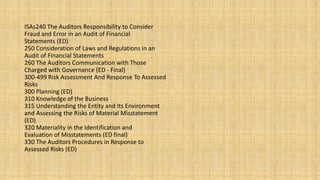
ISAs240 The Auditors Responsibility to Consider
Fraud and Error in an Audit of Financial
Statements (ED)
250 Consideration of Laws and Regulations in an
Audit of Financial Statements
260 The Auditors Communication with Those
Charged with Governance (ED - Final)
300-499 Risk Assessment And Response To Assessed
Risks
300 Planning (ED)
310 Knowledge of the Business
315 Understanding the Entity and Its Environment
and Assessing the Risks of Material Misstatement
(ED)
320 Materiality in the Identification and
Evaluation of Misstatements (ED final)
330 The Auditors Procedures in Response to
Assessed Risks (ED)
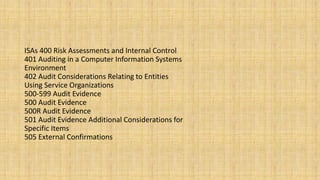
ISAs 400 Risk Assessments and Internal Control
401 Auditing in a Computer Information Systems
Environment
402 Audit Considerations Relating to Entities
Using Service Organizations
500-599 Audit Evidence
500 Audit Evidence
500R Audit Evidence
501 Audit Evidence Additional Considerations for
Specific Items
505 External Confirmations
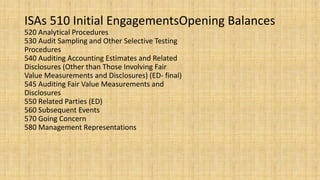
ISAs 510 Initial EngagementsOpening Balances
520 Analytical Procedures
530 Audit Sampling and Other Selective Testing
Procedures
540 Auditing Accounting Estimates and Related
Disclosures (Other than Those Involving Fair
Value Measurements and Disclosures) (ED- final)
545 Auditing Fair Value Measurements and
Disclosures
550 Related Parties (ED)
560 Subsequent Events
570 Going Concern
580 Management Representations
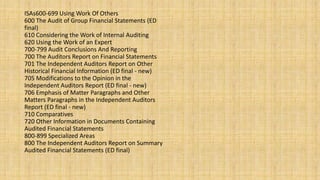
ISAs600-699 Using Work Of Others
600 The Audit of Group Financial Statements (ED
final)
610 Considering the Work of Internal Auditing
620 Using the Work of an Expert
700-799 Audit Conclusions And Reporting
700 The Auditors Report on Financial Statements
701 The Independent Auditors Report on Other
Historical Financial Information (ED final - new)
705 Modifications to the Opinion in the
Independent Auditors Report (ED final - new)
706 Emphasis of Matter Paragraphs and Other
Matters Paragraphs in the Independent Auditors
Report (ED final - new)
710 Comparatives
720 Other Information in Documents Containing
Audited Financial Statements
800-899 Specialized Areas
800 The Independent Auditors Report on Summary
Audited Financial Statements (ED final)
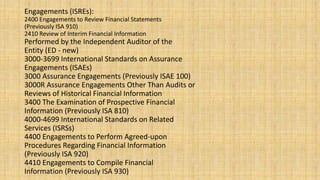
Engagements (ISREs):
2400 Engagements to Review Financial Statements
(Previously ISA 910)
2410 Review of Interim Financial Information
Performed by the Independent Auditor of the
Entity (ED - new)
3000-3699 International Standards on Assurance
Engagements (ISAEs)
3000 Assurance Engagements (Previously ISAE 100)
3000R Assurance Engagements Other Than Audits or
Reviews of Historical Financial Information
3400 The Examination of Prospective Financial
Information (Previously ISA 810)
4000-4699 International Standards on Related
Services (ISRSs)
4400 Engagements to Perform Agreed-upon
Procedures Regarding Financial Information
(Previously ISA 920)
4410 Engagements to Compile Financial
Information (Previously ISA 930)
ISA 200 states the objective of an audit of
financial statements is to enable the auditor to
express an opinion whether the financial
statements are prepared, in all material
respects, in accordance with an identified
financial reporting framework.
Terms used 'give a true and fair view' or
present fairly, in all material respects
equivalent terms?
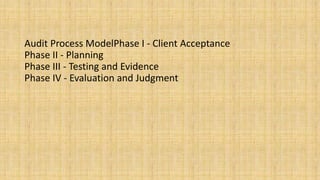
Audit Process ModelPhase I - Client Acceptance
Phase II - Planning
Phase III - Testing and Evidence
Phase IV - Evaluation and Judgment
Phase I Client Acceptance Objective :
The client acceptance phase of the
audit plan, Phase I, involves deciding whether
to accept a new client or continue with an
existing one.
Procedures (1) Evaluate the client's background
and reasons for the audit. (2) Determine whether
the auditor is able to meet the ethical
requirements regarding the client. (3) Determine
need for other professionals. (4) Communicate
with predecessor auditor (5) Prepare client
proposal. (6) Select staff to perform the audit,
and (7) Obtain an engagement letter.
Phase II Planning the audit Objective:
Determine the amount and type of
evidence and review required to give the auditor
assurance that there is no material misstatement
of the financial statements.
Procedures (1) Perform audit procedures to
understand the entity and its environment,
including the entitys internal control (2)
Assess the risks of material misstatements of the
financial statements. (3) Determine materiality
and (4) Prepare the planning memorandum and audit
program, containing the auditors response to the
identified risks.
Phase III Testing and EvidenceObjective
Test for evidence supporting
internal controls and the fairness of the
financial statements.
Procedures (1) Tests of controls (2)
Substantive tests of transactions (3) Analytical
procedures (4) Tests of details of balances. (5)
Search for unrecorded liabilities.
Phase IV, Evaluation and Reporting Objective :
Complete the audit procedures and
issue an opinion.
Procedures (1) Evaluate governance evidence (2)
Perform procedures to identify subsequent events
(3) Review financial statements and other report
material (4) Perform wrap-up procedures (5)
Prepare Matters of Attention for Partners (6)
Report to the board of directors and (7) Prepare
Audit report.
International Public Accouting FirmsThe Big Four
Audit Staff
Staff Accountants (or Junior Assistants then
Senior)
Senior Accountants (or Supervisor)
Managers
Partners/Directors
THANK YOU

INTERNATIONAL AUDITING STANDARDS -PPT.pptx

  • 1.
  • 2.
    Historical backgroundRecords ofauditing activity in early Babylonian times (around 3,000 BC). Ancient China, Greece and Rome. The Latin meaning of the word 'auditor' was a 'hearer or listener' because in Rome auditors heard taxpayers. Modern auditing dates to beginning of the modern corporation
  • 3.
    Brief history ofauditing.The attitude of profit maximization from end middle ages - merchant houses in Italy. Double-entry bookkeeping was first described in Italy (Pacioli 1494). Industrial Revolution Great-Britain 1780 lead to the emergence of large industrial companies. 1853 the Society of Accountants in Edinburgh was founded.
  • 4.
    The function ofauditing is to lend credibility to the financial statements Is the company a going concern? Is it free of fraud? Is it managed properly? Is there integrity in its database? Do directors have proper and adequate information to make decisions? Are there adequate controls? What effect do the company's products and by-products have on the environment? Can an unfortunate mistake bring this company to its knees?
  • 5.
    International Financial ReportingStandardsInternational Financial Reporting Standards (IFRS) are the standards that are applied for financial accounting. IFRS were formerly called International Accounting Standards (IAS) The International Accounting Standards Board (IASB) has accounting standard setting responsibilities for IFRS. The EU has agreed to apply most of the IFRS from 2005 onwards.
  • 6.
    Advantages of InternationalAuditing Standards: worldwide increases confidence in non-domestic investment consistent international investors comprehend financial statements from different countries high quality Non-national standards encourage better quality, less political influence
  • 7.
    International Auditing andAssurance Standards Board (IAASB) IssuesInternational Standards on Auditing (ISAs) as the standards to be applied by auditors in reporting on historical financial information. International Standards on Assurance Engagements (ISAEs) as the standards to be applied by practitioners in assurance engagements dealing with information other than historical financial information International Standards on Quality Control (ISQCs) as the standards to be applied for all services falling under the Standards of the IAASB, and International Standards on Related Services (ISRSs) as the standards to be applied on related
  • 8.
    ISAs100-999 International Standardson Auditing (ISAs) 100-199 Introductory Matters 120 Framework of International Standards on Auditing 200-299 General Principles And Responsibilities 200 Objective and General Principles Governing an Audit of Financial Statements 210 Terms of Audit Engagements 220 Quality Control for Audit Work 230 Documentation (ED)
  • 9.
    ISAs240 The AuditorsResponsibility to Consider Fraud and Error in an Audit of Financial Statements (ED) 250 Consideration of Laws and Regulations in an Audit of Financial Statements 260 The Auditors Communication with Those Charged with Governance (ED - Final) 300-499 Risk Assessment And Response To Assessed Risks 300 Planning (ED) 310 Knowledge of the Business 315 Understanding the Entity and Its Environment and Assessing the Risks of Material Misstatement (ED) 320 Materiality in the Identification and Evaluation of Misstatements (ED final) 330 The Auditors Procedures in Response to Assessed Risks (ED)
  • 10.
    ISAs 400 RiskAssessments and Internal Control 401 Auditing in a Computer Information Systems Environment 402 Audit Considerations Relating to Entities Using Service Organizations 500-599 Audit Evidence 500 Audit Evidence 500R Audit Evidence 501 Audit Evidence Additional Considerations for Specific Items 505 External Confirmations
  • 11.
    ISAs 510 InitialEngagementsOpening Balances 520 Analytical Procedures 530 Audit Sampling and Other Selective Testing Procedures 540 Auditing Accounting Estimates and Related Disclosures (Other than Those Involving Fair Value Measurements and Disclosures) (ED- final) 545 Auditing Fair Value Measurements and Disclosures 550 Related Parties (ED) 560 Subsequent Events 570 Going Concern 580 Management Representations
  • 12.
    ISAs600-699 Using WorkOf Others 600 The Audit of Group Financial Statements (ED final) 610 Considering the Work of Internal Auditing 620 Using the Work of an Expert 700-799 Audit Conclusions And Reporting 700 The Auditors Report on Financial Statements 701 The Independent Auditors Report on Other Historical Financial Information (ED final - new) 705 Modifications to the Opinion in the Independent Auditors Report (ED final - new) 706 Emphasis of Matter Paragraphs and Other Matters Paragraphs in the Independent Auditors Report (ED final - new) 710 Comparatives 720 Other Information in Documents Containing Audited Financial Statements 800-899 Specialized Areas 800 The Independent Auditors Report on Summary Audited Financial Statements (ED final)
  • 13.
    Engagements (ISREs): 2400 Engagementsto Review Financial Statements (Previously ISA 910) 2410 Review of Interim Financial Information Performed by the Independent Auditor of the Entity (ED - new) 3000-3699 International Standards on Assurance Engagements (ISAEs) 3000 Assurance Engagements (Previously ISAE 100) 3000R Assurance Engagements Other Than Audits or Reviews of Historical Financial Information 3400 The Examination of Prospective Financial Information (Previously ISA 810) 4000-4699 International Standards on Related Services (ISRSs) 4400 Engagements to Perform Agreed-upon Procedures Regarding Financial Information (Previously ISA 920) 4410 Engagements to Compile Financial Information (Previously ISA 930)
  • 14.
    ISA 200 statesthe objective of an audit of financial statements is to enable the auditor to express an opinion whether the financial statements are prepared, in all material respects, in accordance with an identified financial reporting framework. Terms used 'give a true and fair view' or present fairly, in all material respects equivalent terms?
  • 15.
    Audit Process ModelPhaseI - Client Acceptance Phase II - Planning Phase III - Testing and Evidence Phase IV - Evaluation and Judgment
  • 16.
    Phase I ClientAcceptance Objective : The client acceptance phase of the audit plan, Phase I, involves deciding whether to accept a new client or continue with an existing one. Procedures (1) Evaluate the client's background and reasons for the audit. (2) Determine whether the auditor is able to meet the ethical requirements regarding the client. (3) Determine need for other professionals. (4) Communicate with predecessor auditor (5) Prepare client proposal. (6) Select staff to perform the audit, and (7) Obtain an engagement letter.
  • 17.
    Phase II Planningthe audit Objective: Determine the amount and type of evidence and review required to give the auditor assurance that there is no material misstatement of the financial statements. Procedures (1) Perform audit procedures to understand the entity and its environment, including the entitys internal control (2) Assess the risks of material misstatements of the financial statements. (3) Determine materiality and (4) Prepare the planning memorandum and audit program, containing the auditors response to the identified risks.
  • 18.
    Phase III Testingand EvidenceObjective Test for evidence supporting internal controls and the fairness of the financial statements. Procedures (1) Tests of controls (2) Substantive tests of transactions (3) Analytical procedures (4) Tests of details of balances. (5) Search for unrecorded liabilities.
  • 19.
    Phase IV, Evaluationand Reporting Objective : Complete the audit procedures and issue an opinion. Procedures (1) Evaluate governance evidence (2) Perform procedures to identify subsequent events (3) Review financial statements and other report material (4) Perform wrap-up procedures (5) Prepare Matters of Attention for Partners (6) Report to the board of directors and (7) Prepare Audit report.
  • 20.
    International Public AccoutingFirmsThe Big Four Audit Staff Staff Accountants (or Junior Assistants then Senior) Senior Accountants (or Supervisor) Managers Partners/Directors
  • 21.