TOPIC 5: AUDIT EVIDENCE &
AUDITING PROCEDURE
References: Chapter 5
AUD390 2014
AUDITING AND
ASSURANCE
SERVICES IN
MALAYSIA
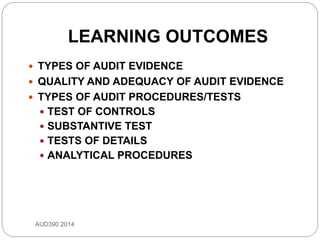
LEARNING OUTCOMES
AUD390 2014
 TYPES OF AUDIT EVIDENCE
 QUALITY AND ADEQUACY OF AUDIT EVIDENCE
 TYPES OF AUDIT PROCEDURES/TESTS
 TEST OF CONTROLS
 SUBSTANTIVE TEST
 TESTS OF DETAILS
 ANALYTICAL PROCEDURES
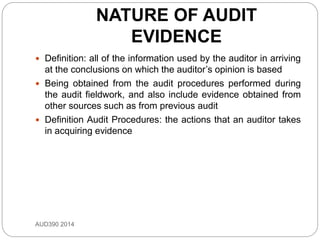
NATURE OF AUDIT
EVIDENCE
AUD390 2014
 Definition: all of the information used by the auditor in arriving
at the conclusions on which the auditor’s opinion is based
 Being obtained from the audit procedures performed during
the audit fieldwork, and also include evidence obtained from
other sources such as from previous audit
 Definition Audit Procedures: the actions that an auditor takes
in acquiring evidence
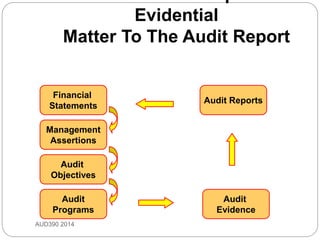
Evidential
Matter To The Audit Report
AUD390 2014
Financial
Statements
Management
Assertions
Audit
Objectives
Audit
Programs
Audit
Evidence
Audit Reports
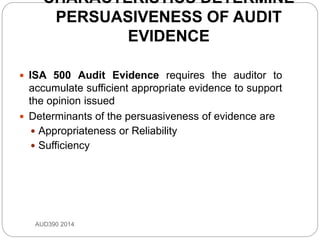
CHARACTERISTICS DETERMINE
PERSUASIVENESS OF AUDIT
EVIDENCE
AUD390 2014
 ISA 500 Audit Evidence requires the auditor to
accumulate sufficient appropriate evidence to support
the opinion issued
 Determinants of the persuasiveness of evidence are
 Appropriateness or Reliability
 Sufficiency
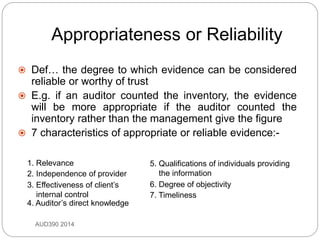
Appropriateness or Reliability
AUD390 2014
 Def… the degree to which evidence can be considered
reliable or worthy of trust
 E.g. if an auditor counted the inventory, the evidence
will be more appropriate if the auditor counted the
inventory rather than the management give the figure
 7 characteristics of appropriate or reliable evidence:-
1. Relevance
2. Independence of provider
7. Timeliness
3. Effectiveness of client’s
internal control
5. Qualifications of individuals providing
the information
6. Degree of objectivity
4. Auditor’s direct knowledge
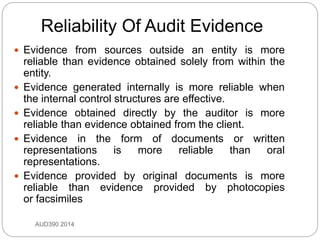
Reliability Of Audit Evidence
 Evidence from sources outside an entity is more
reliable than evidence obtained solely from within the
entity.
 Evidence generated internally is more reliable when
the internal control structures are effective.
 Evidence obtained directly by the auditor is more
reliable than evidence obtained from the client.
 Evidence in the form of documents or written
representations is more reliable than oral
representations.
 Evidence provided by original documents is more
reliable than evidence provided by photocopies
or facsimiles
AUD390 2014
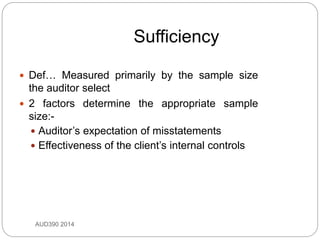
Sufficiency
AUD390 2014
 Def… Measured primarily by the sample size
the auditor select
 2 factors determine the appropriate sample
size:-
 Auditor’s expectation of misstatements
 Effectiveness of the client’s internal controls
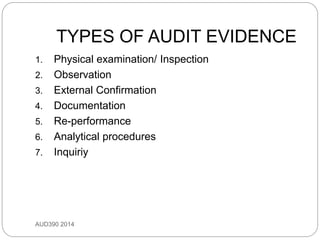
TYPES OF AUDIT EVIDENCE
AUD390 2014
1. Physical examination/ Inspection
2. Observation
3. External Confirmation
4. Documentation
5. Re-performance
6. Analytical procedures
7. Inquiriy
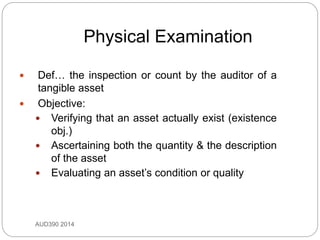
Physical Examination
AUD390 2014
 Def… the inspection or count by the auditor of a
tangible asset
 Objective:
 Verifying that an asset actually exist (existence
obj.)
 Ascertaining both the quantity & the description
of the asset
 Evaluating an asset’s condition or quality
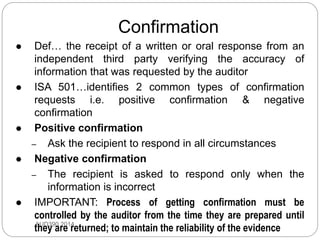
Confirmation
AUD390 2014
 Def… the receipt of a written or oral response from an
independent third party verifying the accuracy of
information that was requested by the auditor
 ISA 501…identifies 2 common types of confirmation
requests i.e. positive confirmation & negative
confirmation
 Positive confirmation
– Ask the recipient to respond in all circumstances
 Negative confirmation
– The recipient is asked to respond only when the
information is incorrect
 IMPORTANT: Process of getting confirmation must be
controlled by the auditor from the time they are prepared until
they are returned; to maintain the reliability of the evidence
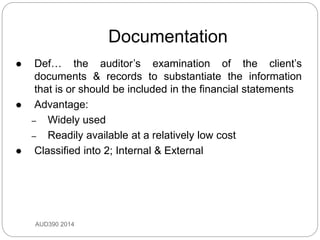
Documentation
AUD390 2014
 Def… the auditor’s examination of the client’s
documents & records to substantiate the information
that is or should be included in the financial statements
 Advantage:
– Widely used
– Readily available at a relatively low cost
 Classified into 2; Internal & External
Con..
AUD390 2014
 Internal Documents
– Docs. that has been prepared & used within the
client’s organisation & retained without ever going to
an outside party
– E.g. duplicate sales invoice, employees’ time reports
& inventory receiving report
 External Documents
– Docs. that has been in the hands of someone
outside the client’s organisation; who is party to the
transaction, but which is either currently in the hands
of the client or readily accessible
– In some cases, docs originate outside the client’s
organisation & ended up in the hand of client
Con…
AUD390 2014
– E.g. vendor’s invoices, cancelled note payable,
insurance policies, cancelled cheque (returned by
supplier/vendor)
 Vouching … the process in which the auditor use
documentation to support recorded transactions or
amounts
– E.g. to vouch recorded acquisition transactions, the
auditor trace transaction from acquisition journal to
support vendor’s invoices & receiving reports
Analytical Procedures
AUD390 2014
 ISA 520 – Analytical procedures use comparisons &
relationships to assess whether account balances or other
data appear reasonable
 It is being used for different purposes on an audit
– Understand the client’s industry & business
– Assess the entity’s ability to continue as a going
concern
– Indicate the presence of possible misstatements in the
financial statements
– Reduce detailed audit tests
Inquiries of the Client
AUD390 2014
 Def… the obtaining of written or oral information from the
client in response to questions from the auditor
 Disadvantage:
– It is not from an independent source & may be biased
in the client’s favor
 When the auditor choose to obtain evidence through
inquiries, it is normally necessary to obtain further
corroborating evidence through other method
Re-performance
AUD390 2014
 Def… Involves rechecking a sample of the
computations and transfers of information made by the
client during the period under audit
 Also known as testing the client’s arithmetical accuracy
Observation
AUD390 2014
 Def… the use of the sense to assess certain activities
 Opportunities to exercise sight, hearing, touch & smell to
evaluate a wide range of items
Tutorial Questions
AUD390 2014
1. List 3 sources of audit evidence with an example of each
of the source.
2. List the 4 determinants for the persuasiveness of the
audit evidence and give a brief explanation for each.
3. Classify the following evidences as either internal or
external documents
i. Purchase requisition
ii. Original copy of Delivery Note
iii. Cheque butt
iv. Payment vouchers
4. What is a standardized audit program?
5. Explain 3 advantages and disadvantages of
standardized audit program?

Topic 5 audit evidence and auditing procedure (2)

  • 1.
    TOPIC 5: AUDITEVIDENCE & AUDITING PROCEDURE References: Chapter 5 AUD390 2014 AUDITING AND ASSURANCE SERVICES IN MALAYSIA
  • 2.
    LEARNING OUTCOMES AUD390 2014 TYPES OF AUDIT EVIDENCE  QUALITY AND ADEQUACY OF AUDIT EVIDENCE  TYPES OF AUDIT PROCEDURES/TESTS  TEST OF CONTROLS  SUBSTANTIVE TEST  TESTS OF DETAILS  ANALYTICAL PROCEDURES
  • 3.
    NATURE OF AUDIT EVIDENCE AUD3902014  Definition: all of the information used by the auditor in arriving at the conclusions on which the auditor’s opinion is based  Being obtained from the audit procedures performed during the audit fieldwork, and also include evidence obtained from other sources such as from previous audit  Definition Audit Procedures: the actions that an auditor takes in acquiring evidence
  • 4.
    Evidential Matter To TheAudit Report AUD390 2014 Financial Statements Management Assertions Audit Objectives Audit Programs Audit Evidence Audit Reports
  • 5.
    CHARACTERISTICS DETERMINE PERSUASIVENESS OFAUDIT EVIDENCE AUD390 2014  ISA 500 Audit Evidence requires the auditor to accumulate sufficient appropriate evidence to support the opinion issued  Determinants of the persuasiveness of evidence are  Appropriateness or Reliability  Sufficiency
  • 6.
    Appropriateness or Reliability AUD3902014  Def… the degree to which evidence can be considered reliable or worthy of trust  E.g. if an auditor counted the inventory, the evidence will be more appropriate if the auditor counted the inventory rather than the management give the figure  7 characteristics of appropriate or reliable evidence:- 1. Relevance 2. Independence of provider 7. Timeliness 3. Effectiveness of client’s internal control 5. Qualifications of individuals providing the information 6. Degree of objectivity 4. Auditor’s direct knowledge
  • 7.
    Reliability Of AuditEvidence  Evidence from sources outside an entity is more reliable than evidence obtained solely from within the entity.  Evidence generated internally is more reliable when the internal control structures are effective.  Evidence obtained directly by the auditor is more reliable than evidence obtained from the client.  Evidence in the form of documents or written representations is more reliable than oral representations.  Evidence provided by original documents is more reliable than evidence provided by photocopies or facsimiles AUD390 2014
  • 8.
    Sufficiency AUD390 2014  Def…Measured primarily by the sample size the auditor select  2 factors determine the appropriate sample size:-  Auditor’s expectation of misstatements  Effectiveness of the client’s internal controls
  • 9.
    TYPES OF AUDITEVIDENCE AUD390 2014 1. Physical examination/ Inspection 2. Observation 3. External Confirmation 4. Documentation 5. Re-performance 6. Analytical procedures 7. Inquiriy
  • 10.
    Physical Examination AUD390 2014 Def… the inspection or count by the auditor of a tangible asset  Objective:  Verifying that an asset actually exist (existence obj.)  Ascertaining both the quantity & the description of the asset  Evaluating an asset’s condition or quality
  • 11.
    Confirmation AUD390 2014  Def…the receipt of a written or oral response from an independent third party verifying the accuracy of information that was requested by the auditor  ISA 501…identifies 2 common types of confirmation requests i.e. positive confirmation & negative confirmation  Positive confirmation – Ask the recipient to respond in all circumstances  Negative confirmation – The recipient is asked to respond only when the information is incorrect  IMPORTANT: Process of getting confirmation must be controlled by the auditor from the time they are prepared until they are returned; to maintain the reliability of the evidence
  • 12.
    Documentation AUD390 2014  Def…the auditor’s examination of the client’s documents & records to substantiate the information that is or should be included in the financial statements  Advantage: – Widely used – Readily available at a relatively low cost  Classified into 2; Internal & External
  • 13.
    Con.. AUD390 2014  InternalDocuments – Docs. that has been prepared & used within the client’s organisation & retained without ever going to an outside party – E.g. duplicate sales invoice, employees’ time reports & inventory receiving report  External Documents – Docs. that has been in the hands of someone outside the client’s organisation; who is party to the transaction, but which is either currently in the hands of the client or readily accessible – In some cases, docs originate outside the client’s organisation & ended up in the hand of client
  • 14.
    Con… AUD390 2014 – E.g.vendor’s invoices, cancelled note payable, insurance policies, cancelled cheque (returned by supplier/vendor)  Vouching … the process in which the auditor use documentation to support recorded transactions or amounts – E.g. to vouch recorded acquisition transactions, the auditor trace transaction from acquisition journal to support vendor’s invoices & receiving reports
  • 15.
    Analytical Procedures AUD390 2014 ISA 520 – Analytical procedures use comparisons & relationships to assess whether account balances or other data appear reasonable  It is being used for different purposes on an audit – Understand the client’s industry & business – Assess the entity’s ability to continue as a going concern – Indicate the presence of possible misstatements in the financial statements – Reduce detailed audit tests
  • 16.
    Inquiries of theClient AUD390 2014  Def… the obtaining of written or oral information from the client in response to questions from the auditor  Disadvantage: – It is not from an independent source & may be biased in the client’s favor  When the auditor choose to obtain evidence through inquiries, it is normally necessary to obtain further corroborating evidence through other method
  • 17.
    Re-performance AUD390 2014  Def…Involves rechecking a sample of the computations and transfers of information made by the client during the period under audit  Also known as testing the client’s arithmetical accuracy
  • 18.
    Observation AUD390 2014  Def…the use of the sense to assess certain activities  Opportunities to exercise sight, hearing, touch & smell to evaluate a wide range of items
  • 19.
    Tutorial Questions AUD390 2014 1.List 3 sources of audit evidence with an example of each of the source. 2. List the 4 determinants for the persuasiveness of the audit evidence and give a brief explanation for each. 3. Classify the following evidences as either internal or external documents i. Purchase requisition ii. Original copy of Delivery Note iii. Cheque butt iv. Payment vouchers 4. What is a standardized audit program? 5. Explain 3 advantages and disadvantages of standardized audit program?