FACULTY OF MANAGEMENT SCIENCE
BACHELORS’ – PROGRAMME
Subject: Auditing Chapter 2
Audit Programme:
This is a step by step plan of the auditing work to be
performed, specifying the procedure to be followed
in verification of each item in the financial
statements, and giving the estimated time
required’. Henceforth an audit programme is a
statement giving instructions and guidance to the
audit staff as to the audit procedure. It arranges
and distributes the work among the audit staff.
It should be noted that before commencing the
audit he should plan his work so that is over
without delay. For this purpose the auditor chalks
out a detailed programme explaining the procedure
to be followed for audit.
ADVANTAGES OF AN AUDIT PROGRAMME:
 It provides the audit staff clear instructions about their
duties.
 It promotes division of work in a well-organized
manner.
 It helps the auditor to monitor the progress of the
work.
 It will be easier to fix responsibilities for omissions and
commissions.
 It serves as a valuable evidence for the work done.
 It serves as a guide for future audit.
 It ensures that audit process in a systematic manner.
 It eliminates inefficiency and saves time.
 Incase if any audit assistant goes on leave, his work can
be easily continued by others.
 It avoids duplication of work.
Disadvantages of Audit Programme
The audit work becomes mechanical.
It kills the creativity of the audit staff.
Chances of work not done properly/ high as
the scope is to be completed within a
scheduled time.
A rigid programme may not be suitable for all
kinds of business.
The above disadvantages can be minimized if
the audit programme is made more flexible and
audit staff encourages to go beyond the work
mentioned in the audit programme. The
auditors should also periodically review the
programme in the light of experiences gained in
the previous year. He should impress upon the
audit staff. The audit programme is only
guidance and they should use their initiatives,
intelligence and common sense at all times
during the course of the audit.
Audit Note Book:
An audit note book is one of the most important
document maintained by the auditor. It is
defined as a record used mainly in recording
audit, containing data on work done and
comments made. Audit Note book contains
information regarding the day to day work
performed by the audit staff, notes about errors,
explanations required etc. the auditor can use it
as an authentic evidence in the court if there is
any case against him.
Contents of Audit Note Book:
Nature of business and important documents
such as MOU, Partnership deed etc.
List of books of accounts.
List of officials, their duties and responsibilities.
Copy of the audit programme.
Information on missing receipts, vouchers etc.
Details of errors discovered.
Explanations sought from the officials.
Points to be included in the audit report.
An audit note book should be preserved by the
auditor as it contains valuable information in
respect of the work done by its staff.
Audit Working Papers:
Audit working papers are those papers which
contain essential facts about accounts, which are
being audited. Its defined as the file of analysis,
summaries, comments and correspondence built up
by the auditor during the course of audit.
The auditor maintains papers as supporting
evidence to the audit work. The institute of
chartered accountants of India states that “an
auditor is expected to maintain evidence of work
done by him and his staff”.
Usually, audit working papers contains a copy of the
trial balances, schedule of debtors and creditors,
reconciliation statements important
correspondence etc.
Purpose of maintaining working paper:
 They show the extent to which accounting principles
and auditing standards have adhered to.
 They provide the required support for the auditors
report.
 They also reveal the efficiency with which the audit
work was done.
 They can be used as evidence in the court to defend
himself against negligence in his duty.
 They help the auditor in finalizing his report quickly.
 They help the auditor to understand the efficiency of
the accounting system, internal check system etc.
Working papers should be clear complete, and
contain the necessary information so that they
may be of maximum utility. They should be
properly organized, documented and signed. In
this regard it is said that “an auditor is often
judged by the quality of the working paper
prepared by him under his guidance”.
Working papers are confidential documents
hence he should not disclose the facts to others.
Doing so results in professional misconduct.
Working papers should be preserved properly
because they are important documents.
OWNERSHIP OF WORKING PAPERS:
The auditor who collects information through
working papers for his audit work. Usually claims
that he is the owner of the working papers. On the
other hand the company claims that the auditor
was appointed by and he only acts as its agent.
Hence, all the documents that the auditor had
collected should belong to the company several
cases have been referred to the courts regarding
the ownership in one of the cases it was decided
that the working papers belong to the auditor
because he was an independent professional and
not an agent of the client. In another case also, it
was held that the working papers belong to the
auditor.
Auditors Lien:
The auditors if has into been paid his
audit fees has the right to keep the
books of accounts and other related
documents in his possession till his
dues are paid. Such a right is known as
Auditors Lien.
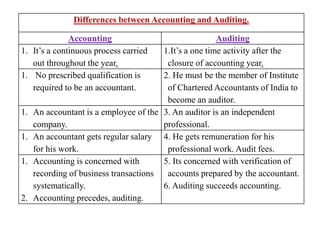
Differences between Accounting and Auditing.
Accounting Auditing
1. It’s a continuous process carried
out throughout the year.
1.It’s a one time activity after the
closure of accounting year.
1. No prescribed qualification is
required to be an accountant.
2. He must be the member of Institute
of Chartered Accountants of India to
become an auditor.
1. An accountant is a employee of the
company.
3. An auditor is an independent
professional.
1. An accountant gets regular salary
for his work.
4. He gets remuneration for his
professional work. Audit fees.
1. Accounting is concerned with
recording of business transactions
systematically.
2. Accounting precedes, auditing.
5. Its concerned with verification of
accounts prepared by the accountant.
6. Auditing succeeds accounting.
Usually an auditor confines his work
only to the verification of accounts. In
small organizations he may also be
asked to finalize accounts. In this case
he acts both as an accountant and as
an auditor but the audit work
commences only when the accounting
work is over. Hence, its said that “Audit
begins where accounting ends”.

Chapter 2 -audit programme

  • 1.
    FACULTY OF MANAGEMENTSCIENCE BACHELORS’ – PROGRAMME Subject: Auditing Chapter 2
  • 2.
    Audit Programme: This isa step by step plan of the auditing work to be performed, specifying the procedure to be followed in verification of each item in the financial statements, and giving the estimated time required’. Henceforth an audit programme is a statement giving instructions and guidance to the audit staff as to the audit procedure. It arranges and distributes the work among the audit staff. It should be noted that before commencing the audit he should plan his work so that is over without delay. For this purpose the auditor chalks out a detailed programme explaining the procedure to be followed for audit.
  • 3.
    ADVANTAGES OF ANAUDIT PROGRAMME:  It provides the audit staff clear instructions about their duties.  It promotes division of work in a well-organized manner.  It helps the auditor to monitor the progress of the work.  It will be easier to fix responsibilities for omissions and commissions.  It serves as a valuable evidence for the work done.  It serves as a guide for future audit.  It ensures that audit process in a systematic manner.  It eliminates inefficiency and saves time.  Incase if any audit assistant goes on leave, his work can be easily continued by others.  It avoids duplication of work.
  • 4.
    Disadvantages of AuditProgramme The audit work becomes mechanical. It kills the creativity of the audit staff. Chances of work not done properly/ high as the scope is to be completed within a scheduled time. A rigid programme may not be suitable for all kinds of business.
  • 5.
    The above disadvantagescan be minimized if the audit programme is made more flexible and audit staff encourages to go beyond the work mentioned in the audit programme. The auditors should also periodically review the programme in the light of experiences gained in the previous year. He should impress upon the audit staff. The audit programme is only guidance and they should use their initiatives, intelligence and common sense at all times during the course of the audit.
  • 6.
    Audit Note Book: Anaudit note book is one of the most important document maintained by the auditor. It is defined as a record used mainly in recording audit, containing data on work done and comments made. Audit Note book contains information regarding the day to day work performed by the audit staff, notes about errors, explanations required etc. the auditor can use it as an authentic evidence in the court if there is any case against him.
  • 7.
    Contents of AuditNote Book: Nature of business and important documents such as MOU, Partnership deed etc. List of books of accounts. List of officials, their duties and responsibilities. Copy of the audit programme. Information on missing receipts, vouchers etc. Details of errors discovered. Explanations sought from the officials. Points to be included in the audit report. An audit note book should be preserved by the auditor as it contains valuable information in respect of the work done by its staff.
  • 8.
    Audit Working Papers: Auditworking papers are those papers which contain essential facts about accounts, which are being audited. Its defined as the file of analysis, summaries, comments and correspondence built up by the auditor during the course of audit. The auditor maintains papers as supporting evidence to the audit work. The institute of chartered accountants of India states that “an auditor is expected to maintain evidence of work done by him and his staff”. Usually, audit working papers contains a copy of the trial balances, schedule of debtors and creditors, reconciliation statements important correspondence etc.
  • 9.
    Purpose of maintainingworking paper:  They show the extent to which accounting principles and auditing standards have adhered to.  They provide the required support for the auditors report.  They also reveal the efficiency with which the audit work was done.  They can be used as evidence in the court to defend himself against negligence in his duty.  They help the auditor in finalizing his report quickly.  They help the auditor to understand the efficiency of the accounting system, internal check system etc.
  • 10.
    Working papers shouldbe clear complete, and contain the necessary information so that they may be of maximum utility. They should be properly organized, documented and signed. In this regard it is said that “an auditor is often judged by the quality of the working paper prepared by him under his guidance”. Working papers are confidential documents hence he should not disclose the facts to others. Doing so results in professional misconduct. Working papers should be preserved properly because they are important documents.
  • 11.
    OWNERSHIP OF WORKINGPAPERS: The auditor who collects information through working papers for his audit work. Usually claims that he is the owner of the working papers. On the other hand the company claims that the auditor was appointed by and he only acts as its agent. Hence, all the documents that the auditor had collected should belong to the company several cases have been referred to the courts regarding the ownership in one of the cases it was decided that the working papers belong to the auditor because he was an independent professional and not an agent of the client. In another case also, it was held that the working papers belong to the auditor.
  • 12.
    Auditors Lien: The auditorsif has into been paid his audit fees has the right to keep the books of accounts and other related documents in his possession till his dues are paid. Such a right is known as Auditors Lien.
  • 13.
    Differences between Accountingand Auditing. Accounting Auditing 1. It’s a continuous process carried out throughout the year. 1.It’s a one time activity after the closure of accounting year. 1. No prescribed qualification is required to be an accountant. 2. He must be the member of Institute of Chartered Accountants of India to become an auditor. 1. An accountant is a employee of the company. 3. An auditor is an independent professional. 1. An accountant gets regular salary for his work. 4. He gets remuneration for his professional work. Audit fees. 1. Accounting is concerned with recording of business transactions systematically. 2. Accounting precedes, auditing. 5. Its concerned with verification of accounts prepared by the accountant. 6. Auditing succeeds accounting.
  • 14.
    Usually an auditorconfines his work only to the verification of accounts. In small organizations he may also be asked to finalize accounts. In this case he acts both as an accountant and as an auditor but the audit work commences only when the accounting work is over. Hence, its said that “Audit begins where accounting ends”.