BY
Atta-ur-Rahman Arif
MEANING
Action to be taken by an auditor, in
respect of any particular field of
verification and reporting, should
be so design that it may enable him
to conduct an audit more
effectively.
MEANING
According to AS # 04
“ Planning means developing a
general strategy and a detailed
approach for the expected nature,
timing and extent of the audit. The
auditor plans to perform the audit in an
efficient and timely manner.”
OVERALL AUDIT PLAN
According to AS # 04
“The auditor should develop and
document an overall audit plan,
describing the expected scope and
conduct of the audit”
6-5
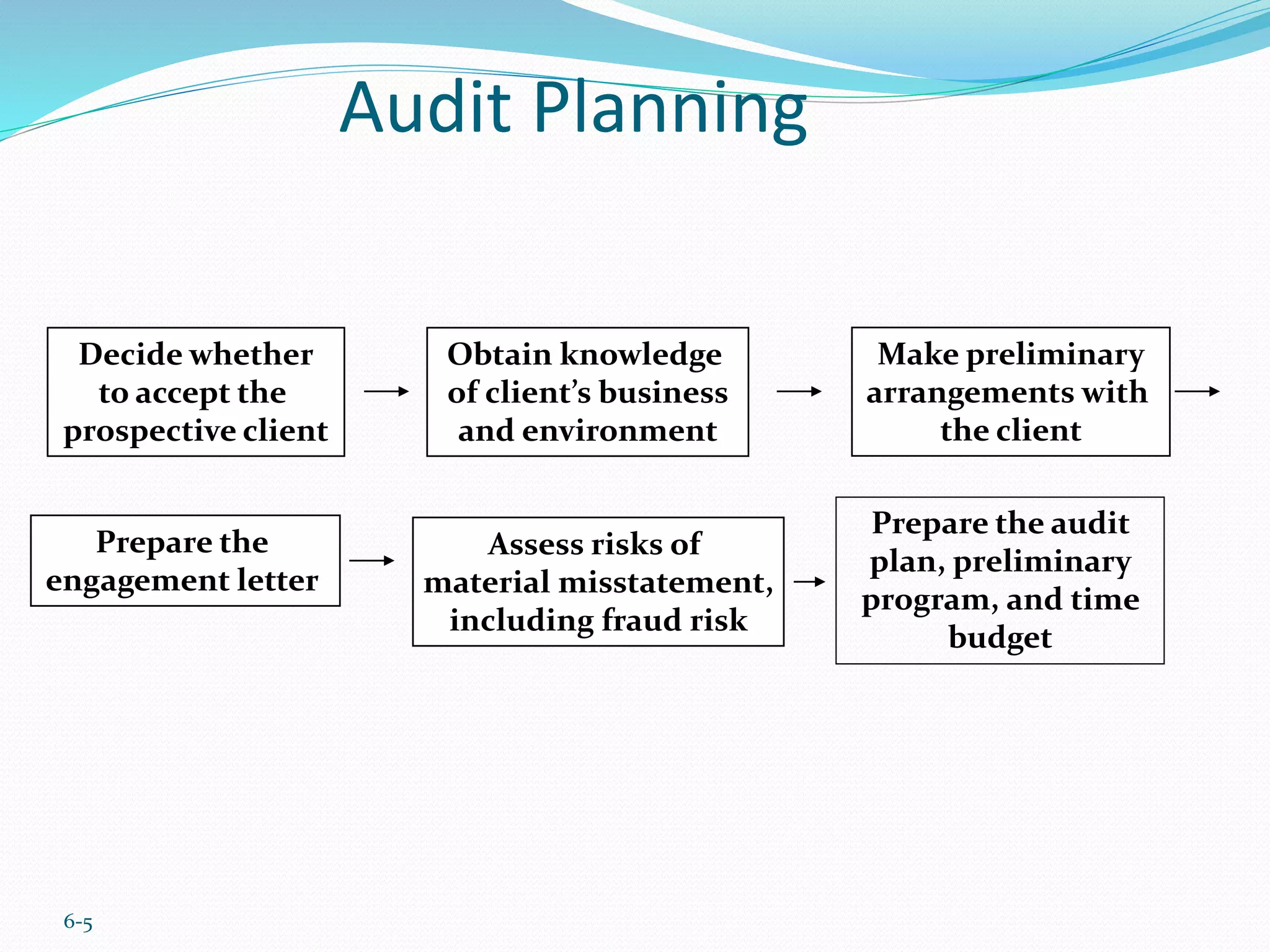
Audit Planning
Decide whether
to accept the
prospective client
Obtain knowledge
of client’s business
and environment
Make preliminary
arrangements with
the client
Prepare the
engagement letter
Assess risks of
material misstatement,
including fraud risk
Prepare the audit
plan, preliminary
program, and time
budget
FACTORS TO BE CONSIDERED
Nature of business
Size and complexity of business
Environment in which an enterprise
operates
Methods of processing transactions
Reporting requirements
Previous experience with the client
Knowledge of clients business
Industry in which the enterprise is
involved
Specific methodology and technology
used
FACTORS TO BE CONSIDERED
6-8
Sources of Information
 Inquiries of management
 Industry Accounting and Auditing Guides
 Industry Risk Alerts
 Government publications
 Prior company annual reports and SEC filings
 Prior tax returns
 Electronic sources
 Tour of plant and offices
 Analytical procedures
6-9
Assessing Fraud Risks
 Two types
 Fraudulent financial reporting (management fraud)
 Misappropriation of assets (defalcations)
 Procedures to assess fraud risks
 Discussion among engagement team
 Inquiries of management and other personnel
 Planning analytical procedures
 Considering fraud risk factors
 Incentives
 Opportunity
 Attitude
PLANNING PROCEDURE
Audit planning is a continuous process and can be
classified into following stages:
1. Sound knowledge regarding business of client
2. Developing an overall audit plan
3. Implementation the audit plan through audit
programme
4. Updating the audit plan according to the
changes
5. Post audit planning review in form of
suggestions
KEY MATTERS
 KNOWLEDGE OF THE BUSINESS
 General economic factors and industry
affecting the entity’s business.
 Important characteristics of entity like
business, financial performance and
reporting requirements including changes
since the last audit.
 General level of competence of
management
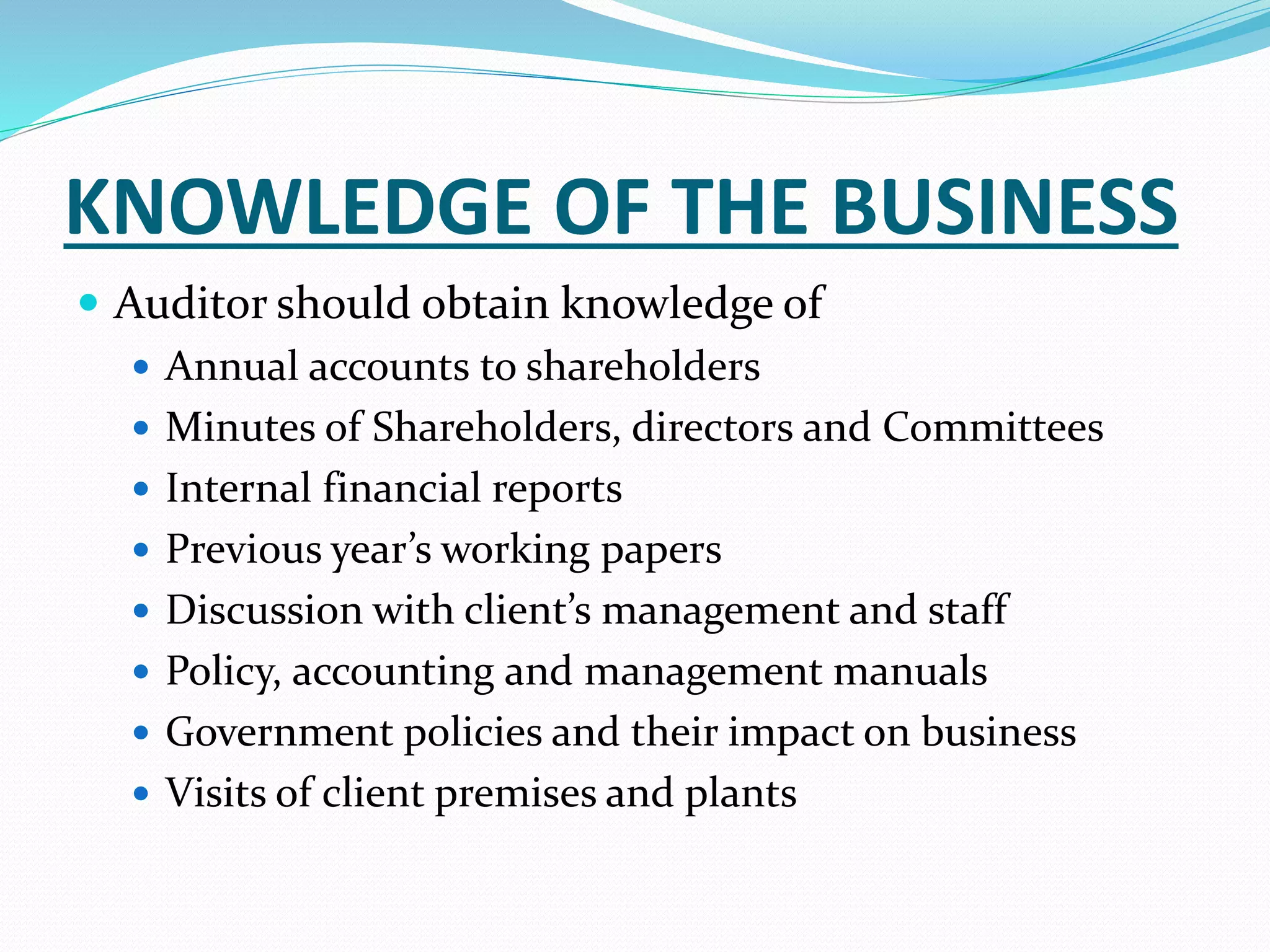
KNOWLEDGE OF THE BUSINESS
 Auditor should obtain knowledge of
 Annual accounts to shareholders
 Minutes of Shareholders, directors and Committees
 Internal financial reports
 Previous year’s working papers
 Discussion with client’s management and staff
 Policy, accounting and management manuals
 Government policies and their impact on business
 Visits of client premises and plants
Overall Audit Strategy
ACCOUNTING AND INETRNAL CONTROL SYSTEM
 Understanding the accounting policies
and changes in those policies.
 The effect of new auditing or accounting
pronouncements.
 Sound knowledge of internal control
system especially on test of control and
substantive procedures.
Overall Audit Strategy
RISK AND MATERIALITY
 Expected assessment of inherent and
control risks.
 Identification of significant audit areas.
 Setting of materiality level for audit
purposes.
 Possibility of material misstatement,
including the experience of past periods
or fraud.
Overall Audit Strategy
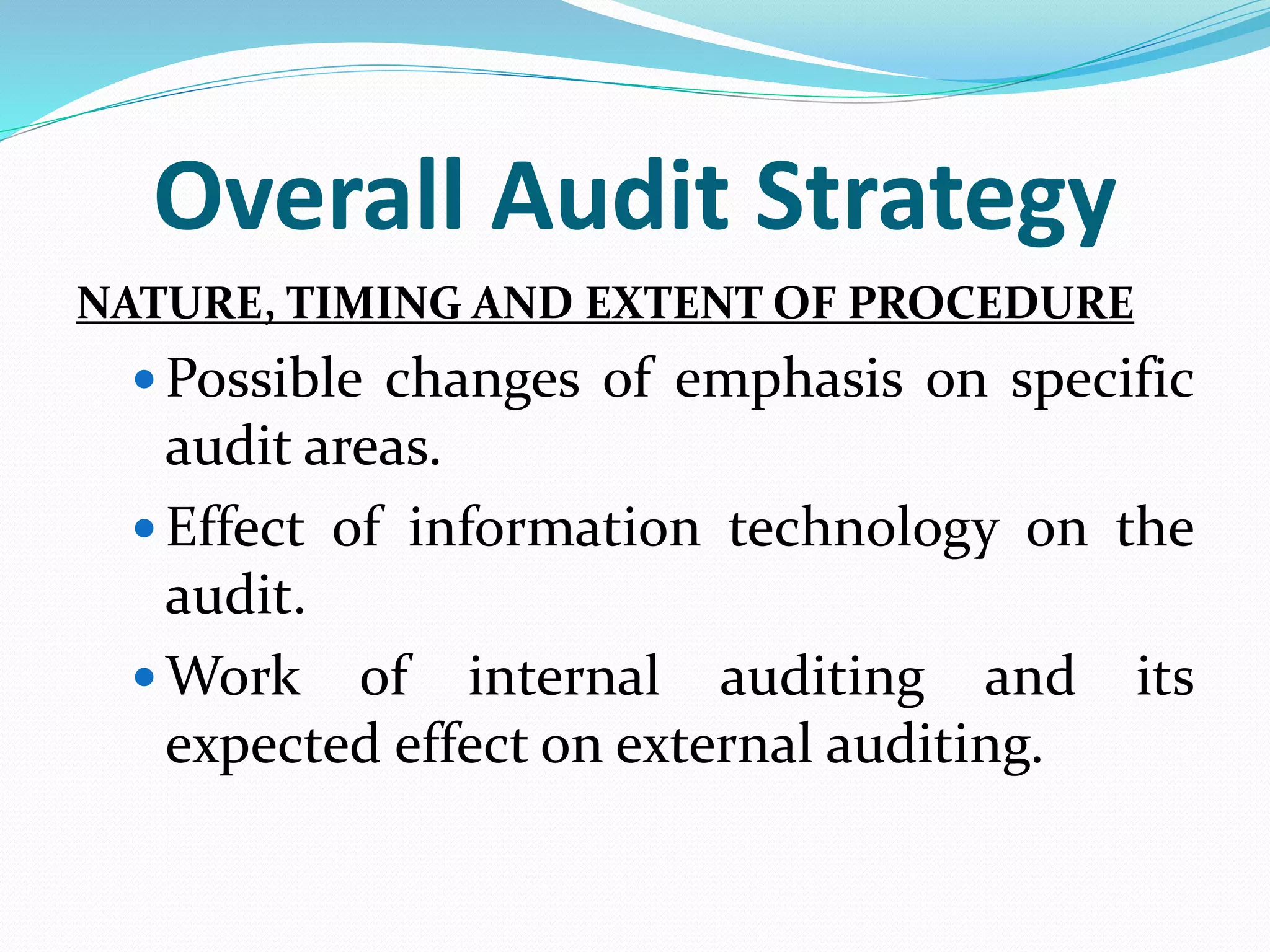
NATURE, TIMING AND EXTENT OF PROCEDURE
 Possible changes of emphasis on specific
audit areas.
 Effect of information technology on the
audit.
 Work of internal auditing and its
expected effect on external auditing.
Overall Audit Strategy
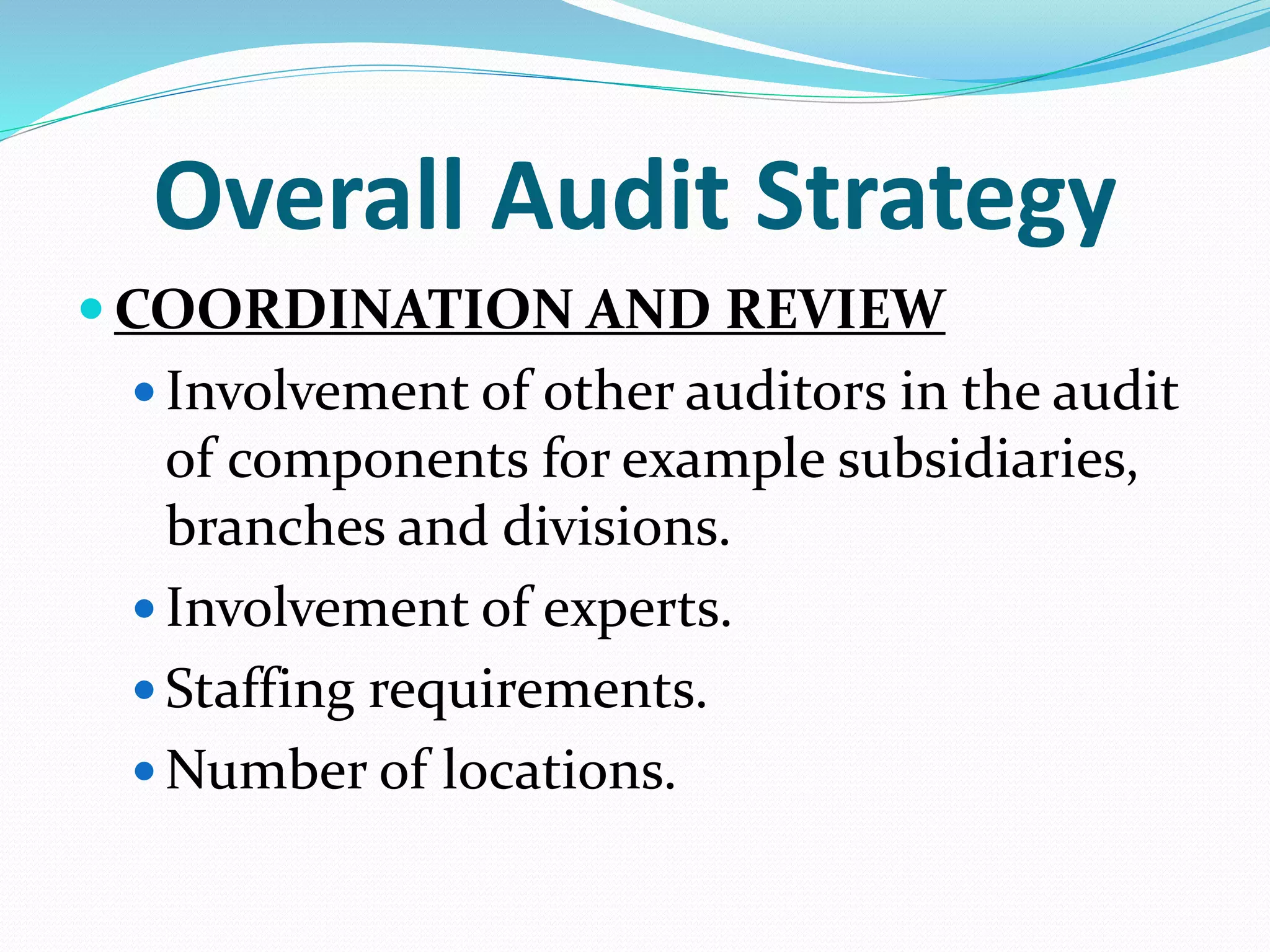
 COORDINATION AND REVIEW
 Involvement of other auditors in the audit
of components for example subsidiaries,
branches and divisions.
 Involvement of experts.
 Staffing requirements.
 Number of locations.
Overall Audit Strategy
 OTHER MATTERS
 Possibility that the going concern
assumption may be subject to question.
 Conditions requiring special attention,
such as the existence of related parties.
 The terms of engagement and the
statutory responsibilities.
 The nature and timing of reports.
DOCUMENTATION OF PLAN
Auditor should document his plan in
the end of the first stage of planning.
Form and extent of document depend
upon the size of each individual audit.
Auditor should follow time table
showing allocated hours for each audit
procedures.
AUDIT TIMETABLE
 Auditor should document an overall audit
timetable setting out the dates agreed with
the client for the commencement and the
completion of audit.
 Make provision for phasing the audit over
the year instead of carrying out the entire
audit work at year end.
ADJUSTMENT OF PLANNING
 Auditor should be continuously amendable to
circumstances with which he is confronted
during audit.
 The errors noticed, should be given due
consideration as all these greatly influence the
audit plan.
 Should extend the scope of audit by increasing
the number of samples in the test if the errors
or fraud has been found
Specific Planning Area
 Time Budgeting
 Staff Planning
 Client’s work Support
 Extent of reliance over internal control
 Meetings with tax and finance department
 Joint audit of sectional audit
 Work performed by distant offices
BENEFITS OF PLANNING
 Appropriate attention to important areas of
audit.
 Prompt identification of potential problems.
 Expeditious completion of task by exercising
proper control and timing.
 Proper utilization of audit force available.
 Effective coordination of audit assignment.
 Review of field work by seniors becomes
simplified and speedy.
Advantages of Planning
1. Progress monitor is easy
2. Uniformity in audit work
3. Division of work made easy
4. Responsibility can easily be fixed when divided
properly
5. Final review made easy
Disadvantages of Planning
 Audit staff loose their initiative and interest
 Audit program may not cover each and every aspect
 Audit became too mechanical
 Rigidity in audit work unless the program not
frequently reviewed and modified

3. planning feb 2014

  • 1.
  • 2.
    MEANING Action to betaken by an auditor, in respect of any particular field of verification and reporting, should be so design that it may enable him to conduct an audit more effectively.
  • 3.
    MEANING According to AS# 04 “ Planning means developing a general strategy and a detailed approach for the expected nature, timing and extent of the audit. The auditor plans to perform the audit in an efficient and timely manner.”
  • 4.
    OVERALL AUDIT PLAN Accordingto AS # 04 “The auditor should develop and document an overall audit plan, describing the expected scope and conduct of the audit”
  • 5.
    6-5 Audit Planning Decide whether toaccept the prospective client Obtain knowledge of client’s business and environment Make preliminary arrangements with the client Prepare the engagement letter Assess risks of material misstatement, including fraud risk Prepare the audit plan, preliminary program, and time budget
  • 6.
    FACTORS TO BECONSIDERED Nature of business Size and complexity of business Environment in which an enterprise operates Methods of processing transactions Reporting requirements
  • 7.
    Previous experience withthe client Knowledge of clients business Industry in which the enterprise is involved Specific methodology and technology used FACTORS TO BE CONSIDERED
  • 8.
    6-8 Sources of Information Inquiries of management  Industry Accounting and Auditing Guides  Industry Risk Alerts  Government publications  Prior company annual reports and SEC filings  Prior tax returns  Electronic sources  Tour of plant and offices  Analytical procedures
  • 9.
    6-9 Assessing Fraud Risks Two types  Fraudulent financial reporting (management fraud)  Misappropriation of assets (defalcations)  Procedures to assess fraud risks  Discussion among engagement team  Inquiries of management and other personnel  Planning analytical procedures  Considering fraud risk factors  Incentives  Opportunity  Attitude
  • 10.
    PLANNING PROCEDURE Audit planningis a continuous process and can be classified into following stages: 1. Sound knowledge regarding business of client 2. Developing an overall audit plan 3. Implementation the audit plan through audit programme 4. Updating the audit plan according to the changes 5. Post audit planning review in form of suggestions
  • 11.
    KEY MATTERS  KNOWLEDGEOF THE BUSINESS  General economic factors and industry affecting the entity’s business.  Important characteristics of entity like business, financial performance and reporting requirements including changes since the last audit.  General level of competence of management
  • 12.
    KNOWLEDGE OF THEBUSINESS  Auditor should obtain knowledge of  Annual accounts to shareholders  Minutes of Shareholders, directors and Committees  Internal financial reports  Previous year’s working papers  Discussion with client’s management and staff  Policy, accounting and management manuals  Government policies and their impact on business  Visits of client premises and plants
  • 13.
    Overall Audit Strategy ACCOUNTINGAND INETRNAL CONTROL SYSTEM  Understanding the accounting policies and changes in those policies.  The effect of new auditing or accounting pronouncements.  Sound knowledge of internal control system especially on test of control and substantive procedures.
  • 14.
    Overall Audit Strategy RISKAND MATERIALITY  Expected assessment of inherent and control risks.  Identification of significant audit areas.  Setting of materiality level for audit purposes.  Possibility of material misstatement, including the experience of past periods or fraud.
  • 15.
    Overall Audit Strategy NATURE,TIMING AND EXTENT OF PROCEDURE  Possible changes of emphasis on specific audit areas.  Effect of information technology on the audit.  Work of internal auditing and its expected effect on external auditing.
  • 16.
    Overall Audit Strategy COORDINATION AND REVIEW  Involvement of other auditors in the audit of components for example subsidiaries, branches and divisions.  Involvement of experts.  Staffing requirements.  Number of locations.
  • 17.
    Overall Audit Strategy OTHER MATTERS  Possibility that the going concern assumption may be subject to question.  Conditions requiring special attention, such as the existence of related parties.  The terms of engagement and the statutory responsibilities.  The nature and timing of reports.
  • 18.
    DOCUMENTATION OF PLAN Auditorshould document his plan in the end of the first stage of planning. Form and extent of document depend upon the size of each individual audit. Auditor should follow time table showing allocated hours for each audit procedures.
  • 19.
    AUDIT TIMETABLE  Auditorshould document an overall audit timetable setting out the dates agreed with the client for the commencement and the completion of audit.  Make provision for phasing the audit over the year instead of carrying out the entire audit work at year end.
  • 20.
    ADJUSTMENT OF PLANNING Auditor should be continuously amendable to circumstances with which he is confronted during audit.  The errors noticed, should be given due consideration as all these greatly influence the audit plan.  Should extend the scope of audit by increasing the number of samples in the test if the errors or fraud has been found
  • 21.
    Specific Planning Area Time Budgeting  Staff Planning  Client’s work Support  Extent of reliance over internal control  Meetings with tax and finance department  Joint audit of sectional audit  Work performed by distant offices
  • 22.
    BENEFITS OF PLANNING Appropriate attention to important areas of audit.  Prompt identification of potential problems.  Expeditious completion of task by exercising proper control and timing.  Proper utilization of audit force available.  Effective coordination of audit assignment.  Review of field work by seniors becomes simplified and speedy.
  • 23.
    Advantages of Planning 1.Progress monitor is easy 2. Uniformity in audit work 3. Division of work made easy 4. Responsibility can easily be fixed when divided properly 5. Final review made easy
  • 24.
    Disadvantages of Planning Audit staff loose their initiative and interest  Audit program may not cover each and every aspect  Audit became too mechanical  Rigidity in audit work unless the program not frequently reviewed and modified

Editor's Notes

  • #6 4
  • #10 Defalcation: embezzlement, stealing (of money); failure to meet an expectation,
  • #16 Cash flow statemennnn