TOPIC 1: INTRODUCTION
References: Chapter 1 & 2
AUD390 2014
AUDITING AND ASSURANCE
SERVICES
IN MALAYSIA
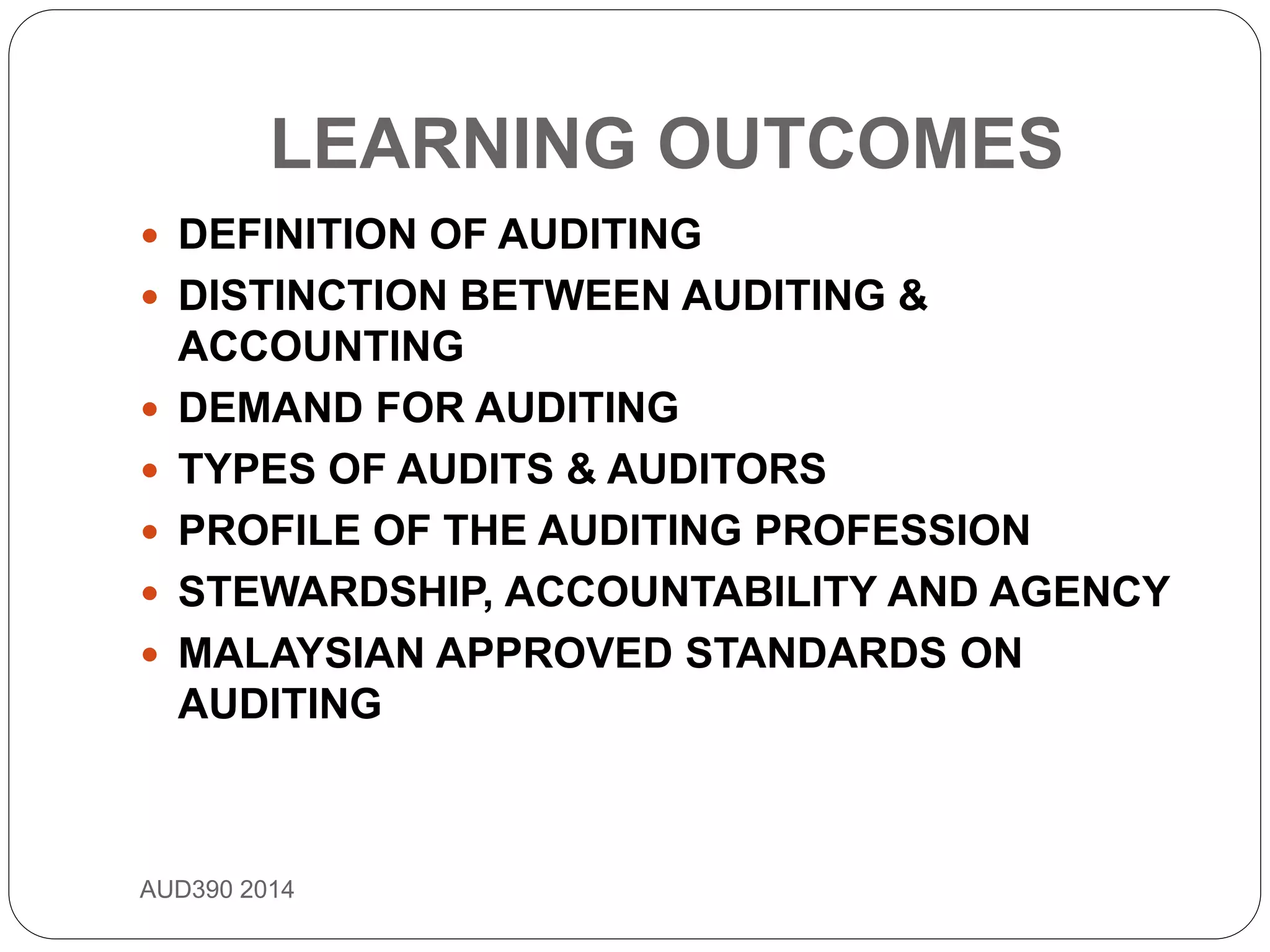
LEARNING OUTCOMES
AUD390 2014
 DEFINITION OF AUDITING
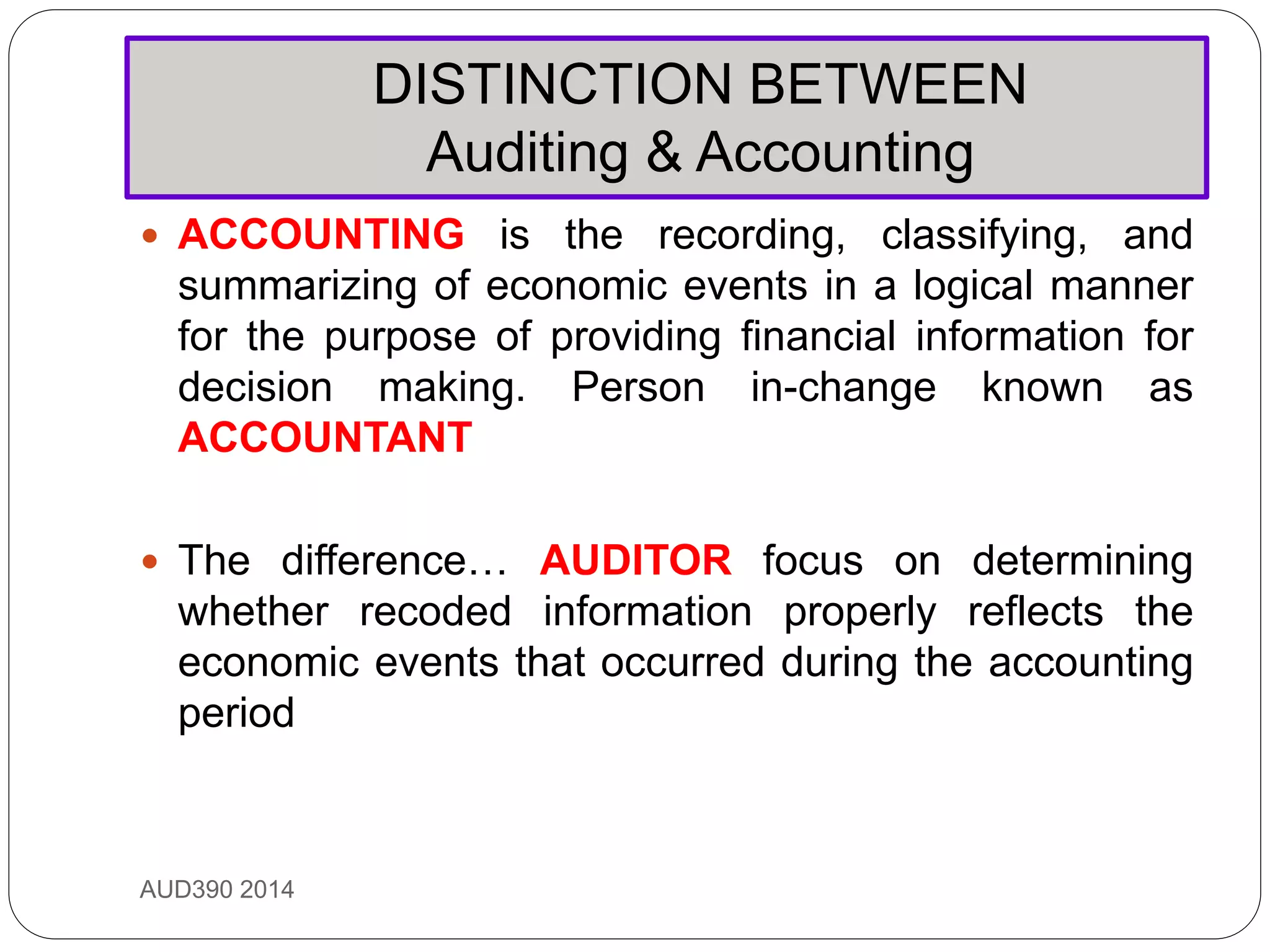
 DISTINCTION BETWEEN AUDITING &
ACCOUNTING
 DEMAND FOR AUDITING
 TYPES OF AUDITS & AUDITORS
 PROFILE OF THE AUDITING PROFESSION
 STEWARDSHIP, ACCOUNTABILITY AND AGENCY
 MALAYSIAN APPROVED STANDARDS ON
AUDITING
DEFINITION OF AUDITING
AUD390 2014
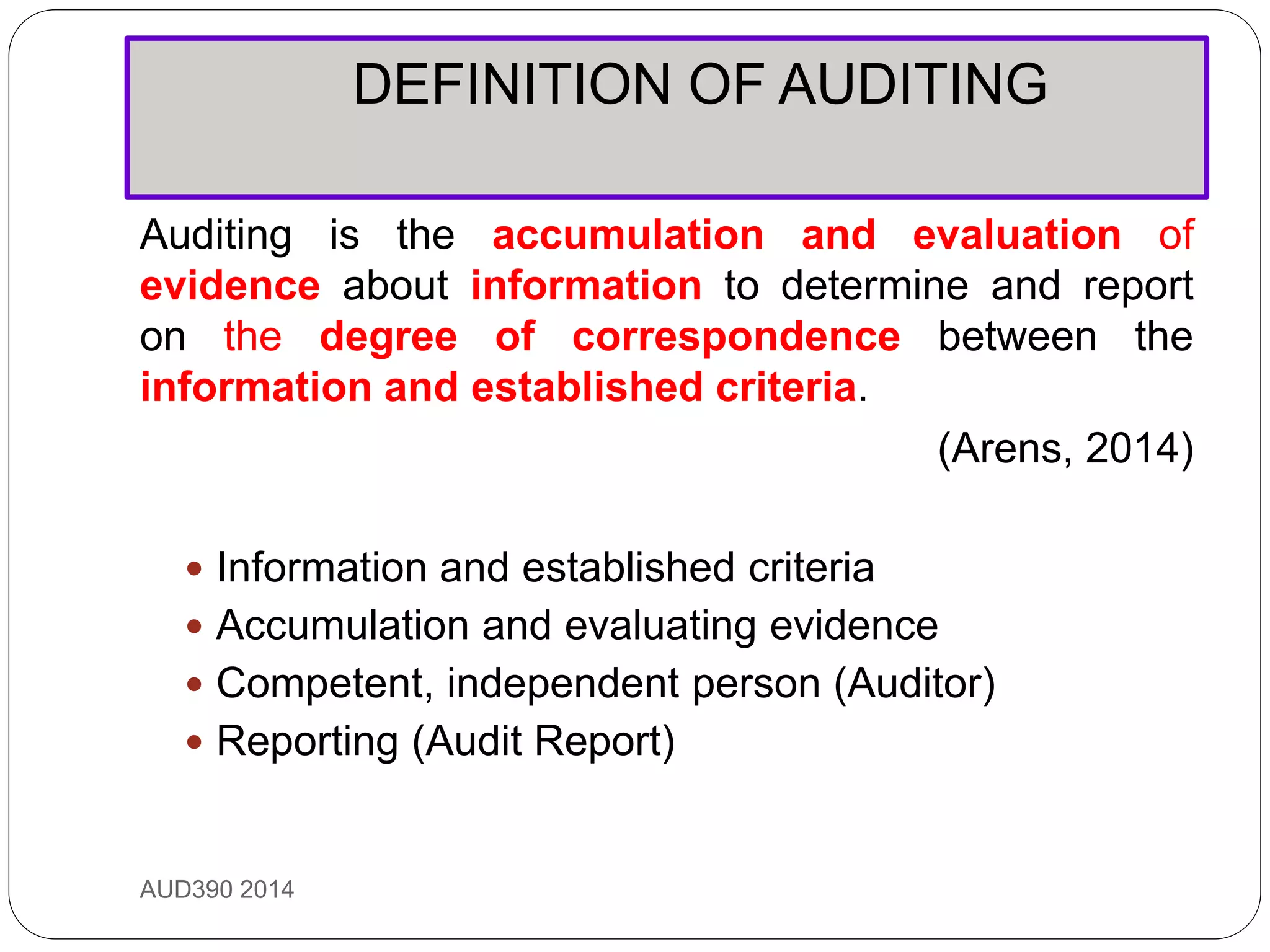
Auditing is the accumulation and evaluation of
evidence about information to determine and report
on the degree of correspondence between the
information and established criteria.
(Arens, 2014)
 Information and established criteria
 Accumulation and evaluating evidence
 Competent, independent person (Auditor)
 Reporting (Audit Report)
DEFINITION OF AUDITING
(Financial Statement Audit)
AUD390 2014
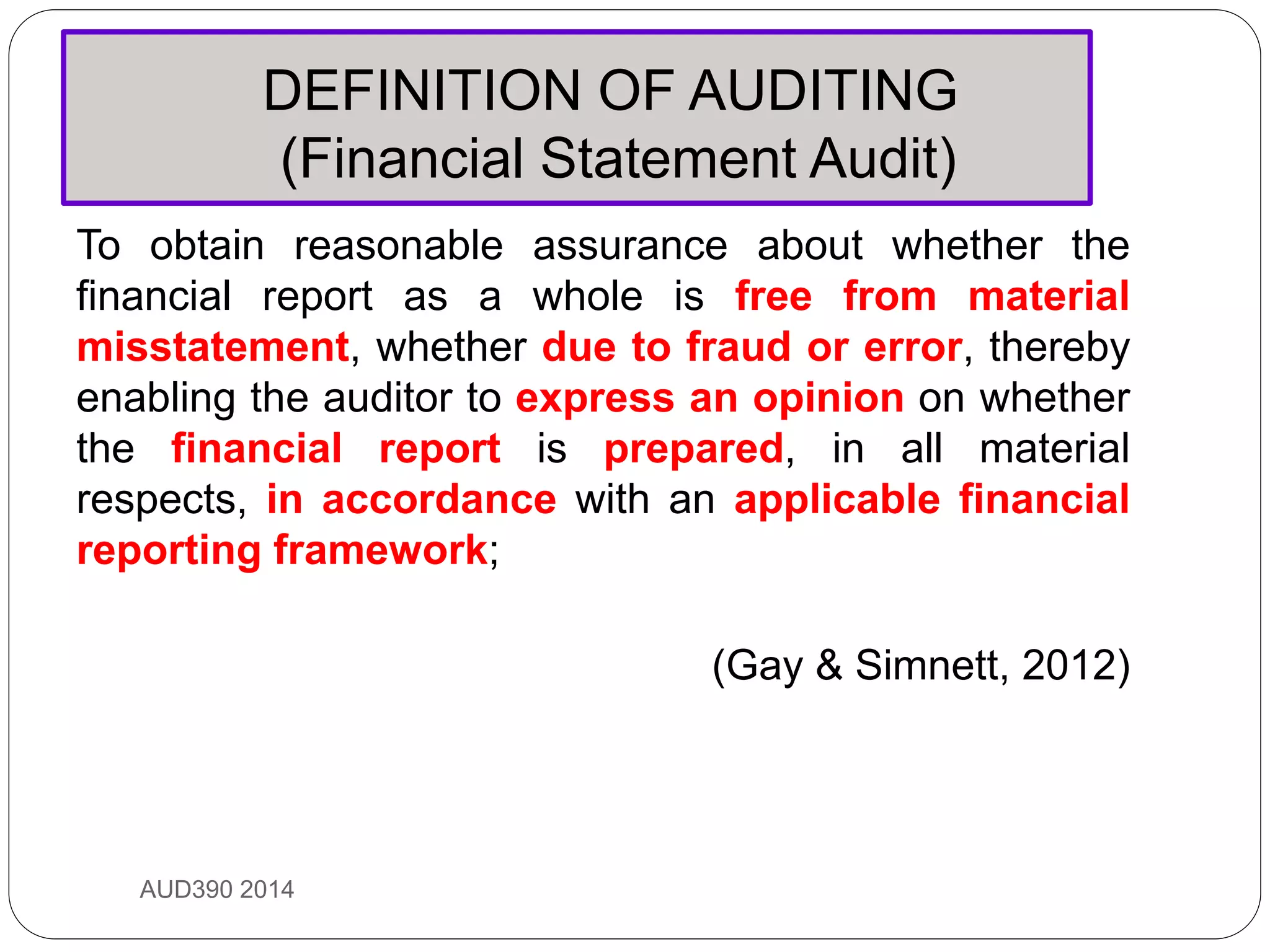
To obtain reasonable assurance about whether the
financial report as a whole is free from material
misstatement, whether due to fraud or error, thereby
enabling the auditor to express an opinion on whether
the financial report is prepared, in all material
respects, in accordance with an applicable financial
reporting framework;
(Gay & Simnett, 2012)
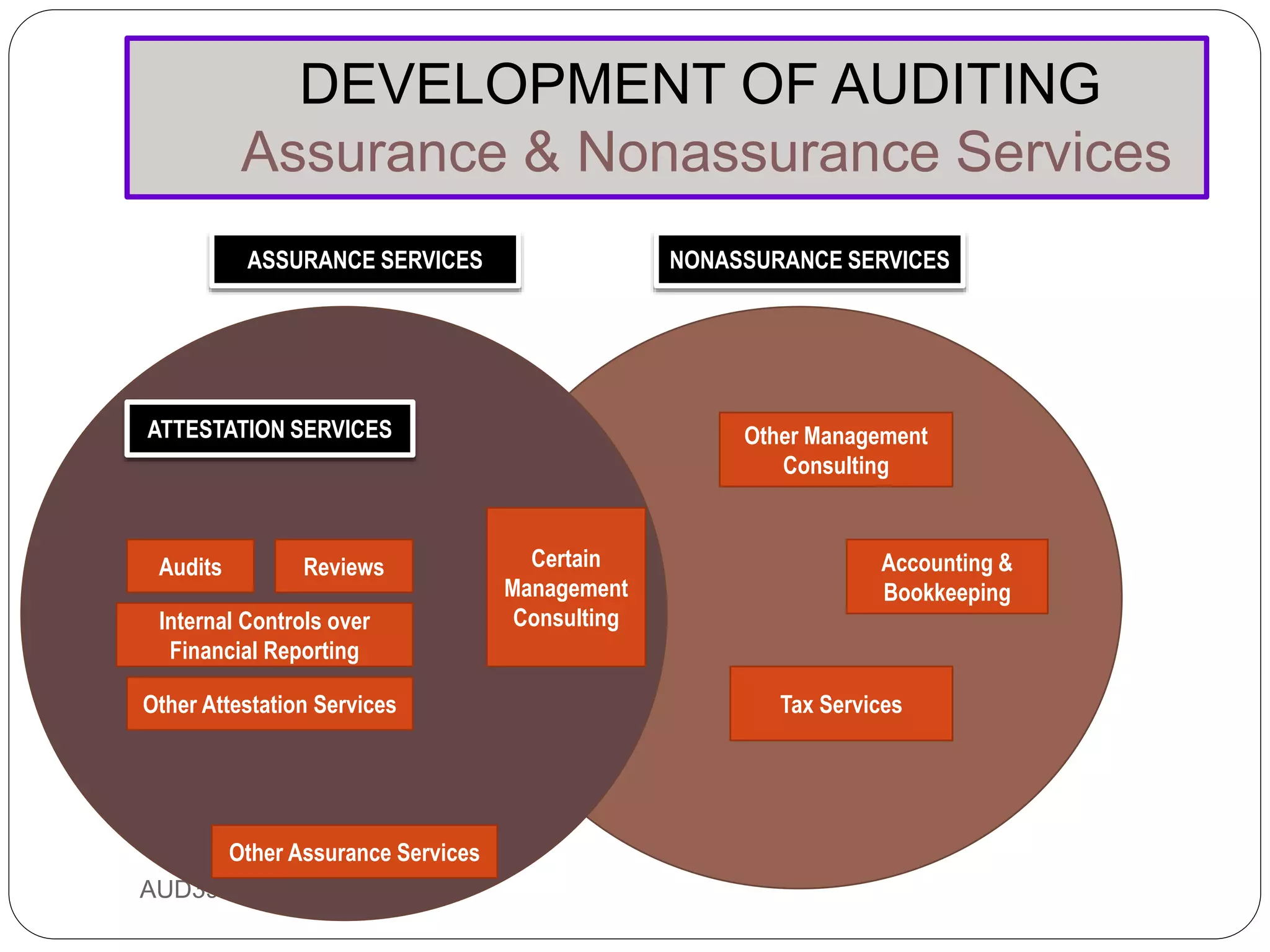
DEVELOPMENT OF AUDITING
Assurance & Nonassurance Services
AUD390 2014
Audits Reviews
Internal Controls over
Financial Reporting
Other Attestation Services
Other Assurance Services
NONASSURANCE SERVICESASSURANCE SERVICES
Other Management
Consulting
Accounting &
Bookkeeping
Tax Services
Certain
Management
Consulting
ATTESTATION SERVICES
DEVELOPMENT OF AUDITING
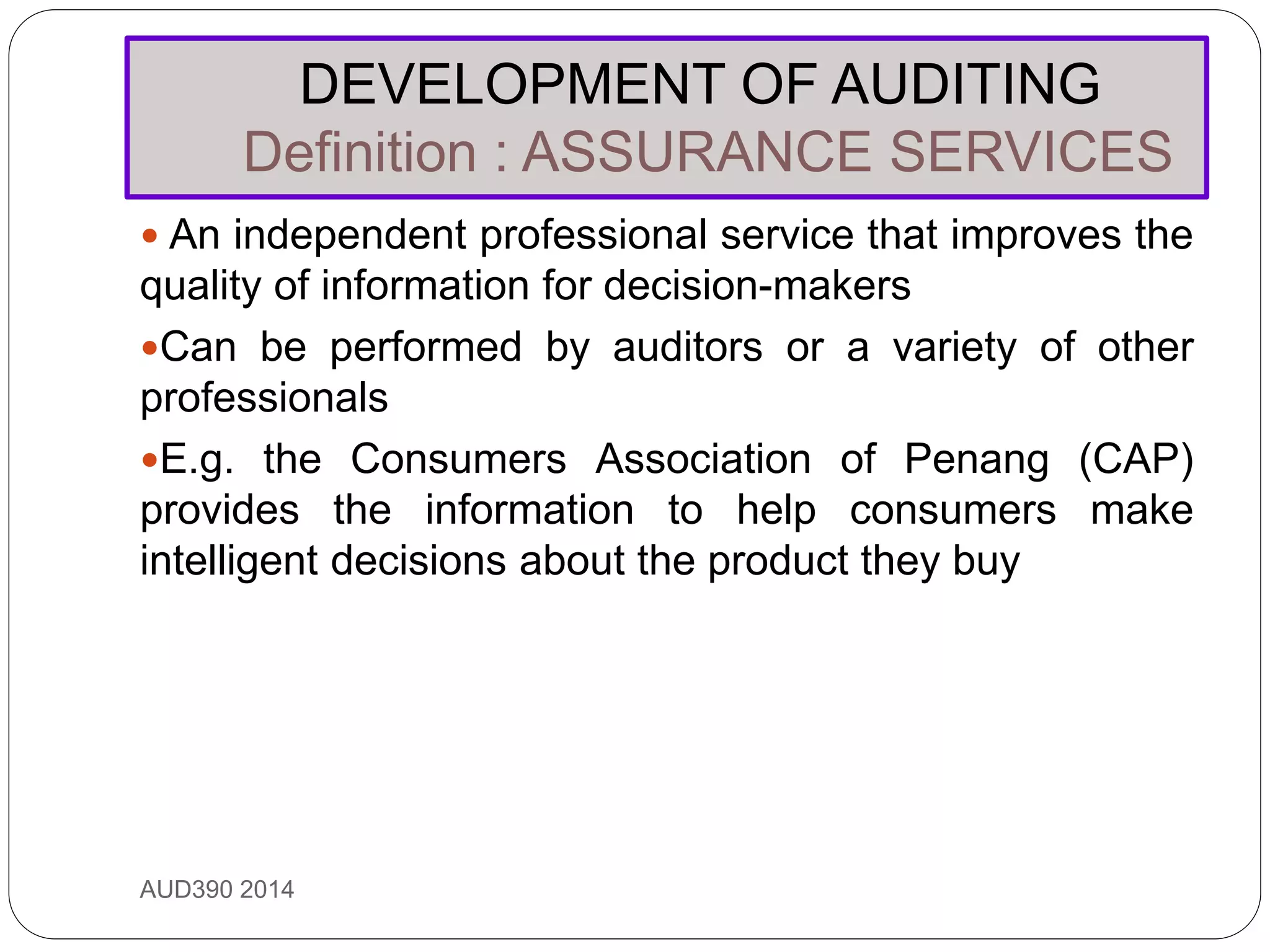
Definition : ASSURANCE SERVICES
AUD390 2014
 An independent professional service that improves the
quality of information for decision-makers
Can be performed by auditors or a variety of other
professionals
E.g. the Consumers Association of Penang (CAP)
provides the information to help consumers make
intelligent decisions about the product they buy
DEVELOPMENT OF AUDITING
Definition : ASSURANCE SERVICES
AUD390 2014
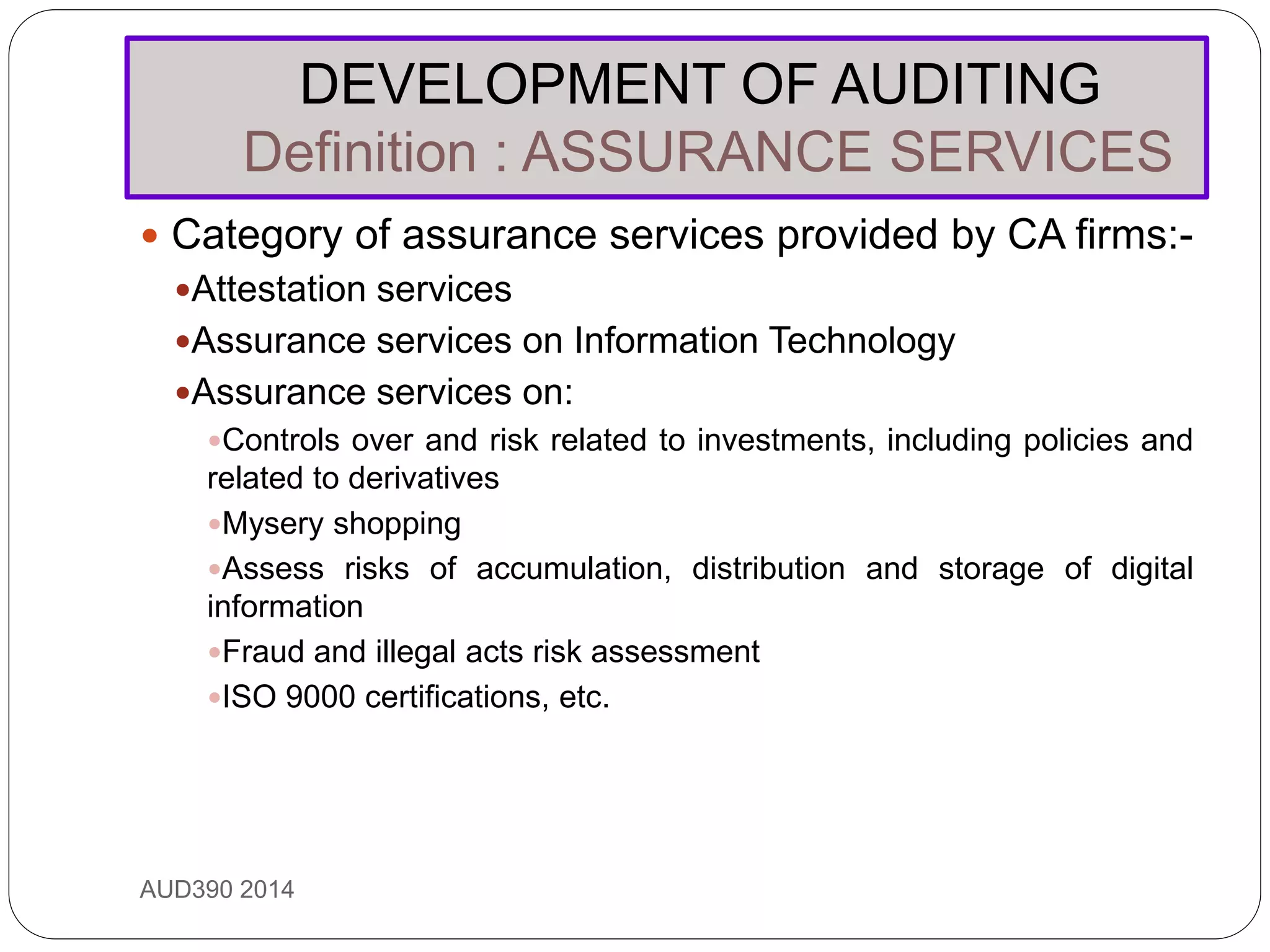
 Category of assurance services provided by CA firms:-
Attestation services
Assurance services on Information Technology
Assurance services on:
Controls over and risk related to investments, including policies and
related to derivatives
Mysery shopping
Assess risks of accumulation, distribution and storage of digital
information
Fraud and illegal acts risk assessment
ISO 9000 certifications, etc.
DEVELOPMENT OF AUDITING
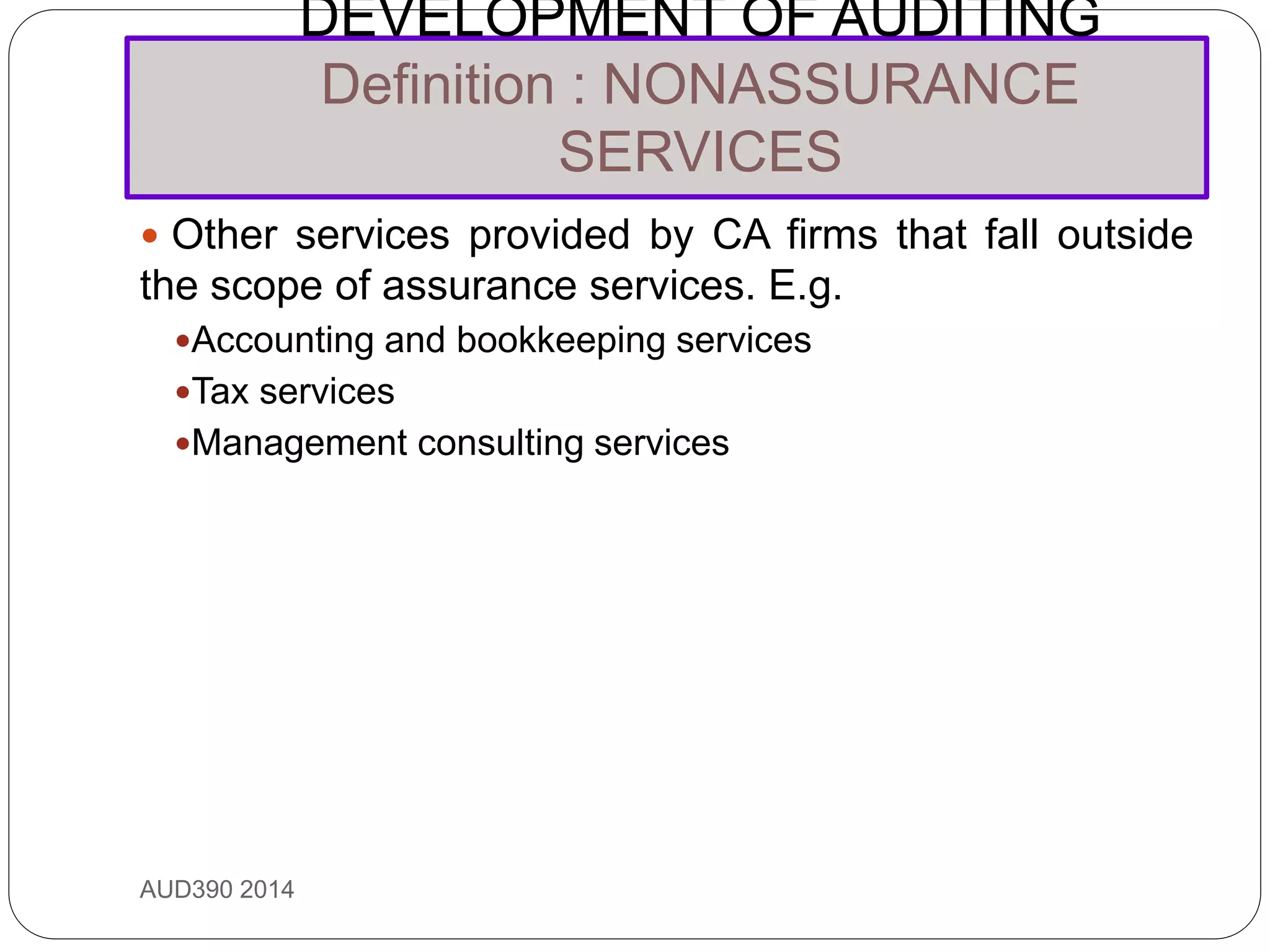
Definition : NONASSURANCE
SERVICES
AUD390 2014
 Other services provided by CA firms that fall outside
the scope of assurance services. E.g.
Accounting and bookkeeping services
Tax services
Management consulting services
DISTINCTION BETWEEN
Auditing & Accounting
AUD390 2014
 ACCOUNTING is the recording, classifying, and
summarizing of economic events in a logical manner
for the purpose of providing financial information for
decision making. Person in-change known as
ACCOUNTANT
 The difference… AUDITOR focus on determining
whether recoded information properly reflects the
economic events that occurred during the accounting
period
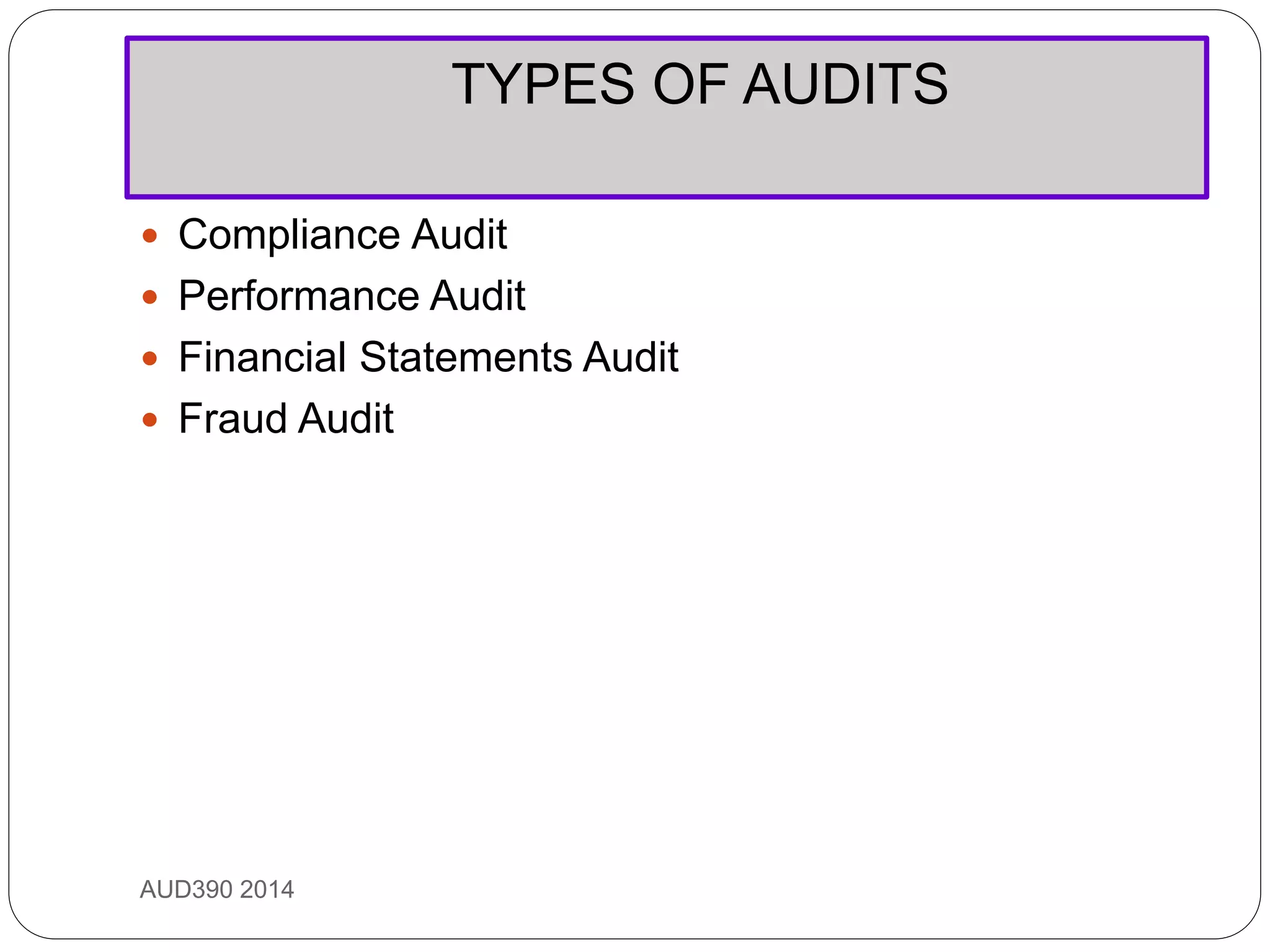
TYPES OF AUDITS
AUD390 2014
 Compliance Audit
 Performance Audit
 Financial Statements Audit
 Fraud Audit
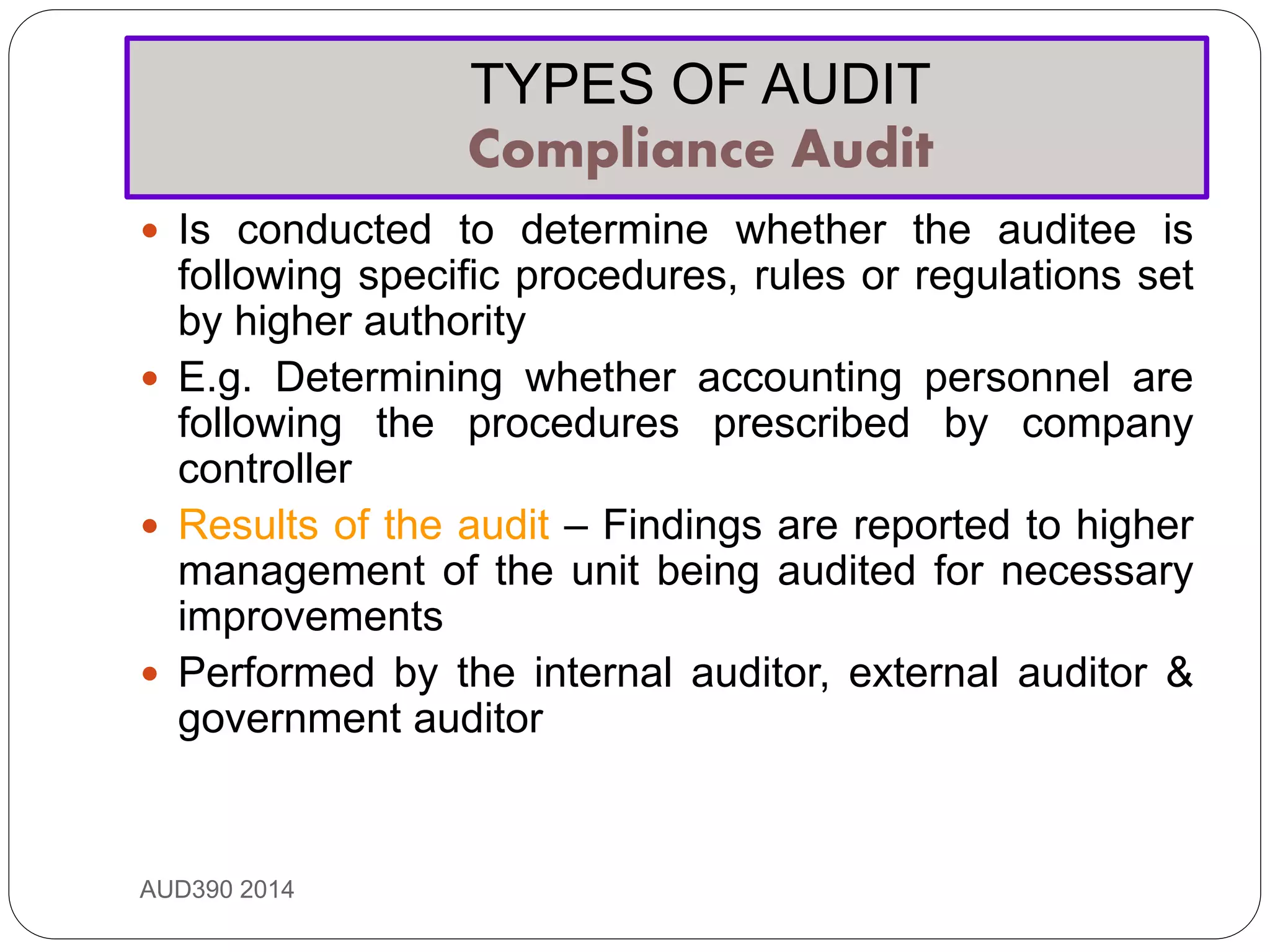
TYPES OF AUDIT
Compliance Audit
AUD390 2014
 Is conducted to determine whether the auditee is
following specific procedures, rules or regulations set
by higher authority
 E.g. Determining whether accounting personnel are
following the procedures prescribed by company
controller
 Results of the audit – Findings are reported to higher
management of the unit being audited for necessary
improvements
 Performed by the internal auditor, external auditor &
government auditor
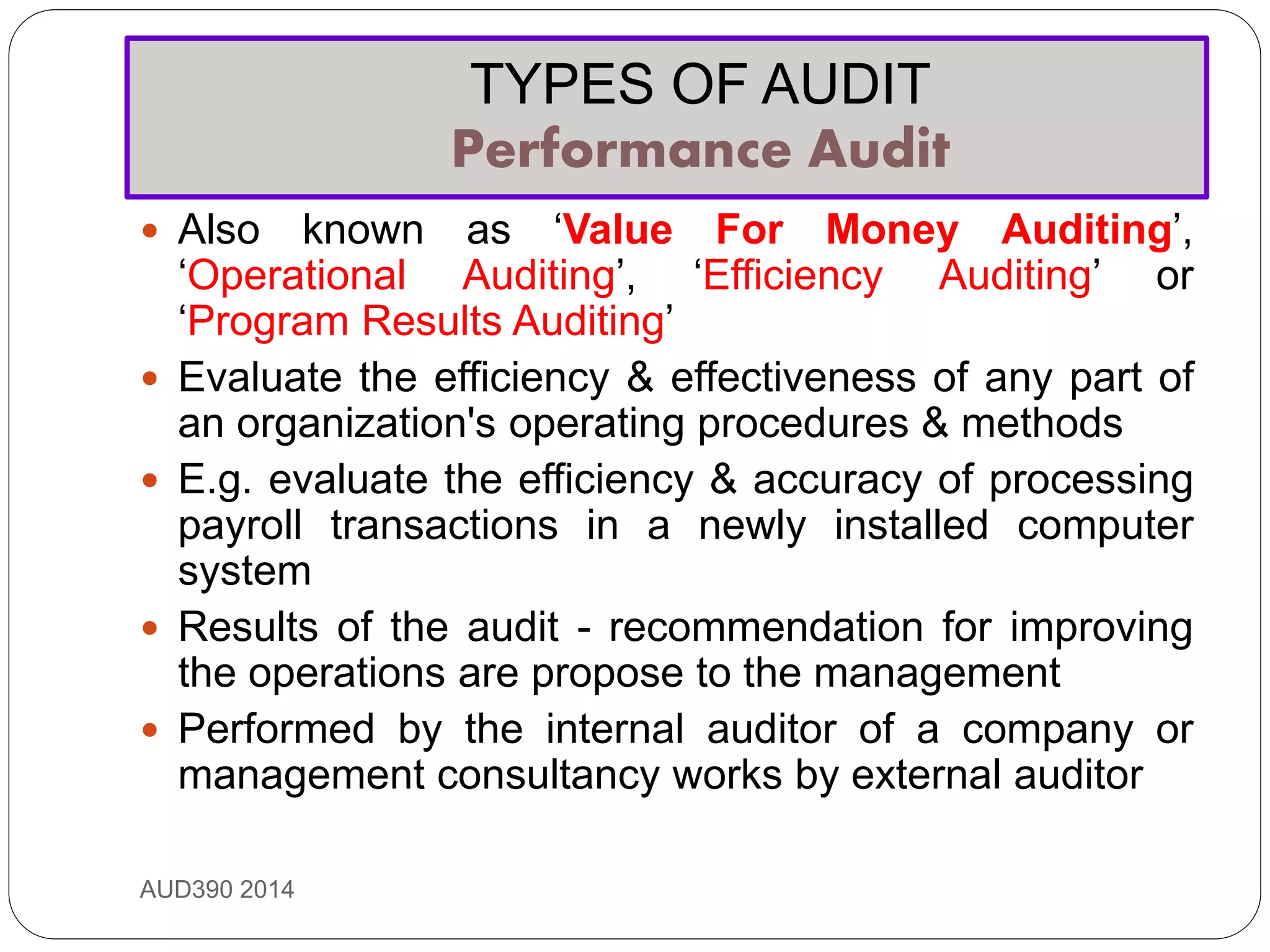
TYPES OF AUDIT
Performance Audit
AUD390 2014
 Also known as ‘Value For Money Auditing’,
‘Operational Auditing’, ‘Efficiency Auditing’ or
‘Program Results Auditing’
 Evaluate the efficiency & effectiveness of any part of
an organization's operating procedures & methods
 E.g. evaluate the efficiency & accuracy of processing
payroll transactions in a newly installed computer
system
 Results of the audit - recommendation for improving
the operations are propose to the management
 Performed by the internal auditor of a company or
management consultancy works by external auditor
TYPES OF AUDIT
Financial Statement Audit
AUD390 2014
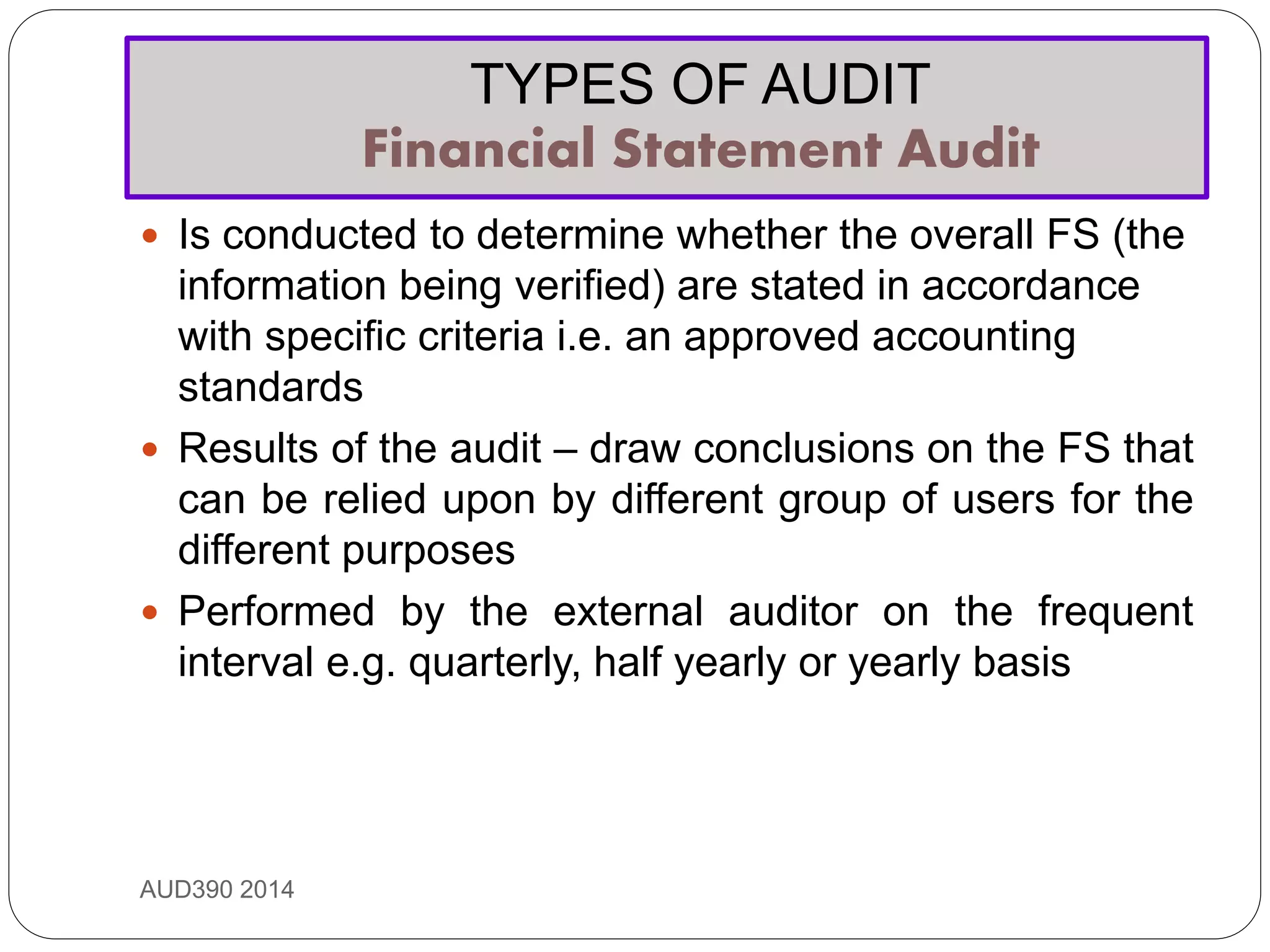
 Is conducted to determine whether the overall FS (the
information being verified) are stated in accordance
with specific criteria i.e. an approved accounting
standards
 Results of the audit – draw conclusions on the FS that
can be relied upon by different group of users for the
different purposes
 Performed by the external auditor on the frequent
interval e.g. quarterly, half yearly or yearly basis
TYPES OF AUDIT
Fraud Audit
AUD390 2014
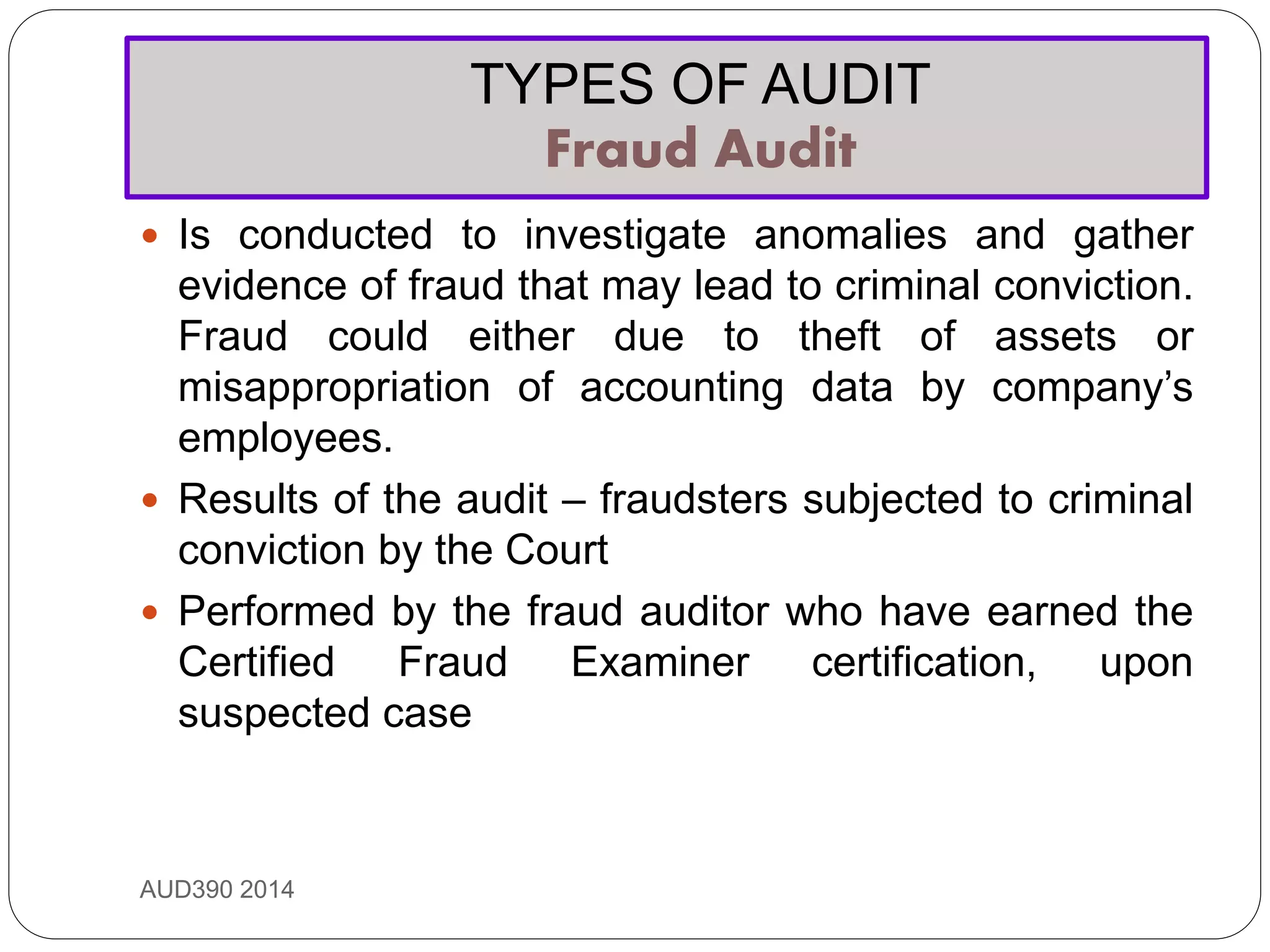
 Is conducted to investigate anomalies and gather
evidence of fraud that may lead to criminal conviction.
Fraud could either due to theft of assets or
misappropriation of accounting data by company’s
employees.
 Results of the audit – fraudsters subjected to criminal
conviction by the Court
 Performed by the fraud auditor who have earned the
Certified Fraud Examiner certification, upon
suspected case
TYPES OF AUDITORS
AUD390 2014
 External Auditor
 Internal Auditors
 Government Auditors
 Inland Revenue Assessment Officers
TYPES OF AUDITORS
External Auditor
AUD390 2014
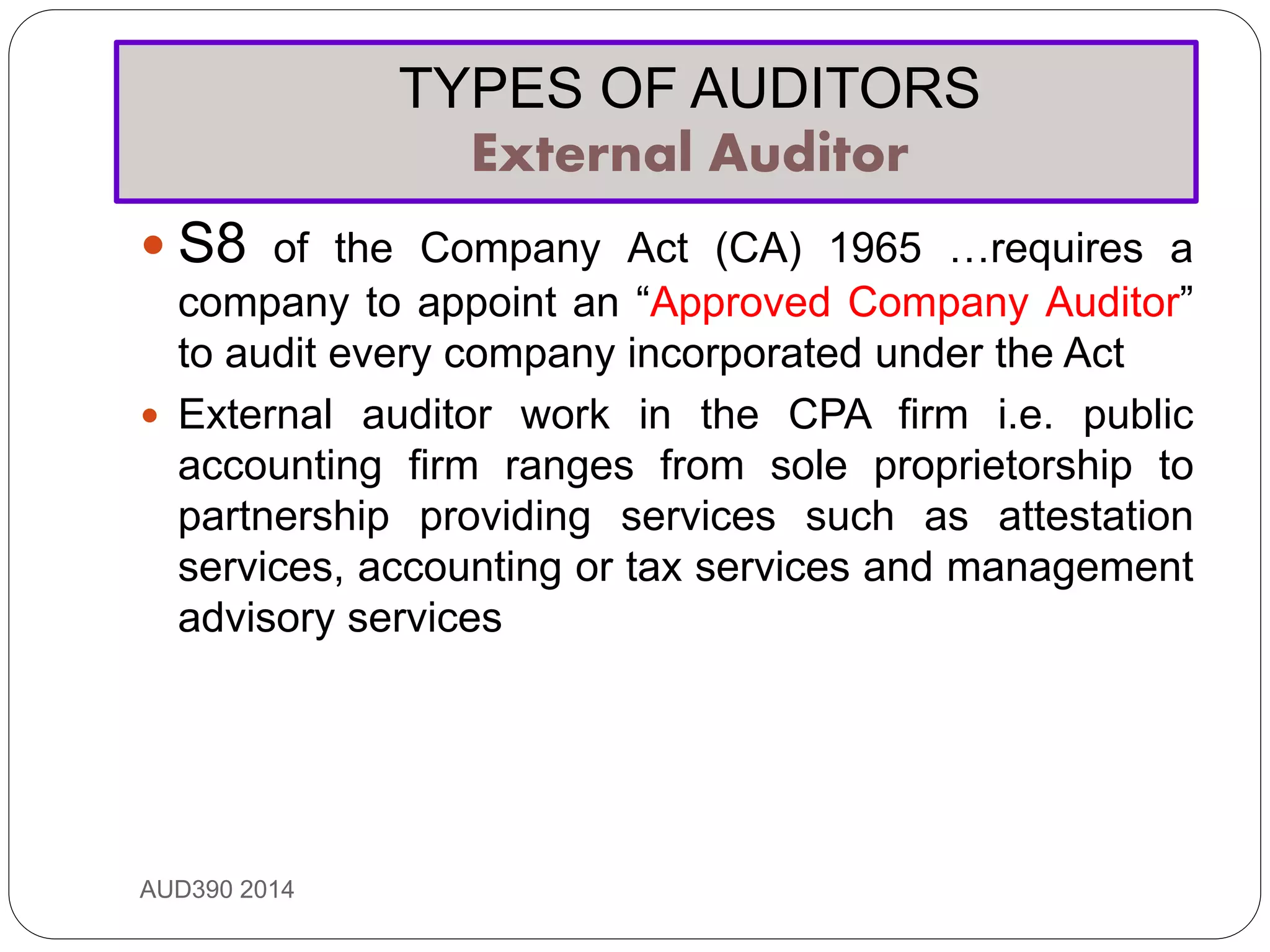
 S8 of the Company Act (CA) 1965 …requires a
company to appoint an “Approved Company Auditor”
to audit every company incorporated under the Act
 External auditor work in the CPA firm i.e. public
accounting firm ranges from sole proprietorship to
partnership providing services such as attestation
services, accounting or tax services and management
advisory services
TYPES OF AUDITORS
Internal Auditor
AUD390 2014
 Employed by individual companies to audit for
management
 Involved in operational auditing or have expertise in
evaluating computer systems
TYPES OF AUDITORS
Government Auditor
AUD390 2014
 Working for the Auditor General Department, headed
by the Auditor General and reports to & is responsible
solely to Yang Dipertuan Agong
 Responsible to evaluate the operational efficiency &
effectiveness for all federal & states as well as
statutory bodies & public authorities
TYPES OF AUDITORS
Inland Revenue Assessment Auditor
AUD390 2014
 Staff of Inland Revenue Board (IRB), which
responsible for enforcing the Income Tax Act as being
defined by Parliament and interpreted by Courts
 Responsible to audit the taxpayers’ returns to
determine whether they have complied with the tax
laws
PRINCIPLES OF STEWARDSHIP,
ACCOUNTABILITY & AGENCY
AUD390 2014
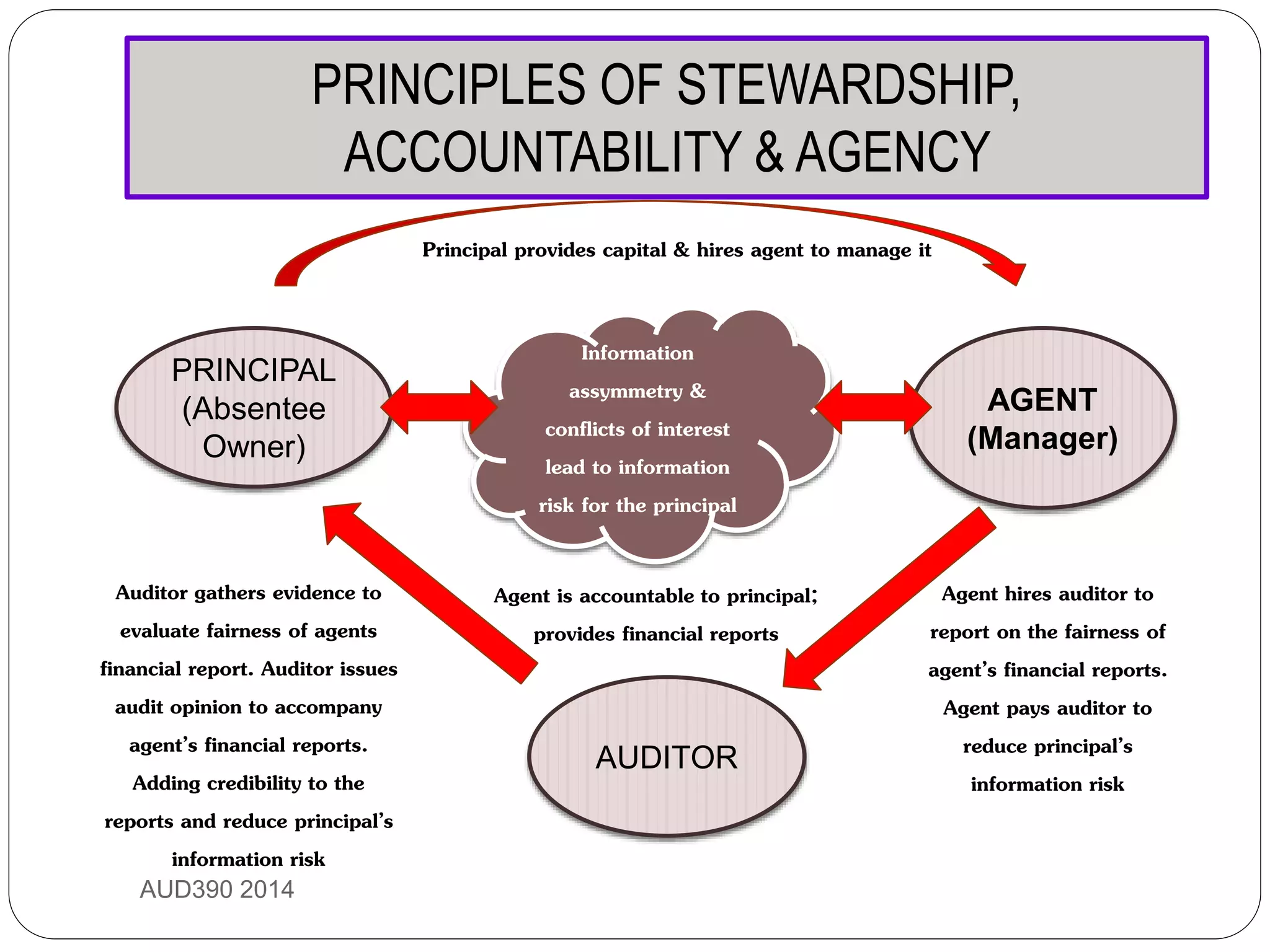
PRINCIPAL
(Absentee
Owner)
AUDITOR
AGENT
(Manager)
Information
assymmetry &
conflicts of interest
lead to information
risk for the principal
Principal provides capital & hires agent to manage it
Agent is accountable to principal;
provides financial reports
Auditor gathers evidence to
evaluate fairness of agents
financial report. Auditor issues
audit opinion to accompany
agent’s financial reports.
Adding credibility to the
reports and reduce principal’s
information risk
Agent hires auditor to
report on the fairness of
agent’s financial reports.
Agent pays auditor to
reduce principal’s
information risk
MALAYSIAN APPROVED
STANDARDS AUDITING
AUD390 2014
 A general guidelines to aid auditors in fulfilling their
professional responsibilities in the audit of historical
financial statements
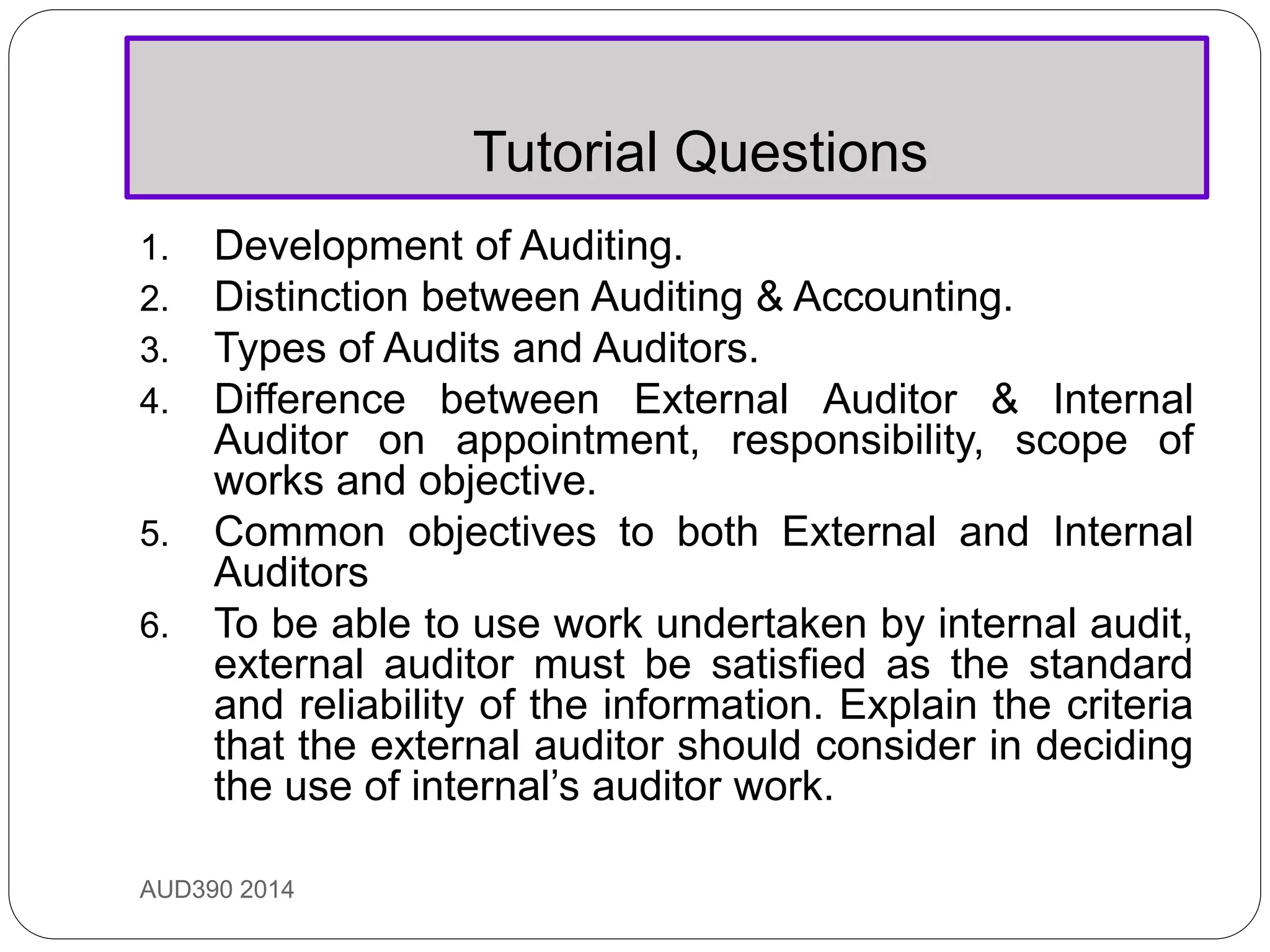
Tutorial Questions
AUD390 2014
1. Development of Auditing.
2. Distinction between Auditing & Accounting.
3. Types of Audits and Auditors.
4. Difference between External Auditor & Internal
Auditor on appointment, responsibility, scope of
works and objective.
5. Common objectives to both External and Internal
Auditors
6. To be able to use work undertaken by internal audit,
external auditor must be satisfied as the standard
and reliability of the information. Explain the criteria
that the external auditor should consider in deciding
the use of internal’s auditor work.

Topic 1 introduction

  • 1.
    TOPIC 1: INTRODUCTION References:Chapter 1 & 2 AUD390 2014 AUDITING AND ASSURANCE SERVICES IN MALAYSIA
  • 2.
    LEARNING OUTCOMES AUD390 2014 DEFINITION OF AUDITING  DISTINCTION BETWEEN AUDITING & ACCOUNTING  DEMAND FOR AUDITING  TYPES OF AUDITS & AUDITORS  PROFILE OF THE AUDITING PROFESSION  STEWARDSHIP, ACCOUNTABILITY AND AGENCY  MALAYSIAN APPROVED STANDARDS ON AUDITING
  • 3.
    DEFINITION OF AUDITING AUD3902014 Auditing is the accumulation and evaluation of evidence about information to determine and report on the degree of correspondence between the information and established criteria. (Arens, 2014)  Information and established criteria  Accumulation and evaluating evidence  Competent, independent person (Auditor)  Reporting (Audit Report)
  • 4.
    DEFINITION OF AUDITING (FinancialStatement Audit) AUD390 2014 To obtain reasonable assurance about whether the financial report as a whole is free from material misstatement, whether due to fraud or error, thereby enabling the auditor to express an opinion on whether the financial report is prepared, in all material respects, in accordance with an applicable financial reporting framework; (Gay & Simnett, 2012)
  • 5.
    DEVELOPMENT OF AUDITING Assurance& Nonassurance Services AUD390 2014 Audits Reviews Internal Controls over Financial Reporting Other Attestation Services Other Assurance Services NONASSURANCE SERVICESASSURANCE SERVICES Other Management Consulting Accounting & Bookkeeping Tax Services Certain Management Consulting ATTESTATION SERVICES
  • 6.
    DEVELOPMENT OF AUDITING Definition: ASSURANCE SERVICES AUD390 2014  An independent professional service that improves the quality of information for decision-makers Can be performed by auditors or a variety of other professionals E.g. the Consumers Association of Penang (CAP) provides the information to help consumers make intelligent decisions about the product they buy
  • 7.
    DEVELOPMENT OF AUDITING Definition: ASSURANCE SERVICES AUD390 2014  Category of assurance services provided by CA firms:- Attestation services Assurance services on Information Technology Assurance services on: Controls over and risk related to investments, including policies and related to derivatives Mysery shopping Assess risks of accumulation, distribution and storage of digital information Fraud and illegal acts risk assessment ISO 9000 certifications, etc.
  • 8.
    DEVELOPMENT OF AUDITING Definition: NONASSURANCE SERVICES AUD390 2014  Other services provided by CA firms that fall outside the scope of assurance services. E.g. Accounting and bookkeeping services Tax services Management consulting services
  • 9.
    DISTINCTION BETWEEN Auditing &Accounting AUD390 2014  ACCOUNTING is the recording, classifying, and summarizing of economic events in a logical manner for the purpose of providing financial information for decision making. Person in-change known as ACCOUNTANT  The difference… AUDITOR focus on determining whether recoded information properly reflects the economic events that occurred during the accounting period
  • 10.
    TYPES OF AUDITS AUD3902014  Compliance Audit  Performance Audit  Financial Statements Audit  Fraud Audit
  • 11.
    TYPES OF AUDIT ComplianceAudit AUD390 2014  Is conducted to determine whether the auditee is following specific procedures, rules or regulations set by higher authority  E.g. Determining whether accounting personnel are following the procedures prescribed by company controller  Results of the audit – Findings are reported to higher management of the unit being audited for necessary improvements  Performed by the internal auditor, external auditor & government auditor
  • 12.
    TYPES OF AUDIT PerformanceAudit AUD390 2014  Also known as ‘Value For Money Auditing’, ‘Operational Auditing’, ‘Efficiency Auditing’ or ‘Program Results Auditing’  Evaluate the efficiency & effectiveness of any part of an organization's operating procedures & methods  E.g. evaluate the efficiency & accuracy of processing payroll transactions in a newly installed computer system  Results of the audit - recommendation for improving the operations are propose to the management  Performed by the internal auditor of a company or management consultancy works by external auditor
  • 13.
    TYPES OF AUDIT FinancialStatement Audit AUD390 2014  Is conducted to determine whether the overall FS (the information being verified) are stated in accordance with specific criteria i.e. an approved accounting standards  Results of the audit – draw conclusions on the FS that can be relied upon by different group of users for the different purposes  Performed by the external auditor on the frequent interval e.g. quarterly, half yearly or yearly basis
  • 14.
    TYPES OF AUDIT FraudAudit AUD390 2014  Is conducted to investigate anomalies and gather evidence of fraud that may lead to criminal conviction. Fraud could either due to theft of assets or misappropriation of accounting data by company’s employees.  Results of the audit – fraudsters subjected to criminal conviction by the Court  Performed by the fraud auditor who have earned the Certified Fraud Examiner certification, upon suspected case
  • 15.
    TYPES OF AUDITORS AUD3902014  External Auditor  Internal Auditors  Government Auditors  Inland Revenue Assessment Officers
  • 16.
    TYPES OF AUDITORS ExternalAuditor AUD390 2014  S8 of the Company Act (CA) 1965 …requires a company to appoint an “Approved Company Auditor” to audit every company incorporated under the Act  External auditor work in the CPA firm i.e. public accounting firm ranges from sole proprietorship to partnership providing services such as attestation services, accounting or tax services and management advisory services
  • 17.
    TYPES OF AUDITORS InternalAuditor AUD390 2014  Employed by individual companies to audit for management  Involved in operational auditing or have expertise in evaluating computer systems
  • 18.
    TYPES OF AUDITORS GovernmentAuditor AUD390 2014  Working for the Auditor General Department, headed by the Auditor General and reports to & is responsible solely to Yang Dipertuan Agong  Responsible to evaluate the operational efficiency & effectiveness for all federal & states as well as statutory bodies & public authorities
  • 19.
    TYPES OF AUDITORS InlandRevenue Assessment Auditor AUD390 2014  Staff of Inland Revenue Board (IRB), which responsible for enforcing the Income Tax Act as being defined by Parliament and interpreted by Courts  Responsible to audit the taxpayers’ returns to determine whether they have complied with the tax laws
  • 20.
    PRINCIPLES OF STEWARDSHIP, ACCOUNTABILITY& AGENCY AUD390 2014 PRINCIPAL (Absentee Owner) AUDITOR AGENT (Manager) Information assymmetry & conflicts of interest lead to information risk for the principal Principal provides capital & hires agent to manage it Agent is accountable to principal; provides financial reports Auditor gathers evidence to evaluate fairness of agents financial report. Auditor issues audit opinion to accompany agent’s financial reports. Adding credibility to the reports and reduce principal’s information risk Agent hires auditor to report on the fairness of agent’s financial reports. Agent pays auditor to reduce principal’s information risk
  • 21.
    MALAYSIAN APPROVED STANDARDS AUDITING AUD3902014  A general guidelines to aid auditors in fulfilling their professional responsibilities in the audit of historical financial statements
  • 22.
    Tutorial Questions AUD390 2014 1.Development of Auditing. 2. Distinction between Auditing & Accounting. 3. Types of Audits and Auditors. 4. Difference between External Auditor & Internal Auditor on appointment, responsibility, scope of works and objective. 5. Common objectives to both External and Internal Auditors 6. To be able to use work undertaken by internal audit, external auditor must be satisfied as the standard and reliability of the information. Explain the criteria that the external auditor should consider in deciding the use of internal’s auditor work.