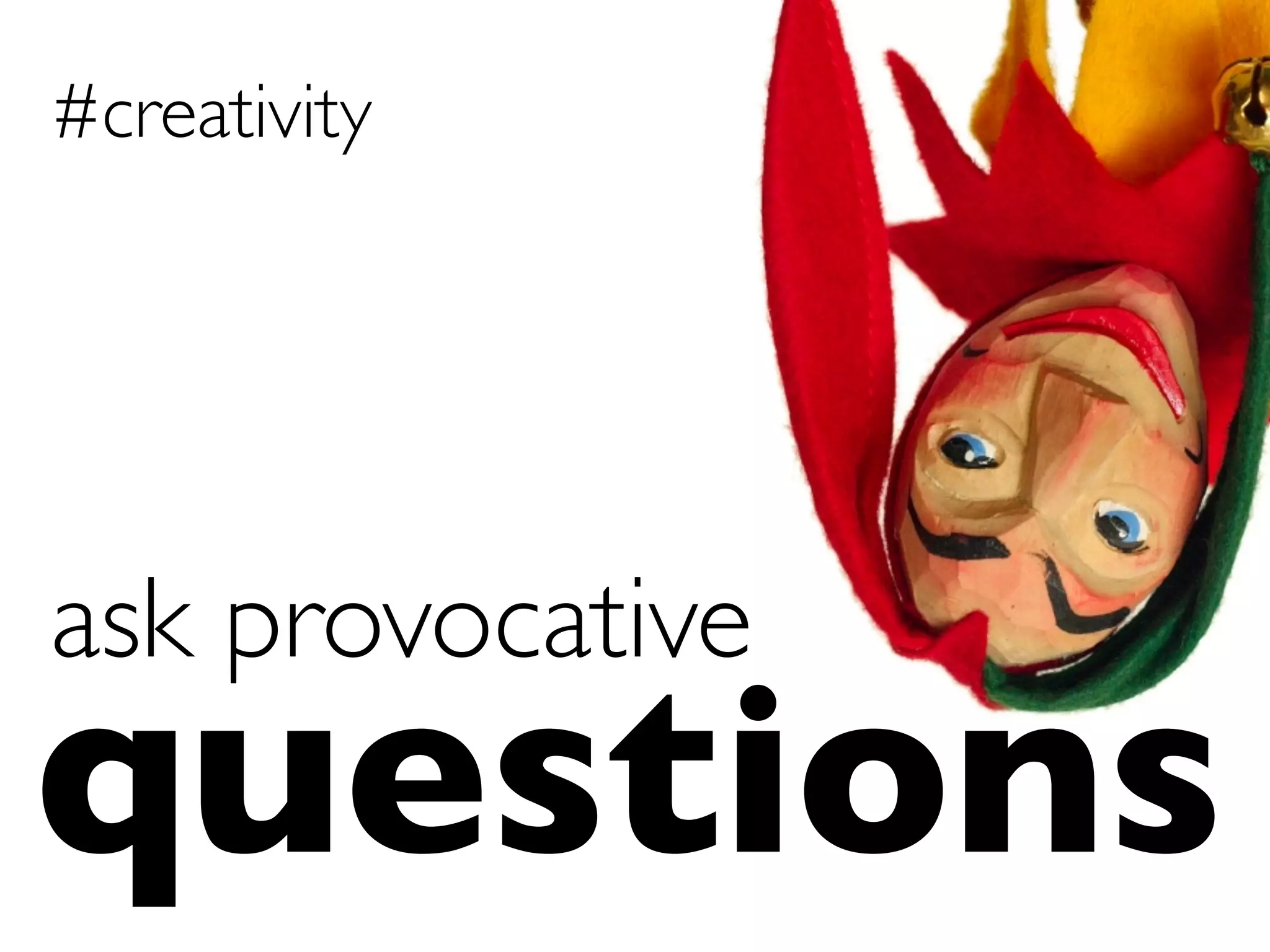
questions	

ask provocative	

#creativity
Don’t be
satisfied 	

with stories,
how things
have gone with
others. 
Unfold your
own myth. 
~Rumi
you were born, raised, educated, and
work in a world smug in its
answers…
man is a rational being
who, if born with a penis, is
considered a boy
schooled in the answers needed to
become a good worker
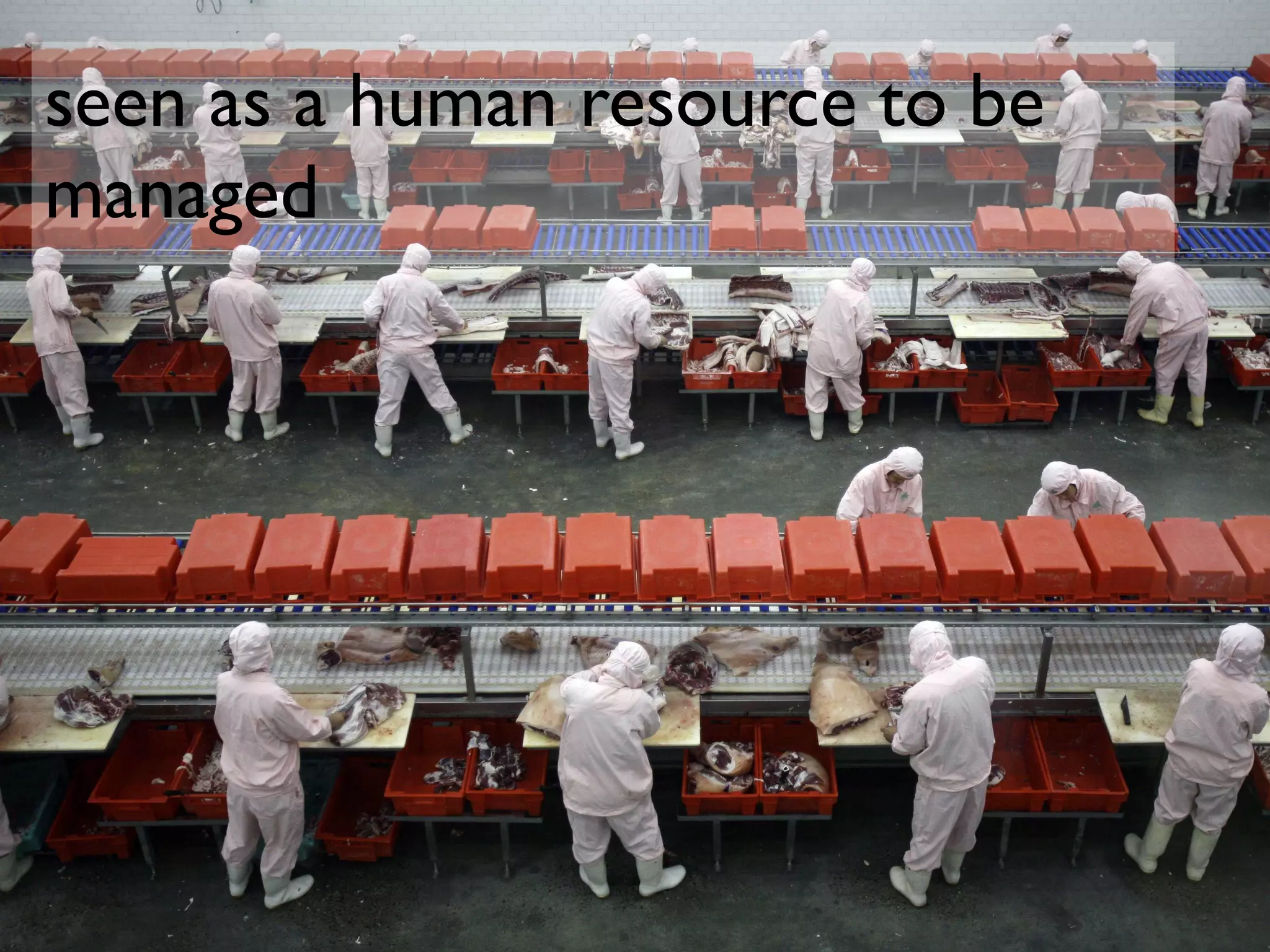
seen as a human resource to be
managed
weaknesses highlighted in an annual
performance review
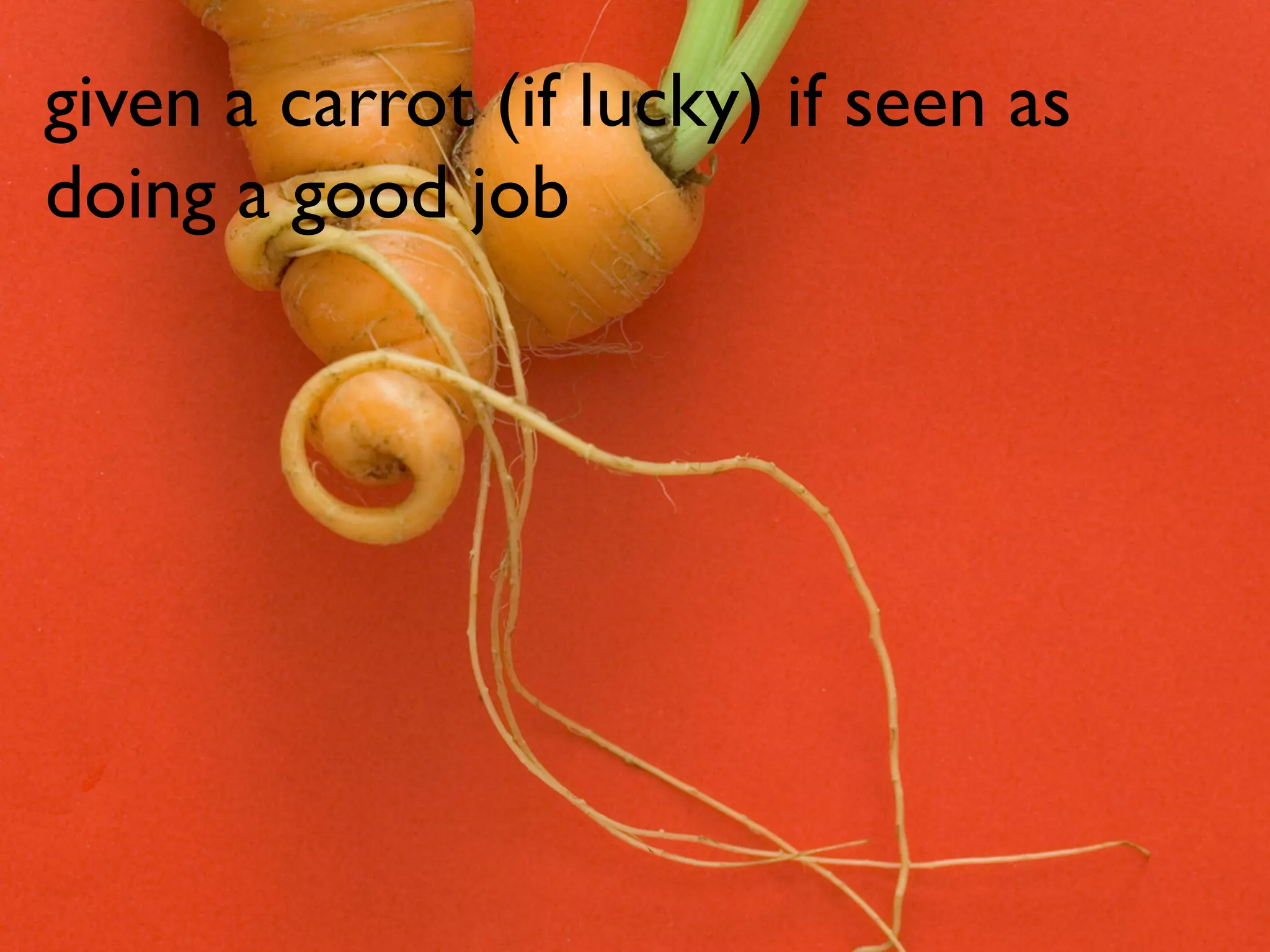
given a carrot (if lucky) if seen as
doing a good job
told to spend spend spend (debt is
no object)
put out to pasture at 65 as no
longer of value
warehoused if difficult to care for
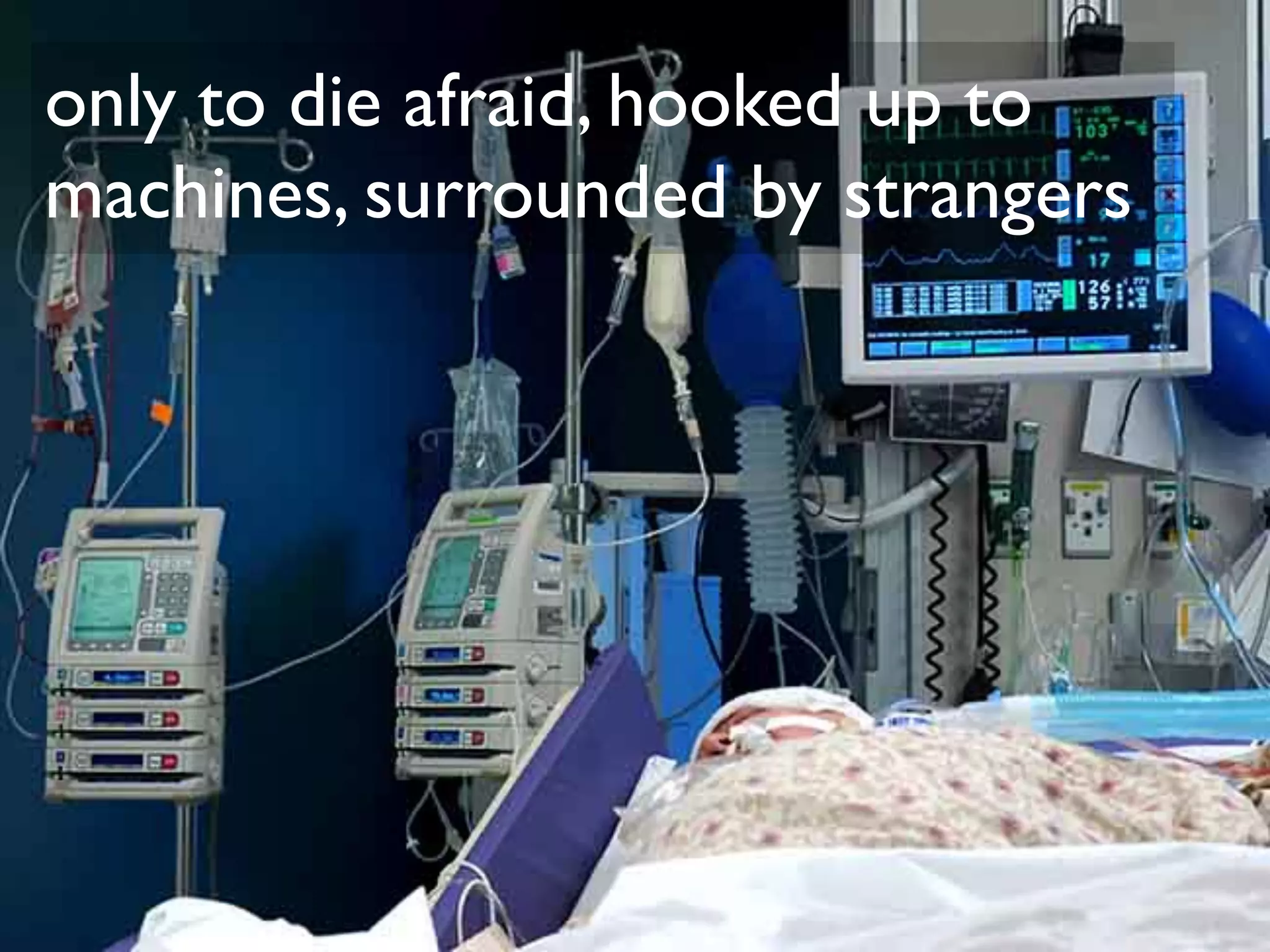
only to die afraid, hooked up to
machines, surrounded by strangers
Western philosophy. Rational economics.
Survival of the fittest. Industrialism. 20th
century management theory. Medicalization
of health. Denial of death.
answer
each of these is an
Do these answers bring you joy?
Help you discover happiness?
Bring a more beautiful world into
being?
?
The consumer economy is sustained by
providing answers.The answer always has a
system quality, because it offers
predictability.Anytime you speak of
answers, you are making a false promise.
The more important dimensions of being
human have no clear answer.
~Peter Block
ANSWERS 
… stifle creativity
… stop thinking in its tracks
… are static and smug
… are endings
… are full of problems
… shut down conversation
… box in space
… freeze history
… stop time
The most interesting thing you can
do in life is really the most natural
thing to do:
call into question the
rules of the game.
~Alan Watts
?question
the answers
?your questions
discover
Why not think of any organization
you're a part of as a unique
medium in which you have the
opportunity to create?
My job was to be loyally
subversive.
~The Creative Paradox, Orbiting the Giant Hairball
Your job is to be loyally
subversive.
Great artists
do not only break the
rules; they redefine them.
~John Kay, Obliquity
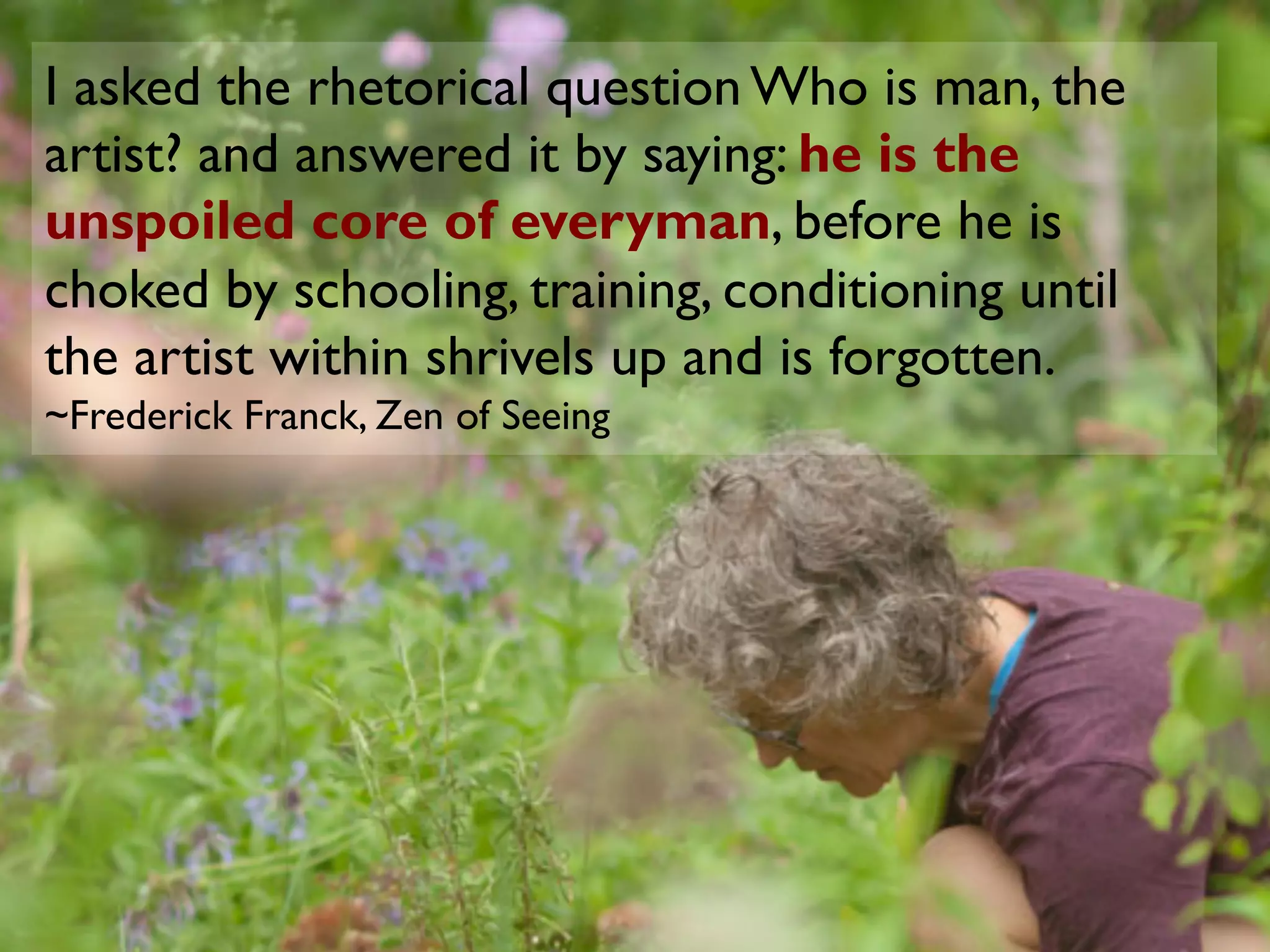
I asked the rhetorical question Who is man, the
artist? and answered it by saying: he is the
unspoiled core of everyman, before he is
choked by schooling, training, conditioning until
the artist within shrivels up and is forgotten.
~Frederick Franck, Zen of Seeing
?artist
you!
The lone, discerning voice has an
effect utterly disproportionate to
its singularity…
Asked at the right time, a
searching question can
make a fortress collapse.
~John O’Donohue
 
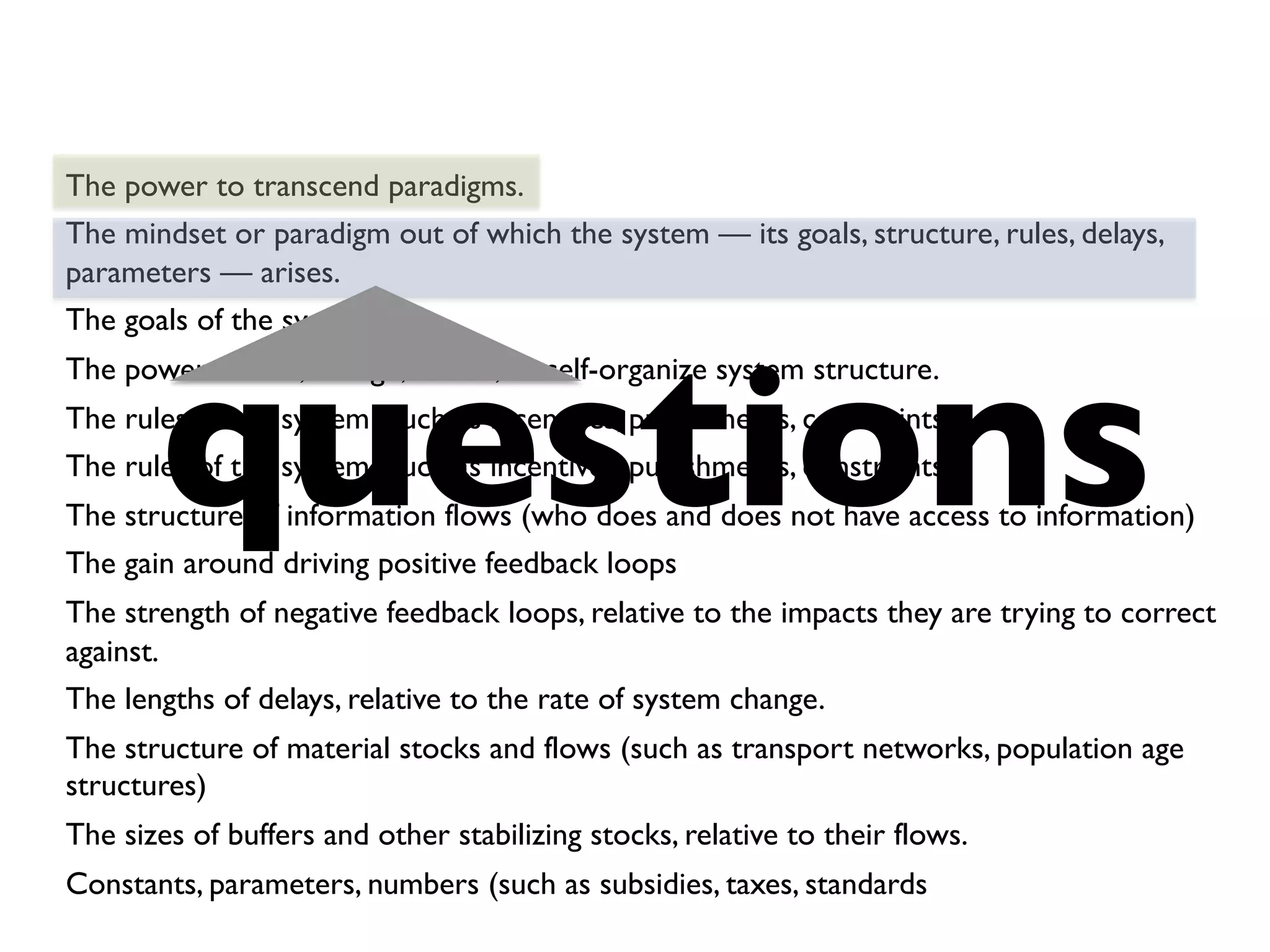
Places to intervene in a system
The power to transcend paradigms.
The mindset or paradigm out of which the system — its goals, structure, rules, delays,
parameters — arises.
The goals of the system
The power to add, change, evolve, or self-organize system structure.
The rules of the system (such as incentives, punishments, constraints)
The structure of information flows (who does and does not have access to information)
The gain around driving positive feedback loops
The strength of negative feedback loops, relative to the impacts they are trying to correct
against.
The lengths of delays, relative to the rate of system change.
The structure of material stocks and flows (such as transport networks, population age
structures)
The sizes of buffers and other stabilizing stocks, relative to their flows.
Constants, parameters, numbers (such as subsidies, taxes, standards
Donella Meadows
individuals
will increasingly reshape institutions rather
than vice versa. […] They will become the
catalysts for much broader changes playing
out across the business and social
landscape.
~Power of Pull
The power to transcend paradigms.
The mindset or paradigm out of which the system — its goals, structure, rules, delays,
parameters — arises.
The goals of the system
The power to add, change, evolve, or self-organize system structure.
The rules of the system (such as incentives, punishments, constraints)
The structure of information flows (who does and does not have access to information)
The gain around driving positive feedback loops
The strength of negative feedback loops, relative to the impacts they are trying to correct
against.
The lengths of delays, relative to the rate of system change.
The structure of material stocks and flows (such as transport networks, population age
structures)
The sizes of buffers and other stabilizing stocks, relative to their flows.
Constants, parameters, numbers (such as subsidies, taxes, standards
questions
?questions	

transform mindsets
transform paradigms
?questions	

how do you discover your
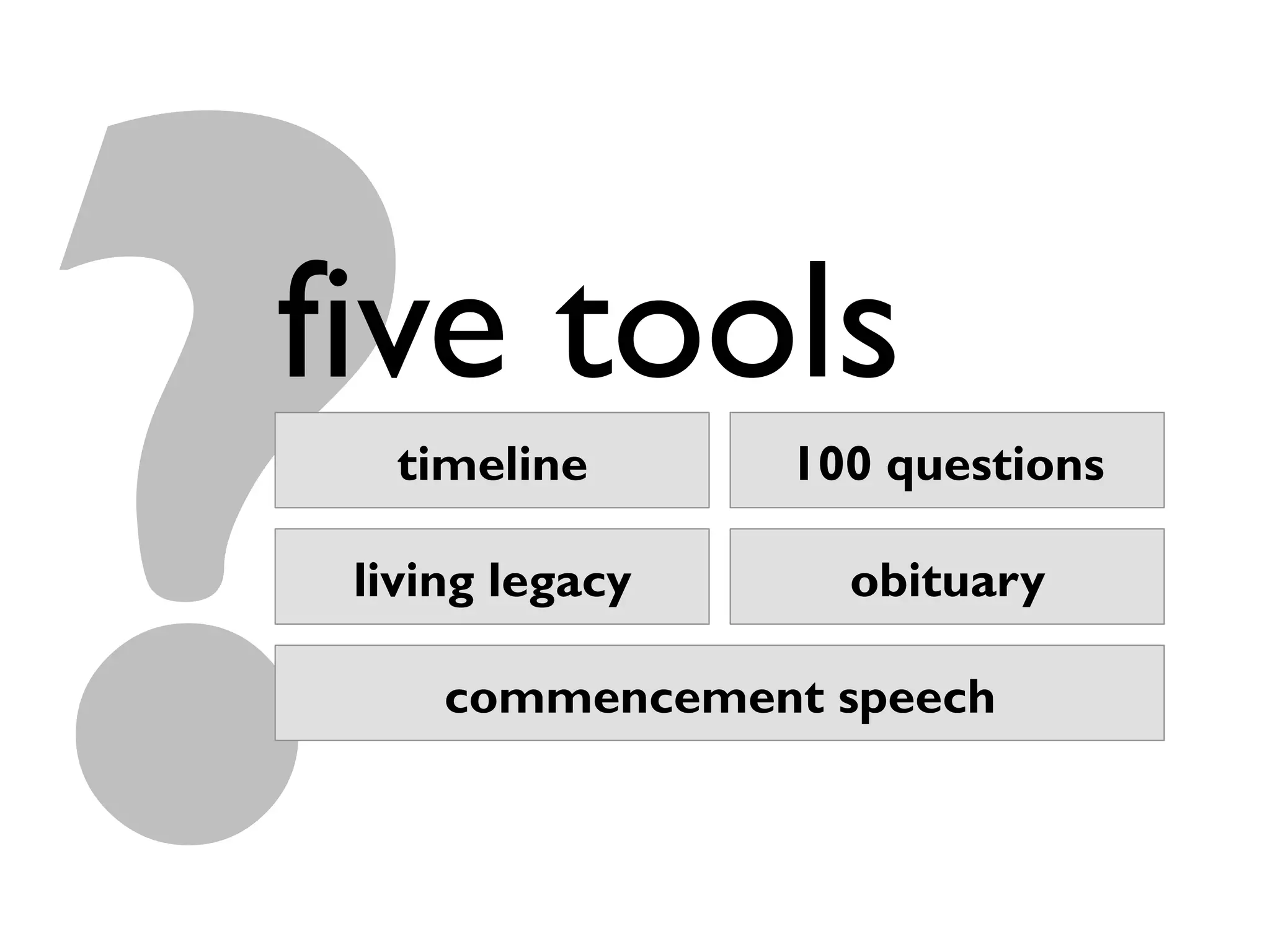
?timeline
living legacy
100 questions
obituary
commencement speech
five tools
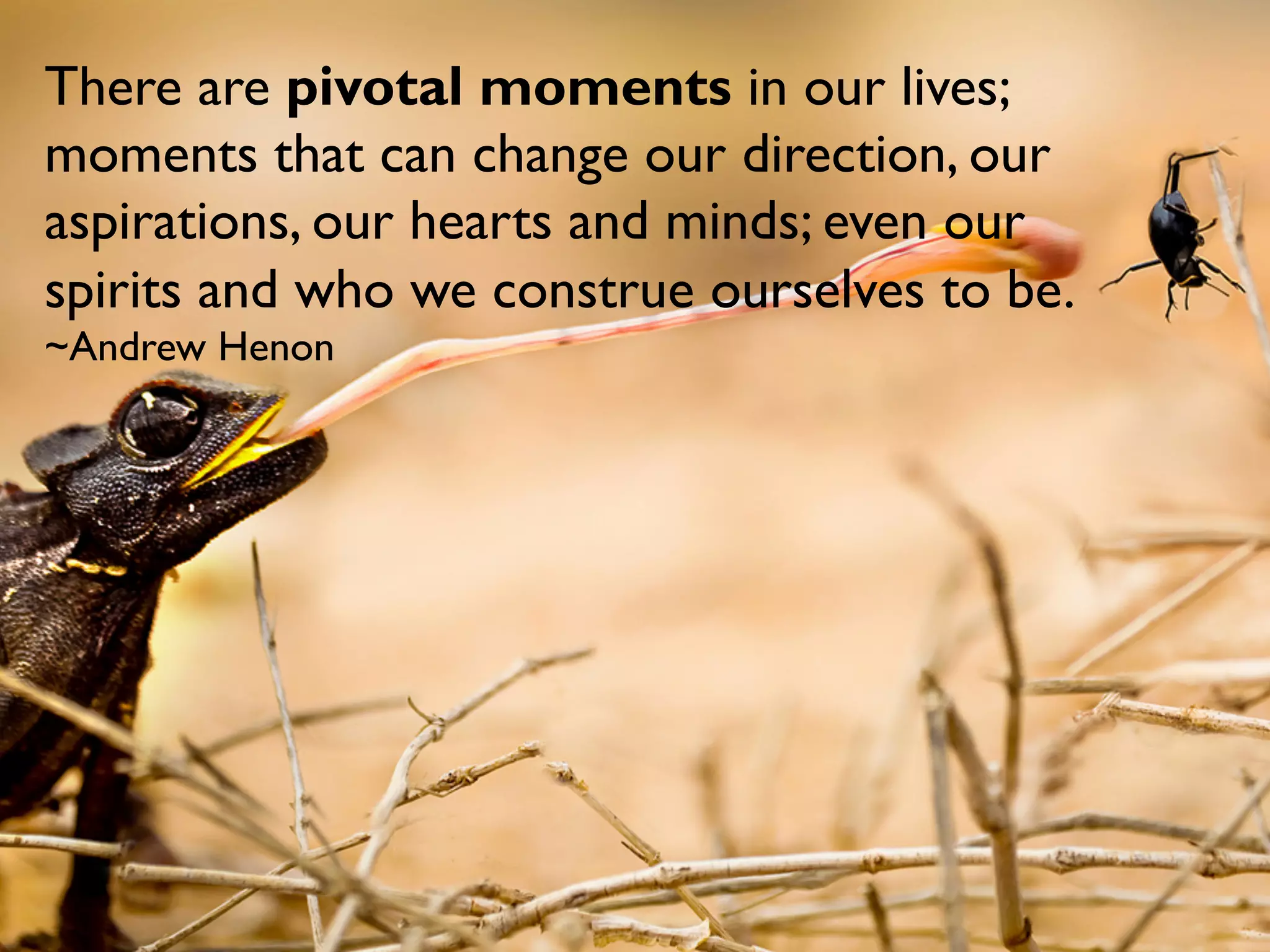
There are pivotal moments in our lives;
moments that can change our direction, our
aspirations, our hearts and minds; even our
spirits and who we construe ourselves to be.
~Andrew Henon
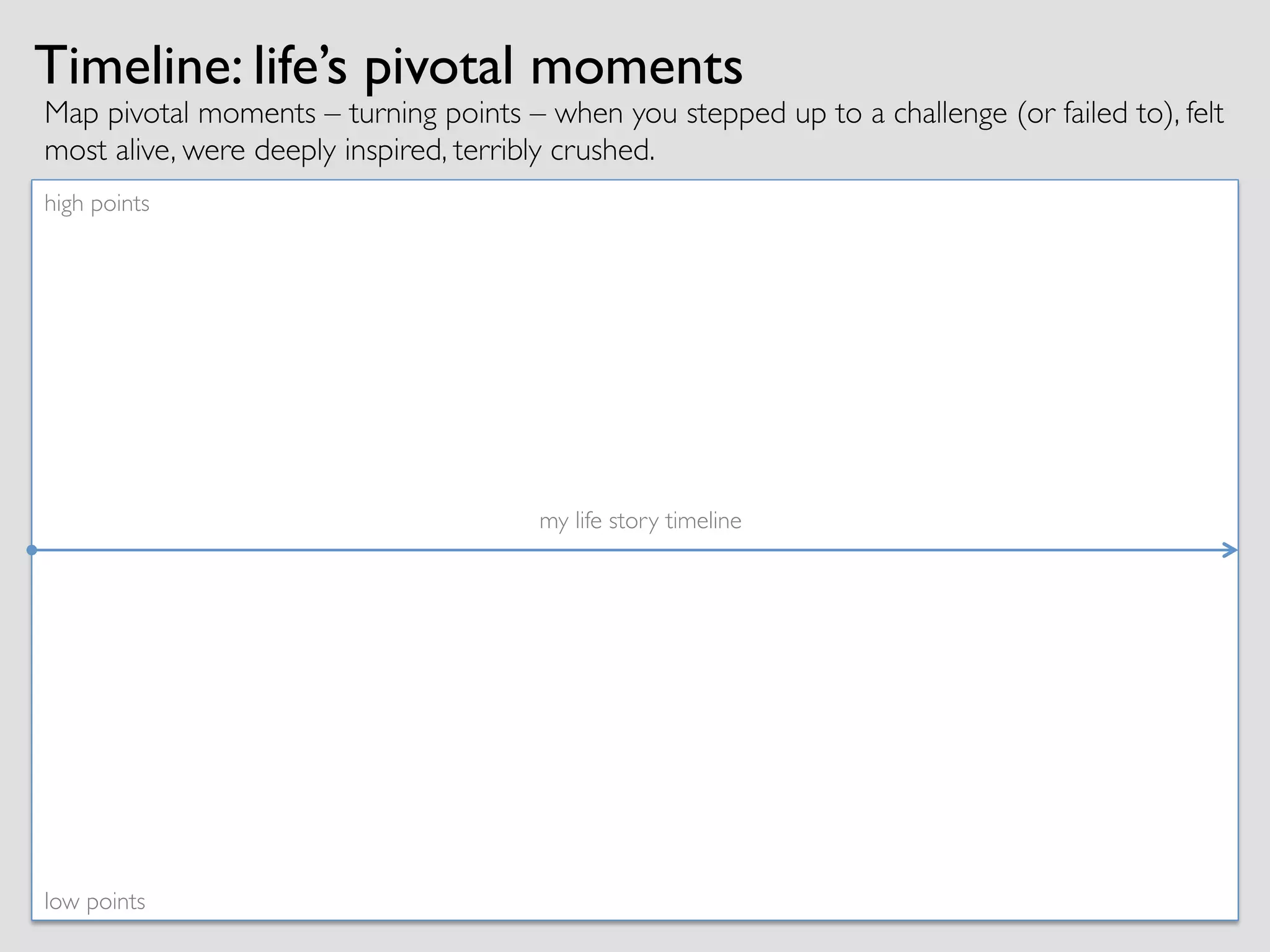
my life story timeline	

low points	

high points	

Timeline: life’s pivotal moments
Map pivotal moments – turning points – when you stepped up to a challenge (or failed to), felt
most alive, were deeply inspired, terribly crushed.
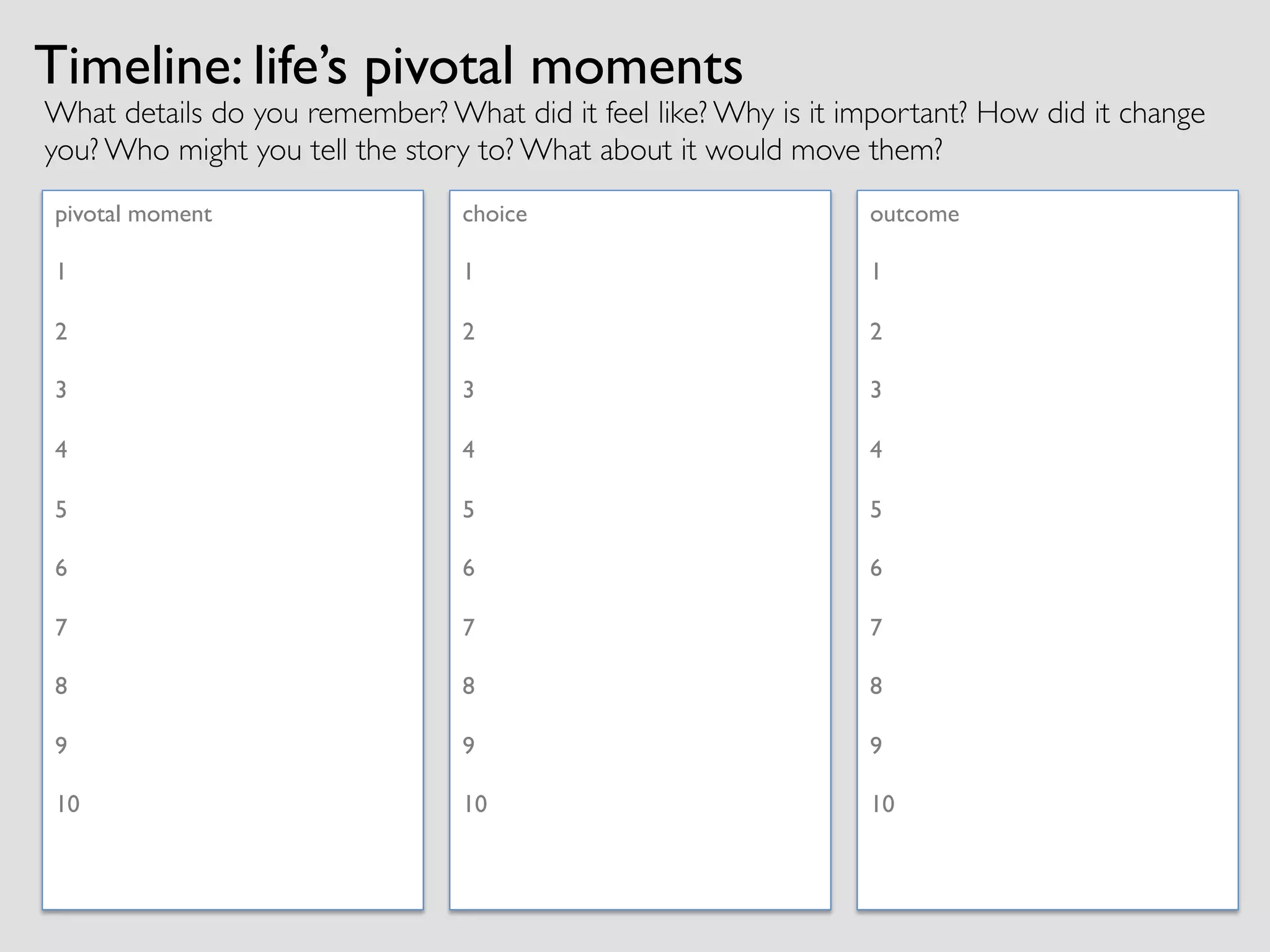
Timeline: life’s pivotal moments
pivotal moment
1
2
3
4
5
6
7
8
9
10
choice
1
2
3
4
5
6
7
8
9
10
outcome
1
2
3
4
5
6
7
8
9
10
What details do you remember? What did it feel like? Why is it important? How did it change
you? Who might you tell the story to? What about it would move them?
low points	

high points	

6 weeks caring for my mother
as she was dying of cancer
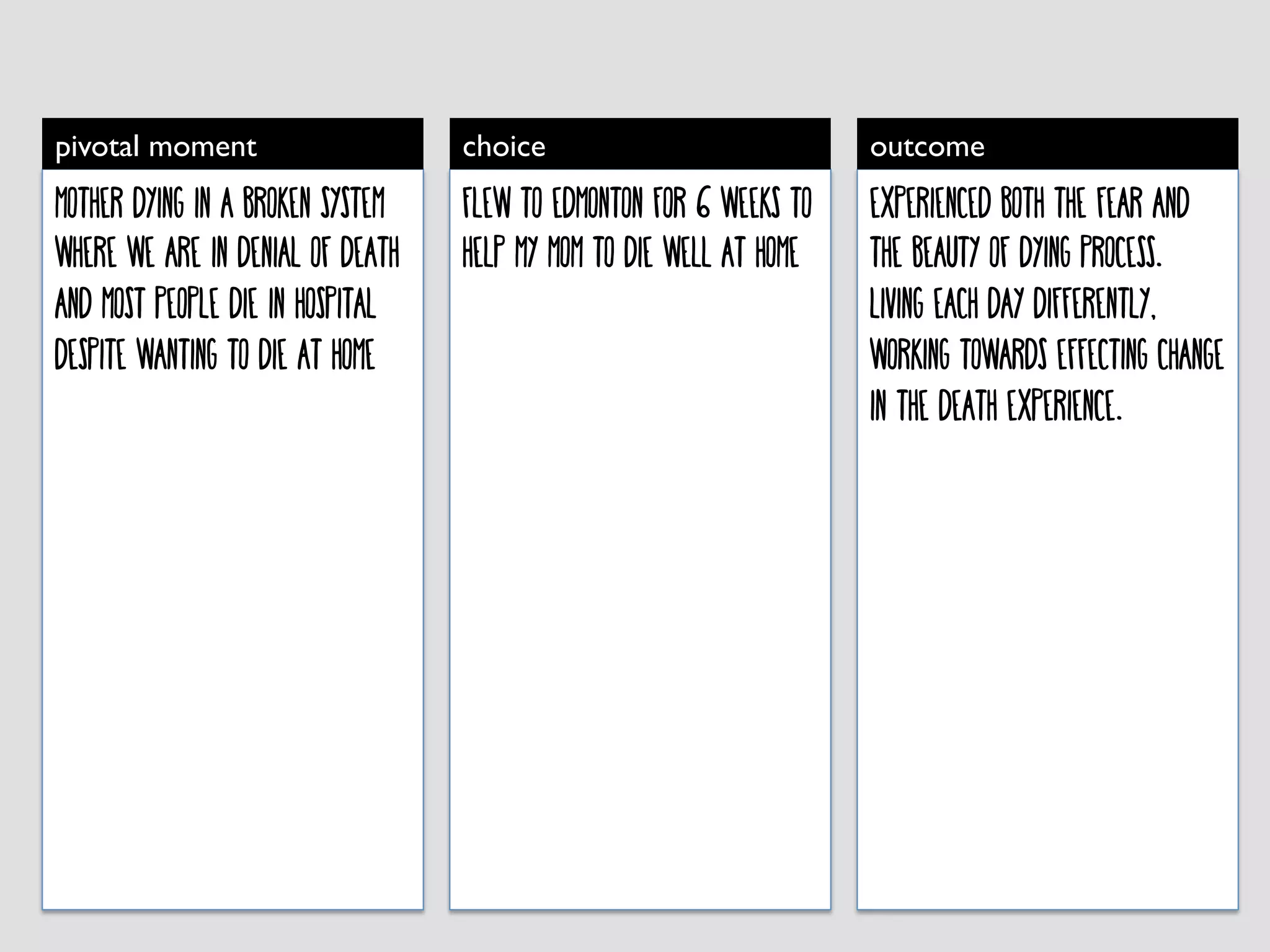
mother dying in a broken system
where we are in denial of death
and most people die in hospital
despite wanting to die at home
flew to Edmonton for 6 weeks to
help my mom to die well at home
Experienced both the fear and
the beauty of dying process.
living each day differently,
working towards effecting change
in the death experience.
pivotal moment choice outcome
How might we rethink the death experience?
We can only connect
the dots that we collect,
which makes everything
you write about you. …
Your connections are the
thread that you weave into
the cloth that becomes
the story that
only you can tell.
~Amanda Palmer
If your timeline is short of dots…
go boldly forth and start collecting!
100 questions
Quickly write 100 questions that feel significant to you. Do the entire list in one sitting.
Without judging, read through and highlight themes that emerge. 	

Choose the 10 that feel the most
significant. Rank from 1-10.
1
2
3
4
5
6
7
8
9
10
Michael Gelb,Think Like DaVinci
Michael Gelb’s 10 questions
When am I most naturally myself - what people, places, activities and circumstances allow me to be most fully
myself?
What is one thing I could stop doing? Start doing? Do differently today that would most improve the quality of my
life?
What is my greatest talent?
How can I get paid for doing what I love?
Who are my most inspiring role models and why?
How can I best serve others?
What is my heart's deepest desire?
How am I perceived by: my closest friends? my worst enemy? my boss? my spouse/partner? children? co-workers?
What are the blessings in my life?
What legacy would I like to leave behind?
Living Legacy: stories creating futures
So many of us have struggled
all our adult lives to improve
the world and in so doing the
lives of today’s children,
tomorrow’s adults.To do so
we have drawn heavily on
external sources of
knowledge, insight and
reliable generalisation, all too
often, ignoring the
authenticity and richness of
our own experience and
resulting ‘knowing’.Yet, in our
practice, again and again,
theories have been tried,
tested, refined and re-
hypothesised.Yes, we embody
the totality of years of
enquiry, study, reflective
practice and knowledge
chiselled into every aspect of
our beings.
~Andrew Henon,Teacher
Living Legacy: stories creating futures
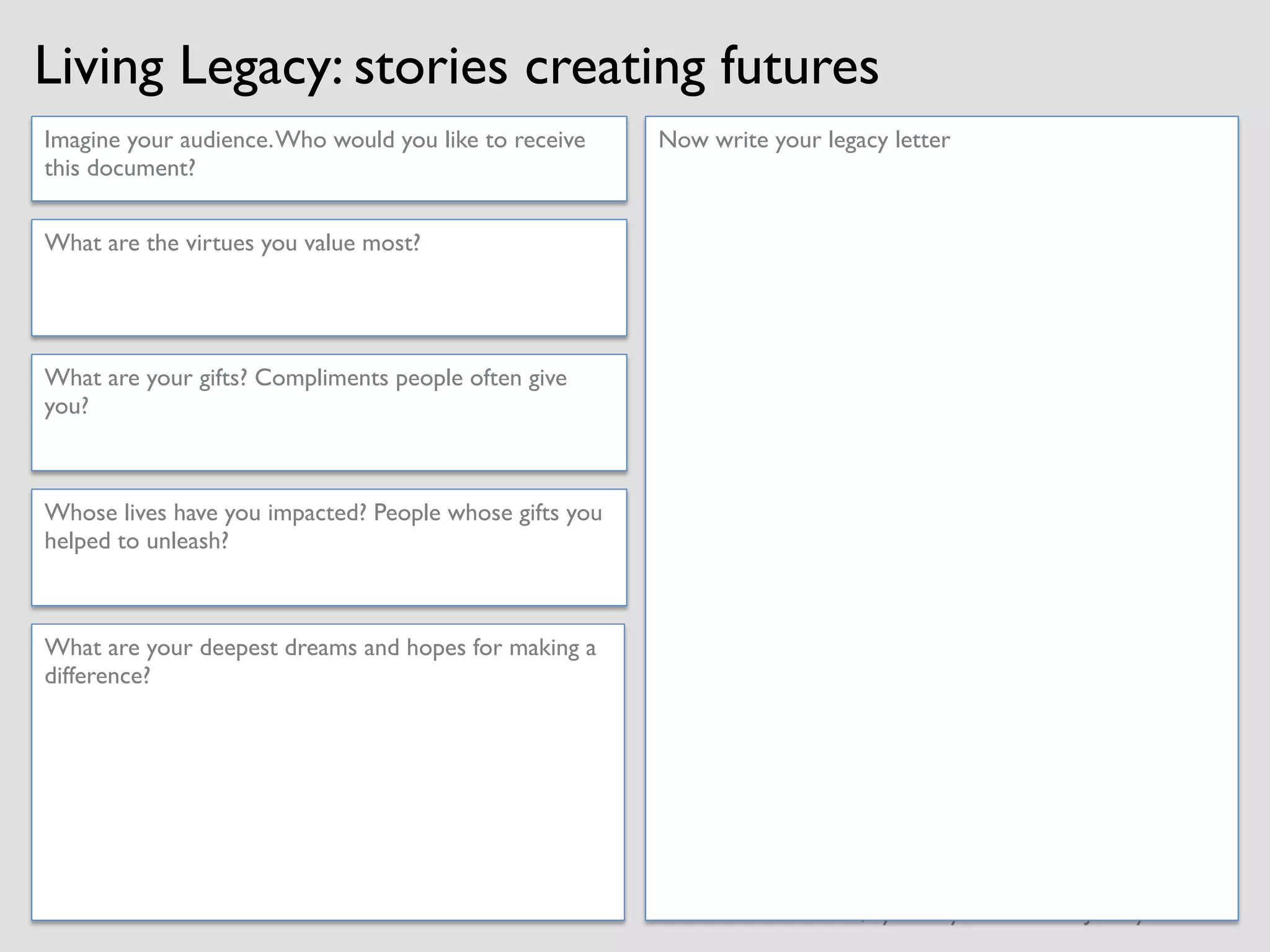
What are your deepest dreams and hopes for making a
difference?
Imagine your audience.Who would you like to receive
this document?
The Last Lecture, by Randy Pausch and Jeffrey Zaslow
What are the virtues you value most?
Now write your legacy letter
What are your gifts? Compliments people often give
you?
Whose lives have you impacted? People whose gifts you
helped to unleash?
Ask someone you trust who knows you well
What is the story I’m telling?
Randy Pausch’s Living Legacy:The Last Lecture
https://youtu.be/ji5_MqicxSo
The key question
to keep asking is:
Are you spending
your time on the
right things? Because
time is all you have.
~Randy Pausch
Obituary: what if you wrote your own?
Write your obituary based on how you are living your
life right now, assuming no risk.
Answer the question “What’s worth doing even if I fail?”
What do you want people to remember or do as a
result of your life story? Write a second obituary
assuming you are living that life.
One day I sat down and wrote
two versions of my obituary.The first
was the one that I wanted to have. I thought
of the obituaries that I enjoyed reading, the
people that I admired.They were the
adventurers and risk-takers… They lived life
with a greediness for new experiences, and
gumption, and a gung-ho attitude that defied
the attempts of naysayers and nigglers to
pigeonhole them or put them down.These
people really knew how to live.The second
version was the obituary that I was heading
for – a conventional, ordinary life – pleasant
and with its moments of excitement, but
always within the
safe confines of normality.
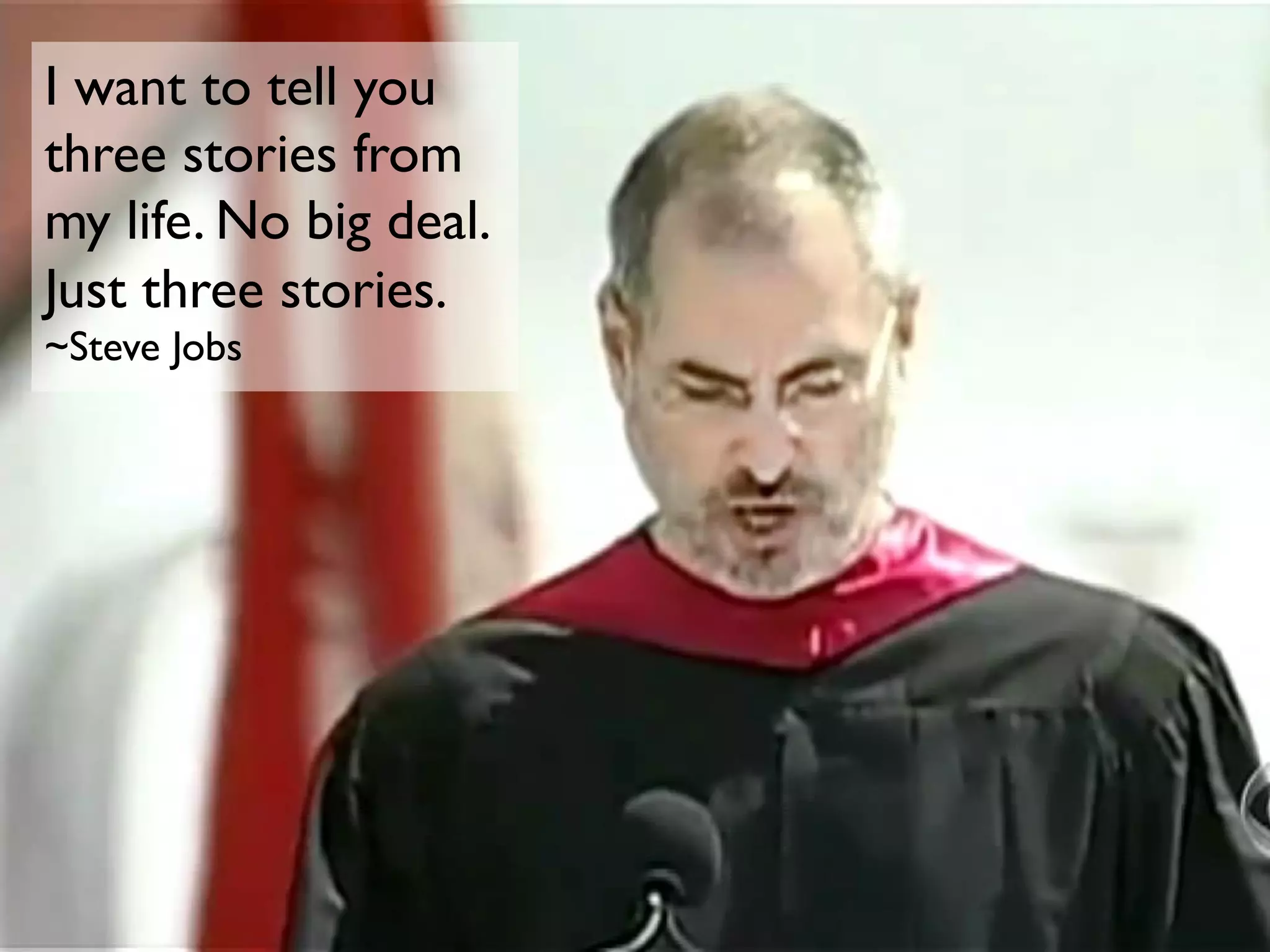
I want to tell you
three stories from
my life. No big deal.
Just three stories.
~Steve Jobs
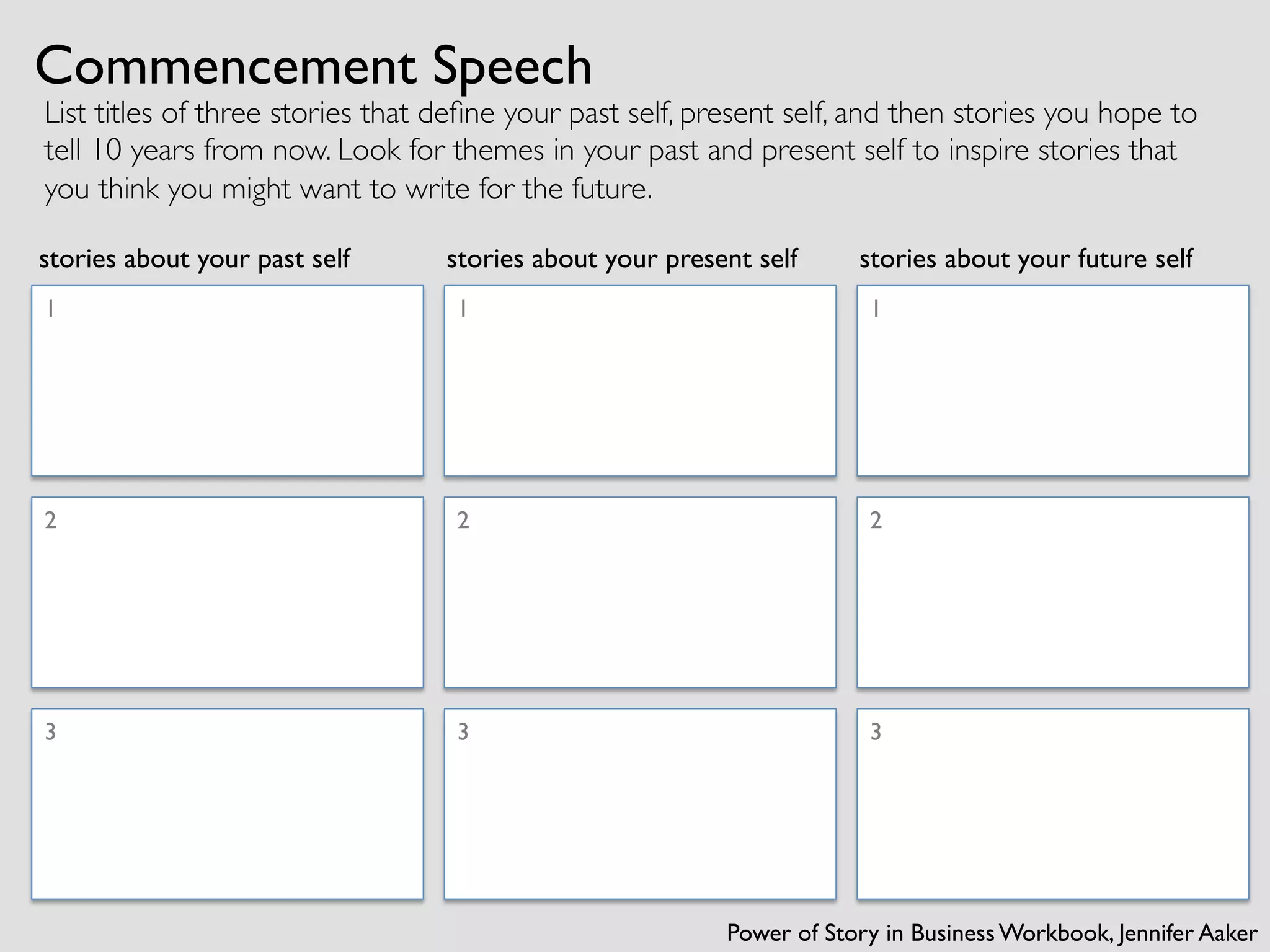
Commencement Speech
List titles of three stories that define your past self, present self, and then stories you hope to
tell 10 years from now. Look for themes in your past and present self to inspire stories that
you think you might want to write for the future.	

1 1
2 2
3 3
1
2
3
stories about your past self stories about your present self stories about your future self
Power of Story in Business Workbook, Jennifer Aaker
Commencement Speech
Now imagine yourself 10 years in the future.You just received an invitation to give a
commencement speech. Share a story about your life, something that would inspire the
graduates.
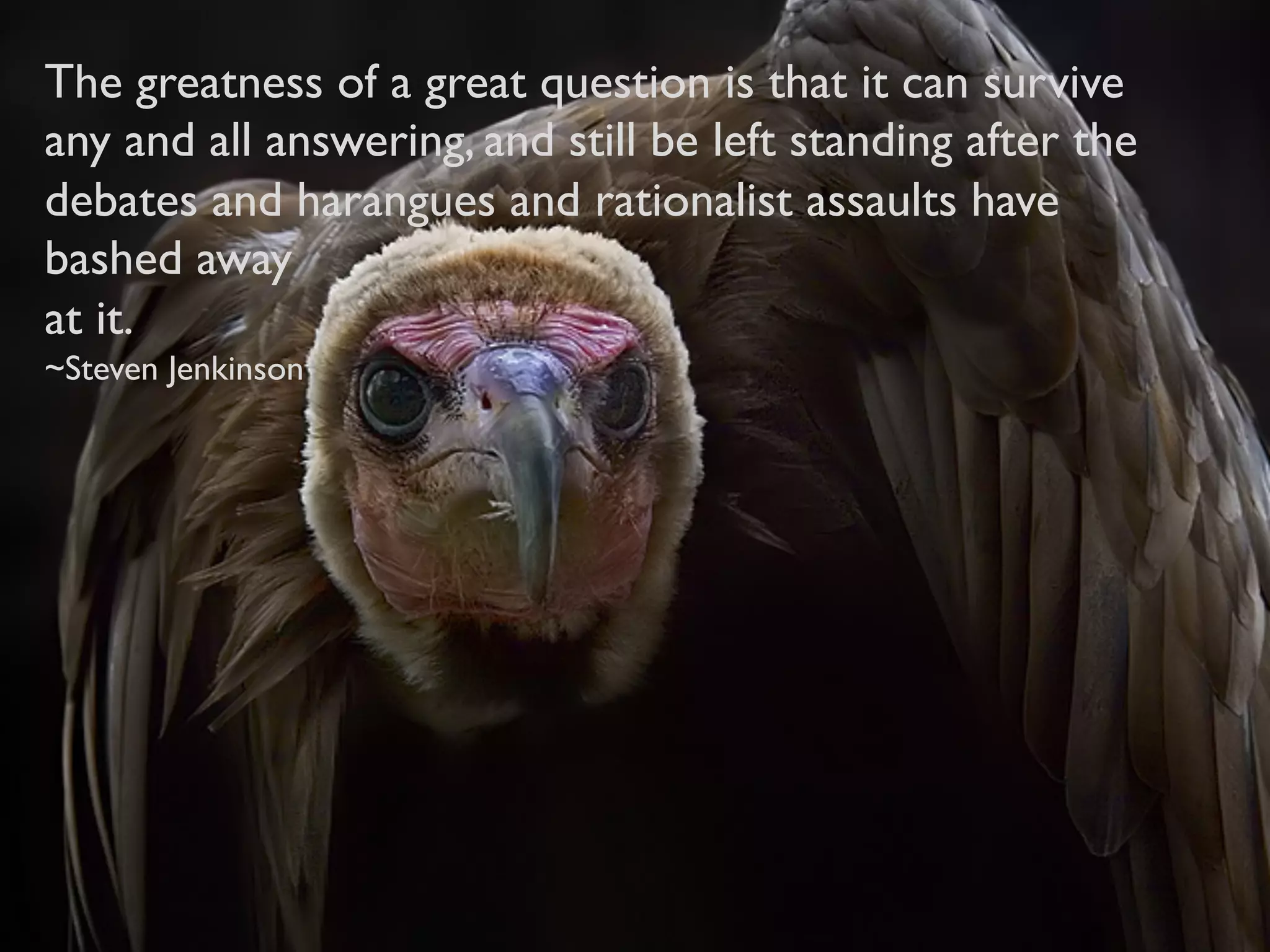
The greatness of a great question is that it can survive
any and all answering, and still be left standing after the
debates and harangues and rationalist assaults have
bashed away
at it.
~Steven Jenkinson
So here’s the thing about changing the world. It turns out
that’s not even the question, because you don’t have a
choice. You are going to change the world, because
that is actually what the world is. You do not pass
through this life, it passes through you.You experience it,
you interpret it, you act, and then it is different.That
happens constantly.
You are changing
the world. 	

~Joss Whedon
[Creativity] endeavors to bring some of our hidden life to expression in order that
we might come to see who we are.When we are creative, we help the unknown to
become known, the visible to be seen and the rich darkness within us to become
illuminated. … Each of us is emerging in every moment.When we discover our
creativity, we begin to attend to this constant emergence of who we are... Beneath
that white page, in the stillness, a harvest of untouched possibility waits.
~John O’Donohue
?(re)frame	

answers that constrain
?questions	

that make the impossible possible
find the
poverty is
condition
difficult to exit
how can we
help the
needy?
a woman with
courage and a
dream, but
little money
how might we
support her
journey
towards
realizing her
dreams?
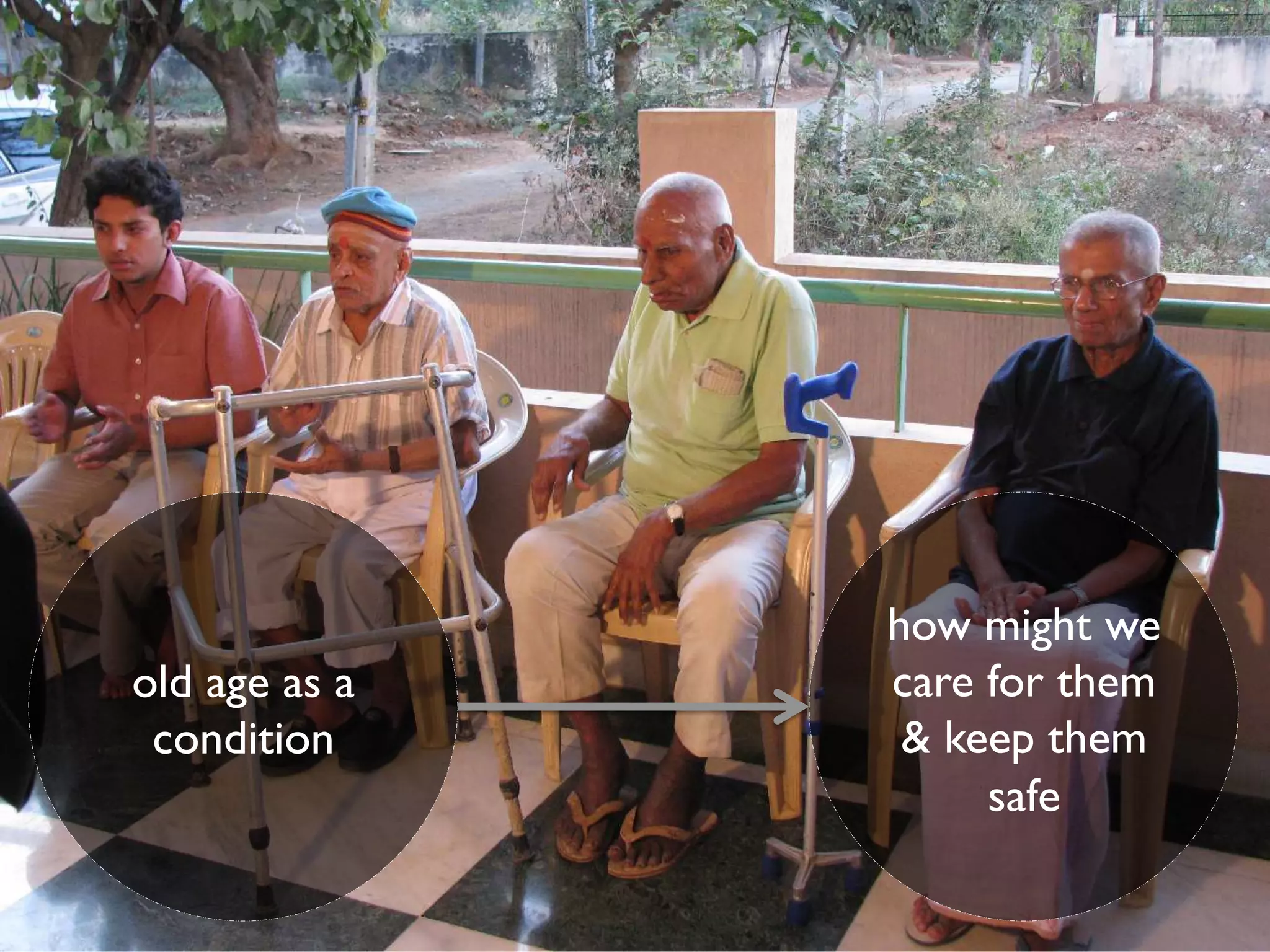
old age as a
condition
how might we
care for them
 keep them
safe
a man in
yearning to
contribute his
life learnings in
his final stage
of life
how might
they continue
to contribute
their gifts in
the last stage
of their life?
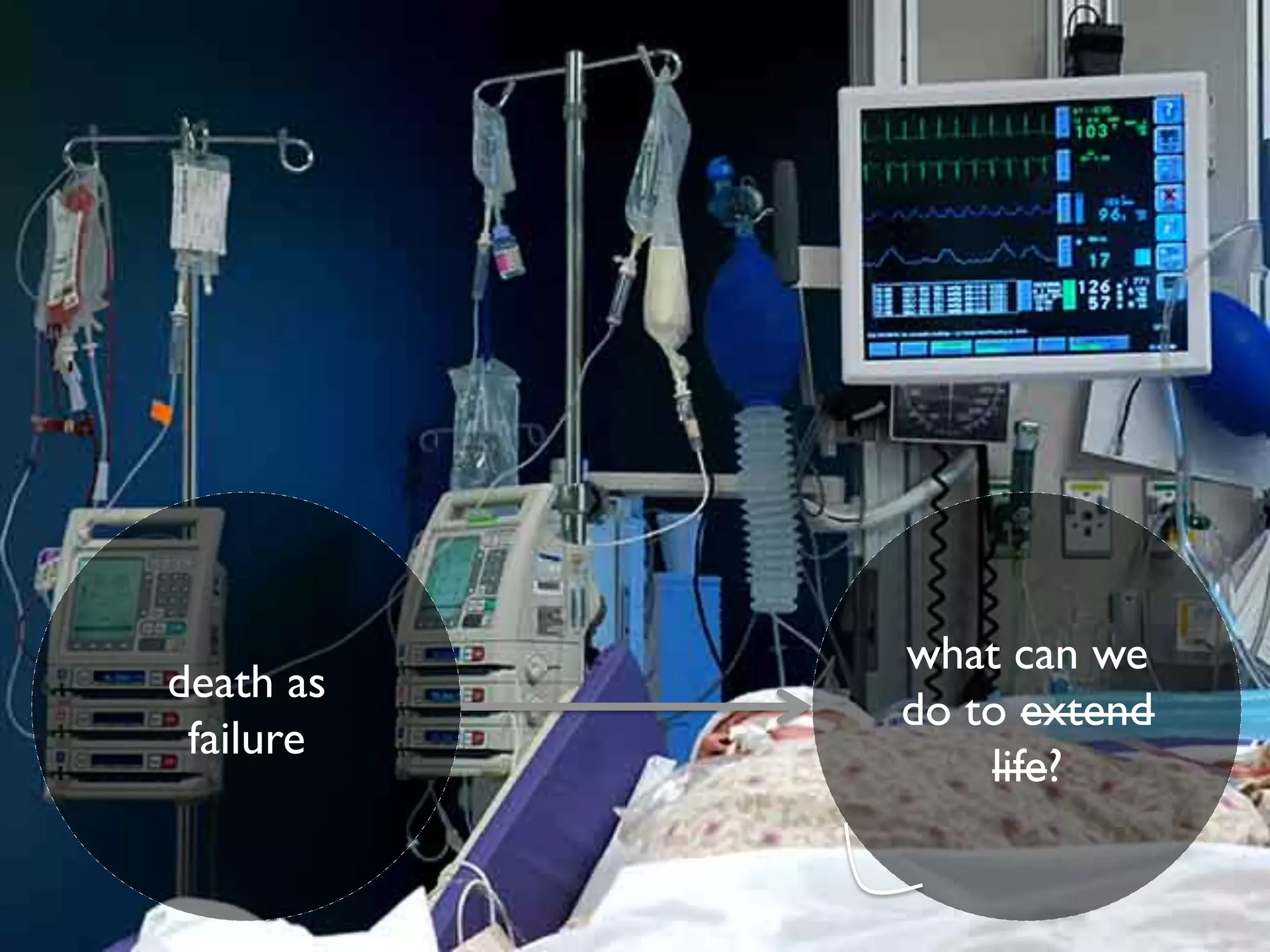
death as
failure
what can we
do to extend
life?
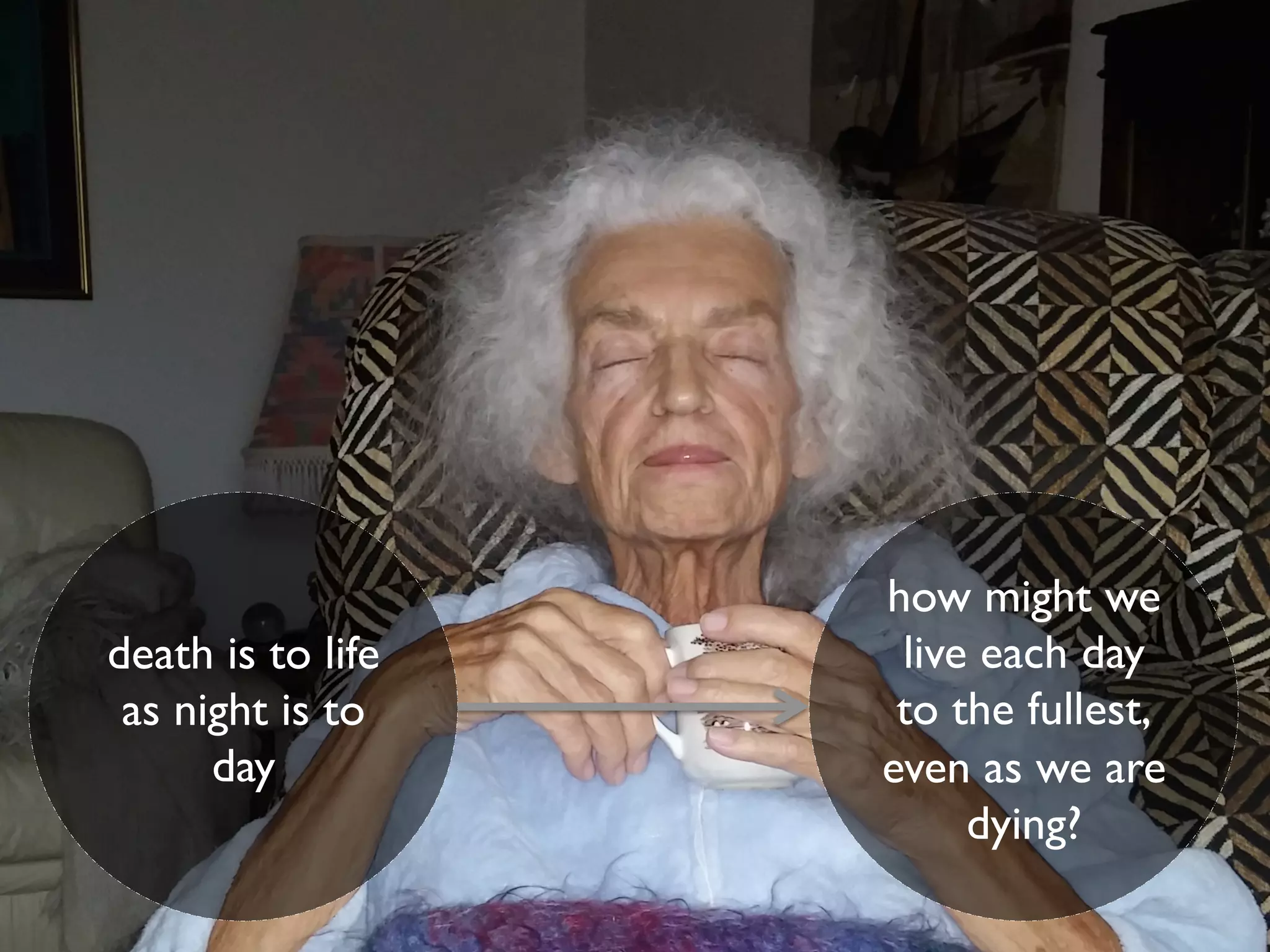
death is to life
as night is to
day
how might we
live each day
to the fullest,
even as we are
dying?
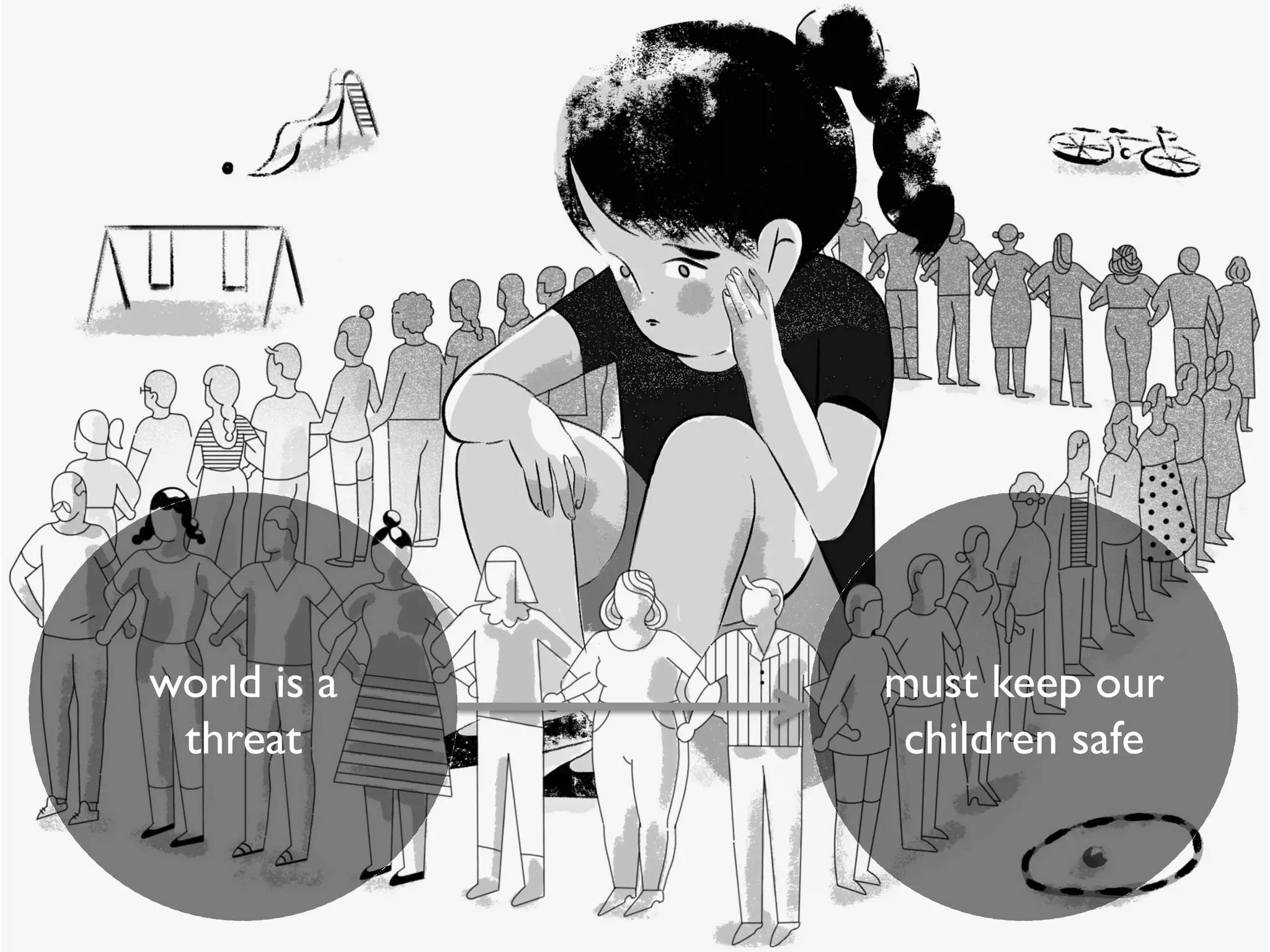
world is a
threat
must keep our
children safe
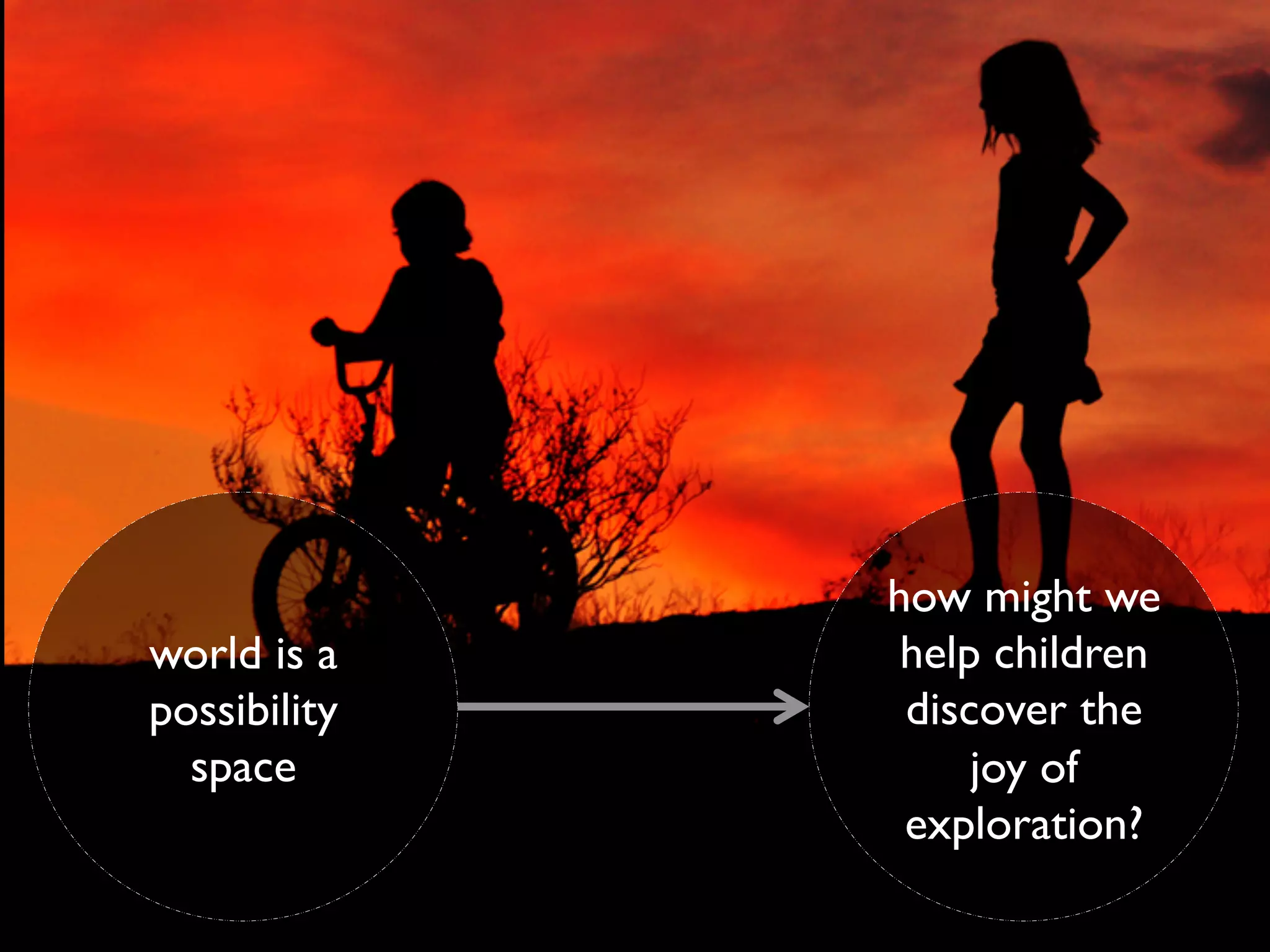
world is a
possibility
space
how might we
help children
discover the
joy of
exploration?
employees as
human
resources
we must drive
productivity,
efficiency, and
performance
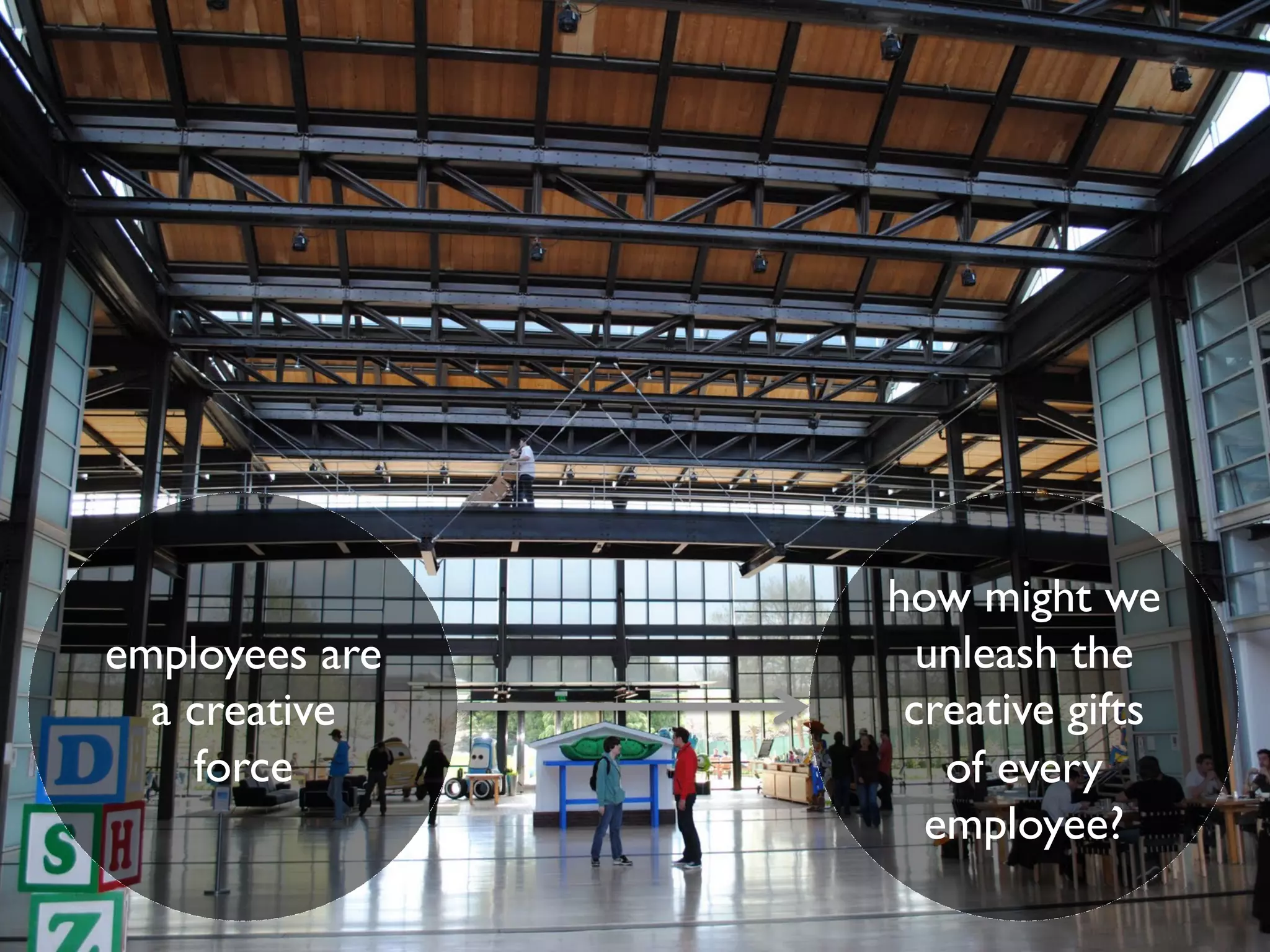
employees are
a creative
force
how might we
unleash the
creative gifts
of every
employee?
QUESTIONS
…spark creativity
…generate thinking
…are provocative and dynamic
…are beginnings 	

…are full of possibilities	

…invite conversation	

…open space	

…create history	

…make time permeable
don’t think
The intellect is a great danger to creativity … because you begin to rationalize
and make up reasons for things, instead of staying with your own basic truth
— who you are, what you are, what you want to be. I’ve had a sign over my
typewriter for over 25 years now, which reads “Don’t think!” You must
never think at the typewriter — you must feel… The worst thing you do
when you think is lie — you can make up reasons that are not true for the
things that you did, and what you’re trying to do as a creative person is
surprise yourself — find out who you really are, and try not to lie, try to tell
the truth all the time.And the only way to do this is by being very active and
very emotional, and get it out of yourself — making things that you hate and
things that you love…
~Ray Bradbury
feelquestions
No more words. Hear only the
voice within.
~ Rumi
cultivate
curiosity
Curiosity might be
pictured as being made
up of chains of small
questions extending
outwards, sometimes
over huge distances,
from a central hub
composed of a few
blunt, large questions.
~Alain de Botton
Observe for a day
Choose a theme for the day (one of your questions or
anything of interest) and record observations in your
notebook.Aim for accurate, simple observations.Write.
Sketch. Speculation, opinion, and theory are also ok.
Contemplate a question
Find a quite place to sit. Hang your question in front of you. Set a
timer for 10 minutes. Relax, breath deeply, and sit with your question.
If your mind wanders, bring it back by reading the question again, out
loud.Try doing this before going to sleep and again when you wake up.
Explore using stream of consciousness
Set a timer for between 10 minutes and an hour. Choose any question and
write. Don’t judge, censor, hesitate. Keep your pen moving until the time is
up.Take a break. Highlight the words or phrases that speak to you most
strongly. Look for themes and more questions. Repeat.
83
Make a collage (team)
Send out your team to investigate the question space. Interview  observe
people. Read widely and collect inspiration. Create colleges of learnings,
then present and discuss. Make sense as a collective of all you’ve learned.
What assumptions? What’s the story? What frame will you place around
your question? How will you reword it? What will you include in the frame?
What will you exclude? What new words or phrases will you use to capture
the possibility space? For words  frames are powerful weapons.
create
prototypes
All life is an
experiment.
The more
experiments you
make the better.
~Ralph Waldo Emerson
So, whenever you’re faced with
something labeled a problem,
what question
should you ask?
?WHY
	

WHY
WHY
WHY
WHY
the way you
ask the
question is
the frame in
which the
answers will
fall
bigger box
box
smaller box
smaller
different
box
bigger
different box
different
box
smaller
biggerdifferent
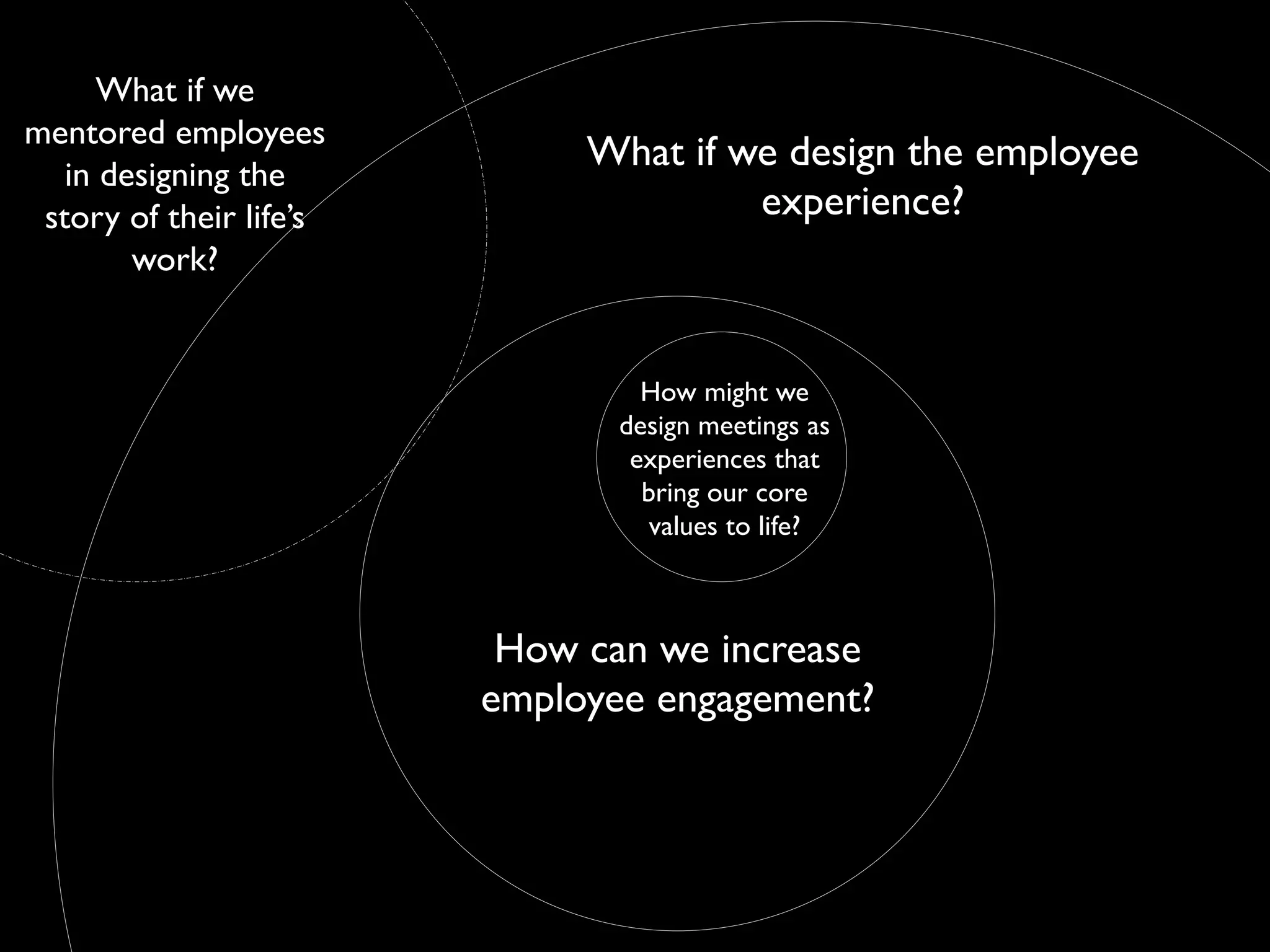
What if we
mentored employees
in designing the
story of their life’s
work?
How can we increase
employee engagement?
How might we
design meetings as
experiences that
bring our core
values to life?
What if we design the employee
experience?
As soon as we label something, we put
it in a box and move it to another part
of our brain.We stop seeing it as it
really is.
~Marty Neumeier
different box
thinking
different
bigger box
smaller
different
box
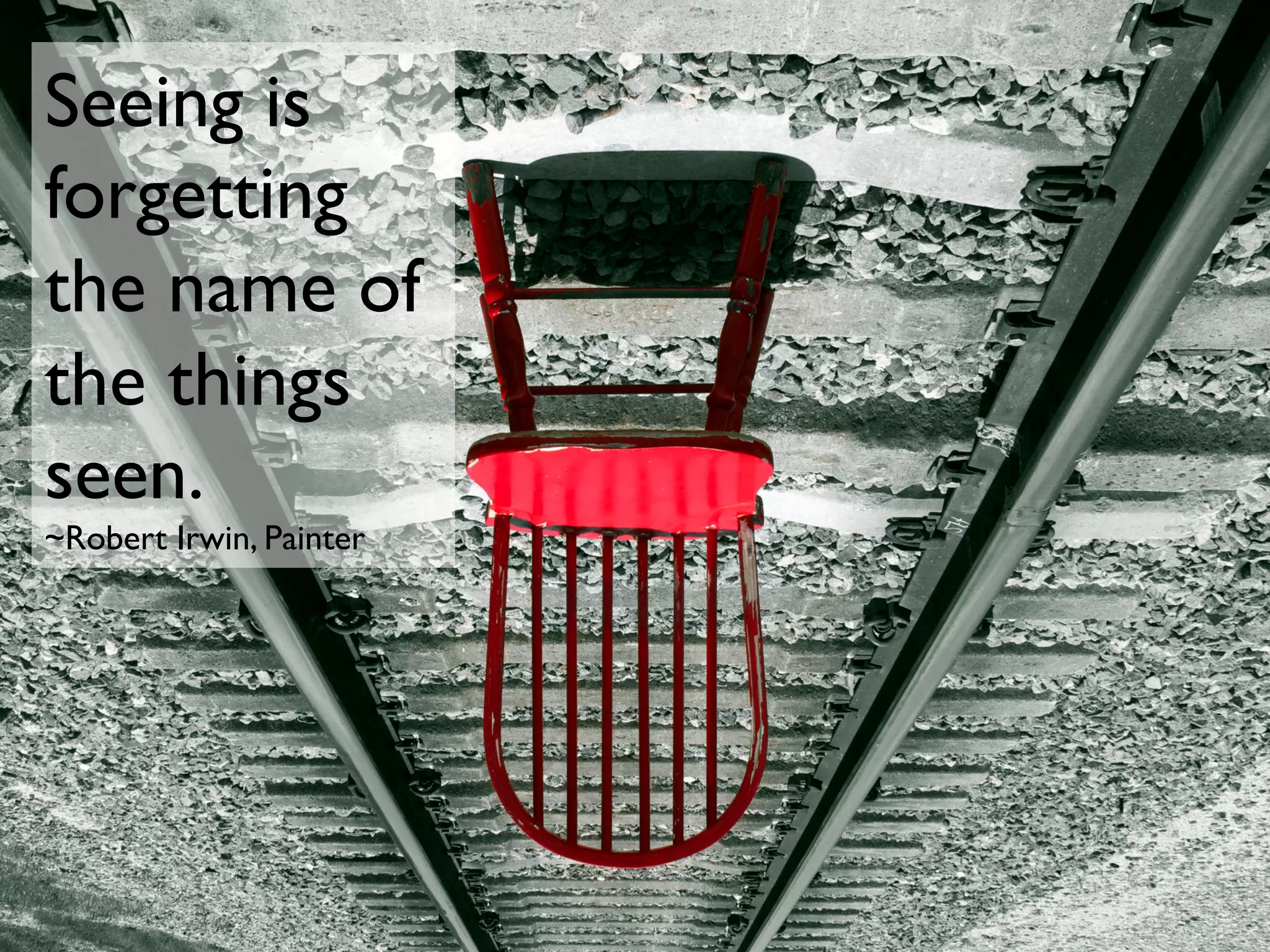
Seeing is
forgetting
the name of
the things
seen.
~Robert Irwin, Painter
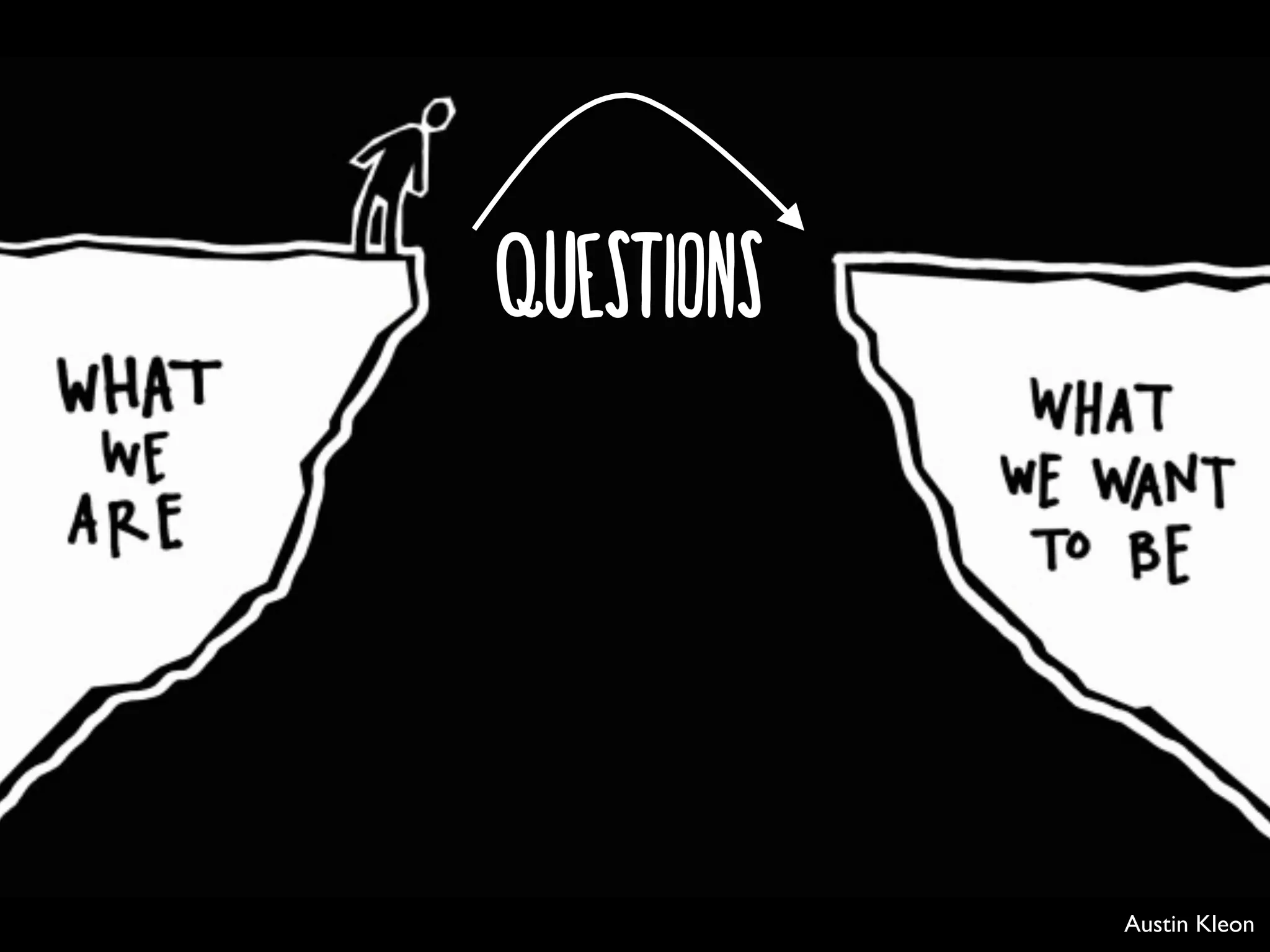
questions
Austin Kleon
stop
worrying about finding your
passion
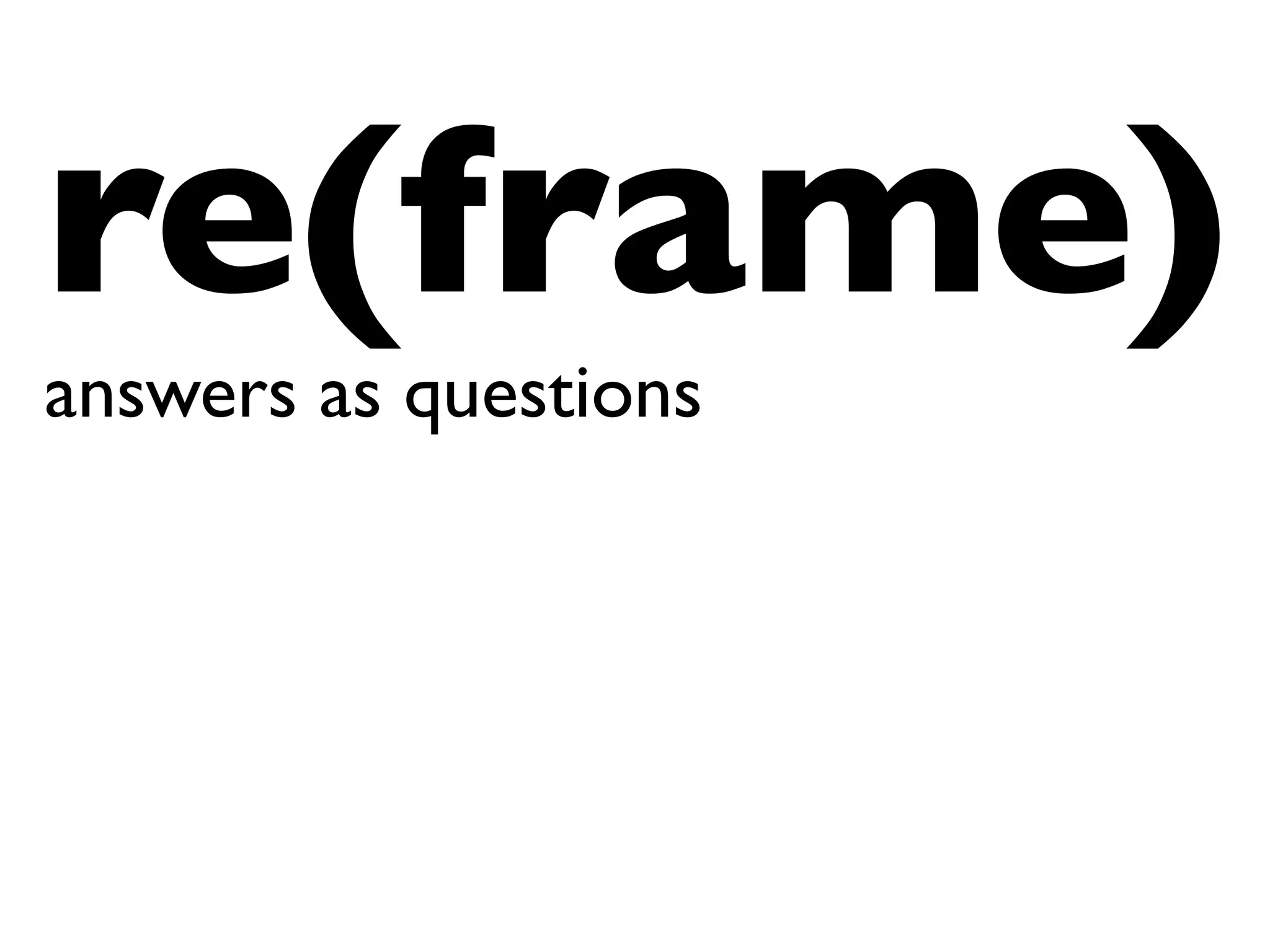
re(frame)
answers as questions
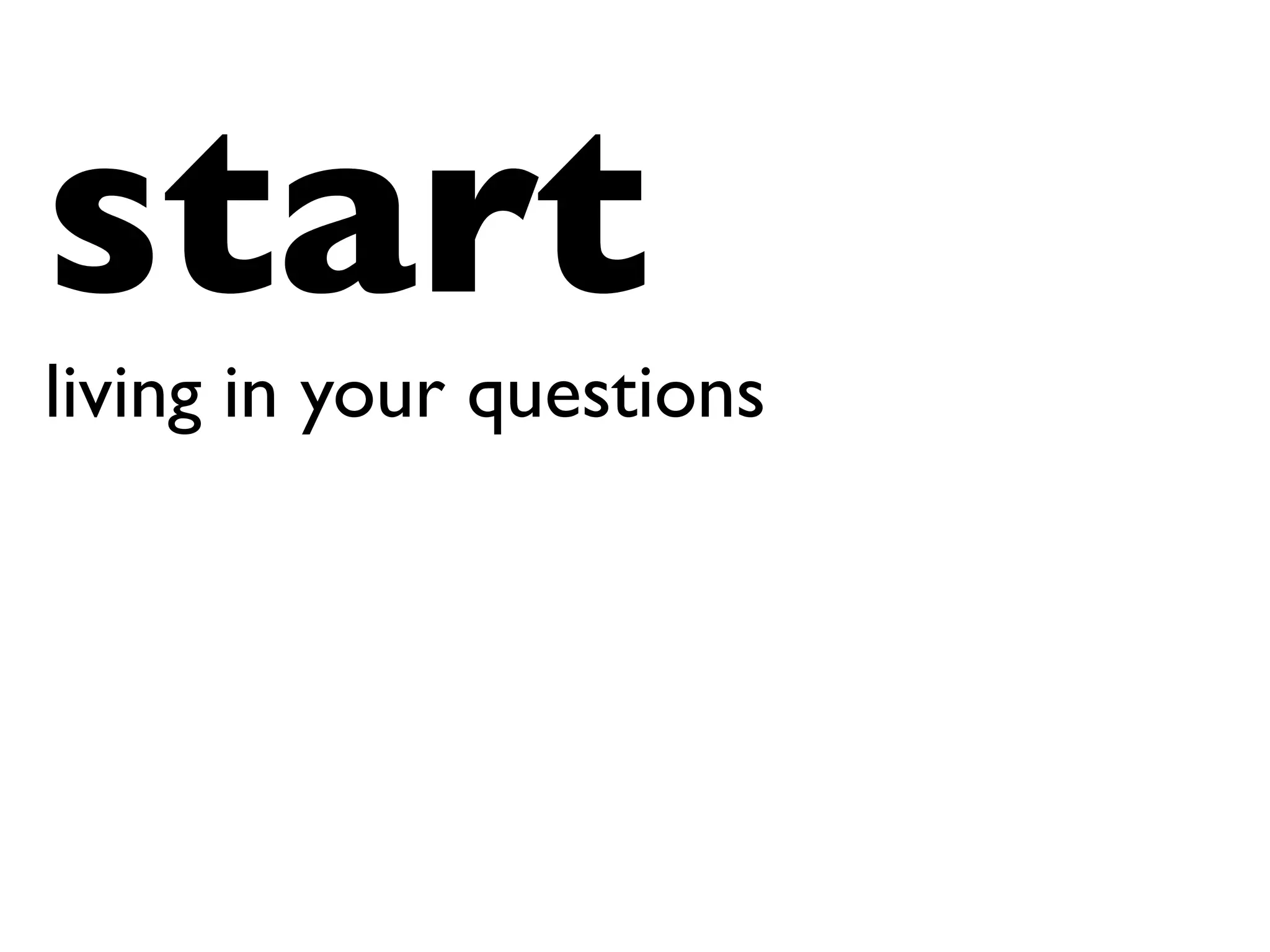
start
living in your questions
We live in the world our
questions create.
~David Cooperrider
Live your
questions now,
and perhaps even
without knowing
it, you will live
along some
distant day into
your answers. 
~Rilke
…our future will come from the individual
imagination in conversation with all other
individual imaginations.A mobilization of
something that exists at the edges between
things.A sea formed not from a general’s
command but from the flow and turn of a
thousand creative conversational
elements.
~David Whyte
a thousand questions
(re)frame
innovate using questions	


joycehostyn.com	

joyce_hostyn@yahoo.com

the art of creativity: asking provocative questions

  • 1.
  • 2.
    Don’t be satisfied withstories, how things have gone with others. Unfold your own myth. ~Rumi
  • 3.
    you were born,raised, educated, and work in a world smug in its answers…
  • 4.
    man is arational being
  • 5.
    who, if bornwith a penis, is considered a boy
  • 6.
    schooled in theanswers needed to become a good worker
  • 7.
    seen as ahuman resource to be managed
  • 8.
    weaknesses highlighted inan annual performance review
  • 9.
    given a carrot(if lucky) if seen as doing a good job
  • 10.
    told to spendspend spend (debt is no object)
  • 11.
    put out topasture at 65 as no longer of value
  • 12.
  • 13.
    only to dieafraid, hooked up to machines, surrounded by strangers
  • 15.
    Western philosophy. Rationaleconomics. Survival of the fittest. Industrialism. 20th century management theory. Medicalization of health. Denial of death. answer each of these is an
  • 16.
    Do these answersbring you joy?
  • 17.
  • 18.
    Bring a morebeautiful world into being?
  • 19.
  • 20.
    The consumer economyis sustained by providing answers.The answer always has a system quality, because it offers predictability.Anytime you speak of answers, you are making a false promise. The more important dimensions of being human have no clear answer. ~Peter Block
  • 21.
    ANSWERS … stiflecreativity … stop thinking in its tracks … are static and smug … are endings … are full of problems … shut down conversation … box in space … freeze history … stop time
  • 22.
    The most interestingthing you can do in life is really the most natural thing to do: call into question the rules of the game. ~Alan Watts
  • 23.
  • 24.
  • 25.
    Why not thinkof any organization you're a part of as a unique medium in which you have the opportunity to create? My job was to be loyally subversive. ~The Creative Paradox, Orbiting the Giant Hairball
  • 26.
    Your job isto be loyally subversive.
  • 27.
    Great artists do notonly break the rules; they redefine them. ~John Kay, Obliquity
  • 28.
    I asked therhetorical question Who is man, the artist? and answered it by saying: he is the unspoiled core of everyman, before he is choked by schooling, training, conditioning until the artist within shrivels up and is forgotten. ~Frederick Franck, Zen of Seeing
  • 29.
  • 30.
  • 31.
    The lone, discerningvoice has an effect utterly disproportionate to its singularity… Asked at the right time, a searching question can make a fortress collapse. ~John O’Donohue  
  • 32.
    Places to intervenein a system The power to transcend paradigms. The mindset or paradigm out of which the system — its goals, structure, rules, delays, parameters — arises. The goals of the system The power to add, change, evolve, or self-organize system structure. The rules of the system (such as incentives, punishments, constraints) The rules of the system (such as incentives, punishments, constraints) The structure of information flows (who does and does not have access to information) The gain around driving positive feedback loops The strength of negative feedback loops, relative to the impacts they are trying to correct against. The lengths of delays, relative to the rate of system change. The structure of material stocks and flows (such as transport networks, population age structures) The sizes of buffers and other stabilizing stocks, relative to their flows. Constants, parameters, numbers (such as subsidies, taxes, standards Donella Meadows
  • 33.
    individuals will increasingly reshapeinstitutions rather than vice versa. […] They will become the catalysts for much broader changes playing out across the business and social landscape. ~Power of Pull
  • 34.
    The power totranscend paradigms. The mindset or paradigm out of which the system — its goals, structure, rules, delays, parameters — arises. The goals of the system The power to add, change, evolve, or self-organize system structure. The rules of the system (such as incentives, punishments, constraints) The rules of the system (such as incentives, punishments, constraints) The structure of information flows (who does and does not have access to information) The gain around driving positive feedback loops The strength of negative feedback loops, relative to the impacts they are trying to correct against. The lengths of delays, relative to the rate of system change. The structure of material stocks and flows (such as transport networks, population age structures) The sizes of buffers and other stabilizing stocks, relative to their flows. Constants, parameters, numbers (such as subsidies, taxes, standards questions
  • 35.
  • 36.
    ?questions how do youdiscover your
  • 37.
  • 38.
    There are pivotalmoments in our lives; moments that can change our direction, our aspirations, our hearts and minds; even our spirits and who we construe ourselves to be. ~Andrew Henon
  • 39.
    my life storytimeline low points high points Timeline: life’s pivotal moments Map pivotal moments – turning points – when you stepped up to a challenge (or failed to), felt most alive, were deeply inspired, terribly crushed.
  • 40.
    Timeline: life’s pivotalmoments pivotal moment 1 2 3 4 5 6 7 8 9 10 choice 1 2 3 4 5 6 7 8 9 10 outcome 1 2 3 4 5 6 7 8 9 10 What details do you remember? What did it feel like? Why is it important? How did it change you? Who might you tell the story to? What about it would move them?
  • 41.
    low points high points 6weeks caring for my mother as she was dying of cancer
  • 42.
    mother dying ina broken system where we are in denial of death and most people die in hospital despite wanting to die at home flew to Edmonton for 6 weeks to help my mom to die well at home Experienced both the fear and the beauty of dying process. living each day differently, working towards effecting change in the death experience. pivotal moment choice outcome
  • 43.
    How might werethink the death experience?
  • 44.
    We can onlyconnect the dots that we collect, which makes everything you write about you. … Your connections are the thread that you weave into the cloth that becomes the story that only you can tell. ~Amanda Palmer
  • 45.
    If your timelineis short of dots… go boldly forth and start collecting!
  • 46.
    100 questions Quickly write100 questions that feel significant to you. Do the entire list in one sitting. Without judging, read through and highlight themes that emerge. Choose the 10 that feel the most significant. Rank from 1-10. 1 2 3 4 5 6 7 8 9 10 Michael Gelb,Think Like DaVinci
  • 47.
    Michael Gelb’s 10questions When am I most naturally myself - what people, places, activities and circumstances allow me to be most fully myself? What is one thing I could stop doing? Start doing? Do differently today that would most improve the quality of my life? What is my greatest talent? How can I get paid for doing what I love? Who are my most inspiring role models and why? How can I best serve others? What is my heart's deepest desire? How am I perceived by: my closest friends? my worst enemy? my boss? my spouse/partner? children? co-workers? What are the blessings in my life? What legacy would I like to leave behind?
  • 48.
    Living Legacy: storiescreating futures
  • 49.
    So many ofus have struggled all our adult lives to improve the world and in so doing the lives of today’s children, tomorrow’s adults.To do so we have drawn heavily on external sources of knowledge, insight and reliable generalisation, all too often, ignoring the authenticity and richness of our own experience and resulting ‘knowing’.Yet, in our practice, again and again, theories have been tried, tested, refined and re- hypothesised.Yes, we embody the totality of years of enquiry, study, reflective practice and knowledge chiselled into every aspect of our beings. ~Andrew Henon,Teacher
  • 50.
    Living Legacy: storiescreating futures What are your deepest dreams and hopes for making a difference? Imagine your audience.Who would you like to receive this document? The Last Lecture, by Randy Pausch and Jeffrey Zaslow What are the virtues you value most? Now write your legacy letter What are your gifts? Compliments people often give you? Whose lives have you impacted? People whose gifts you helped to unleash?
  • 51.
    Ask someone youtrust who knows you well What is the story I’m telling?
  • 52.
    Randy Pausch’s LivingLegacy:The Last Lecture https://youtu.be/ji5_MqicxSo The key question to keep asking is: Are you spending your time on the right things? Because time is all you have. ~Randy Pausch
  • 53.
    Obituary: what ifyou wrote your own? Write your obituary based on how you are living your life right now, assuming no risk. Answer the question “What’s worth doing even if I fail?” What do you want people to remember or do as a result of your life story? Write a second obituary assuming you are living that life.
  • 54.
    One day Isat down and wrote two versions of my obituary.The first was the one that I wanted to have. I thought of the obituaries that I enjoyed reading, the people that I admired.They were the adventurers and risk-takers… They lived life with a greediness for new experiences, and gumption, and a gung-ho attitude that defied the attempts of naysayers and nigglers to pigeonhole them or put them down.These people really knew how to live.The second version was the obituary that I was heading for – a conventional, ordinary life – pleasant and with its moments of excitement, but always within the safe confines of normality.
  • 55.
    I want totell you three stories from my life. No big deal. Just three stories. ~Steve Jobs
  • 56.
    Commencement Speech List titlesof three stories that define your past self, present self, and then stories you hope to tell 10 years from now. Look for themes in your past and present self to inspire stories that you think you might want to write for the future. 1 1 2 2 3 3 1 2 3 stories about your past self stories about your present self stories about your future self Power of Story in Business Workbook, Jennifer Aaker
  • 57.
    Commencement Speech Now imagineyourself 10 years in the future.You just received an invitation to give a commencement speech. Share a story about your life, something that would inspire the graduates.
  • 58.
    The greatness ofa great question is that it can survive any and all answering, and still be left standing after the debates and harangues and rationalist assaults have bashed away at it. ~Steven Jenkinson
  • 59.
    So here’s thething about changing the world. It turns out that’s not even the question, because you don’t have a choice. You are going to change the world, because that is actually what the world is. You do not pass through this life, it passes through you.You experience it, you interpret it, you act, and then it is different.That happens constantly. You are changing the world. ~Joss Whedon
  • 60.
    [Creativity] endeavors tobring some of our hidden life to expression in order that we might come to see who we are.When we are creative, we help the unknown to become known, the visible to be seen and the rich darkness within us to become illuminated. … Each of us is emerging in every moment.When we discover our creativity, we begin to attend to this constant emergence of who we are... Beneath that white page, in the stillness, a harvest of untouched possibility waits. ~John O’Donohue
  • 61.
  • 62.
    ?questions that make theimpossible possible find the
  • 63.
    poverty is condition difficult toexit how can we help the needy?
  • 64.
    a woman with courageand a dream, but little money how might we support her journey towards realizing her dreams?
  • 65.
    old age asa condition how might we care for them keep them safe
  • 66.
    a man in yearningto contribute his life learnings in his final stage of life how might they continue to contribute their gifts in the last stage of their life?
  • 67.
    death as failure what canwe do to extend life?
  • 68.
    death is tolife as night is to day how might we live each day to the fullest, even as we are dying?
  • 69.
    world is a threat mustkeep our children safe
  • 70.
    world is a possibility space howmight we help children discover the joy of exploration?
  • 71.
    employees as human resources we mustdrive productivity, efficiency, and performance
  • 72.
    employees are a creative force howmight we unleash the creative gifts of every employee?
  • 73.
    QUESTIONS …spark creativity …generate thinking …areprovocative and dynamic …are beginnings …are full of possibilities …invite conversation …open space …create history …make time permeable
  • 74.
  • 75.
    The intellect isa great danger to creativity … because you begin to rationalize and make up reasons for things, instead of staying with your own basic truth — who you are, what you are, what you want to be. I’ve had a sign over my typewriter for over 25 years now, which reads “Don’t think!” You must never think at the typewriter — you must feel… The worst thing you do when you think is lie — you can make up reasons that are not true for the things that you did, and what you’re trying to do as a creative person is surprise yourself — find out who you really are, and try not to lie, try to tell the truth all the time.And the only way to do this is by being very active and very emotional, and get it out of yourself — making things that you hate and things that you love… ~Ray Bradbury
  • 76.
  • 77.
    No more words.Hear only the voice within. ~ Rumi
  • 78.
  • 79.
    Curiosity might be picturedas being made up of chains of small questions extending outwards, sometimes over huge distances, from a central hub composed of a few blunt, large questions. ~Alain de Botton
  • 80.
    Observe for aday Choose a theme for the day (one of your questions or anything of interest) and record observations in your notebook.Aim for accurate, simple observations.Write. Sketch. Speculation, opinion, and theory are also ok.
  • 81.
    Contemplate a question Finda quite place to sit. Hang your question in front of you. Set a timer for 10 minutes. Relax, breath deeply, and sit with your question. If your mind wanders, bring it back by reading the question again, out loud.Try doing this before going to sleep and again when you wake up.
  • 82.
    Explore using streamof consciousness Set a timer for between 10 minutes and an hour. Choose any question and write. Don’t judge, censor, hesitate. Keep your pen moving until the time is up.Take a break. Highlight the words or phrases that speak to you most strongly. Look for themes and more questions. Repeat.
  • 83.
    83 Make a collage(team) Send out your team to investigate the question space. Interview observe people. Read widely and collect inspiration. Create colleges of learnings, then present and discuss. Make sense as a collective of all you’ve learned. What assumptions? What’s the story? What frame will you place around your question? How will you reword it? What will you include in the frame? What will you exclude? What new words or phrases will you use to capture the possibility space? For words frames are powerful weapons.
  • 84.
  • 85.
    All life isan experiment. The more experiments you make the better. ~Ralph Waldo Emerson
  • 86.
    So, whenever you’refaced with something labeled a problem, what question should you ask?
  • 87.
  • 88.
    the way you askthe question is the frame in which the answers will fall
  • 89.
  • 90.
  • 91.
    What if we mentoredemployees in designing the story of their life’s work? How can we increase employee engagement? How might we design meetings as experiences that bring our core values to life? What if we design the employee experience?
  • 92.
    As soon aswe label something, we put it in a box and move it to another part of our brain.We stop seeing it as it really is. ~Marty Neumeier different box thinking different bigger box smaller different box
  • 94.
    Seeing is forgetting the nameof the things seen. ~Robert Irwin, Painter
  • 95.
  • 96.
  • 97.
  • 98.
  • 99.
    We live inthe world our questions create. ~David Cooperrider
  • 100.
    Live your questions now, andperhaps even without knowing it, you will live along some distant day into your answers. ~Rilke
  • 101.
    …our future willcome from the individual imagination in conversation with all other individual imaginations.A mobilization of something that exists at the edges between things.A sea formed not from a general’s command but from the flow and turn of a thousand creative conversational elements. ~David Whyte a thousand questions
  • 102.