TINTED LENS AND
COATING
VINIT KUMAR & ARBIND
OPTOMETRIST ,SCEH LAHAN
TINTED LENS
• Tinted lenses can reduce glare, improve contrast, and enhanced
depth perception.
• They can have a huge impact on your performance as an athlete,
spectator, and lover of the great outdoors
• SomeLensesaretintedbyaddingasubstance suchasametaloxidetothelens
materialwhen thelensisbeing created.
• Tintscanalsobeappliedtothesurfaceofa lens.
• Surfaceapplicationallowsawidevarietyof tintsandcreatesauniform
darknessacrossthe entirelens,regardlessofprescriptionstrength
• Plasticlensesaretintedbydippingthemin asolutioncontainingtheappropriate
organicdye.
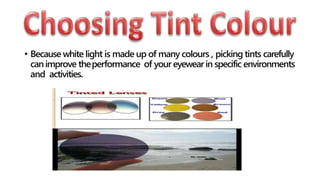
• Because white light is made up of many colours , picking tints carefully
canimprove theperformance of your eyewearin specific environments
and activities.
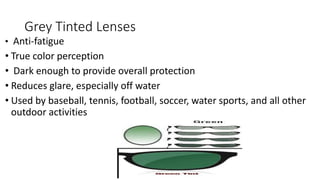
Grey Tinted Lenses
• Anti-fatigue
• True color perception
• Dark enough to provide overall protection
• Reduces glare, especially off water
• Used by baseball, tennis, football, soccer, water sports, and all other
outdoor activities
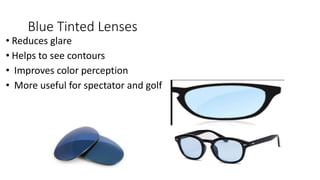
Blue Tinted Lenses
• Reduces glare
• Helps to see contours
• Improves color perception
• More useful for spectator and golf
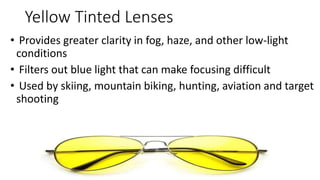
Yellow Tinted Lenses
• Provides greater clarity in fog, haze, and other low-light
conditions
• Filters out blue light that can make focusing difficult
• Used by skiing, mountain biking, hunting, aviation and target
shooting
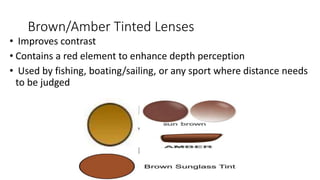
Brown/Amber Tinted Lenses
• Improves contrast
• Contains a red element to enhance depth perception
• Used by fishing, boating/sailing, or any sport where distance needs
to be judged
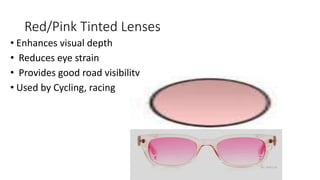
Red/Pink Tinted Lenses
• Enhances visual depth
• Reduces eye strain
• Provides good road visibility
• Used by Cycling, racing
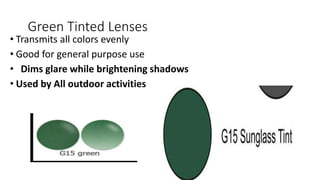
Green Tinted Lenses
• Transmits all colors evenly
• Good for general purpose use
• Dims glare while brightening shadows
• Used by All outdoor activities
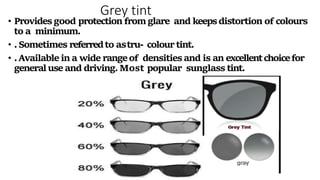
Grey tint
• Providesgood protection fromglare and keepsdistortion of colours
to a minimum.
• .Sometimes referredto astru- colourtint.
• .Available in a wide rangeof densitiesand is an excellentchoicefor
generaluse and driving.Most popular sunglass tint.
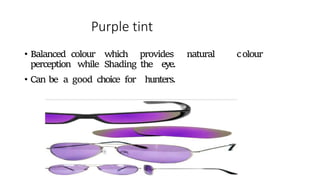
Purple tint
• Balanced colour which provides natural colour
perception while Shading the eye.
• Can be a good choice for hunters.
Why Coating is Done?
• Protection
• Appearance
• Clarity
• Fog
Types of coatings commonly
applied.
• MAR Coating
• Tints
• UV Coating
• Scratch Resistant Coating
• Mirror Coating
• Polarized Coating
• Edge Coatings
MAR(multiple anti-reflection)
coatings
(anti-glare/non-glare)
• Allows maximum Transmission
• Hydrophobic.
• Oleo-Phobic.
• Anti-Static.
• Enhanced vision in low light Intensity.
Anti-Reflective Coating
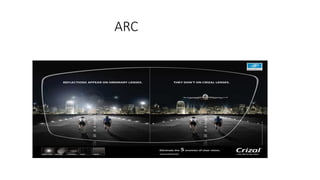
• Anti-reflective coating (also called AR coating or anti-glare
coating) is a microscopically thin multilayer coating that
eliminates reflections from the front and back surface of eyeglass
lenses.
• By doing so, AR coating makes your lenses nearly invisible so
people can focus on your eyes, not distracting reflections from
your eyeglasses
• Anti-reflective coating also eliminates glare caused by light
reflecting from your lenses. So it provide better vision for night
driving and more comfortable vision for reading and computer
use.
ARC
Advantage
• Reduce the fatigue from
computer vision syndrome
• Eliminate glare
• Improve vision amd
comfortness
• Eliminate reflection
Disadvantage
• Look dirty as a result may
have to clean
• Not recommended for
reading glasses
• Cost-effective
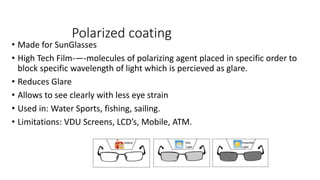
Polarized coating
• Made for SunGlasses
• High Tech Film-—-molecules of polarizing agent placed in specific order to
block specific wavelength of light which is percieved as glare.
• Reduces Glare
• Allows to see clearly with less eye strain
• Used in: Water Sports, fishing, sailing.
• Limitations: VDU Screens, LCD’s, Mobile, ATM.
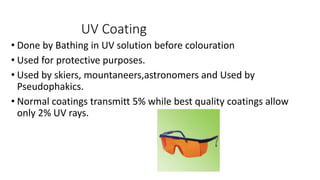
UV Coating
• Done by Bathing in UV solution before colouration
• Used for protective purposes.
• Used by skiers, mountaneers,astronomers and Used by
Pseudophakics.
• Normal coatings transmitt 5% while best quality coatings allow
only 2% UV rays.
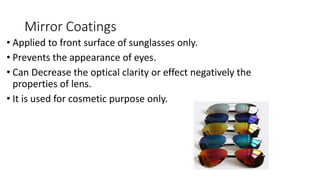
Mirror Coatings
• Applied to front surface of sunglasses only.
• Prevents the appearance of eyes.
• Can Decrease the optical clarity or effect negatively the
properties of lens.
• It is used for cosmetic purpose only.
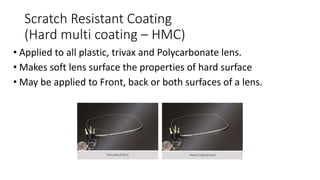
Scratch Resistant Coating
(Hard multi coating – HMC)
• Applied to all plastic, trivax and Polycarbonate lens.
• Makes soft lens surface the properties of hard surface
• May be applied to Front, back or both surfaces of a lens.
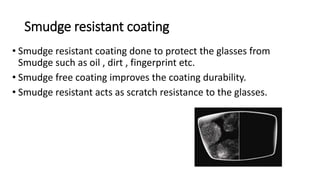
Smudge resistant coating
• Smudge resistant coating done to protect the glasses from
Smudge such as oil , dirt , fingerprint etc.
• Smudge free coating improves the coating durability.
• Smudge resistant acts as scratch resistance to the glasses.
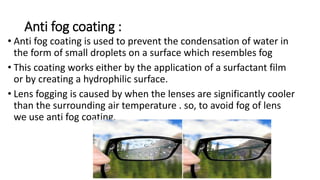
Anti fog coating :
• Anti fog coating is used to prevent the condensation of water in
the form of small droplets on a surface which resembles fog
• This coating works either by the application of a surfactant film
or by creating a hydrophilic surface.
• Lens fogging is caused by when the lenses are significantly cooler
than the surrounding air temperature . so, to avoid fog of lens
we use anti fog coating.
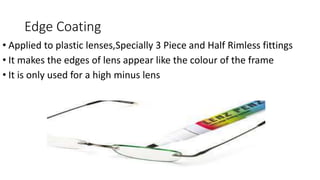
Edge Coating
• Applied to plastic lenses,Specially 3 Piece and Half Rimless fittings
• It makes the edges of lens appear like the colour of the frame
• It is only used for a high minus lens
SOME IMPORTANT QUESTIONS
Q. Describe lens coating available.
Q. Write about different type of tints with their indication?
Q. What is ARC? Write its uses,advantage and disadvantage.
THANK YOU
ALL THE BEST

Class for ophthalmic assistant student 2nd year

  • 1.
    TINTED LENS AND COATING VINITKUMAR & ARBIND OPTOMETRIST ,SCEH LAHAN
  • 2.
    TINTED LENS • Tintedlenses can reduce glare, improve contrast, and enhanced depth perception. • They can have a huge impact on your performance as an athlete, spectator, and lover of the great outdoors • SomeLensesaretintedbyaddingasubstance suchasametaloxidetothelens materialwhen thelensisbeing created. • Tintscanalsobeappliedtothesurfaceofa lens. • Surfaceapplicationallowsawidevarietyof tintsandcreatesauniform darknessacrossthe entirelens,regardlessofprescriptionstrength • Plasticlensesaretintedbydippingthemin asolutioncontainingtheappropriate organicdye.
  • 3.
    • Because whitelight is made up of many colours , picking tints carefully canimprove theperformance of your eyewearin specific environments and activities.
  • 4.
    Grey Tinted Lenses •Anti-fatigue • True color perception • Dark enough to provide overall protection • Reduces glare, especially off water • Used by baseball, tennis, football, soccer, water sports, and all other outdoor activities
  • 5.
    Blue Tinted Lenses •Reduces glare • Helps to see contours • Improves color perception • More useful for spectator and golf
  • 6.
    Yellow Tinted Lenses •Provides greater clarity in fog, haze, and other low-light conditions • Filters out blue light that can make focusing difficult • Used by skiing, mountain biking, hunting, aviation and target shooting
  • 7.
    Brown/Amber Tinted Lenses •Improves contrast • Contains a red element to enhance depth perception • Used by fishing, boating/sailing, or any sport where distance needs to be judged
  • 8.
    Red/Pink Tinted Lenses •Enhances visual depth • Reduces eye strain • Provides good road visibility • Used by Cycling, racing
  • 9.
    Green Tinted Lenses •Transmits all colors evenly • Good for general purpose use • Dims glare while brightening shadows • Used by All outdoor activities
  • 10.
    Grey tint • Providesgoodprotection fromglare and keepsdistortion of colours to a minimum. • .Sometimes referredto astru- colourtint. • .Available in a wide rangeof densitiesand is an excellentchoicefor generaluse and driving.Most popular sunglass tint.
  • 11.
    Purple tint • Balancedcolour which provides natural colour perception while Shading the eye. • Can be a good choice for hunters.
  • 12.
    Why Coating isDone? • Protection • Appearance • Clarity • Fog
  • 13.
    Types of coatingscommonly applied. • MAR Coating • Tints • UV Coating • Scratch Resistant Coating • Mirror Coating • Polarized Coating • Edge Coatings
  • 14.
    MAR(multiple anti-reflection) coatings (anti-glare/non-glare) • Allowsmaximum Transmission • Hydrophobic. • Oleo-Phobic. • Anti-Static. • Enhanced vision in low light Intensity.
  • 15.
    Anti-Reflective Coating • Anti-reflectivecoating (also called AR coating or anti-glare coating) is a microscopically thin multilayer coating that eliminates reflections from the front and back surface of eyeglass lenses. • By doing so, AR coating makes your lenses nearly invisible so people can focus on your eyes, not distracting reflections from your eyeglasses • Anti-reflective coating also eliminates glare caused by light reflecting from your lenses. So it provide better vision for night driving and more comfortable vision for reading and computer use.
  • 16.
  • 17.
    Advantage • Reduce thefatigue from computer vision syndrome • Eliminate glare • Improve vision amd comfortness • Eliminate reflection Disadvantage • Look dirty as a result may have to clean • Not recommended for reading glasses • Cost-effective
  • 18.
    Polarized coating • Madefor SunGlasses • High Tech Film-—-molecules of polarizing agent placed in specific order to block specific wavelength of light which is percieved as glare. • Reduces Glare • Allows to see clearly with less eye strain • Used in: Water Sports, fishing, sailing. • Limitations: VDU Screens, LCD’s, Mobile, ATM.
  • 19.
    UV Coating • Doneby Bathing in UV solution before colouration • Used for protective purposes. • Used by skiers, mountaneers,astronomers and Used by Pseudophakics. • Normal coatings transmitt 5% while best quality coatings allow only 2% UV rays.
  • 20.
    Mirror Coatings • Appliedto front surface of sunglasses only. • Prevents the appearance of eyes. • Can Decrease the optical clarity or effect negatively the properties of lens. • It is used for cosmetic purpose only.
  • 21.
    Scratch Resistant Coating (Hardmulti coating – HMC) • Applied to all plastic, trivax and Polycarbonate lens. • Makes soft lens surface the properties of hard surface • May be applied to Front, back or both surfaces of a lens.
  • 22.
    Smudge resistant coating •Smudge resistant coating done to protect the glasses from Smudge such as oil , dirt , fingerprint etc. • Smudge free coating improves the coating durability. • Smudge resistant acts as scratch resistance to the glasses.
  • 23.
    Anti fog coating: • Anti fog coating is used to prevent the condensation of water in the form of small droplets on a surface which resembles fog • This coating works either by the application of a surfactant film or by creating a hydrophilic surface. • Lens fogging is caused by when the lenses are significantly cooler than the surrounding air temperature . so, to avoid fog of lens we use anti fog coating.
  • 24.
    Edge Coating • Appliedto plastic lenses,Specially 3 Piece and Half Rimless fittings • It makes the edges of lens appear like the colour of the frame • It is only used for a high minus lens
  • 25.
    SOME IMPORTANT QUESTIONS Q.Describe lens coating available. Q. Write about different type of tints with their indication? Q. What is ARC? Write its uses,advantage and disadvantage. THANK YOU ALL THE BEST