PHOTOCHROMATIC LENSES
ANUJA DHAKAL
BOVS PHASE II,NEH
25/06/021
PRESENTATION LAYOUT
• INTRODUCTION
• HISTORY
• GLASS V/S PLASTIC PHOTOCHROMATICS
• MANUFACTURE OF PHOTOCHROMATICS
• FACTORS INFLUENCING PHOTOCHROMATIC PERFORMANCE
• ADVANTAGES & DISADVANTAGS
• COATINGS FOR PHOTOCHROMATICS
• DISPENSING TIPS
2
INTRODUCTION
• The word "photochromatic" comes from two Greek words
"photos" - light
"Chroma" - colour , so photochromatic simply means
something that changes colour in response to light.
• Photochromatic lenses are lenses that darken on
exposure to specific types of light, most commonly
ultraviolet (UV) radiation.
3
OTHER NAMES FOR PHOTOCHROMATIC LENS:
• TRANSITION LENSES
• DAY AND NIGHT LENSES
4
https://youtu.be/MOBohmIpKes
5
HISTORY
•Introduced by corning in 1964 as BESTILE LENS
•photogray lens -1968 •photogray II
•photosun lens-1971 •photosun II
•photogray extra -1978
•photobrown extra-1981
6
Chemistry Behind Photochromatic Glass
• The reduction-oxidation reaction includes two half reactions,
usually an ion gaining electrons from another ion. An example
of this would be Silver Chloride and Copper(I) Chloride:
Ag + cl -----> Ag+ + cl- Cu2+ cl- ------> CuCl2
• The first half of the reaction on the left (the silver chloride) is
the reaction causing the glass to darken while the second
reaction on the right (the copper chloride) fades the glass.
7
8
Reversal of colour of photochromatics
• when activating light is ceased ,the silver specks again
disassociate into silver ions and recombine with halogen
ions which are still trapped into the glass and form light
sensitive silver halide microcrystals again.
silver + halogen silver halide.
• The recombination process is enhanced either by the
removal of light (optical bleaching) or by raising the
temperature (thermal bleaching).
9
GLASS PHOTOCHROMATICS
•The darkening occurs as a result of silver halide crystals within
the glasses ,activated by uv and short visible wavelength.
silver halide silver + halogen.
•silver halides crystals are 50-100 Å ,and the average spacing is
around 500-1000 Å.
•The glass photochromatics will not wear out with repeated
darkening and lightening cycles, although over certain period of
time it won’t fade as it used to fade at first.
10
Contd.
•In the united states the most generally used glass
photochromatic material is photogray extra lens.
•Ideal glass photochromatic lens:
ref index of 1.523
colourless in inactivated stage
pale brown colour in light exposure.
11
PLASTIC PHOTOCHROMATICS
•In 1982,American Optical introduced a plastic photochromatic
lens called ‘photolite lens’.
•Instead of using an inorganic material,such as the silver halide
crystals used for glass lenses, plastic photochromatics use
organic dyes(spiro-indoline molecule).
•ESSILOR OPTICAL & PPG Industries combined in 1990 to
produce plastic photo chromic lens known as TRANSITION LENS
the second generation of this lens is now called as the
TRANSITION COMFORT LENS.
12
THE CORLON LENS
•In 1982 corning introduced a new type of lens, called the
corlon,that combines both glass and plastic.
Photochromic
Or clear layer.
13
Polyurethan
layer.
DIFFERENT MANUFACTURING METHODS
1)IMBIBITION SURFACE TECHNOLOGY:
-Transition photochromatic lens.
-plastic materials (cr-39 or other organic lenses) where their
surfaces are infused with photochromatic material using a
proprietary manufacturing process.
-Even colour density over the surface.
14
2) IN-MASS TECHNOLOGY:
-Standard technology for glass photochromatics.
-photochromatic dyes mixed into liquid lens material before the
lens has been formed.
-The thicker the lens ,darker the colour.
-Eg: corning sunsensors,Rodenstock colormatic lens.
15
3) DIP COATING:
-lens dip coated in photochromic dye and then cured with heat
process.
4) FRONT-SURFACE COATING:
-coat front surface with the dye.
16
5) TRANSBONDING:
-polycarbonate and high-index lenses.
-surface treatment with ophthalmic grade layers.
6) MULTIMATRIX:
-process where clear lens is bonded with 1mm layer of
photochromatic dye.
17
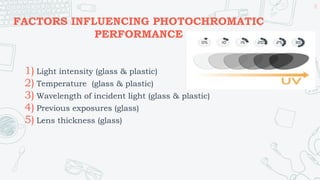
FACTORS INFLUENCING PHOTOCHROMATIC
PERFORMANCE
1) Light intensity (glass & plastic)
2) Temperature (glass & plastic)
3) Wavelength of incident light (glass & plastic)
4) Previous exposures (glass)
5) Lens thickness (glass)
18
1)Light intensity
-The transmittance decreases as the intensity increases.
-The reversal of the photochromatic lens to lighter state occurs
when exposed to red light or infrared radiation.( OPTICAL
BLEACHING).
2)Temperature :
-The lenses will be darker in gloomy days & lighter on hot days.
-Increased temperature will bleach the lens (THERMAL
BLEACHING)
19
3)Wavelength of incident light:
-The closer the wavelength of incident light to
optimum radiation,the darker the lens becomes.
4)Exposure memory:
-Full changing range and speed after ‘breaking-in’ period.
-They respond to light in proportion to accumulated total recent
exposures.
-May affect when only one of the lenses must be changed.
20
5) Lens thickness:
- mainly glass lens are influenced .
-eg: photogray extra lens
- 22% transmittance @ 2mm
- 11% transmittance @ 4mm
21
ADVANTAGES
They absorb 100% UVB & 98% UVA radiation that can
otherwise damage eyes.
They allow you to stop juggling between your pair of clear
glasses and your sunglasses.
Available for most prescriptions.
These lenses sometimes are used to enhance the vision of
patients who have various ocular pathologies including aniridia
albinism ,macular degenerations.
22
contd
Photochromics are available in single vision, bifocal
and varifocal forms .
Available in different colours to suit your needs.
Gives visual comfort both indoor and outdoors.
23
DISADVANTAGES
The main disadvantage of the photochromic lenses is they
do not adjust immediately.
They will not darken when worn inside vehicles because
windscreen green glass absorbs virtually 100% of UV
light.
Although they perform like sunlenses in darkened state
but they can’t really be replaced by sunglasses.
24
Contd.
Lens may wear out faster if worn during high sunlight
frequently
Different ageing of lens.
Not suitable in hot climates.
25
COATINGS
When coating (AR /TINT) is applied to the photochromatic
lenses it must be applied within a critical temp of approx 230-
375°C.
Any coating that absorbs the near uv radiation must be applied
to the back surface of the lens.
Antireflection coatings produce slightly higher transmission as
expected.
26
DISPENSING TIPS
When temperature increases the reaction slows So ,
they are not recommended to replace sunglasses.
Anti reflection coating will not reduce the range of the
photo chromic cycles but as with any lens , will increase
the transmission in both the lightened and darkened
status.
27
Availability of different companies
• Essilor = transitions
• German lens (rodenstock) =colormatic
• Vision-ease = lifeRx 30
28
USEFUL KEYS TO AVOID PROBLEM
Always make sure that the new lens is of the same type as the
old lens , i.e. , same brand , same thickness etc.
If the old lens has been chemtemperated , have it re-strengthen
along with as the new lens.
If the old lens has not been treated in anyway , place it with the
new lens in boiling water for half an hour.
29
WHEN TO PRESCRIBE ?
People who don’t want to carry two glasses.
Reduction of glare symptoms.
To avoid uv radiation causing degenerations in eye.
People having history of photochromatic glass use.
30
References
System for ophthalmic dispensing 3rd edition- Clifford
W.Brooks, irvin M.Borish.
Clinical optics 2nd edition – Troy E.Fannin, Theodore
Grosvenor.
Web sources
:https://www.essilorindia.com/products/adaptive-
photochromic-lenses
https://www.opto-reseau.com/en/blog/benefits-of-
photochromic-lenses
31
Thank you & stay safe !
32

Photochromatics.

  • 1.
  • 2.
    PRESENTATION LAYOUT • INTRODUCTION •HISTORY • GLASS V/S PLASTIC PHOTOCHROMATICS • MANUFACTURE OF PHOTOCHROMATICS • FACTORS INFLUENCING PHOTOCHROMATIC PERFORMANCE • ADVANTAGES & DISADVANTAGS • COATINGS FOR PHOTOCHROMATICS • DISPENSING TIPS 2
  • 3.
    INTRODUCTION • The word"photochromatic" comes from two Greek words "photos" - light "Chroma" - colour , so photochromatic simply means something that changes colour in response to light. • Photochromatic lenses are lenses that darken on exposure to specific types of light, most commonly ultraviolet (UV) radiation. 3
  • 4.
    OTHER NAMES FORPHOTOCHROMATIC LENS: • TRANSITION LENSES • DAY AND NIGHT LENSES 4
  • 5.
  • 6.
    HISTORY •Introduced by corningin 1964 as BESTILE LENS •photogray lens -1968 •photogray II •photosun lens-1971 •photosun II •photogray extra -1978 •photobrown extra-1981 6
  • 7.
    Chemistry Behind PhotochromaticGlass • The reduction-oxidation reaction includes two half reactions, usually an ion gaining electrons from another ion. An example of this would be Silver Chloride and Copper(I) Chloride: Ag + cl -----> Ag+ + cl- Cu2+ cl- ------> CuCl2 • The first half of the reaction on the left (the silver chloride) is the reaction causing the glass to darken while the second reaction on the right (the copper chloride) fades the glass. 7
  • 8.
  • 9.
    Reversal of colourof photochromatics • when activating light is ceased ,the silver specks again disassociate into silver ions and recombine with halogen ions which are still trapped into the glass and form light sensitive silver halide microcrystals again. silver + halogen silver halide. • The recombination process is enhanced either by the removal of light (optical bleaching) or by raising the temperature (thermal bleaching). 9
  • 10.
    GLASS PHOTOCHROMATICS •The darkeningoccurs as a result of silver halide crystals within the glasses ,activated by uv and short visible wavelength. silver halide silver + halogen. •silver halides crystals are 50-100 Å ,and the average spacing is around 500-1000 Å. •The glass photochromatics will not wear out with repeated darkening and lightening cycles, although over certain period of time it won’t fade as it used to fade at first. 10
  • 11.
    Contd. •In the unitedstates the most generally used glass photochromatic material is photogray extra lens. •Ideal glass photochromatic lens: ref index of 1.523 colourless in inactivated stage pale brown colour in light exposure. 11
  • 12.
    PLASTIC PHOTOCHROMATICS •In 1982,AmericanOptical introduced a plastic photochromatic lens called ‘photolite lens’. •Instead of using an inorganic material,such as the silver halide crystals used for glass lenses, plastic photochromatics use organic dyes(spiro-indoline molecule). •ESSILOR OPTICAL & PPG Industries combined in 1990 to produce plastic photo chromic lens known as TRANSITION LENS the second generation of this lens is now called as the TRANSITION COMFORT LENS. 12
  • 13.
    THE CORLON LENS •In1982 corning introduced a new type of lens, called the corlon,that combines both glass and plastic. Photochromic Or clear layer. 13 Polyurethan layer.
  • 14.
    DIFFERENT MANUFACTURING METHODS 1)IMBIBITIONSURFACE TECHNOLOGY: -Transition photochromatic lens. -plastic materials (cr-39 or other organic lenses) where their surfaces are infused with photochromatic material using a proprietary manufacturing process. -Even colour density over the surface. 14
  • 15.
    2) IN-MASS TECHNOLOGY: -Standardtechnology for glass photochromatics. -photochromatic dyes mixed into liquid lens material before the lens has been formed. -The thicker the lens ,darker the colour. -Eg: corning sunsensors,Rodenstock colormatic lens. 15
  • 16.
    3) DIP COATING: -lensdip coated in photochromic dye and then cured with heat process. 4) FRONT-SURFACE COATING: -coat front surface with the dye. 16
  • 17.
    5) TRANSBONDING: -polycarbonate andhigh-index lenses. -surface treatment with ophthalmic grade layers. 6) MULTIMATRIX: -process where clear lens is bonded with 1mm layer of photochromatic dye. 17
  • 18.
    FACTORS INFLUENCING PHOTOCHROMATIC PERFORMANCE 1)Light intensity (glass & plastic) 2) Temperature (glass & plastic) 3) Wavelength of incident light (glass & plastic) 4) Previous exposures (glass) 5) Lens thickness (glass) 18
  • 19.
    1)Light intensity -The transmittancedecreases as the intensity increases. -The reversal of the photochromatic lens to lighter state occurs when exposed to red light or infrared radiation.( OPTICAL BLEACHING). 2)Temperature : -The lenses will be darker in gloomy days & lighter on hot days. -Increased temperature will bleach the lens (THERMAL BLEACHING) 19
  • 20.
    3)Wavelength of incidentlight: -The closer the wavelength of incident light to optimum radiation,the darker the lens becomes. 4)Exposure memory: -Full changing range and speed after ‘breaking-in’ period. -They respond to light in proportion to accumulated total recent exposures. -May affect when only one of the lenses must be changed. 20
  • 21.
    5) Lens thickness: -mainly glass lens are influenced . -eg: photogray extra lens - 22% transmittance @ 2mm - 11% transmittance @ 4mm 21
  • 22.
    ADVANTAGES They absorb 100%UVB & 98% UVA radiation that can otherwise damage eyes. They allow you to stop juggling between your pair of clear glasses and your sunglasses. Available for most prescriptions. These lenses sometimes are used to enhance the vision of patients who have various ocular pathologies including aniridia albinism ,macular degenerations. 22
  • 23.
    contd Photochromics are availablein single vision, bifocal and varifocal forms . Available in different colours to suit your needs. Gives visual comfort both indoor and outdoors. 23
  • 24.
    DISADVANTAGES The main disadvantageof the photochromic lenses is they do not adjust immediately. They will not darken when worn inside vehicles because windscreen green glass absorbs virtually 100% of UV light. Although they perform like sunlenses in darkened state but they can’t really be replaced by sunglasses. 24
  • 25.
    Contd. Lens may wearout faster if worn during high sunlight frequently Different ageing of lens. Not suitable in hot climates. 25
  • 26.
    COATINGS When coating (AR/TINT) is applied to the photochromatic lenses it must be applied within a critical temp of approx 230- 375°C. Any coating that absorbs the near uv radiation must be applied to the back surface of the lens. Antireflection coatings produce slightly higher transmission as expected. 26
  • 27.
    DISPENSING TIPS When temperatureincreases the reaction slows So , they are not recommended to replace sunglasses. Anti reflection coating will not reduce the range of the photo chromic cycles but as with any lens , will increase the transmission in both the lightened and darkened status. 27
  • 28.
    Availability of differentcompanies • Essilor = transitions • German lens (rodenstock) =colormatic • Vision-ease = lifeRx 30 28
  • 29.
    USEFUL KEYS TOAVOID PROBLEM Always make sure that the new lens is of the same type as the old lens , i.e. , same brand , same thickness etc. If the old lens has been chemtemperated , have it re-strengthen along with as the new lens. If the old lens has not been treated in anyway , place it with the new lens in boiling water for half an hour. 29
  • 30.
    WHEN TO PRESCRIBE? People who don’t want to carry two glasses. Reduction of glare symptoms. To avoid uv radiation causing degenerations in eye. People having history of photochromatic glass use. 30
  • 31.
    References System for ophthalmicdispensing 3rd edition- Clifford W.Brooks, irvin M.Borish. Clinical optics 2nd edition – Troy E.Fannin, Theodore Grosvenor. Web sources :https://www.essilorindia.com/products/adaptive- photochromic-lenses https://www.opto-reseau.com/en/blog/benefits-of- photochromic-lenses 31
  • 32.
    Thank you &stay safe ! 32