INDEX
01 Time series model
02 Stochas ti c process
03 Stationa rit y
04 Wold decompo si ti o n
05 Impuls e - Re sp o ns e Analysis
06 ARMA Proces s
Time series model
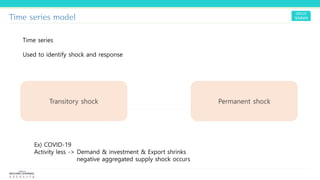
Transitory shock Permanent shock
Ex) COVID-19
Activity less -> Demand & investment & Export shrinks
negative aggregated supply shock occurs
Time series
Used to identify shock and response
Time series model
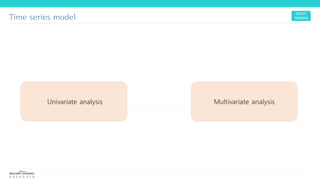
Univariate analysis Multivariate analysis
Stochastic Process
Stochastic Process
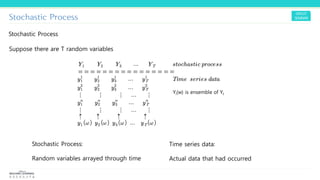
Suppose there are T random variables
Yi(w) is ensemble of Yt
Stochastic Process:
Random variables arrayed through time
Time series data:
Actual data that had occurred
Stochastic Process
Stochastic Process
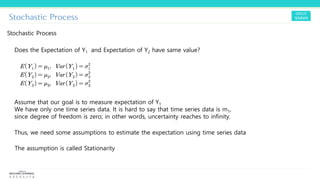
Does the Expectation of Y1 and Expectation of Y2 have same value?
Assume that our goal is to measure expectation of Y1
We have only one time series data. It is hard to say that time series data is m1,
since degree of freedom is zero; in other words, uncertainty reaches to infinity.
Thus, we need some assumptions to estimate the expectation using time series data
The assumption is called Stationarity
Stationarity
Stationarity
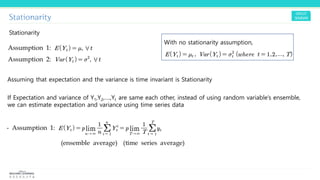
With no stationarity assumption,
Assuming that expectation and the variance is time invariant is Stationarity
If Expectation and variance of Y1,Y2,….,Yt are same each other, instead of using random variable’s ensemble,
we can estimate expectation and variance using time series data
Stationarity
Stationarity
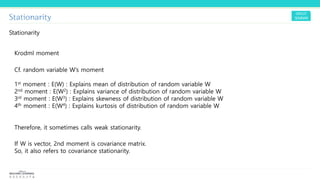
Krodml moment
Cf. random variable W’s moment
1st moment : E(W) : Explains mean of distribution of random variable W
2nd moment : E(W2) : Explains variance of distribution of random variable W
3rd moment : E(W3) : Explains skewness of distribution of random variable W
4th moment : E(W4) : Explains kurtosis of distribution of random variable W
Therefore, it sometimes calls weak stationarity.
If W is vector, 2nd moment is covariance matrix.
So, it also refers to covariance stationarity.
Stationarity
Stationarity
Conditional vs Unconditional
Conditional : Forecasting with present and past data
Unconditional : Forecasting with no considering present and past data
Wold decomposition
Wold decomposition
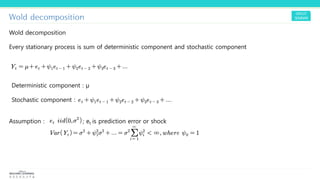
Every stationary process is sum of deterministic component and stochastic component
Deterministic component : µ
Stochastic component :
Assumption : ; et is prediction error or shock
Wold decomposition
Wold decomposition
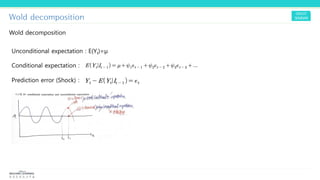
Unconditional expectation : E(Yt)=µ
Conditional expectation :
Prediction error (Shock) :
Wold decomposition
Wold decomposition
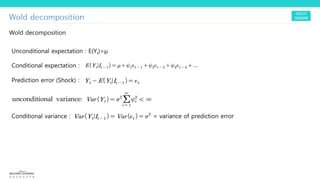
Unconditional expectation : E(Yt)=µ
Conditional expectation :
Prediction error (Shock) :
Conditional variance : = variance of prediction error
Impulse-Response Analysis
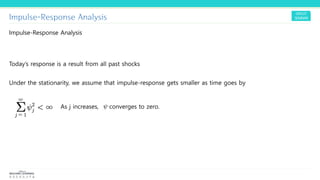
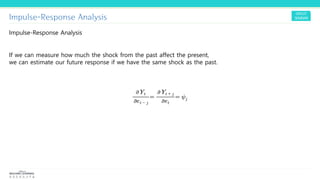
Today’s response is a result from all past shocks
Under the stationarity, we assume that impulse-response gets smaller as time goes by
As j increases, converges to zero.
Impulse-Response Analysis
If we can measure how much the shock from the past affect the present,
we can estimate our future response if we have the same shock as the past.
Impulse-Response Analysis
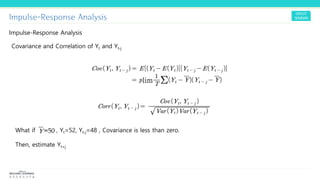
Covariance and Correlation of Yt and Yt-j
What if , Yt=52, Yt-j=48 , Covariance is less than zero.
Then, estimate Yt+j
AR Process
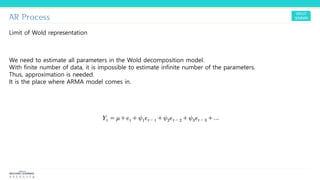
Limit of Wold representation
We need to estimate all parameters in the Wold decomposition model.
With finite number of data, it is impossible to estimate infinite number of the parameters.
Thus, approximation is needed.
It is the place where ARMA model comes in.
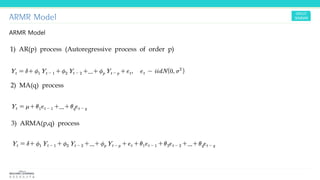
ARMR Model
ARMR Model
ARMA Model
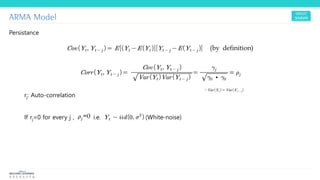
Persistance
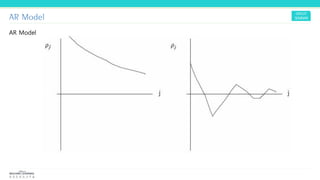
rj: Auto-correlation
If rj=0 for every j , i.e. (White-noise)
ARMA Model
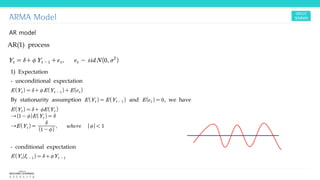
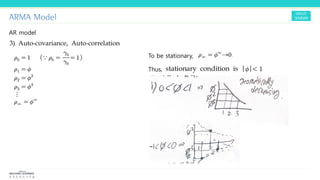
AR model
ARMA Model
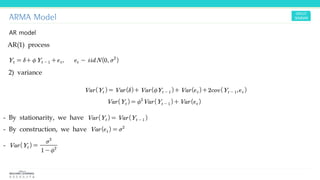
AR model
ARMA Model
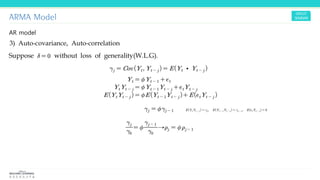
AR model
ARMA Model
AR model
To be stationary,
Thus,
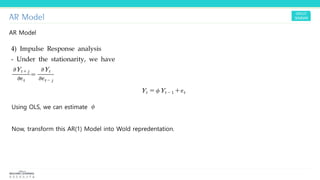
AR Model
AR Model
Using OLS, we can estimate
Now, transform this AR(1) Model into Wold repredentation.
AR Model
AR Model
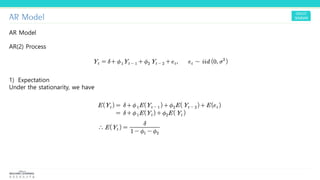
AR(2) Process
1) Expectation
Under the stationarity, we have
AR Model
AR Model
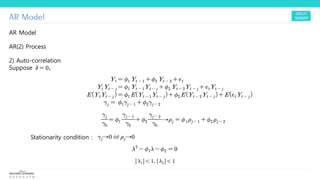
AR(2) Process
2) Auto-correlation
Suppose
Stationarity condition :
AR Model
AR Model
AR Model
AR Model
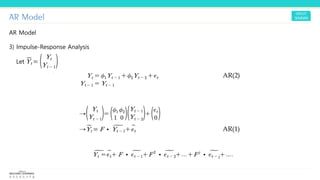
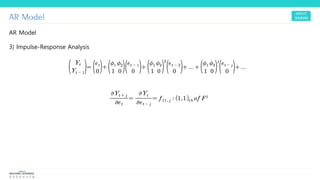
3) Impulse-Response Analysis
Let
AR Model
AR Model
3) Impulse-Response Analysis
Time Series Analysis - ARMA

Time Series Analysis - ARMA