Download to read offline

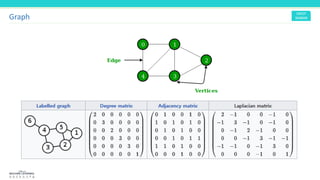
![Adjacency matrix
Node feature
DNN
Ideal algorithm?
[ Naïve Approach ]
1. # of parameters
2. Invariant to node ordering
3. Locality
Graph Convolutional Network](https://image.slidesharecdn.com/gcn-200601151804/85/Graph-Convolutional-Network-10-320.jpg)
![[ Input ]
[ Output ]
[ NN layer]
Graph Convolutional Network](https://image.slidesharecdn.com/gcn-200601151804/85/Graph-Convolutional-Network-13-320.jpg)
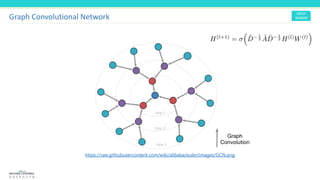
![[ Layer-wise propagation rule ]
Graph Convolutional Network
With weight matix W(l) of dimension F(l) x F(l+1)](https://image.slidesharecdn.com/gcn-200601151804/85/Graph-Convolutional-Network-14-320.jpg)
![[ Layer-wise propagation rule ]
Graph Convolutional Network
symmetric normalized Laplacian matrix form](https://image.slidesharecdn.com/gcn-200601151804/85/Graph-Convolutional-Network-15-320.jpg)
![[ Convolution on Graphs? ]
Chebyshev polynomial
Eigen value, vector,
decomposition
Fourier transform
Normalized Graph Laplacian
…….
Graph Convolutional Network
[ Fast Approximate Convolutions on Graphs]
= [ Graph Fourier Transform from Laplacian Matrix ]](https://image.slidesharecdn.com/gcn-200601151804/85/Graph-Convolutional-Network-16-320.jpg)

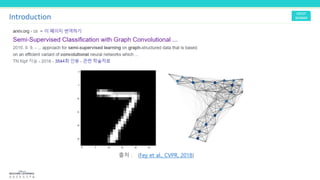
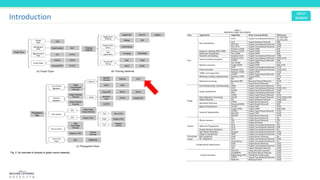
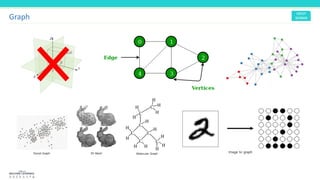
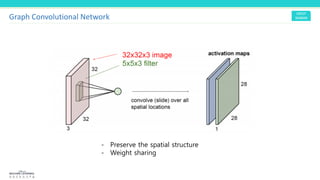
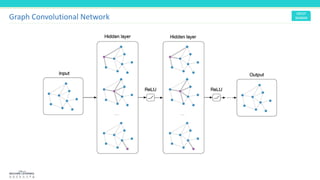
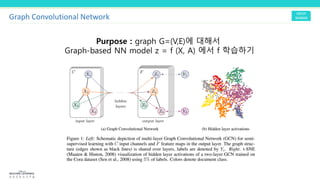
This document discusses graph convolutional networks (GCNs), which are neural network models for graph-structured data. GCNs aim to learn functions on graphs by preserving the graph's spatial structure and enabling weight sharing. The document outlines the basic components of a GCN, including the adjacency matrix, node features, and application of deep neural network layers. It also notes some challenges with applying convolutions to graphs and discusses approaches like using the graph Fourier transform based on the Laplacian matrix.


![[DL輪読会]In Search of Lost Domain Generalization](https://cdn.slidesharecdn.com/ss_thumbnails/20210716ohashi-210716050334-thumbnail.jpg?width=640&height=640&fit=bounds)
![[DL輪読会]近年のオフライン強化学習のまとめ —Offline Reinforcement Learning: Tutorial, Review, an...](https://cdn.slidesharecdn.com/ss_thumbnails/20200626journalclubpub-200630064755-thumbnail.jpg?width=640&height=640&fit=bounds)


![[DL Hacks]Semi-Supervised Classification with Graph Convolutional Networks](https://cdn.slidesharecdn.com/ss_thumbnails/gcn1-181102025619-thumbnail.jpg?width=640&height=640&fit=bounds)


![[NS][Lab_Seminar_240710]Improving Graph Networks through Selection-based Conv...](https://cdn.slidesharecdn.com/ss_thumbnails/nslabseminar240710selgcn-240723105252-3f46ad9d-thumbnail.jpg?width=640&height=640&fit=bounds)


![[DSC Europe 25] Josip Saban - Career building for data professionals.pptx](https://cdn.slidesharecdn.com/ss_thumbnails/zroflcttkm1vmli0txea-josip-saban-career-building-for-data-professionals-260123083019-587cdb8c-thumbnail.jpg?width=640&height=640&fit=bounds)
![[DSC Europe 25] Mikhail Rozhkov - AI Product Canvas: From Business Goals to T...](https://cdn.slidesharecdn.com/ss_thumbnails/d53doddtpgfqivmzqel6-mikhail-rozhkov-ai-product-canvas-v1-260121115910-9dd517a7-thumbnail.jpg?width=640&height=640&fit=bounds)
![[DSC Europe 25] Milovan Jovicic - Beyond AI's Reach: The Enduring Value of Ev...](https://cdn.slidesharecdn.com/ss_thumbnails/pyeij0hurgwq5jugmtnv-2-milovan-jovicic-beyond-ais-reach-the-enduring-value-of-evergreen-design-v2-260120105856-d6ee57e5-thumbnail.jpg?width=640&height=640&fit=bounds)


![[DSC Europe 25] Bojan Djuricic - Predictive Design Process.pdf](https://cdn.slidesharecdn.com/ss_thumbnails/5awdrbedqdek3gqu2ezy-4-the-predictive-design-bojan-djuricic-260120105856-6c399e9b-thumbnail.jpg?width=640&height=640&fit=bounds)
![[DSC Europe 25] Tali Fulman - Guild Meetings, Then What? Building Data Commun...](https://cdn.slidesharecdn.com/ss_thumbnails/fgohhi33rwmhqdowdj5k-tali-fulman-guild-meetings-then-what-building-data-communities-that-actually-ch-260120105855-528492c3-thumbnail.jpg?width=640&height=640&fit=bounds)

![[DSC Europe 25] Dubravko Culibrk - Deep Learning for Mammography.pptx](https://cdn.slidesharecdn.com/ss_thumbnails/yiscimuktacgqoiu4dkp-deep-learning-for-mammography-260119121559-aad59182-thumbnail.jpg?width=640&height=640&fit=bounds)


![[DSC Europe 25] Marcos Heidemann - Beyond the Hype: Making AI Coding Assistan...](https://cdn.slidesharecdn.com/ss_thumbnails/eexkhvldrjsopspdjbur-marcos-heidemann-beyond-the-hype-getting-real-value-out-of-ai-assisted-coding-260121115910-7e9d41ec-thumbnail.jpg?width=640&height=640&fit=bounds)