An Introduction to Time Series
Ginger Davis
VIGRE Computational Finance Seminar
Rice University
November 26, 2003
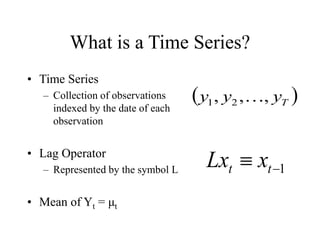
What is a Time Series?
• Time Series
– Collection of observations
indexed by the date of each
observation
• Lag Operator
– Represented by the symbol L
• Mean of Yt = μt
 
T
y
y
y ,
,
, 2
1 
1

 t
t x
Lx
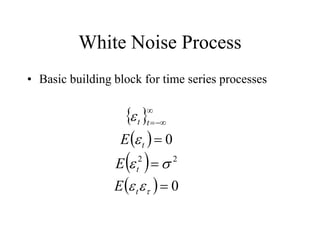
White Noise Process
• Basic building block for time series processes
 
 
 
  0
0
2
2













t
t
t
t
t
E
E
E
White Noise Processes, cont.
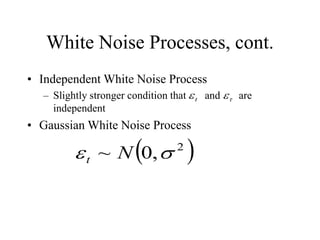
• Independent White Noise Process
– Slightly stronger condition that and are
independent
• Gaussian White Noise Process
 
2
,
0
~ 
 N
t
t
 

Autocovariance
• Covariance of Yt with its own lagged value
• Example: Calculate autocovariances for:
  
j
t
j
t
t
t
jt Y
Y
E 
 

 


    
j
t
t
j
t
t
jt
t
t
E
Y
Y
E
Y

 












Stationarity
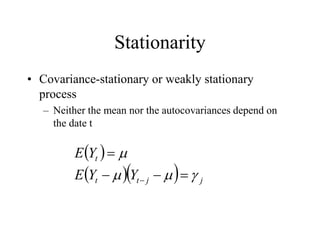
• Covariance-stationary or weakly stationary
process
– Neither the mean nor the autocovariances depend on
the date t
 
   j
j
t
t
t
Y
Y
E
Y
E









Stationarity, cont.
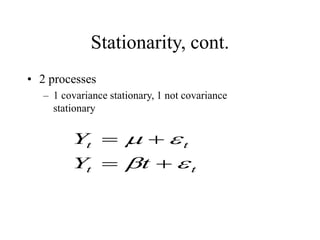
• 2 processes
– 1 covariance stationary, 1 not covariance
stationary
t
t
t
t
t
Y
Y








Stationarity, cont.
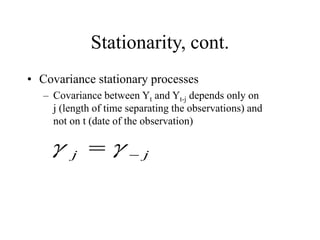
• Covariance stationary processes
– Covariance between Yt and Yt-j depends only on
j (length of time separating the observations) and
not on t (date of the observation)
j
j 
 

Stationarity, cont.
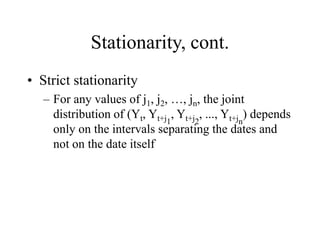
• Strict stationarity
– For any values of j1, j2, …, jn, the joint
distribution of (Yt, Yt+j1
, Yt+j2
, ..., Yt+jn
) depends
only on the intervals separating the dates and
not on the date itself
Gaussian Processes
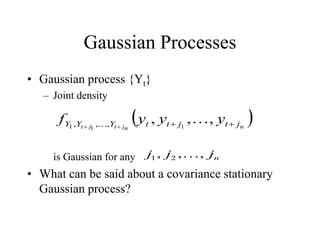
• Gaussian process {Yt}
– Joint density
is Gaussian for any
• What can be said about a covariance stationary
Gaussian process?
 
n
n
j
t
j
t j
t
j
t
t
Y
Y
Y y
y
y
f 



,
,
, 1
1
1 ,
,
, 

n
j
j
j ,
,
, 2
1 
Ergodicity
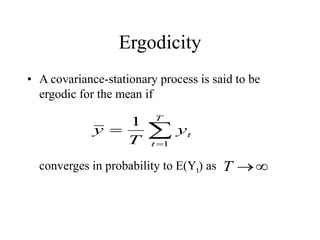
• A covariance-stationary process is said to be
ergodic for the mean if
converges in probability to E(Yt) as



T
t
t
y
T
y
1
1


T
Describing the dynamics
of a Time Series
• Moving Average (MA) processes
• Autoregressive (AR) processes
• Autoregressive / Moving Average (ARMA)
processes
• Autoregressive conditional heteroscedastic
(ARCH) processes
Moving Average Processes
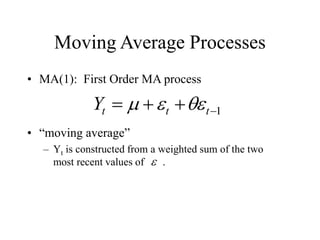
• MA(1): First Order MA process
• “moving average”
– Yt is constructed from a weighted sum of the two
most recent values of .
1



 t
t
t
Y 



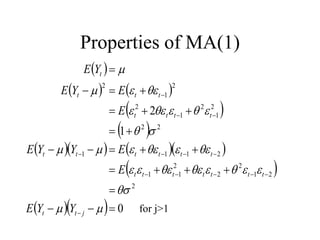
Properties of MA(1)
 
   
 
 
     
 
   0
1
2
2
2
1
2
2
2
1
1
2
1
1
1
2
2
2
1
2
1
2
2
1
2































































j
t
t
t
t
t
t
t
t
t
t
t
t
t
t
t
t
t
t
t
t
t
t
t
Y
Y
E
E
E
Y
Y
E
E
E
Y
E
Y
E
for j>1
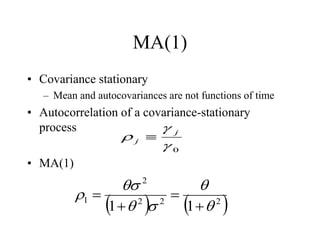
MA(1)
• Covariance stationary
– Mean and autocovariances are not functions of time
• Autocorrelation of a covariance-stationary
process
• MA(1)
0


 j
j 
   
2
2
2
2
1
1
1 









Autocorrelation Function for White Noise:
0.0
0.2
0.4
0.6
0.8
1.0
0 5 10 15 20
Lag
Autocorrelation
t
t
Y 

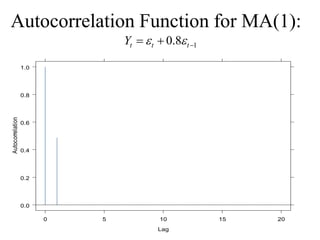
Autocorrelation Function for MA(1):
1
8
.
0 

 t
t
t
Y 

0.0
0.2
0.4
0.6
0.8
1.0
0 5 10 15 20
Lag
Autocorrelation
Moving Average Processes
of higher order
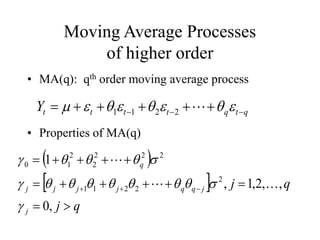
• MA(q): qth order moving average process
• Properties of MA(q)
q
t
q
t
t
t
t
Y 

 




 






 
2
2
1
1
 
 
q
j
q
j
j
j
q
q
j
j
j
j
q
















,
0
,
,
2
,
1
,
1
2
2
2
1
1
2
2
2
2
2
1
0


















Autoregressive Processes
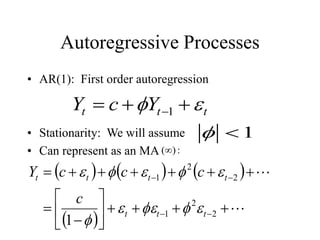
• AR(1): First order autoregression
• Stationarity: We will assume
• Can represent as an MA
t
t
t Y
c
Y 
 

 1
1


     
 

























2
2
1
2
2
1
1
t
t
t
t
t
t
t
c
c
c
c
Y










:
)
(
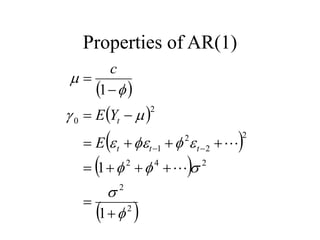
Properties of AR(1)
 
 
 
 
 
2
2
2
4
2
2
2
2
1
2
0
1
1
1































t
t
t
t
E
Y
E
c
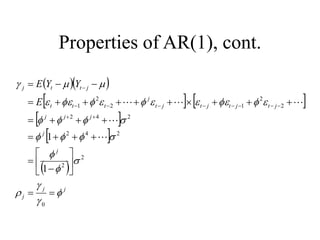
Properties of AR(1), cont.
  
   
 
 
 
j
j
j
j
j
j
j
j
j
t
j
t
j
t
j
t
j
t
t
t
j
t
t
j
E
Y
Y
E






































































0
2
2
2
4
2
2
4
2
2
2
1
2
2
1
1
1 




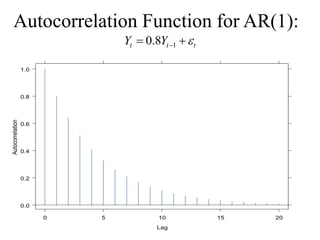
Autocorrelation Function for AR(1):
t
t
t Y
Y 

 1
8
.
0
0.0
0.2
0.4
0.6
0.8
1.0
0 5 10 15 20
Lag
Autocorrelation
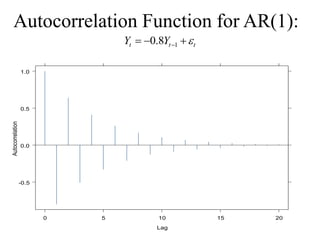
Autocorrelation Function for AR(1):
t
t
t Y
Y 


 1
8
.
0
-0.5
0.0
0.5
1.0
0 5 10 15 20
Lag
Autocorrelation
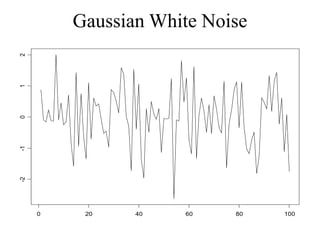
Gaussian White Noise
0 20 40 60 80 100
-2
-1
0
1
2
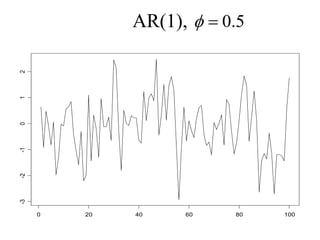
AR(1),
0 20 40 60 80 100
-3
-2
-1
0
1
2 5
.
0


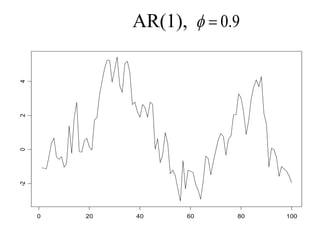
AR(1),
0 20 40 60 80 100
-2
0
2
4 9
.
0


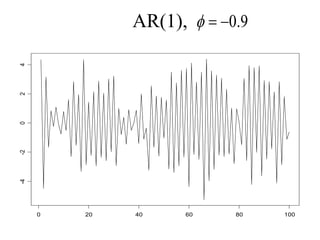
AR(1),
0 20 40 60 80 100
-4
-2
0
2
4 9
.
0



Autoregressive Processes
of higher order
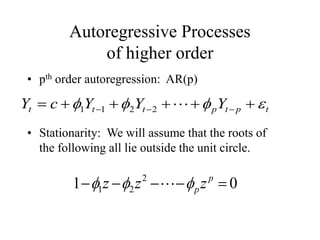
• pth order autoregression: AR(p)
• Stationarity: We will assume that the roots of
the following all lie outside the unit circle.
t
p
t
p
t
t
t Y
Y
Y
c
Y 


 




 

 
2
2
1
1
0
1 2
2
1 



 p
p z
z
z 

 
Properties of AR(p)
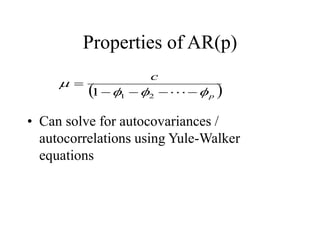
• Can solve for autocovariances /
autocorrelations using Yule-Walker
equations
 
p
c










2
1
1
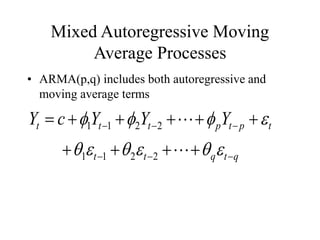
Mixed Autoregressive Moving
Average Processes
• ARMA(p,q) includes both autoregressive and
moving average terms
q
t
q
t
t
t
p
t
p
t
t
t Y
Y
Y
c
Y




























2
2
1
1
2
2
1
1
Time Series Models
for Financial Data
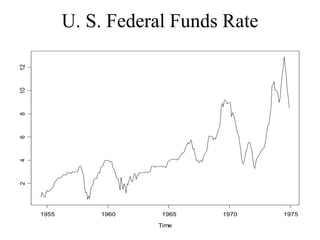
• A Motivating Example
– Federal Funds rate
– We are interested in forecasting not only the
level of the series, but also its variance.
– Variance is not constant over time
U. S. Federal Funds Rate
Time
1955 1960 1965 1970 1975
2
4
6
8
10
12
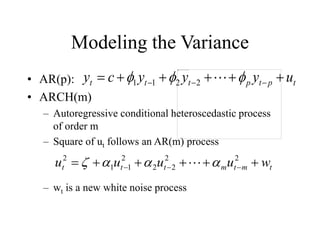
Modeling the Variance
• AR(p):
• ARCH(m)
– Autoregressive conditional heteroscedastic process
of order m
– Square of ut follows an AR(m) process
– wt is a new white noise process
t
p
t
p
t
t
t u
y
y
y
c
y 




 

 

 
2
2
1
1
t
m
t
m
t
t
t w
u
u
u
u 




 


2
2
2
2
2
1
1
2



 
References
• Investopia.com
• Economagic.com
• Hamilton, J. D. (1994), Time Series
Analysis, Princeton, New Jersey: Princeton
University Press.

Timeseries_presentation.ppt

  • 1.
    An Introduction toTime Series Ginger Davis VIGRE Computational Finance Seminar Rice University November 26, 2003
  • 2.
    What is aTime Series? • Time Series – Collection of observations indexed by the date of each observation • Lag Operator – Represented by the symbol L • Mean of Yt = μt   T y y y , , , 2 1  1   t t x Lx
  • 3.
    White Noise Process •Basic building block for time series processes         0 0 2 2              t t t t t E E E
  • 4.
    White Noise Processes,cont. • Independent White Noise Process – Slightly stronger condition that and are independent • Gaussian White Noise Process   2 , 0 ~   N t t   
  • 5.
    Autocovariance • Covariance ofYt with its own lagged value • Example: Calculate autocovariances for:    j t j t t t jt Y Y E              j t t j t t jt t t E Y Y E Y               
  • 6.
    Stationarity • Covariance-stationary orweakly stationary process – Neither the mean nor the autocovariances depend on the date t      j j t t t Y Y E Y E         
  • 7.
    Stationarity, cont. • 2processes – 1 covariance stationary, 1 not covariance stationary t t t t t Y Y        
  • 8.
    Stationarity, cont. • Covariancestationary processes – Covariance between Yt and Yt-j depends only on j (length of time separating the observations) and not on t (date of the observation) j j    
  • 9.
    Stationarity, cont. • Strictstationarity – For any values of j1, j2, …, jn, the joint distribution of (Yt, Yt+j1 , Yt+j2 , ..., Yt+jn ) depends only on the intervals separating the dates and not on the date itself
  • 10.
    Gaussian Processes • Gaussianprocess {Yt} – Joint density is Gaussian for any • What can be said about a covariance stationary Gaussian process?   n n j t j t j t j t t Y Y Y y y y f     , , , 1 1 1 , , ,   n j j j , , , 2 1 
  • 11.
    Ergodicity • A covariance-stationaryprocess is said to be ergodic for the mean if converges in probability to E(Yt) as    T t t y T y 1 1   T
  • 12.
    Describing the dynamics ofa Time Series • Moving Average (MA) processes • Autoregressive (AR) processes • Autoregressive / Moving Average (ARMA) processes • Autoregressive conditional heteroscedastic (ARCH) processes
  • 13.
    Moving Average Processes •MA(1): First Order MA process • “moving average” – Yt is constructed from a weighted sum of the two most recent values of . 1     t t t Y    
  • 14.
    Properties of MA(1)                     0 1 2 2 2 1 2 2 2 1 1 2 1 1 1 2 2 2 1 2 1 2 2 1 2                                                                j t t t t t t t t t t t t t t t t t t t t t t t Y Y E E E Y Y E E E Y E Y E for j>1
  • 15.
    MA(1) • Covariance stationary –Mean and autocovariances are not functions of time • Autocorrelation of a covariance-stationary process • MA(1) 0    j j      2 2 2 2 1 1 1          
  • 16.
    Autocorrelation Function forWhite Noise: 0.0 0.2 0.4 0.6 0.8 1.0 0 5 10 15 20 Lag Autocorrelation t t Y  
  • 17.
    Autocorrelation Function forMA(1): 1 8 . 0    t t t Y   0.0 0.2 0.4 0.6 0.8 1.0 0 5 10 15 20 Lag Autocorrelation
  • 18.
    Moving Average Processes ofhigher order • MA(q): qth order moving average process • Properties of MA(q) q t q t t t t Y                   2 2 1 1     q j q j j j q q j j j j q                 , 0 , , 2 , 1 , 1 2 2 2 1 1 2 2 2 2 2 1 0                  
  • 19.
    Autoregressive Processes • AR(1):First order autoregression • Stationarity: We will assume • Can represent as an MA t t t Y c Y      1 1                                    2 2 1 2 2 1 1 t t t t t t t c c c c Y           : ) (
  • 20.
    Properties of AR(1)          2 2 2 4 2 2 2 2 1 2 0 1 1 1                                t t t t E Y E c
  • 21.
    Properties of AR(1),cont.              j j j j j j j j j t j t j t j t j t t t j t t j E Y Y E                                                                       0 2 2 2 4 2 2 4 2 2 2 1 2 2 1 1 1     
  • 22.
    Autocorrelation Function forAR(1): t t t Y Y    1 8 . 0 0.0 0.2 0.4 0.6 0.8 1.0 0 5 10 15 20 Lag Autocorrelation
  • 23.
    Autocorrelation Function forAR(1): t t t Y Y     1 8 . 0 -0.5 0.0 0.5 1.0 0 5 10 15 20 Lag Autocorrelation
  • 24.
    Gaussian White Noise 020 40 60 80 100 -2 -1 0 1 2
  • 25.
    AR(1), 0 20 4060 80 100 -3 -2 -1 0 1 2 5 . 0  
  • 26.
    AR(1), 0 20 4060 80 100 -2 0 2 4 9 . 0  
  • 27.
    AR(1), 0 20 4060 80 100 -4 -2 0 2 4 9 . 0   
  • 28.
    Autoregressive Processes of higherorder • pth order autoregression: AR(p) • Stationarity: We will assume that the roots of the following all lie outside the unit circle. t p t p t t t Y Y Y c Y               2 2 1 1 0 1 2 2 1      p p z z z    
  • 29.
    Properties of AR(p) •Can solve for autocovariances / autocorrelations using Yule-Walker equations   p c           2 1 1
  • 30.
    Mixed Autoregressive Moving AverageProcesses • ARMA(p,q) includes both autoregressive and moving average terms q t q t t t p t p t t t Y Y Y c Y                             2 2 1 1 2 2 1 1
  • 31.
    Time Series Models forFinancial Data • A Motivating Example – Federal Funds rate – We are interested in forecasting not only the level of the series, but also its variance. – Variance is not constant over time
  • 32.
    U. S. FederalFunds Rate Time 1955 1960 1965 1970 1975 2 4 6 8 10 12
  • 33.
    Modeling the Variance •AR(p): • ARCH(m) – Autoregressive conditional heteroscedastic process of order m – Square of ut follows an AR(m) process – wt is a new white noise process t p t p t t t u y y y c y              2 2 1 1 t m t m t t t w u u u u          2 2 2 2 2 1 1 2     
  • 34.
    References • Investopia.com • Economagic.com •Hamilton, J. D. (1994), Time Series Analysis, Princeton, New Jersey: Princeton University Press.