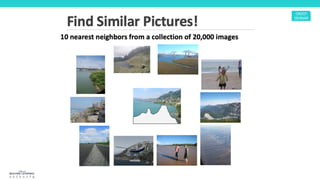
Lecture notes of AI506 by Kijung Shin
Introduction
Motivation
A Common Metaphor
• Many problems can be expressed as finding “similar” sets.
• Find near-neighbors in high-dimensional space.
• Examples :
• Pages with similar words.
• Customers who purchased similar products.
• Images with similar features.
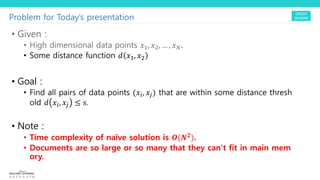
Problem for Today’s presentation
• Given :
• High dimensional data points !!, !", … , !#.
• Some distance function $ !!, !"
• Goal :
• Find all pairs of data points (!$, !%) that are within some distance thresh
old $ !$, !% ≤ s.
• Note :
• Time complexity of naïve solution is )(*&).
• Documents are so large or so many that they can’t fit in main mem
ory.
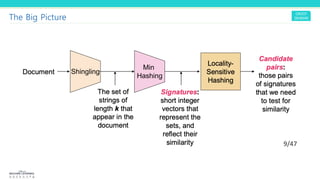
The Big Picture
Documents as High-Dimensional Data
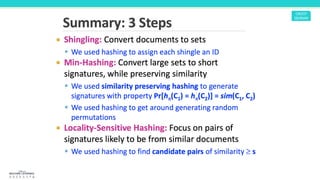
• Step1 : Shingling
• Convert documents to sets.
• It’s preprocessing stage
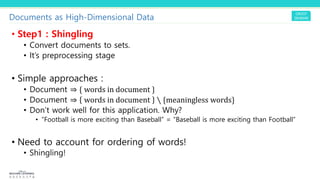
• Simple approaches :
• Document ⇒ { words in document }
• Document ⇒ words in document ∖ {meaningless words}
• Don’t work well for this application. Why?
• “Football is more exciting than Baseball” = “Baseball is more exciting than Football”
• Need to account for ordering of words!
• Shingling!
Step 1 : Shingling
• A k-shingle for a document is a sequence of k-tokens that appea
rs in the document
• Example : k=2 document D=abcab
• Shingling -> {ab, bc, ca, ab} -> {ab, bc, ca}
• Hash the shingles -> {1, 5, 7} = [1, 0, 0, 0, 1, 0, 1]
• If you worry about order of shingles yet, pich k large enough
• K=5 is OK for short documents
Step 2 : Min-hashing
• We just have completed pre-processing
• It remains computational cost problem
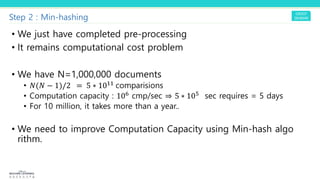
• We have N=1,000,000 documents
• =(= − 1)/2 = 5 ∗ 10!! comparisions
• Computation capacity : 10' cmp/sec ⇒ 5 ∗ 10( sec requires = 5 days
• For 10 million, it takes more than a year..
• We need to improve Computation Capacity using Min-hash algo
rithm.
Step 2 : Min-hashing
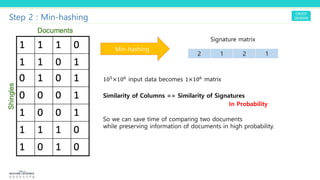
Min-hashing
2 1 2 1
10!×10" input data becomes 1×10" matrix
Signature matrix
Similarity of Columns == Similarity of Signatures
In Probability
So we can save time of comparing two documents
while preserving information of documents in high probability.
Step 2 : Min-hashing
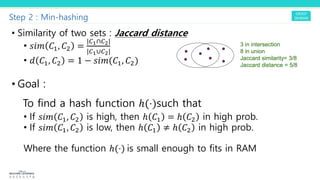
• Similarity of two sets : Jaccard distance
• !"# $!, $" =
|$!∩$"|
|$!∪$"|
• ' $!, $" = 1 − !"#($!, $")
• Goal :
To find a hash function ℎ(⋅)such that
• If !"# $!, $" is high, then ℎ $! = ℎ $" in high prob.
• If !"# $!, $" is low, then ℎ $! ≠ ℎ $" in high prob.
Where the function ℎ(⋅) is small enough to fits in RAM
Step 2 : Min-hashing
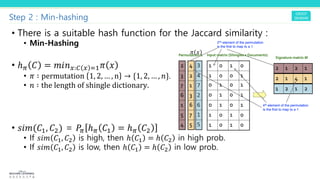
• There is a suitable hash function for the Jaccard similarity :
• Min-Hashing
• ℎ' $ = #"/(:$ ( *!0 1
• F ∶ permutation 1, 2, … , n → {1, 2, … , J}.
• J ∶ the length of shingle dictionary.
• !"#($!, $") = 2' ℎ' $! = ℎ' $"
• If OPQ R!, R" is high, then ℎ R! = ℎ R" in high prob.
• If OPQ R!, R" is low, then ℎ R! = ℎ R" in low prob.
, -
Step 2 : Min-hashing
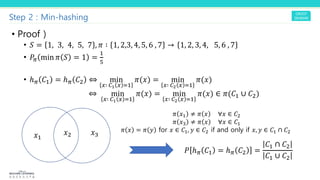
• Proof )
• T = 1, 3, 4, 5, 7 , F ∶ 1, 2,3, 4, 5, 6 , 7 → 1, 2, 3, 4, 5, 6 , 7
• Y. min F T = 1 =
!
(
• ℎ. R! = ℎ. R" ⇔ min
/∶ 1! / 2!
F(!) = min
/∶ 1" / 2!
F(!)
⇔ min
/∶ 1! / 2!
F(!) = min
/∶ 1" / 2!
F(!) ∈ F(R! ∪ R")
!! x1!" !3
x1
+ ,! ≠ + , ∀, ∈ 0"
+ ,# ≠ + , ∀, ∈ 0!
+ , = + 2 for , ∈ 0!, 2 ∈ 0" if and only if ,, 2 ∈ 0! ∩ 0"
Y ℎ. R! = ℎ. R" =
R! ∩ R"
R! ∪ R"
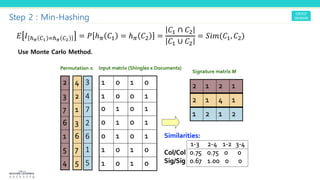
Step 2 : Min-Hashing
^ _ 4# 1! 24# 1"
= Y ℎ. R! = ℎ. R" =
R! ∩ R"
R! ∪ R"
= TPQ(R!, R")
Use Monte Carlo Method.
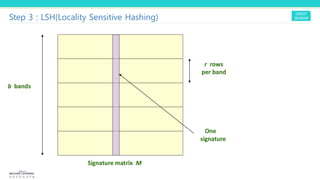
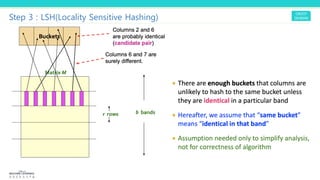
Step 3 : LSH(Locality Sensitive Hashing)
• Goal : Find all pairs of data points (14, 15) that are within some di
stance threshold ' 14, 15 ≤ s.
• General Idea of LSH : Find all candidate pairs whose similarity m
ust be evaluated.
Step 3 : LSH(Locality Sensitive Hashing)
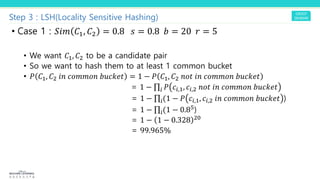
• Case 1 : 5"# $!, $" = 0.8 ! = 0.8 9 = 20 ; = 5
• We want R!, R" to be a candidate pair
• So we want to hash them to at least 1 common bucket
• Y R!, R" PJ `aQQaJ bc`def = 1 − Y R!, R" Jaf PJ `aQQaJ bc`def
= 1 − ∏$ Y `$,!, `$," Jaf PJ `aQQaJ bc`def
= 1 − ∏$(1 − Y `$,!, `$," PJ `aQQaJ bc`def )
= 1 − ∏$(1 − 0.8()
= 1 − 1 − 0.328 "6
= 99.965%
Step 3 : LSH(Locality Sensitive Hashing)
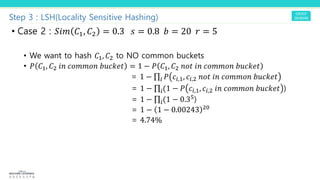
• Case 2 : 5"# $!, $" = 0.3 ! = 0.8 9 = 20 ; = 5
• We want to hash R!, R" to NO common buckets
• Y R!, R" PJ `aQQaJ bc`def = 1 − Y R!, R" Jaf PJ `aQQaJ bc`def
= 1 − ∏$ Y `$,!, `$," Jaf PJ `aQQaJ bc`def
= 1 − ∏$(1 − Y `$,!, `$," PJ `aQQaJ bc`def )
= 1 − ∏$(1 − 0.3()
= 1 − 1 − 0.00243 "6
= 4.74%
Locality sensitive hashing

Locality sensitive hashing

  • 2.
    Lecture notes ofAI506 by Kijung Shin Introduction
  • 3.
  • 5.
    A Common Metaphor •Many problems can be expressed as finding “similar” sets. • Find near-neighbors in high-dimensional space. • Examples : • Pages with similar words. • Customers who purchased similar products. • Images with similar features.
  • 6.
    Problem for Today’spresentation • Given : • High dimensional data points !!, !", … , !#. • Some distance function $ !!, !" • Goal : • Find all pairs of data points (!$, !%) that are within some distance thresh old $ !$, !% ≤ s. • Note : • Time complexity of naïve solution is )(*&). • Documents are so large or so many that they can’t fit in main mem ory.
  • 7.
  • 8.
    Documents as High-DimensionalData • Step1 : Shingling • Convert documents to sets. • It’s preprocessing stage • Simple approaches : • Document ⇒ { words in document } • Document ⇒ words in document ∖ {meaningless words} • Don’t work well for this application. Why? • “Football is more exciting than Baseball” = “Baseball is more exciting than Football” • Need to account for ordering of words! • Shingling!
  • 9.
    Step 1 :Shingling • A k-shingle for a document is a sequence of k-tokens that appea rs in the document • Example : k=2 document D=abcab • Shingling -> {ab, bc, ca, ab} -> {ab, bc, ca} • Hash the shingles -> {1, 5, 7} = [1, 0, 0, 0, 1, 0, 1] • If you worry about order of shingles yet, pich k large enough • K=5 is OK for short documents
  • 10.
    Step 2 :Min-hashing • We just have completed pre-processing • It remains computational cost problem • We have N=1,000,000 documents • =(= − 1)/2 = 5 ∗ 10!! comparisions • Computation capacity : 10' cmp/sec ⇒ 5 ∗ 10( sec requires = 5 days • For 10 million, it takes more than a year.. • We need to improve Computation Capacity using Min-hash algo rithm.
  • 11.
    Step 2 :Min-hashing Min-hashing 2 1 2 1 10!×10" input data becomes 1×10" matrix Signature matrix Similarity of Columns == Similarity of Signatures In Probability So we can save time of comparing two documents while preserving information of documents in high probability.
  • 12.
    Step 2 :Min-hashing • Similarity of two sets : Jaccard distance • !"# $!, $" = |$!∩$"| |$!∪$"| • ' $!, $" = 1 − !"#($!, $") • Goal : To find a hash function ℎ(⋅)such that • If !"# $!, $" is high, then ℎ $! = ℎ $" in high prob. • If !"# $!, $" is low, then ℎ $! ≠ ℎ $" in high prob. Where the function ℎ(⋅) is small enough to fits in RAM
  • 13.
    Step 2 :Min-hashing • There is a suitable hash function for the Jaccard similarity : • Min-Hashing • ℎ' $ = #"/(:$ ( *!0 1 • F ∶ permutation 1, 2, … , n → {1, 2, … , J}. • J ∶ the length of shingle dictionary. • !"#($!, $") = 2' ℎ' $! = ℎ' $" • If OPQ R!, R" is high, then ℎ R! = ℎ R" in high prob. • If OPQ R!, R" is low, then ℎ R! = ℎ R" in low prob. , -
  • 14.
    Step 2 :Min-hashing • Proof ) • T = 1, 3, 4, 5, 7 , F ∶ 1, 2,3, 4, 5, 6 , 7 → 1, 2, 3, 4, 5, 6 , 7 • Y. min F T = 1 = ! ( • ℎ. R! = ℎ. R" ⇔ min /∶ 1! / 2! F(!) = min /∶ 1" / 2! F(!) ⇔ min /∶ 1! / 2! F(!) = min /∶ 1" / 2! F(!) ∈ F(R! ∪ R") !! x1!" !3 x1 + ,! ≠ + , ∀, ∈ 0" + ,# ≠ + , ∀, ∈ 0! + , = + 2 for , ∈ 0!, 2 ∈ 0" if and only if ,, 2 ∈ 0! ∩ 0" Y ℎ. R! = ℎ. R" = R! ∩ R" R! ∪ R"
  • 15.
    Step 2 :Min-Hashing ^ _ 4# 1! 24# 1" = Y ℎ. R! = ℎ. R" = R! ∩ R" R! ∪ R" = TPQ(R!, R") Use Monte Carlo Method.
  • 16.
    Step 3 :LSH(Locality Sensitive Hashing) • Goal : Find all pairs of data points (14, 15) that are within some di stance threshold ' 14, 15 ≤ s. • General Idea of LSH : Find all candidate pairs whose similarity m ust be evaluated.
  • 17.
    Step 3 :LSH(Locality Sensitive Hashing)
  • 18.
    Step 3 :LSH(Locality Sensitive Hashing)
  • 19.
    Step 3 :LSH(Locality Sensitive Hashing) • Case 1 : 5"# $!, $" = 0.8 ! = 0.8 9 = 20 ; = 5 • We want R!, R" to be a candidate pair • So we want to hash them to at least 1 common bucket • Y R!, R" PJ `aQQaJ bc`def = 1 − Y R!, R" Jaf PJ `aQQaJ bc`def = 1 − ∏$ Y `$,!, `$," Jaf PJ `aQQaJ bc`def = 1 − ∏$(1 − Y `$,!, `$," PJ `aQQaJ bc`def ) = 1 − ∏$(1 − 0.8() = 1 − 1 − 0.328 "6 = 99.965%
  • 20.
    Step 3 :LSH(Locality Sensitive Hashing) • Case 2 : 5"# $!, $" = 0.3 ! = 0.8 9 = 20 ; = 5 • We want to hash R!, R" to NO common buckets • Y R!, R" PJ `aQQaJ bc`def = 1 − Y R!, R" Jaf PJ `aQQaJ bc`def = 1 − ∏$ Y `$,!, `$," Jaf PJ `aQQaJ bc`def = 1 − ∏$(1 − Y `$,!, `$," PJ `aQQaJ bc`def ) = 1 − ∏$(1 − 0.3() = 1 − 1 − 0.00243 "6 = 4.74%