TIME MANAGEMENT IN CLASSROOM
TIME IS MONEY…..
BY
DR.SHAZIA ZAMIR
(EDUCATION DEPARTMENT,NUML)
ACTIVITY
THE BIG ROCKS OF MY LIFE
SCHEME OF SESSION
 Time management
 Purpose of Time Management
 Building Blocks of Time Management
 Steps to Managing Your Time
 Principles of time management
 Teaching approaches
 Most common time management mistakes
 Steps to minimize wasted hours in
classroom
 What can we do for time management?
 Review
TIME MANAGEMENT
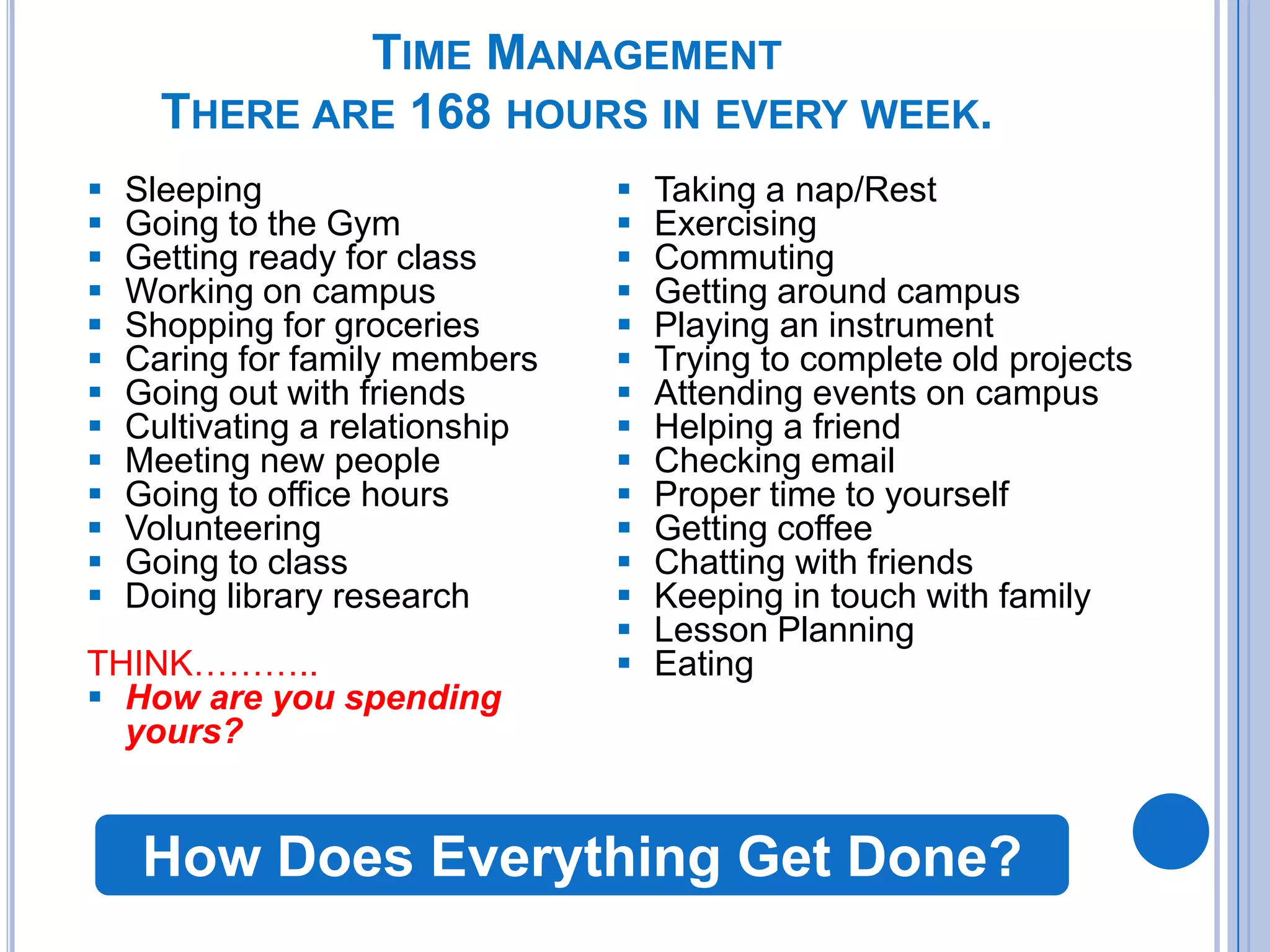
THERE ARE 168 HOURS IN EVERY WEEK.
 Sleeping
 Going to the Gym
 Getting ready for class
 Working on campus
 Shopping for groceries
 Caring for family members
 Going out with friends
 Cultivating a relationship
 Meeting new people
 Going to office hours
 Volunteering
 Going to class
 Doing library research
THINK………..
 How are you spending
yours?
 Taking a nap/Rest
 Exercising
 Commuting
 Getting around campus
 Playing an instrument
 Trying to complete old projects
 Attending events on campus
 Helping a friend
 Checking email
 Proper time to yourself
 Getting coffee
 Chatting with friends
 Keeping in touch with family
 Lesson Planning
 Eating
How Does Everything Get Done?
TIME MANAGEMENT
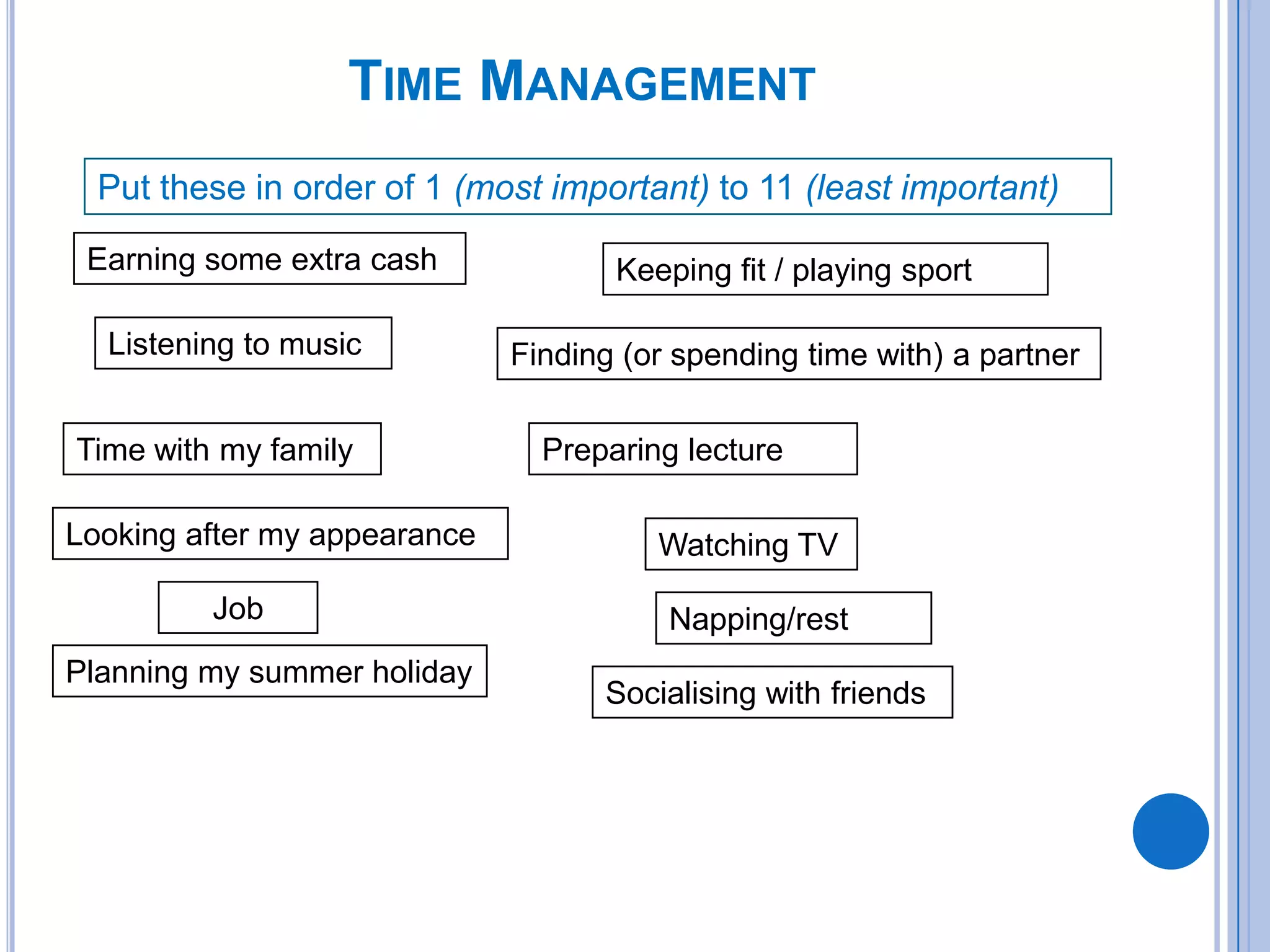
Put these in order of 1 (most important) to 11 (least important)
Earning some extra cash
Listening to music
Time with my family
Looking after my appearance
Planning my summer holiday
Finding (or spending time with) a partner
Watching TV
Socialising with friends
Keeping fit / playing sport
Preparing lecture
Napping/restJob
TIME MANAGEMENT
It is managing ourselves in relation to time. It
is setting priorities and taking charge of your
situation and time utilization.
Time must be explicitly managed, just like
money.
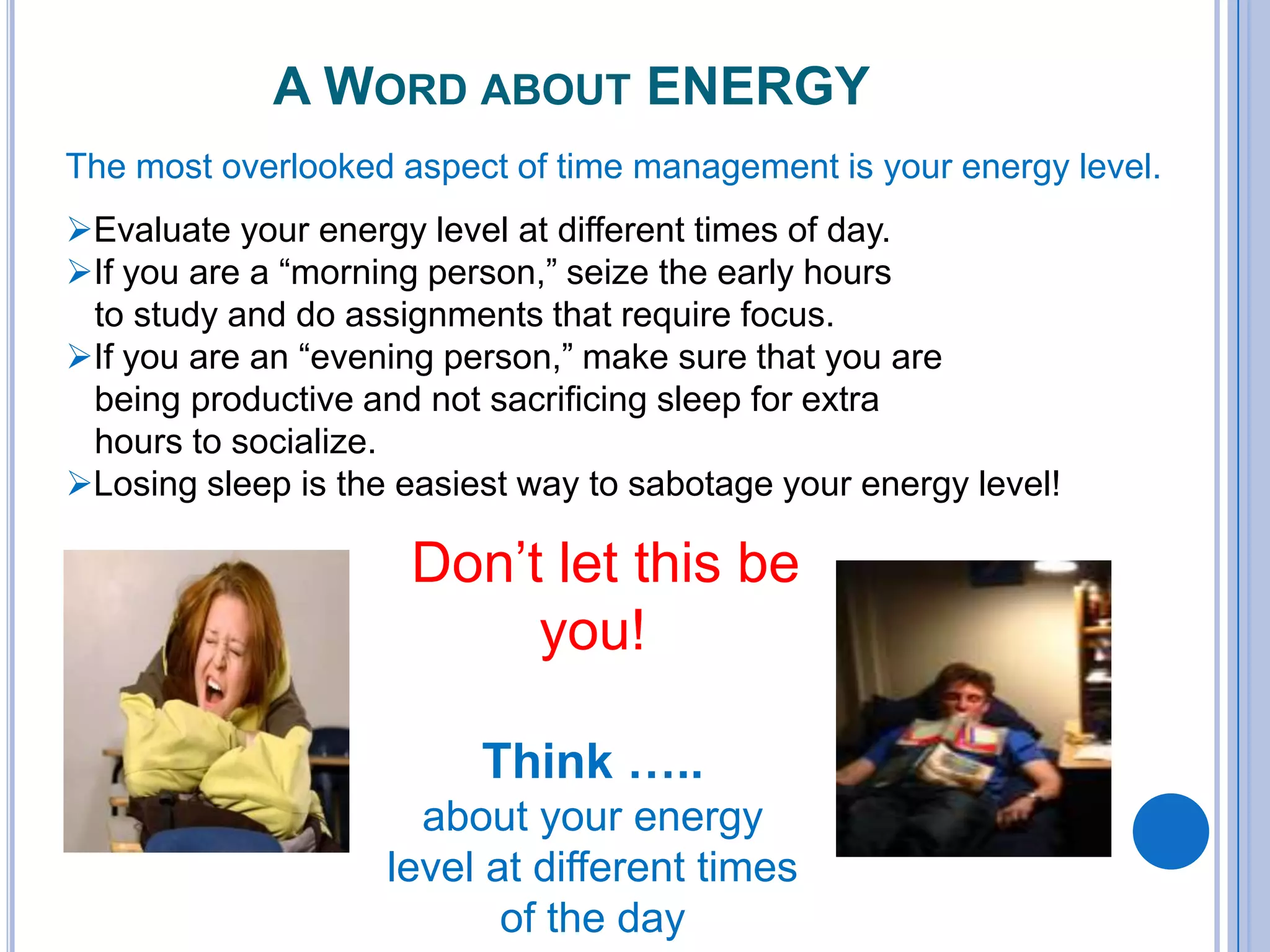
A WORD ABOUT ENERGY
The most overlooked aspect of time management is your energy level.
Evaluate your energy level at different times of day.
If you are a “morning person,” seize the early hours
to study and do assignments that require focus.
If you are an “evening person,” make sure that you are
being productive and not sacrificing sleep for extra
hours to socialize.
Losing sleep is the easiest way to sabotage your energy level!
Don’t let this be
you!
Think …..
about your energy
level at different times
of the day
Time
Management
Self
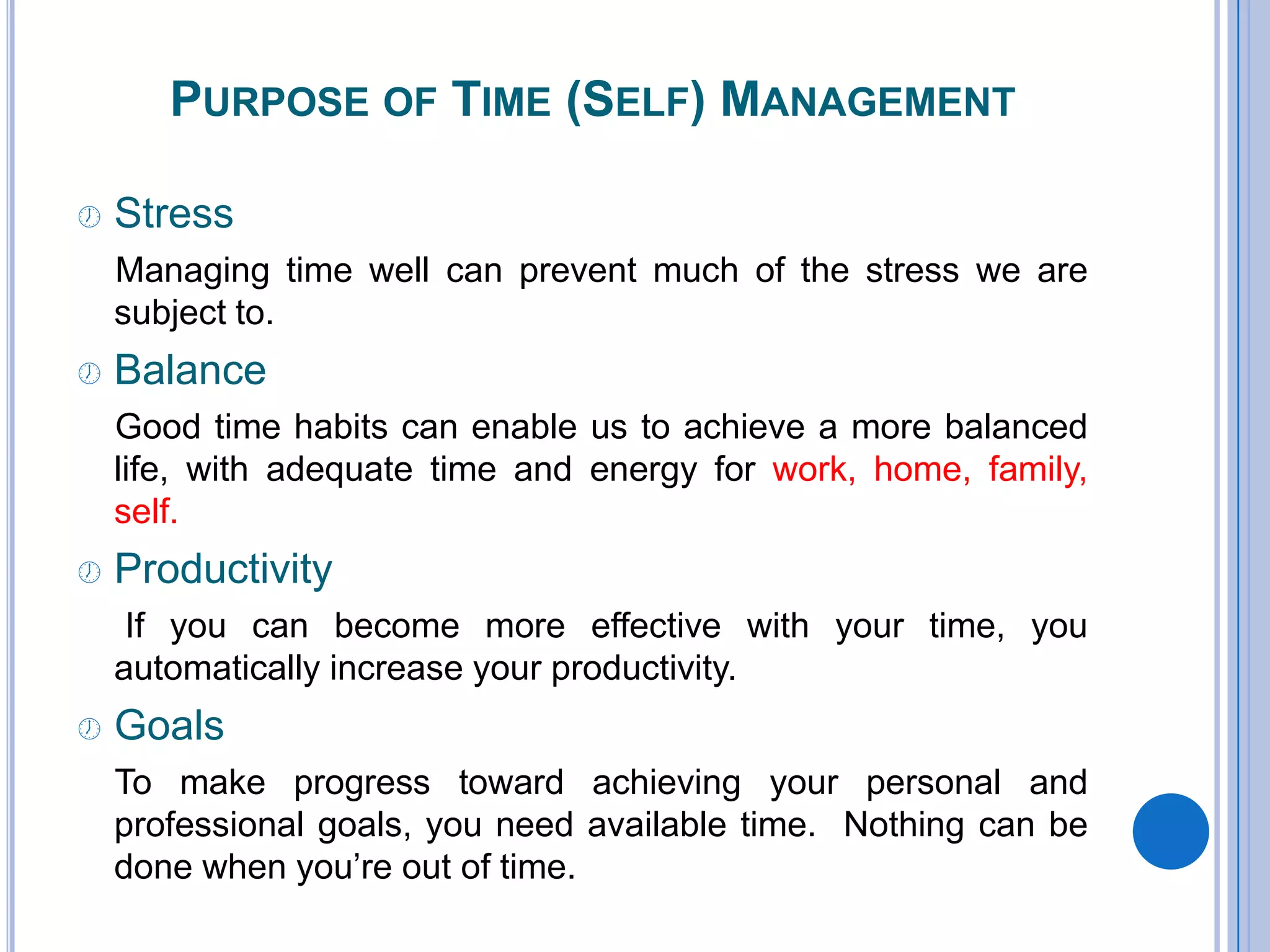
PURPOSE OF TIME (SELF) MANAGEMENT
 Stress
Managing time well can prevent much of the stress we are
subject to.
 Balance
Good time habits can enable us to achieve a more balanced
life, with adequate time and energy for work, home, family,
self.
 Productivity
If you can become more effective with your time, you
automatically increase your productivity.
 Goals
To make progress toward achieving your personal and
professional goals, you need available time. Nothing can be
done when you’re out of time.
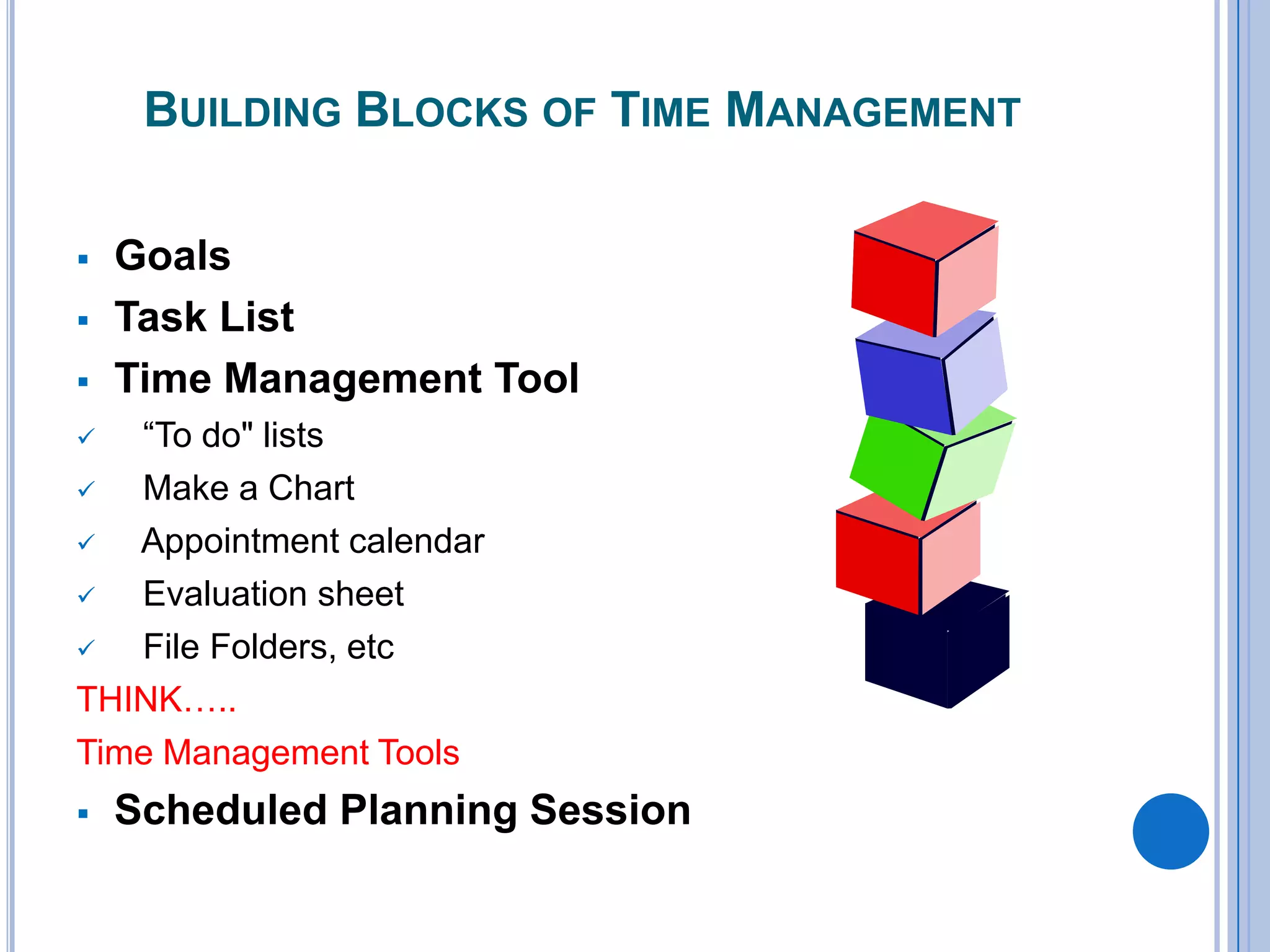
BUILDING BLOCKS OF TIME MANAGEMENT
 Goals
 Task List
 Time Management Tool
 “To do" lists
 Make a Chart
 Appointment calendar
 Evaluation sheet
 File Folders, etc
THINK…..
Time Management Tools
 Scheduled Planning Session
STEPS TO MANAGING YOUR TIME
1. Set Goals
2. Make a Schedule
3. Revisit and Revise Your Plan
WHERE TO START?
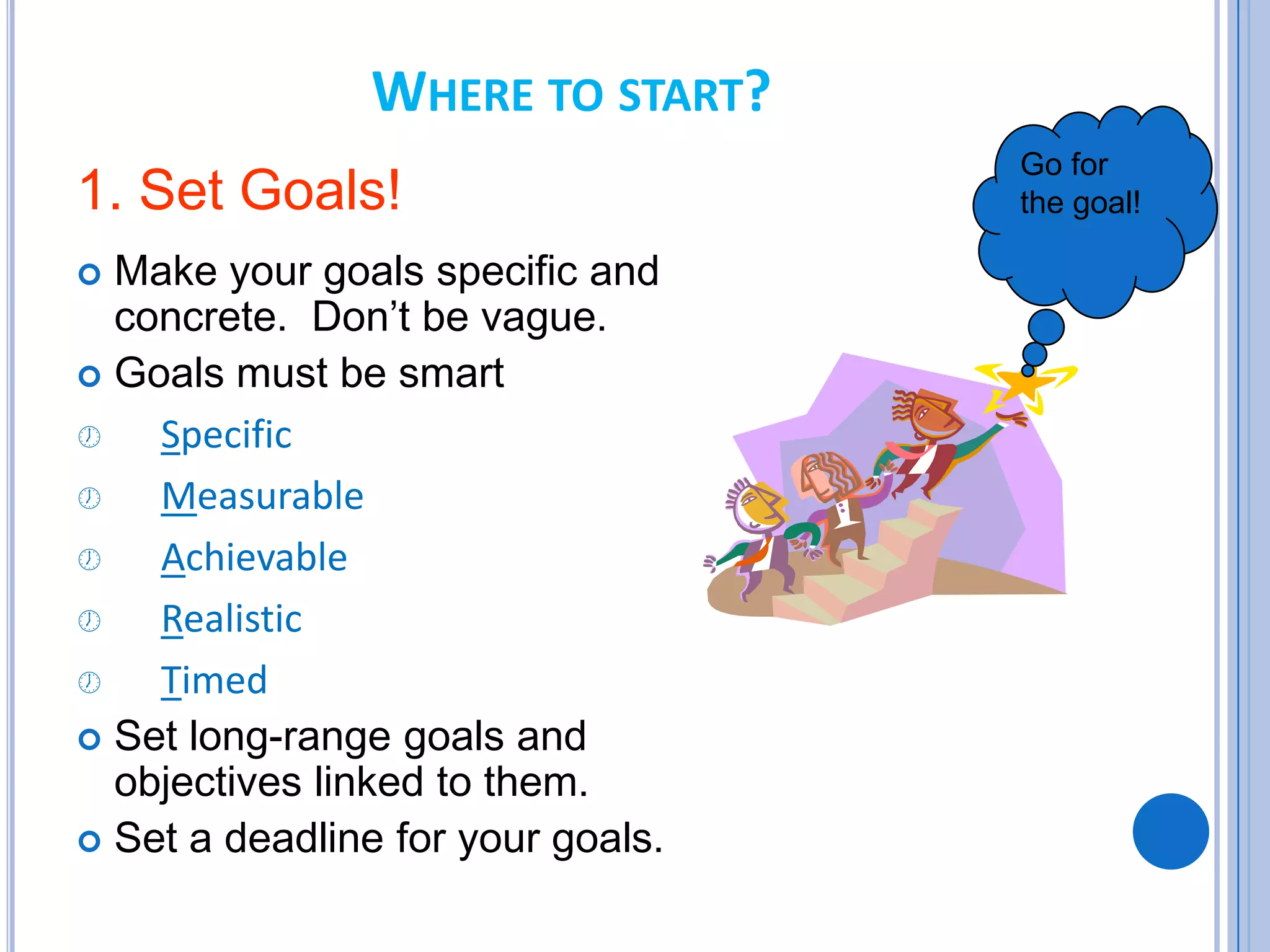
1. Set Goals!
 Make your goals specific and
concrete. Don’t be vague.
 Goals must be smart
 Specific
 Measurable
 Achievable
 Realistic
 Timed
 Set long-range goals and
objectives linked to them.
 Set a deadline for your goals.
Go for
the goal!
SET GOALS! CONTINUED
From your goals, set priorities.
 What’s important and what isn’t?
 What order do things need to be done in?
 Use an A-B-C rating system for items on your "to
do" lists with A items being highest priority.
 Once you know what your priorities are, you need
to plan out a schedule for the semester, the week
and the day.
 Planning may seem hard at first, but the more you
do it, the easier and more natural it gets.
o ASSIGN realistic priorities to each task
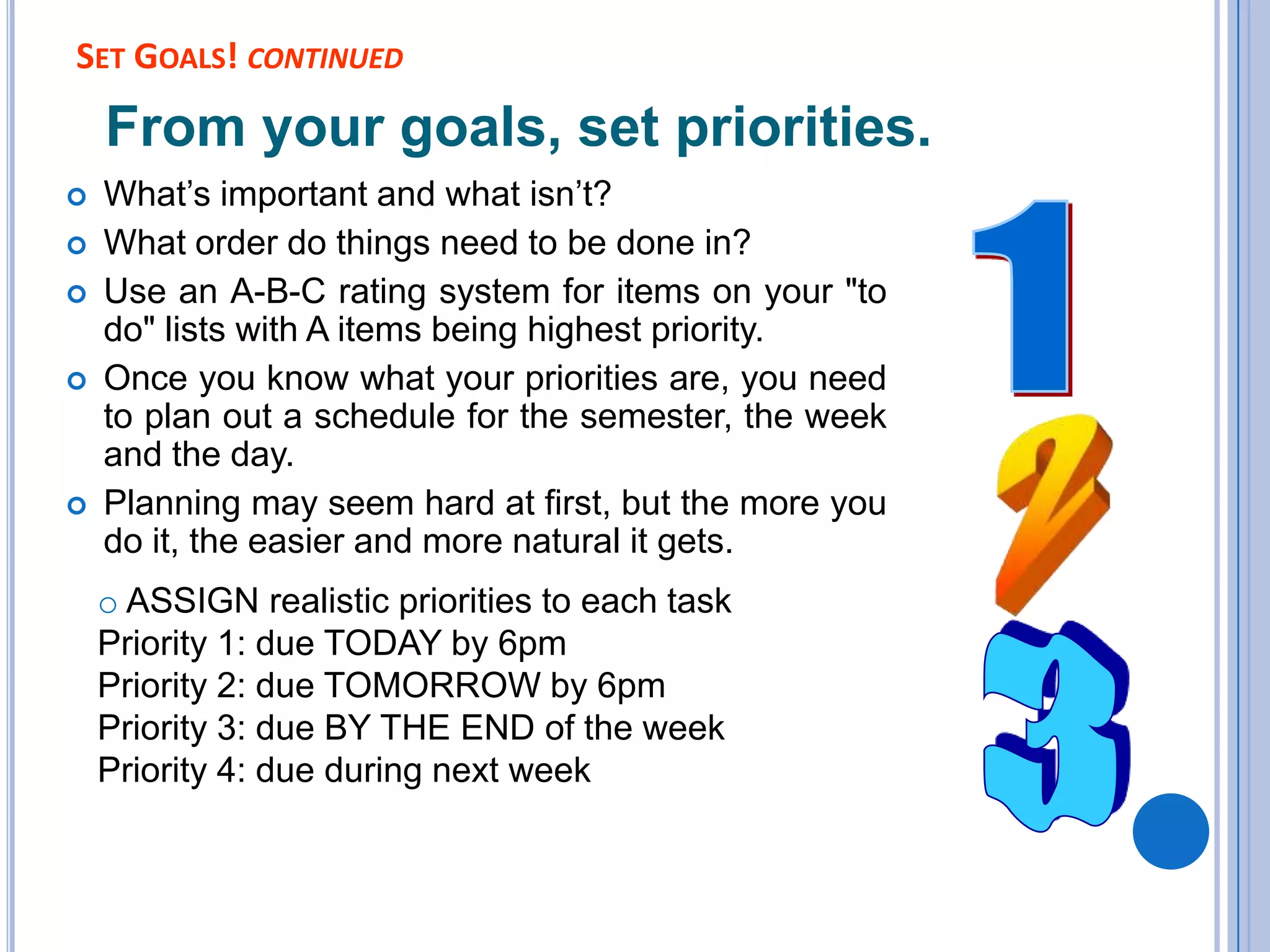
Priority 1: due TODAY by 6pm
Priority 2: due TOMORROW by 6pm
Priority 3: due BY THE END of the week
Priority 4: due during next week
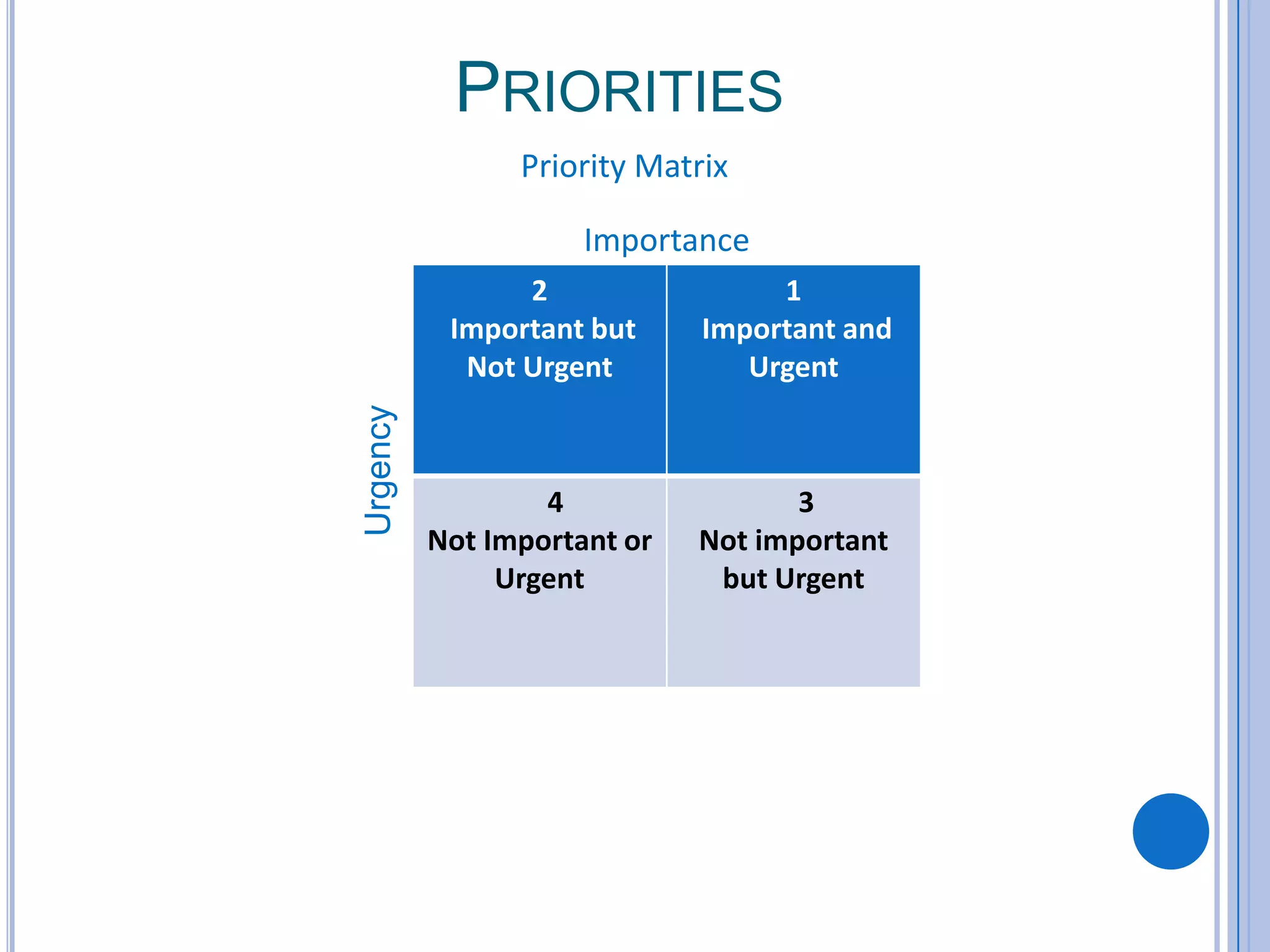
2
Important but
Not Urgent
1
Important and
Urgent
4
Not Important or
Urgent
3
Not important
but Urgent
Importance
Urgency
Priority Matrix
PRIORITIES
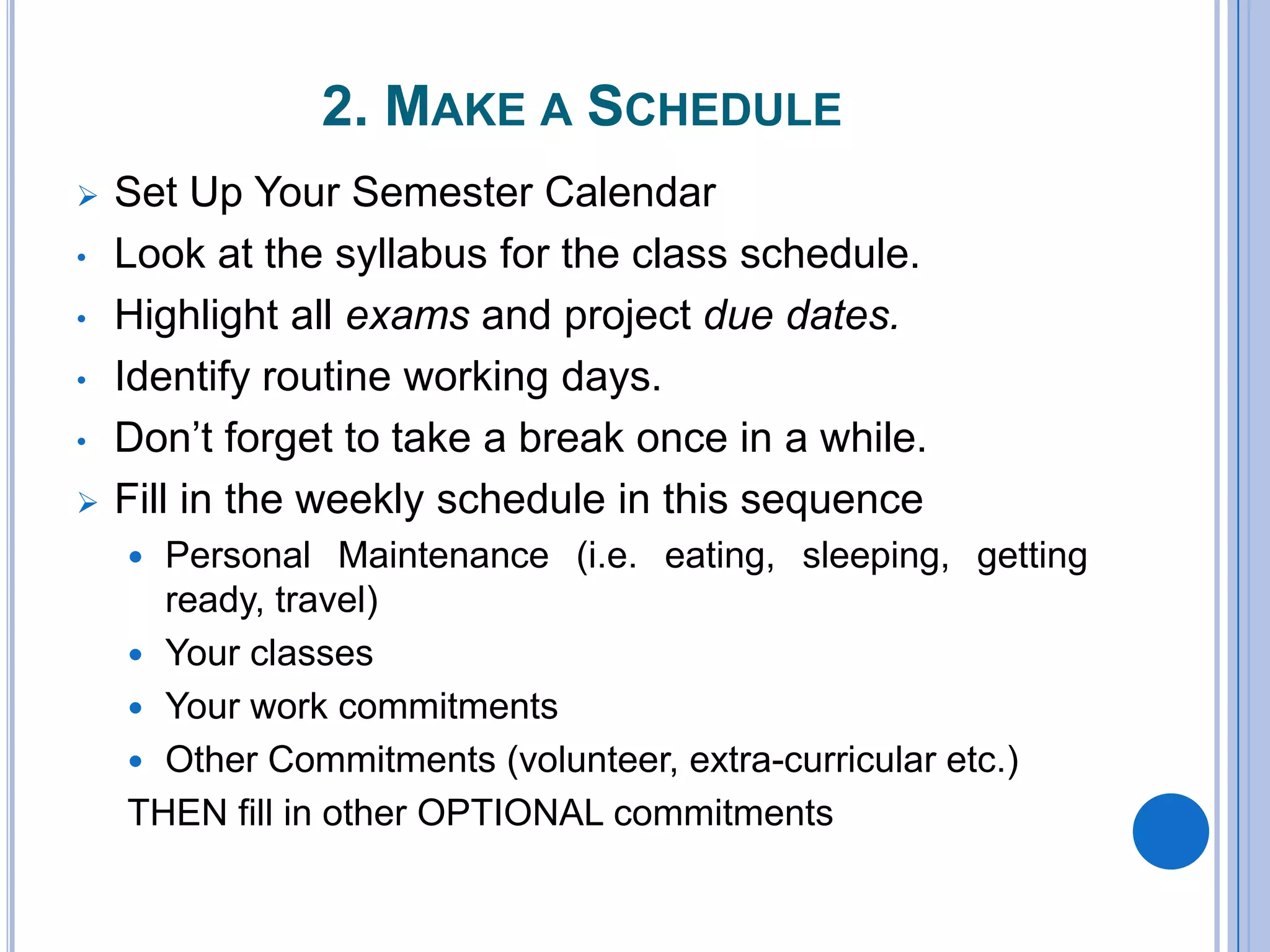
2. MAKE A SCHEDULE
 Set Up Your Semester Calendar
• Look at the syllabus for the class schedule.
• Highlight all exams and project due dates.
• Identify routine working days.
• Don’t forget to take a break once in a while.
 Fill in the weekly schedule in this sequence
 Personal Maintenance (i.e. eating, sleeping, getting
ready, travel)
 Your classes
 Your work commitments
 Other Commitments (volunteer, extra-curricular etc.)
THEN fill in other OPTIONAL commitments
MAKE A SCHEDULE
(CONTINUED)
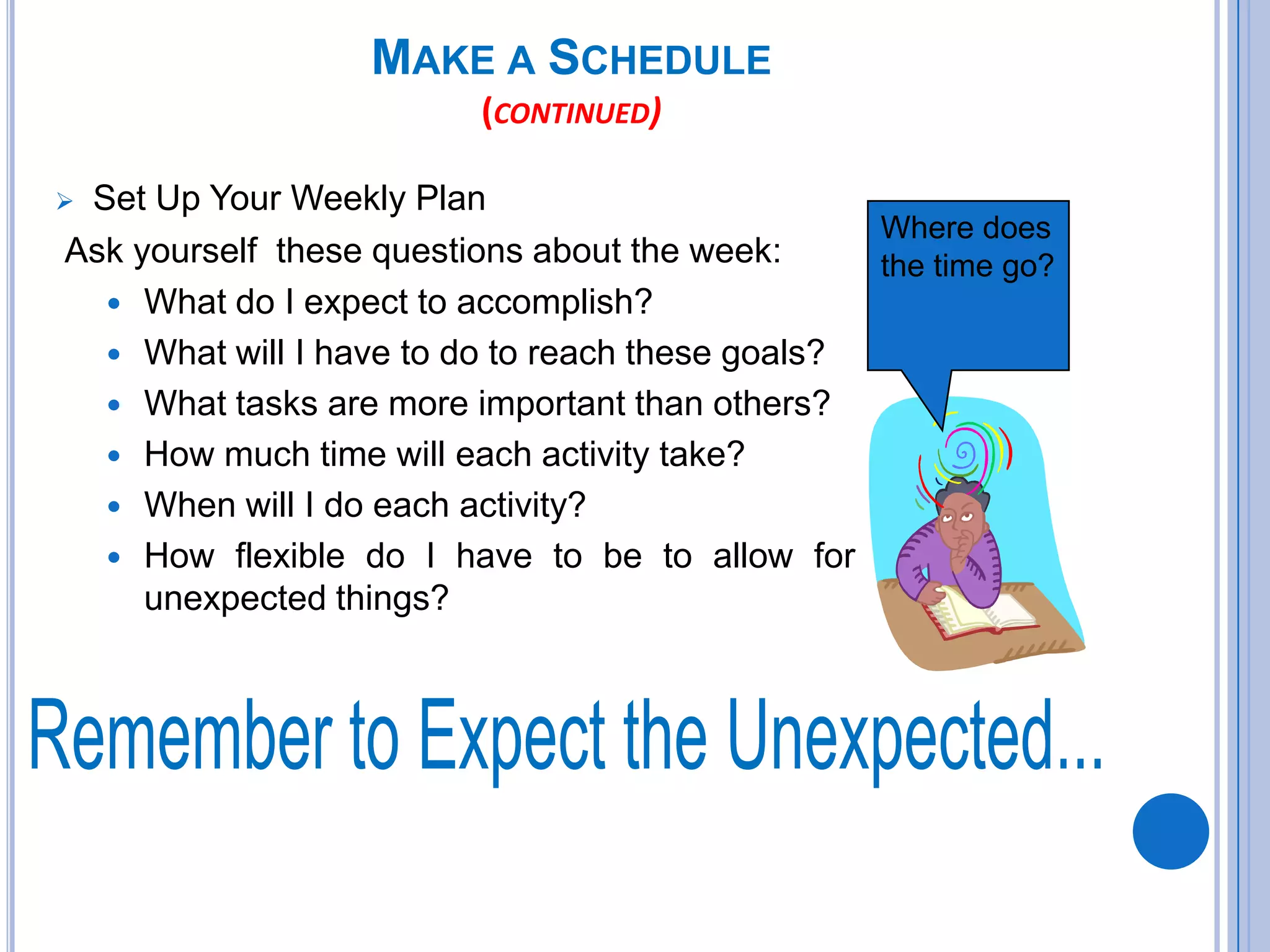
 Set Up Your Weekly Plan
Ask yourself these questions about the week:
 What do I expect to accomplish?
 What will I have to do to reach these goals?
 What tasks are more important than others?
 How much time will each activity take?
 When will I do each activity?
 How flexible do I have to be to allow for
unexpected things?
Where does
the time go?
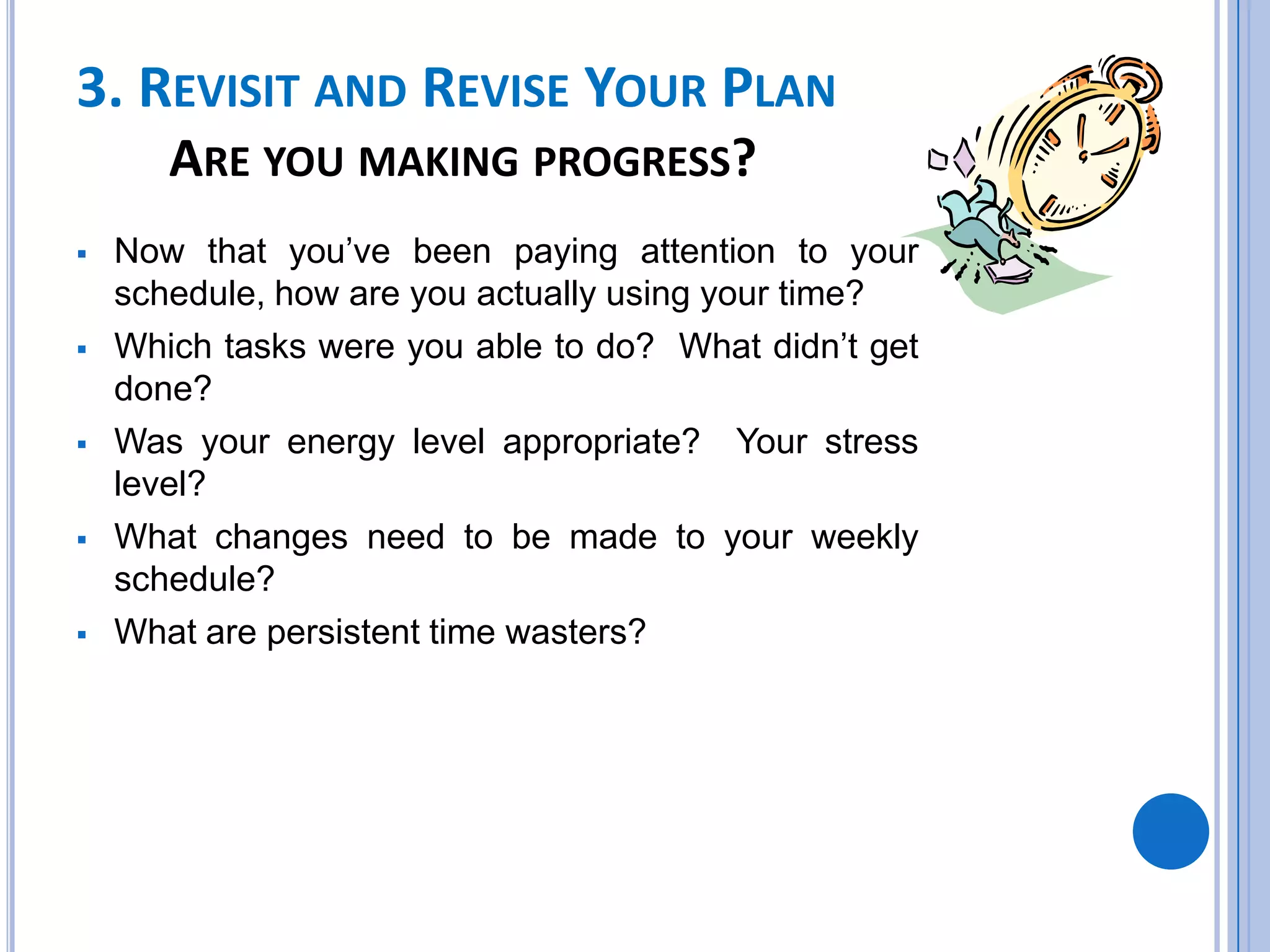
3. REVISIT AND REVISE YOUR PLAN
ARE YOU MAKING PROGRESS?
 Now that you’ve been paying attention to your
schedule, how are you actually using your time?
 Which tasks were you able to do? What didn’t get
done?
 Was your energy level appropriate? Your stress
level?
 What changes need to be made to your weekly
schedule?
 What are persistent time wasters?
PRINCIPLES OF TIME MANAGEMENT
 Set goals and Establish priorities
 Spot the Time Wasters
 unclear objectives
 Disorganizations
 Interruptions
 Inability to say no…etc………….
 Think quality not quantity of Time
 Organize Yourself for success – Prioritize, Clear your goals,
delicate work to others, stay healthy in body and mind, Act
purposefully and positively.
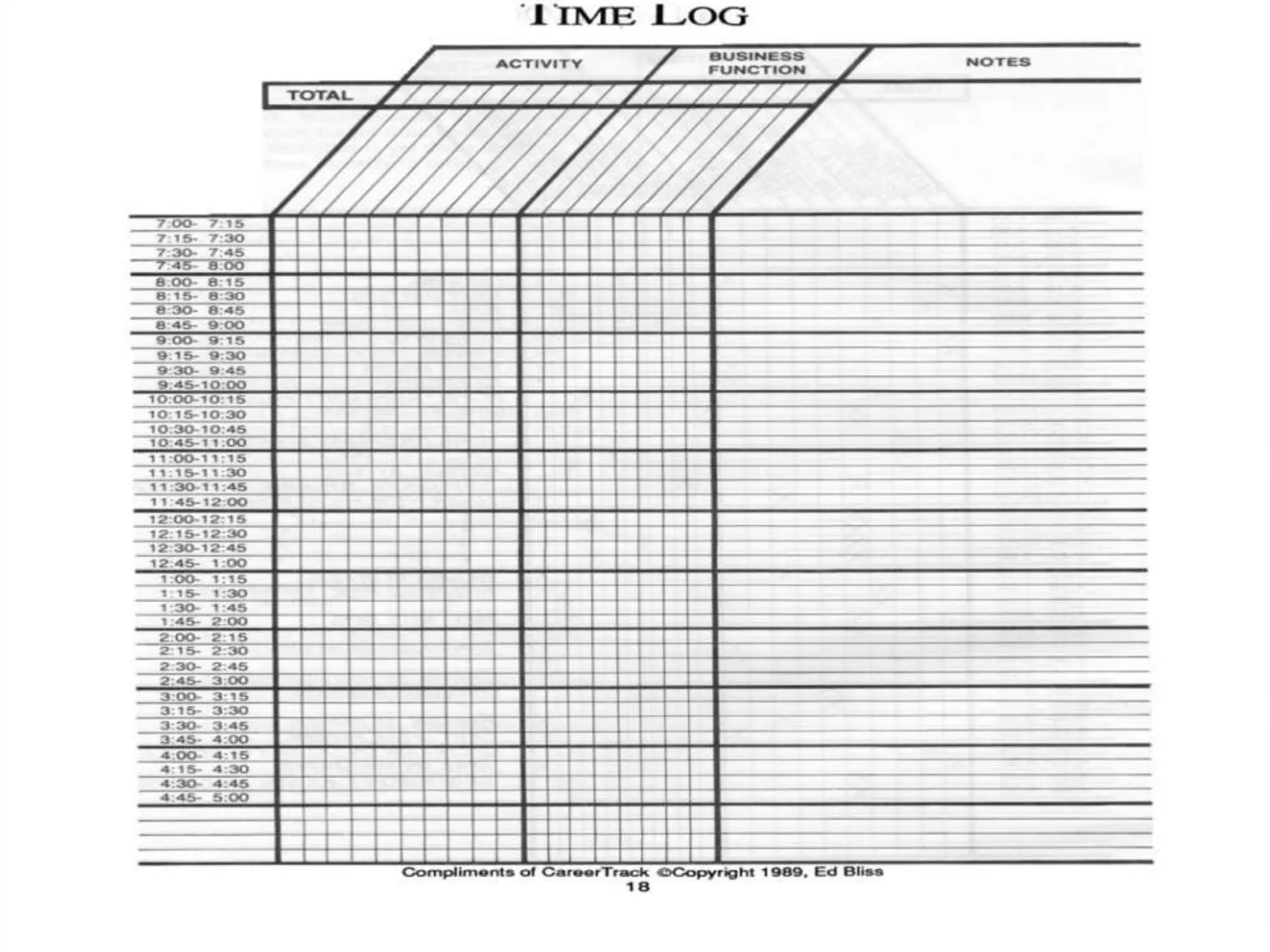
 Write a Daily Time schedule: - Time, Activity, Priority (mark each
activity according to how important it is (A: Extremely important;
B: Important; C: relatively unimportant), Effectiveness and then
evaluate the complete time plan of the day.
TEACHING APPROACHES
 As teachers become more and more accountable for student
success, taking advantage of every minute of class time
becomes crucial. Efficient use of class time can increase
student performance and decrease teacher anxiety.
 Phases of teaching
 Pre-active phase
 Interactive phase
 Post active phase
TEACHING APPROACHES
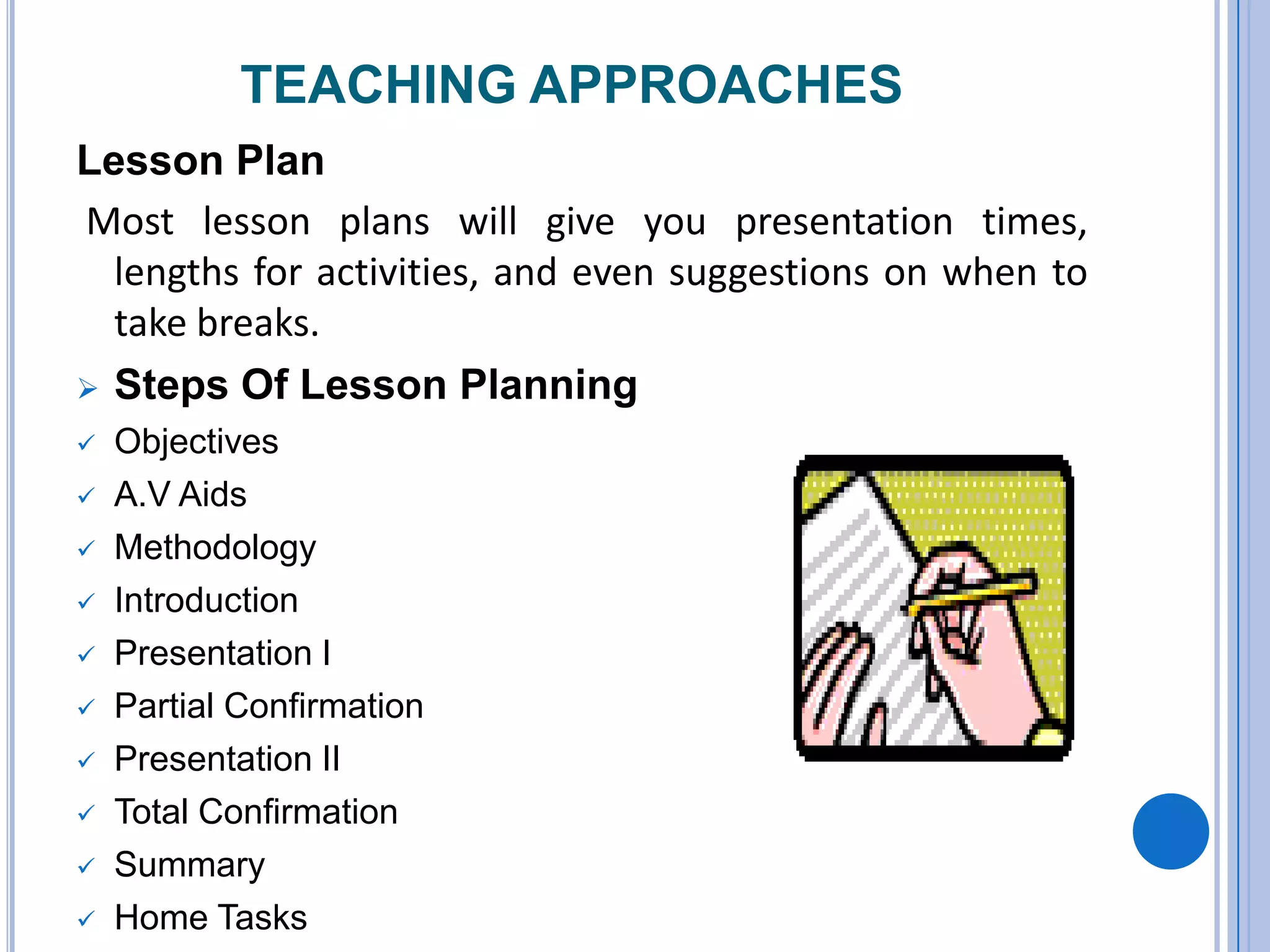
Lesson Plan
Most lesson plans will give you presentation times,
lengths for activities, and even suggestions on when to
take breaks.
 Steps Of Lesson Planning
 Objectives
 A.V Aids
 Methodology
 Introduction
 Presentation I
 Partial Confirmation
 Presentation II
 Total Confirmation
 Summary
 Home Tasks
TEACHING APPROACHES(CONTINUED)
 Lead-In Activity (10 minutes)- technique used to get students on-
task immediately upon entering the classroom, while the teacher
takes role and organizes class materials.
 Shortly. discuss the lead-in activity before beginning class.
 “Quote/Word of the Day“ - Students respond to a quote or word
written on the board by putting in down in their notebooks.
 Brain Teaser Question - Students are given a question that will
challenge them and get their brains “warmed up.”
 Preview (5 minutes)- make sure students know what is expected
of them during your class time.
 Discuss each portion of the class in advance so that
students know what is in store for them.
 Have a student recap the previous day’s lesson by giving a
short overview in front of the class (this also promotes
communication skills.)
TEACHING APPROACHES(CONTINUED)
 Lecture/Notes (20-30 minutes) - Students attention spans are short,
but notes and lecture are very necessary.
 Cover a suitable amount of material so that the main points can
be reinforced later in the class through activities.
 Encourage student input and questioning during lecture time.
 Demonstration/ Group Activity (15-20 minutes) - provide a hands-
on activity to reinforce the class topic.
 Examples of this could be a group assignment, a lab experiment,
a brainstorming activity, a demonstration, etc.
 Lesson Overview (10-15 minutes)- make sure that all the main points
of the lesson have been addressed during this time.
 Review topics by asking students “What did we learn today?” See
if they got the message.
 Have students reflect in their notebooks what they thought were
the important topics of the day’s lesson.
MOST COMMON TIME MANAGEMENT MISTAKES
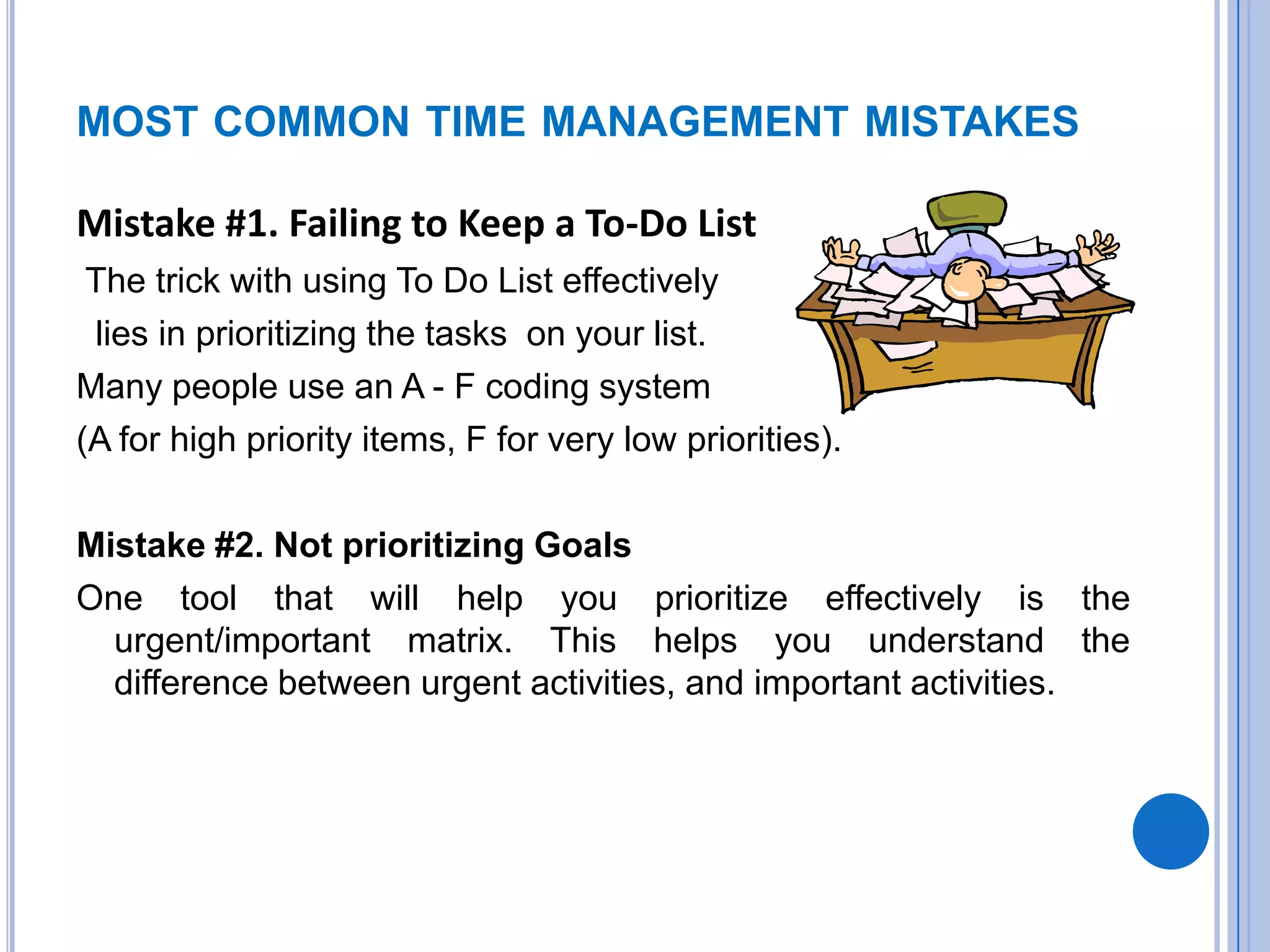
Mistake #1. Failing to Keep a To-Do List
The trick with using To Do List effectively
lies in prioritizing the tasks on your list.
Many people use an A - F coding system
(A for high priority items, F for very low priorities).
Mistake #2. Not prioritizing Goals
One tool that will help you prioritize effectively is the
urgent/important matrix. This helps you understand the
difference between urgent activities, and important activities.
MOST COMMON TIME MANAGEMENT MISTAKES
(CONTINUED)
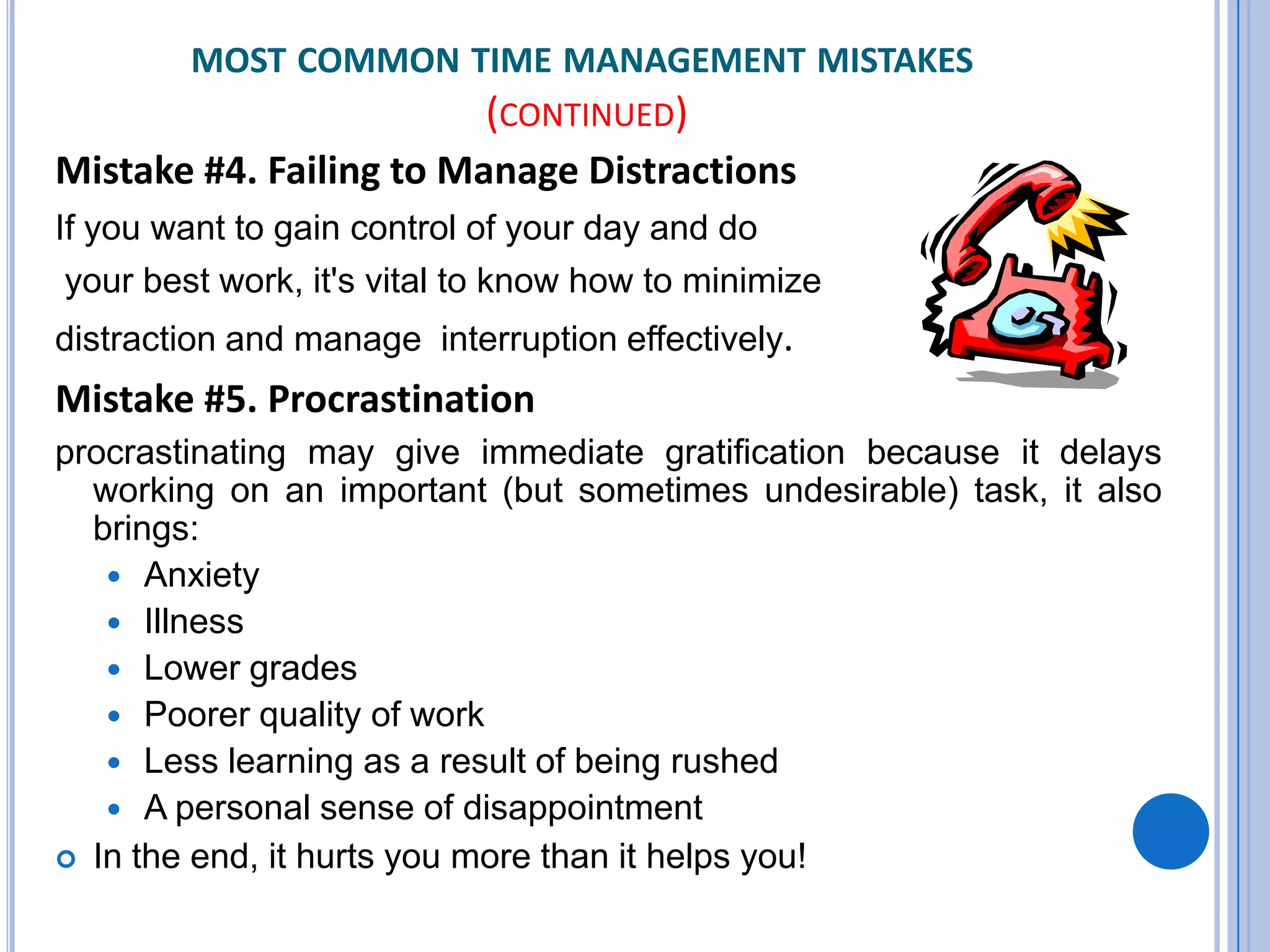
Mistake #4. Failing to Manage Distractions
If you want to gain control of your day and do
your best work, it's vital to know how to minimize
distraction and manage interruption effectively.
Mistake #5. Procrastination
procrastinating may give immediate gratification because it delays
working on an important (but sometimes undesirable) task, it also
brings:
 Anxiety
 Illness
 Lower grades
 Poorer quality of work
 Less learning as a result of being rushed
 A personal sense of disappointment
 In the end, it hurts you more than it helps you!
MOST COMMON TIME MANAGEMENT MISTAKES
(CONTINUED)
Mistake #6. Inability to say “No”
Are you a person who has a hard time
saying "no" to people?
Most of us have been taught that “no” is
disrespectful and even insulting.
This can lead to poor performance, stress, and low morale.
Mistake #7. Multitasking
It can take 20-40 percent more time
to finish a list of jobs when you multitask,
compared with completing the same
list of tasks in sequence.
Mistake #8. All work and no play
If it's hard for you to stop working, then schedule
breaks for yourself. Go for a quick walk, grab
a cup of coffee, or just sit and meditate at your desk.
THINK…………………………
Other Mistakes…………..
MOST COMMON TIME MANAGEMENT MISTAKES
(CONTINUED)
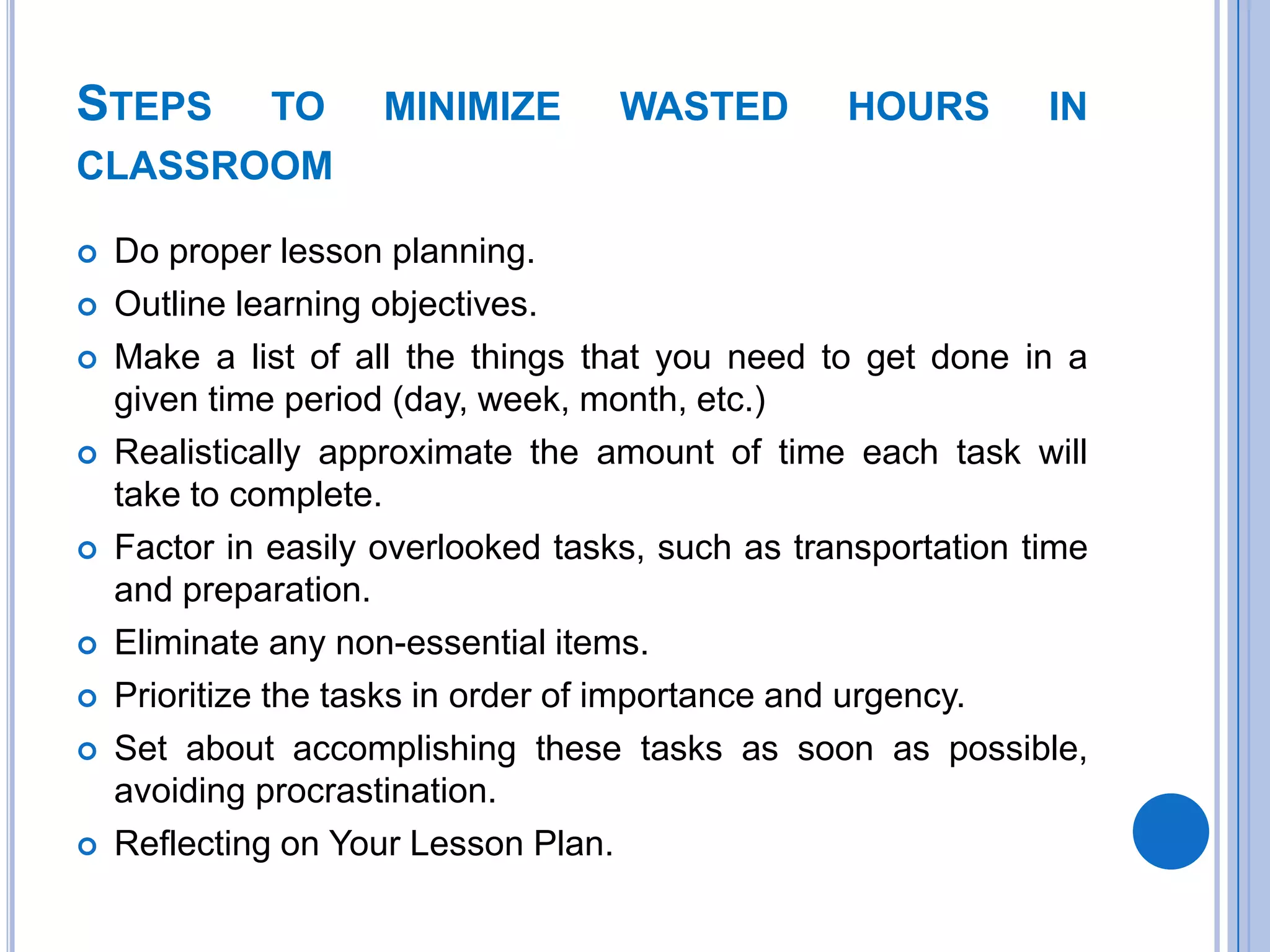
STEPS TO MINIMIZE WASTED HOURS IN
CLASSROOM
 Do proper lesson planning.
 Outline learning objectives.
 Make a list of all the things that you need to get done in a
given time period (day, week, month, etc.)
 Realistically approximate the amount of time each task will
take to complete.
 Factor in easily overlooked tasks, such as transportation time
and preparation.
 Eliminate any non-essential items.
 Prioritize the tasks in order of importance and urgency.
 Set about accomplishing these tasks as soon as possible,
avoiding procrastination.
 Reflecting on Your Lesson Plan.
WHAT CAN WE DO FOR TIME MANAGEMENT?
• Set goals
• Prioritize
 Do
 Delegate
 Delay
 Delete
• Organize
• Learn when to say “NO”
• Consider your personal prime time
Morning?
Evening?
Late night?
• Celebrate success
REVIEW
THANK YOU

Time management in classroom by DR.SHAZIA ZAMIR,NUML.

  • 1.
    TIME MANAGEMENT INCLASSROOM TIME IS MONEY….. BY DR.SHAZIA ZAMIR (EDUCATION DEPARTMENT,NUML)
  • 2.
  • 3.
    SCHEME OF SESSION Time management  Purpose of Time Management  Building Blocks of Time Management  Steps to Managing Your Time  Principles of time management  Teaching approaches  Most common time management mistakes  Steps to minimize wasted hours in classroom  What can we do for time management?  Review
  • 4.
    TIME MANAGEMENT THERE ARE168 HOURS IN EVERY WEEK.  Sleeping  Going to the Gym  Getting ready for class  Working on campus  Shopping for groceries  Caring for family members  Going out with friends  Cultivating a relationship  Meeting new people  Going to office hours  Volunteering  Going to class  Doing library research THINK………..  How are you spending yours?  Taking a nap/Rest  Exercising  Commuting  Getting around campus  Playing an instrument  Trying to complete old projects  Attending events on campus  Helping a friend  Checking email  Proper time to yourself  Getting coffee  Chatting with friends  Keeping in touch with family  Lesson Planning  Eating How Does Everything Get Done?
  • 5.
    TIME MANAGEMENT Put thesein order of 1 (most important) to 11 (least important) Earning some extra cash Listening to music Time with my family Looking after my appearance Planning my summer holiday Finding (or spending time with) a partner Watching TV Socialising with friends Keeping fit / playing sport Preparing lecture Napping/restJob
  • 6.
    TIME MANAGEMENT It ismanaging ourselves in relation to time. It is setting priorities and taking charge of your situation and time utilization. Time must be explicitly managed, just like money.
  • 7.
    A WORD ABOUTENERGY The most overlooked aspect of time management is your energy level. Evaluate your energy level at different times of day. If you are a “morning person,” seize the early hours to study and do assignments that require focus. If you are an “evening person,” make sure that you are being productive and not sacrificing sleep for extra hours to socialize. Losing sleep is the easiest way to sabotage your energy level! Don’t let this be you! Think ….. about your energy level at different times of the day
  • 8.
  • 9.
    PURPOSE OF TIME(SELF) MANAGEMENT  Stress Managing time well can prevent much of the stress we are subject to.  Balance Good time habits can enable us to achieve a more balanced life, with adequate time and energy for work, home, family, self.  Productivity If you can become more effective with your time, you automatically increase your productivity.  Goals To make progress toward achieving your personal and professional goals, you need available time. Nothing can be done when you’re out of time.
  • 10.
    BUILDING BLOCKS OFTIME MANAGEMENT  Goals  Task List  Time Management Tool  “To do" lists  Make a Chart  Appointment calendar  Evaluation sheet  File Folders, etc THINK….. Time Management Tools  Scheduled Planning Session
  • 11.
    STEPS TO MANAGINGYOUR TIME 1. Set Goals 2. Make a Schedule 3. Revisit and Revise Your Plan
  • 12.
    WHERE TO START? 1.Set Goals!  Make your goals specific and concrete. Don’t be vague.  Goals must be smart  Specific  Measurable  Achievable  Realistic  Timed  Set long-range goals and objectives linked to them.  Set a deadline for your goals. Go for the goal!
  • 13.
    SET GOALS! CONTINUED Fromyour goals, set priorities.  What’s important and what isn’t?  What order do things need to be done in?  Use an A-B-C rating system for items on your "to do" lists with A items being highest priority.  Once you know what your priorities are, you need to plan out a schedule for the semester, the week and the day.  Planning may seem hard at first, but the more you do it, the easier and more natural it gets. o ASSIGN realistic priorities to each task Priority 1: due TODAY by 6pm Priority 2: due TOMORROW by 6pm Priority 3: due BY THE END of the week Priority 4: due during next week
  • 14.
    2 Important but Not Urgent 1 Importantand Urgent 4 Not Important or Urgent 3 Not important but Urgent Importance Urgency Priority Matrix PRIORITIES
  • 15.
    2. MAKE ASCHEDULE  Set Up Your Semester Calendar • Look at the syllabus for the class schedule. • Highlight all exams and project due dates. • Identify routine working days. • Don’t forget to take a break once in a while.  Fill in the weekly schedule in this sequence  Personal Maintenance (i.e. eating, sleeping, getting ready, travel)  Your classes  Your work commitments  Other Commitments (volunteer, extra-curricular etc.) THEN fill in other OPTIONAL commitments
  • 16.
    MAKE A SCHEDULE (CONTINUED) Set Up Your Weekly Plan Ask yourself these questions about the week:  What do I expect to accomplish?  What will I have to do to reach these goals?  What tasks are more important than others?  How much time will each activity take?  When will I do each activity?  How flexible do I have to be to allow for unexpected things? Where does the time go?
  • 17.
    3. REVISIT ANDREVISE YOUR PLAN ARE YOU MAKING PROGRESS?  Now that you’ve been paying attention to your schedule, how are you actually using your time?  Which tasks were you able to do? What didn’t get done?  Was your energy level appropriate? Your stress level?  What changes need to be made to your weekly schedule?  What are persistent time wasters?
  • 18.
    PRINCIPLES OF TIMEMANAGEMENT  Set goals and Establish priorities  Spot the Time Wasters  unclear objectives  Disorganizations  Interruptions  Inability to say no…etc………….  Think quality not quantity of Time  Organize Yourself for success – Prioritize, Clear your goals, delicate work to others, stay healthy in body and mind, Act purposefully and positively.  Write a Daily Time schedule: - Time, Activity, Priority (mark each activity according to how important it is (A: Extremely important; B: Important; C: relatively unimportant), Effectiveness and then evaluate the complete time plan of the day.
  • 19.
    TEACHING APPROACHES  Asteachers become more and more accountable for student success, taking advantage of every minute of class time becomes crucial. Efficient use of class time can increase student performance and decrease teacher anxiety.  Phases of teaching  Pre-active phase  Interactive phase  Post active phase
  • 20.
    TEACHING APPROACHES Lesson Plan Mostlesson plans will give you presentation times, lengths for activities, and even suggestions on when to take breaks.  Steps Of Lesson Planning  Objectives  A.V Aids  Methodology  Introduction  Presentation I  Partial Confirmation  Presentation II  Total Confirmation  Summary  Home Tasks
  • 21.
    TEACHING APPROACHES(CONTINUED)  Lead-InActivity (10 minutes)- technique used to get students on- task immediately upon entering the classroom, while the teacher takes role and organizes class materials.  Shortly. discuss the lead-in activity before beginning class.  “Quote/Word of the Day“ - Students respond to a quote or word written on the board by putting in down in their notebooks.  Brain Teaser Question - Students are given a question that will challenge them and get their brains “warmed up.”  Preview (5 minutes)- make sure students know what is expected of them during your class time.  Discuss each portion of the class in advance so that students know what is in store for them.  Have a student recap the previous day’s lesson by giving a short overview in front of the class (this also promotes communication skills.)
  • 22.
    TEACHING APPROACHES(CONTINUED)  Lecture/Notes(20-30 minutes) - Students attention spans are short, but notes and lecture are very necessary.  Cover a suitable amount of material so that the main points can be reinforced later in the class through activities.  Encourage student input and questioning during lecture time.  Demonstration/ Group Activity (15-20 minutes) - provide a hands- on activity to reinforce the class topic.  Examples of this could be a group assignment, a lab experiment, a brainstorming activity, a demonstration, etc.  Lesson Overview (10-15 minutes)- make sure that all the main points of the lesson have been addressed during this time.  Review topics by asking students “What did we learn today?” See if they got the message.  Have students reflect in their notebooks what they thought were the important topics of the day’s lesson.
  • 24.
    MOST COMMON TIMEMANAGEMENT MISTAKES Mistake #1. Failing to Keep a To-Do List The trick with using To Do List effectively lies in prioritizing the tasks on your list. Many people use an A - F coding system (A for high priority items, F for very low priorities). Mistake #2. Not prioritizing Goals One tool that will help you prioritize effectively is the urgent/important matrix. This helps you understand the difference between urgent activities, and important activities.

  • 25.
    MOST COMMON TIMEMANAGEMENT MISTAKES (CONTINUED) Mistake #4. Failing to Manage Distractions If you want to gain control of your day and do your best work, it's vital to know how to minimize distraction and manage interruption effectively. Mistake #5. Procrastination procrastinating may give immediate gratification because it delays working on an important (but sometimes undesirable) task, it also brings:  Anxiety  Illness  Lower grades  Poorer quality of work  Less learning as a result of being rushed  A personal sense of disappointment  In the end, it hurts you more than it helps you!
  • 26.
    MOST COMMON TIMEMANAGEMENT MISTAKES (CONTINUED) Mistake #6. Inability to say “No” Are you a person who has a hard time saying "no" to people? Most of us have been taught that “no” is disrespectful and even insulting. This can lead to poor performance, stress, and low morale. Mistake #7. Multitasking It can take 20-40 percent more time to finish a list of jobs when you multitask, compared with completing the same list of tasks in sequence.
  • 27.
    Mistake #8. Allwork and no play If it's hard for you to stop working, then schedule breaks for yourself. Go for a quick walk, grab a cup of coffee, or just sit and meditate at your desk. THINK………………………… Other Mistakes………….. MOST COMMON TIME MANAGEMENT MISTAKES (CONTINUED)
  • 28.
    STEPS TO MINIMIZEWASTED HOURS IN CLASSROOM  Do proper lesson planning.  Outline learning objectives.  Make a list of all the things that you need to get done in a given time period (day, week, month, etc.)  Realistically approximate the amount of time each task will take to complete.  Factor in easily overlooked tasks, such as transportation time and preparation.  Eliminate any non-essential items.  Prioritize the tasks in order of importance and urgency.  Set about accomplishing these tasks as soon as possible, avoiding procrastination.  Reflecting on Your Lesson Plan.
  • 29.
    WHAT CAN WEDO FOR TIME MANAGEMENT?
  • 30.
    • Set goals •Prioritize  Do  Delegate  Delay  Delete • Organize • Learn when to say “NO” • Consider your personal prime time Morning? Evening? Late night? • Celebrate success REVIEW
  • 31.