Tidal Energy
Emily Ricard & Alex Grandmont
What is tidal energy?
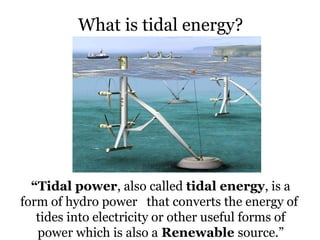
“Tidal power, also called tidal energy, is a
form of hydro power that converts the energy of
tides into electricity or other useful forms of
power which is also a Renewable source.”
advantages
●
Once you've built it, tidal power is free
●
●
It needs no fuel
●
●
It produces no greenhouse gases or other
waste
disadvantages
●
There are few suitable sites for tidal barrages.
●
Only provide power for around 10 hours each day.
●
It disrupts underwater habitat and often kills fish and other underwater
creatures
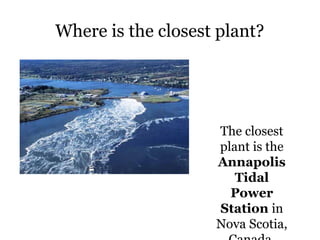
Where is the closest plant?
The closest
plant is the
Annapolis
Tidal
Power
Station in
Nova Scotia,
Does Tidal Power contribute to Global
Warming?
No, Tidal Energy plants do no
release any waste or smoke or
any pollutants therefore it
does not contribute to global
warming.
How much does it cost to run a
tidal plant?
The price of constructing a tidal plant
varies with the size of the plant. It has
been reported that the cost can get up to
48 billion dollars!
Cost per watt?
Tidal power costs 5
to 8 cents per
kilowatt hour!
In comparison, oil costs
5 cents per kilowatt hour
also.
Tidal Power: The next big
wave?
http://green.blogs.nytimes.com/2010/10/20/tidal-power-the-next-wave/
Tides are particularly attractive sources of power because they are predictable,
unlike sunshine and wind. Not surprisingly, countries with rough seas like
Britain and Portugal are leading the way in exploring ocean power.
Portugal, which now gets more than 40 percent of its electricity from
renewable sources, was one of the first countries to install a commercial “wave
farm.” There, several years ago, a British company used a snakelike device
called the Pelamis system to absorb the energy of waves.
The Portugal experiment met with mixed results before it was halted because
of financial problems. One stumbling block was that the floating machines that
absorbed wave energy quickly broke under the constant assault of the waves.
The European Energy Association estimates that, globally, the oceans could
yield more than 100.000 terawatt hours a year if the technology to harness
that power can be perfected. That is more than five times the electricity the
world uses in a year.
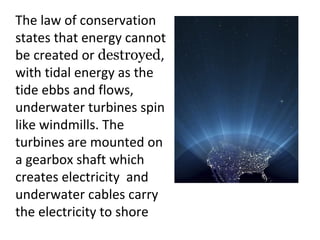
The law of conservation
states that energy cannot
be created or destroyed,
with tidal energy as the
tide ebbs and flows,
underwater turbines spin
like windmills. The
turbines are mounted on
a gearbox shaft which
creates electricity and
underwater cables carry
the electricity to shore
Facts
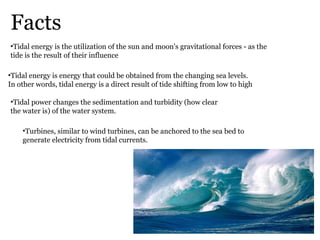
•Tidal energy is the utilization of the sun and moon's gravitational forces - as the
tide is the result of their influence
•Tidal energy is energy that could be obtained from the changing sea levels.
In other words, tidal energy is a direct result of tide shifting from low to high
•Tidal power changes the sedimentation and turbidity (how clear
the water is) of the water system.
•Turbines, similar to wind turbines, can be anchored to the sea bed to
generate electricity from tidal currents.
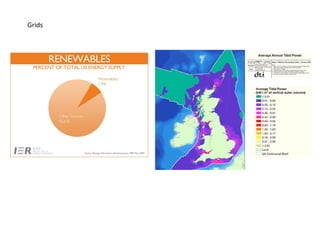
Grids
http://www.tech-faq.com/tidal-energy.html
http://www.energysavers.gov/renewable_energy/ocean/index.cfm/mytopic=50008
http://inventors.about.com/od/tstartinventions/a/tidal_power.htm
http://renewableenergydev.com/red/tidal-energy/
http://www.ems.psu.edu/~elsworth/courses/cause2003/finalprojects/canutepaper.pdf
http://www.greenstudentu.com/encyclopedia/energy/tidal
http://www.energyplanet.info/Tidal_Energy/

Tidal power.

  • 1.
    Tidal Energy Emily Ricard& Alex Grandmont
  • 2.
    What is tidalenergy? “Tidal power, also called tidal energy, is a form of hydro power that converts the energy of tides into electricity or other useful forms of power which is also a Renewable source.”
  • 3.
    advantages ● Once you've builtit, tidal power is free ● ● It needs no fuel ● ● It produces no greenhouse gases or other waste
  • 4.
    disadvantages ● There are fewsuitable sites for tidal barrages. ● Only provide power for around 10 hours each day. ● It disrupts underwater habitat and often kills fish and other underwater creatures
  • 5.
    Where is theclosest plant? The closest plant is the Annapolis Tidal Power Station in Nova Scotia,
  • 6.
    Does Tidal Powercontribute to Global Warming? No, Tidal Energy plants do no release any waste or smoke or any pollutants therefore it does not contribute to global warming.
  • 7.
    How much doesit cost to run a tidal plant? The price of constructing a tidal plant varies with the size of the plant. It has been reported that the cost can get up to 48 billion dollars!
  • 8.
    Cost per watt? Tidalpower costs 5 to 8 cents per kilowatt hour! In comparison, oil costs 5 cents per kilowatt hour also.
  • 9.
    Tidal Power: Thenext big wave? http://green.blogs.nytimes.com/2010/10/20/tidal-power-the-next-wave/ Tides are particularly attractive sources of power because they are predictable, unlike sunshine and wind. Not surprisingly, countries with rough seas like Britain and Portugal are leading the way in exploring ocean power. Portugal, which now gets more than 40 percent of its electricity from renewable sources, was one of the first countries to install a commercial “wave farm.” There, several years ago, a British company used a snakelike device called the Pelamis system to absorb the energy of waves. The Portugal experiment met with mixed results before it was halted because of financial problems. One stumbling block was that the floating machines that absorbed wave energy quickly broke under the constant assault of the waves. The European Energy Association estimates that, globally, the oceans could yield more than 100.000 terawatt hours a year if the technology to harness that power can be perfected. That is more than five times the electricity the world uses in a year.
  • 10.
    The law ofconservation states that energy cannot be created or destroyed, with tidal energy as the tide ebbs and flows, underwater turbines spin like windmills. The turbines are mounted on a gearbox shaft which creates electricity and underwater cables carry the electricity to shore
  • 11.
    Facts •Tidal energy isthe utilization of the sun and moon's gravitational forces - as the tide is the result of their influence •Tidal energy is energy that could be obtained from the changing sea levels. In other words, tidal energy is a direct result of tide shifting from low to high •Tidal power changes the sedimentation and turbidity (how clear the water is) of the water system. •Turbines, similar to wind turbines, can be anchored to the sea bed to generate electricity from tidal currents.
  • 12.
  • 13.