Energy from the moon
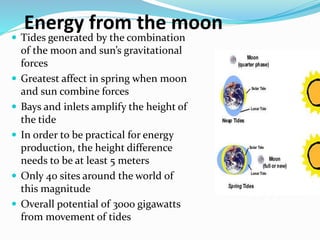
 Tides generated by the combination
of the moon and sun’s gravitational
forces
 Greatest affect in spring when moon
and sun combine forces
 Bays and inlets amplify the height of
the tide
 In order to be practical for energy
production, the height difference
needs to be at least 5 meters
 Only 40 sites around the world of
this magnitude
 Overall potential of 3000 gigawatts
from movement of tides
How it works
 First generation, barrage-style tidal power
plants
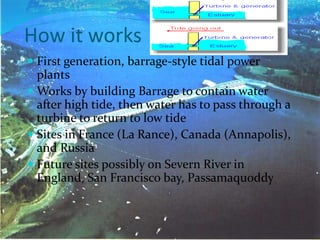
 Works by building Barrage to contain water
after high tide, then water has to pass through a
turbine to return to low tide
 Sites in France (La Rance), Canada (Annapolis),
and Russia
 Future sites possibly on Severn River in
England, San Francisco bay, Passamaquoddy
Second-generation tidal power plants
 Barrage not need, limiting total costs
 Two types- vertical axis and horizontal axis
 Davis Hydro turbine….. Successfully tested in
St. Lawrence Seaway
 Harness the energy of tidal streams
 More efficient because they allow for energy
production on both the ebbing and surging tides
 One site has potential to equal the generating
power of 3 nuclear power plants
disadvantages
 Presently costly
 Expensive to build and maintain
 A 1085MW facility could cost as much as 1.2 billion dollars
to construct and run
 Connection to the grid
 Technology is not fully developed
 Barrage style only produces energy for about 10
hours out of the day
 Barrage style has environmental affects
 Such as fish and plant migration
 Silt deposits
 Local tides change- affects still under study
Advantages
 No pollution
 Renewable resource
 More efficient than wind because of the density of
water
 Predictable source of energy vs. wind and solar
 Second generation has very few disadvantages
 Does not affect wildlife
 Does not affect silt deposits
 Less costly – both in building and maintenance
BY – SIDDHARTH SINGH 8A

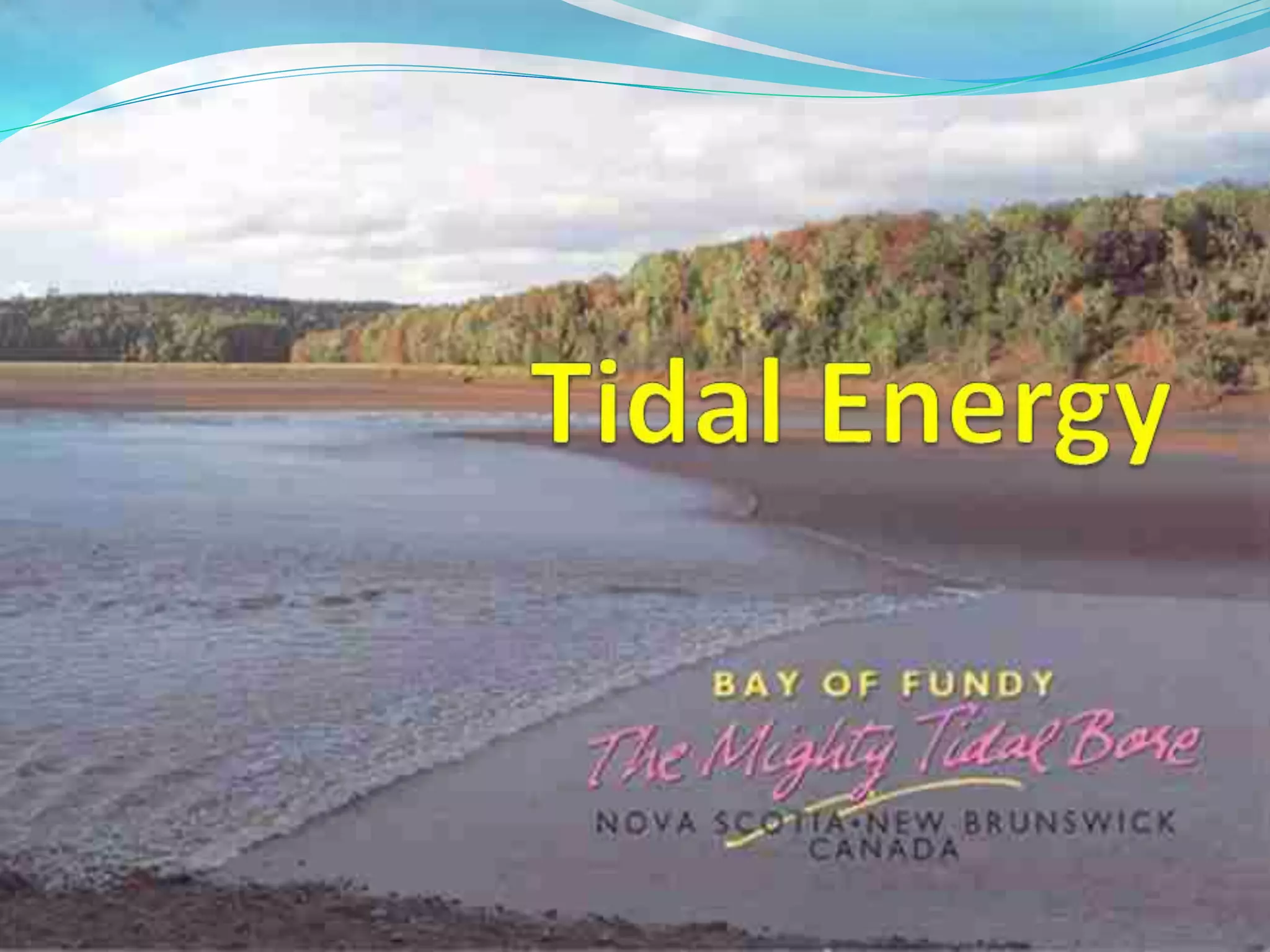
Tidal energy

  • 2.
    Energy from themoon  Tides generated by the combination of the moon and sun’s gravitational forces  Greatest affect in spring when moon and sun combine forces  Bays and inlets amplify the height of the tide  In order to be practical for energy production, the height difference needs to be at least 5 meters  Only 40 sites around the world of this magnitude  Overall potential of 3000 gigawatts from movement of tides
  • 3.
    How it works First generation, barrage-style tidal power plants  Works by building Barrage to contain water after high tide, then water has to pass through a turbine to return to low tide  Sites in France (La Rance), Canada (Annapolis), and Russia  Future sites possibly on Severn River in England, San Francisco bay, Passamaquoddy
  • 4.
    Second-generation tidal powerplants  Barrage not need, limiting total costs  Two types- vertical axis and horizontal axis  Davis Hydro turbine….. Successfully tested in St. Lawrence Seaway  Harness the energy of tidal streams  More efficient because they allow for energy production on both the ebbing and surging tides  One site has potential to equal the generating power of 3 nuclear power plants
  • 5.
    disadvantages  Presently costly Expensive to build and maintain  A 1085MW facility could cost as much as 1.2 billion dollars to construct and run  Connection to the grid  Technology is not fully developed  Barrage style only produces energy for about 10 hours out of the day  Barrage style has environmental affects  Such as fish and plant migration  Silt deposits  Local tides change- affects still under study
  • 6.
    Advantages  No pollution Renewable resource  More efficient than wind because of the density of water  Predictable source of energy vs. wind and solar  Second generation has very few disadvantages  Does not affect wildlife  Does not affect silt deposits  Less costly – both in building and maintenance
  • 7.