Index 
Tidal energy 
Wind Energy 
HYDRO POWER 
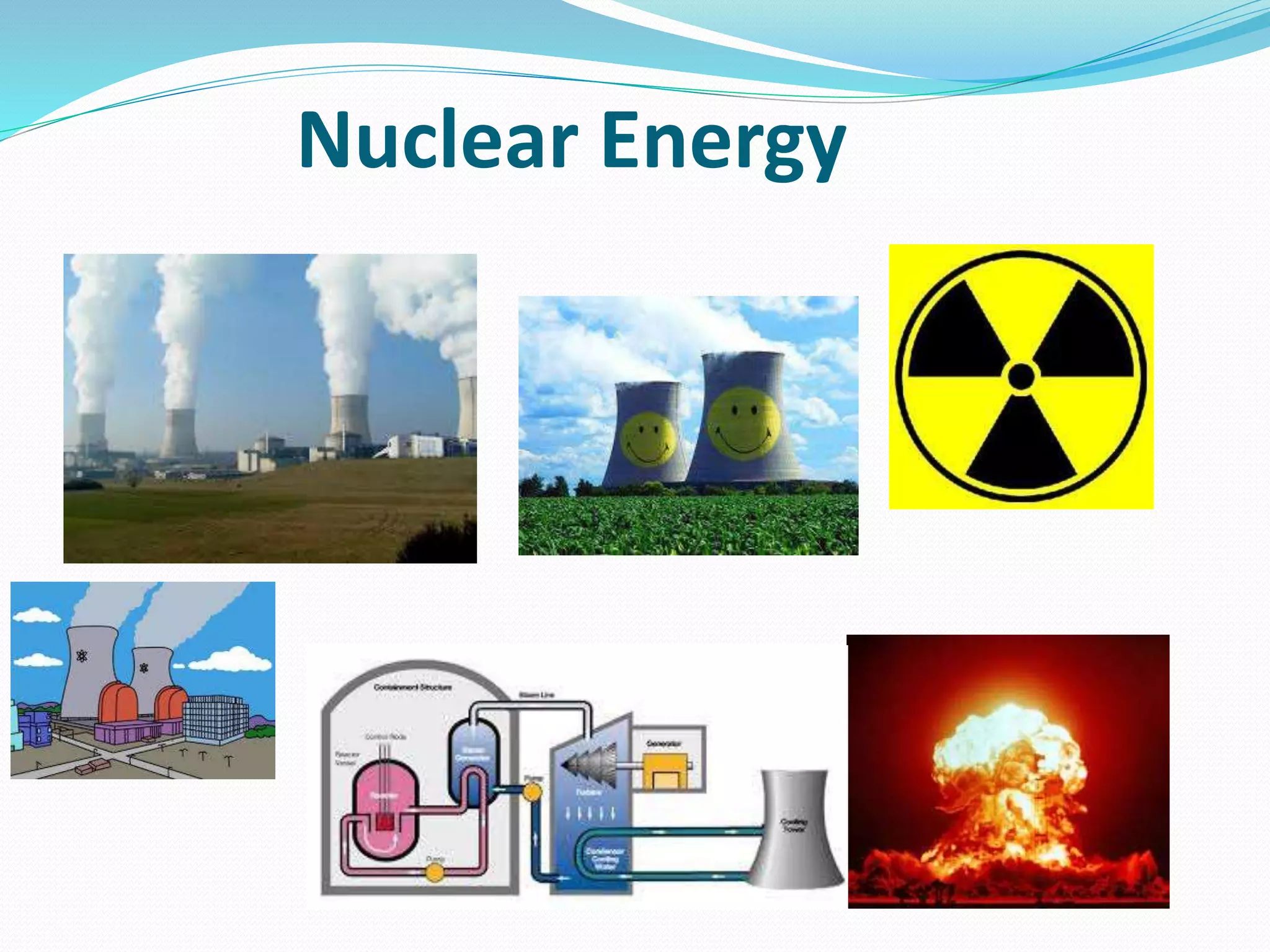
Nuclear Energy 
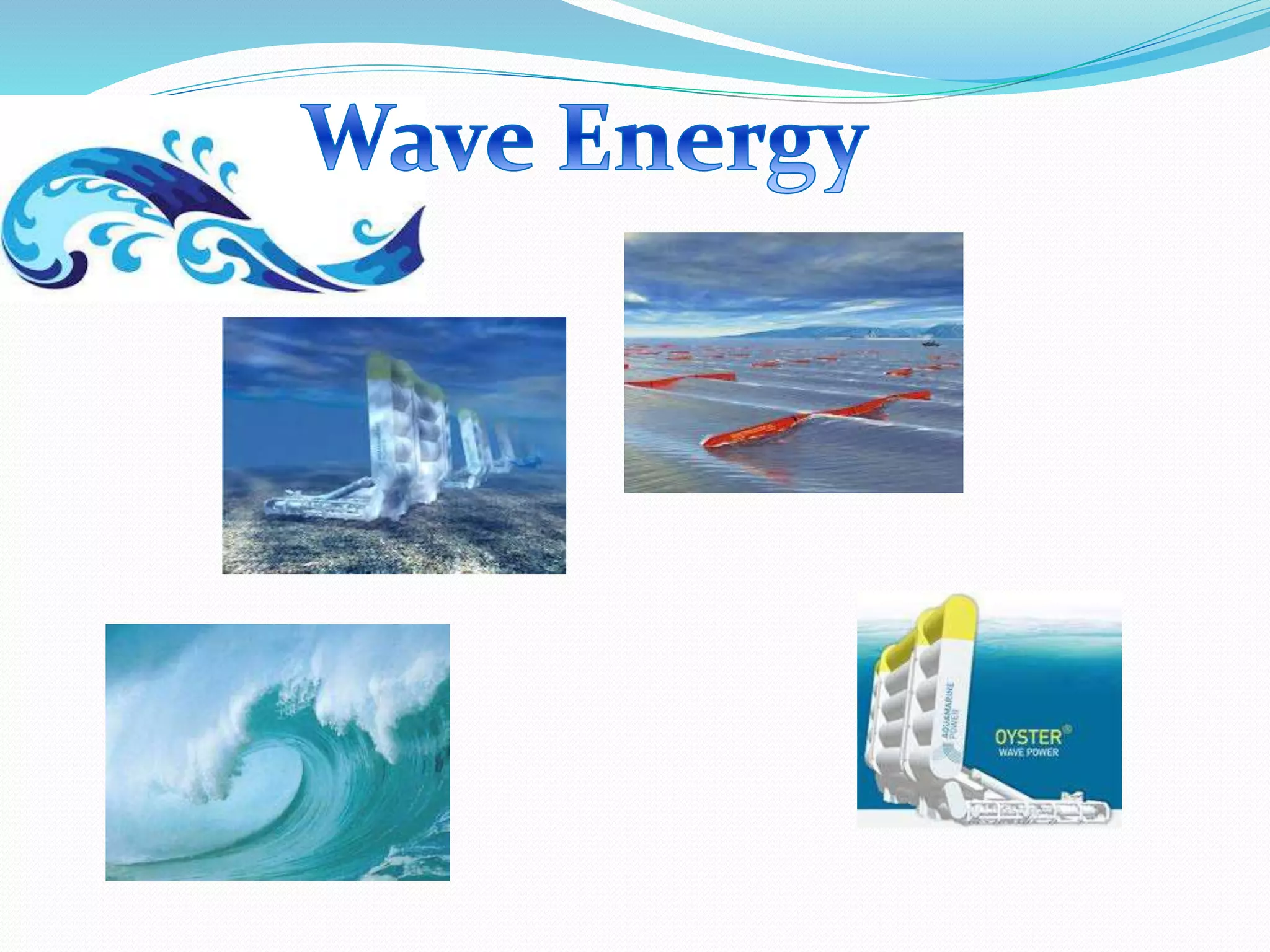
Wave Energy 
Calculating tidal energy 
Calculations of wave energy 
Poem on conservation of energy 
History behind the tidal energy 
CONCLUSION
Acknowledgement 
• For the successful completion of the project, I would like 
to thank first to our teachers [Mrs. Rama mam, 
Mrs.Gavathri mam, Mr.Jaiswal sir, Mrs.Jesna mam, Mrs. 
Alka mam] who introduced me to this project and 
incepted me with the idea of how to proceed with the 
project. This project definitely would have not been a 
successful project without his assistance and vigilance. 
There are many other people whom I would like to 
thank. First I would like to thank our parents for helping 
me in the project with their own ideas and suggestions. 
Again, I would like to thank the above mentioned people. 
Without them, this project could not have been the way it 
is. 
• I hope you'd enjoy the project.
Preface 
• We know that the energy is very important. Man is surrounded by an 
ocean of energy but he has been able to tap only a fraction of it. The 
most colossal dynamo of all energy is the sun, an unimaginable vast 
powerhouse which affects everything on earth. 
• But then, why do we hear about energy crisis? We know that energy can 
be converted from one form to another and that energy can neither be 
created nor be destroyed. But in all processes whether it is a physical 
process or a chemical one we observe that the energy in the usable form 
is dissipated to the surroundings in less usable forms. Hence, any source 
of energy we use, to do work, is consumed and cannot be used again. 
• The term 'energy' used here has thus a slightly different meaning. The 
term 'energy' actually means 'the useful energy' or 'the energy that we 
can use'; for cooking, operating machines, to run vehicles and so on. 
And we get this useful energy only from specific sources, which we call 
'sources of energy
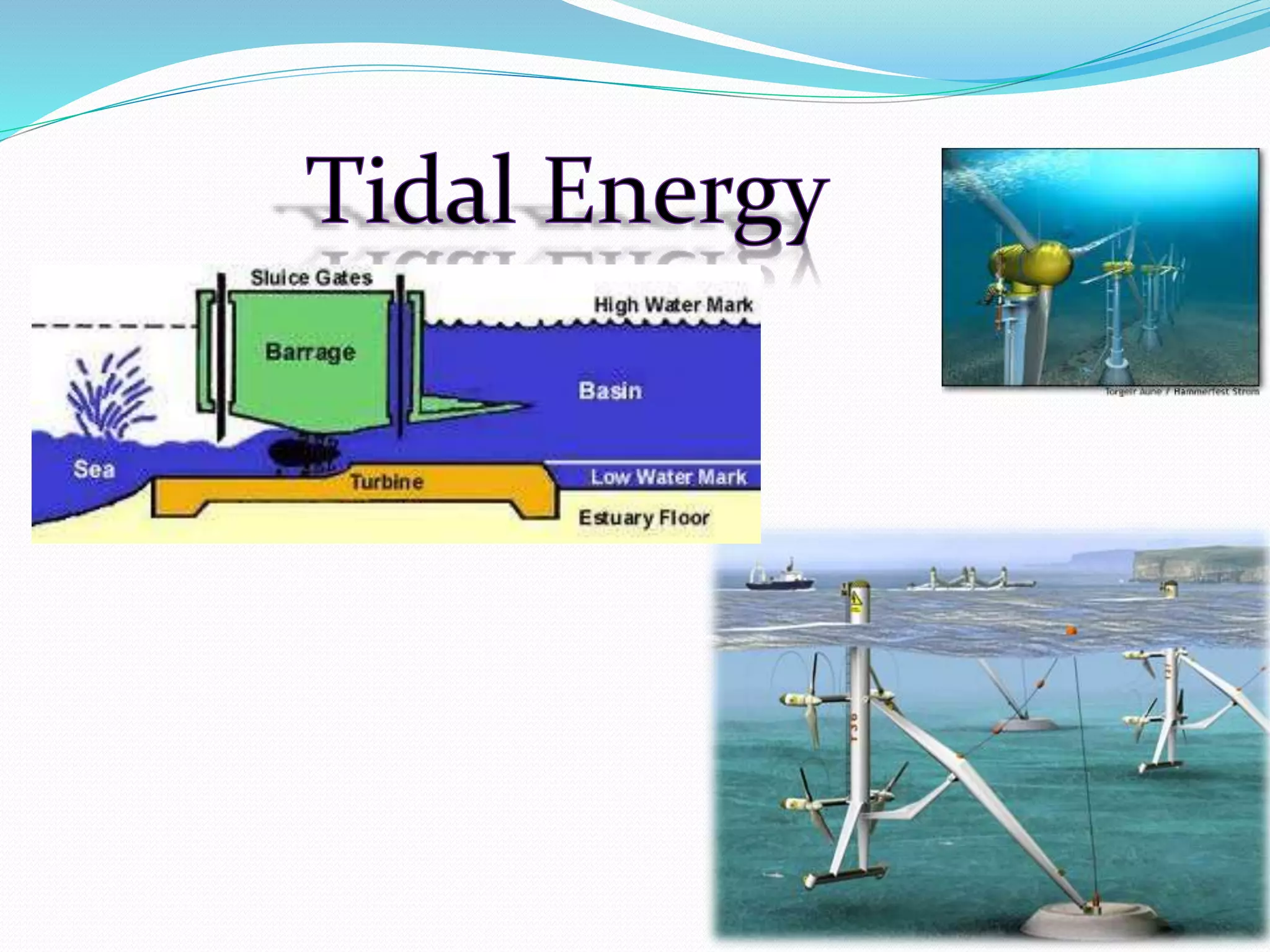
Tidal Energy 
Due to the gravitational pull of mainly the moon on 
the spinning earth, the level of water in the sea rises 
and falls. The phenomenon is called high and low 
tides and the difference in sea- levels gives us tidal 
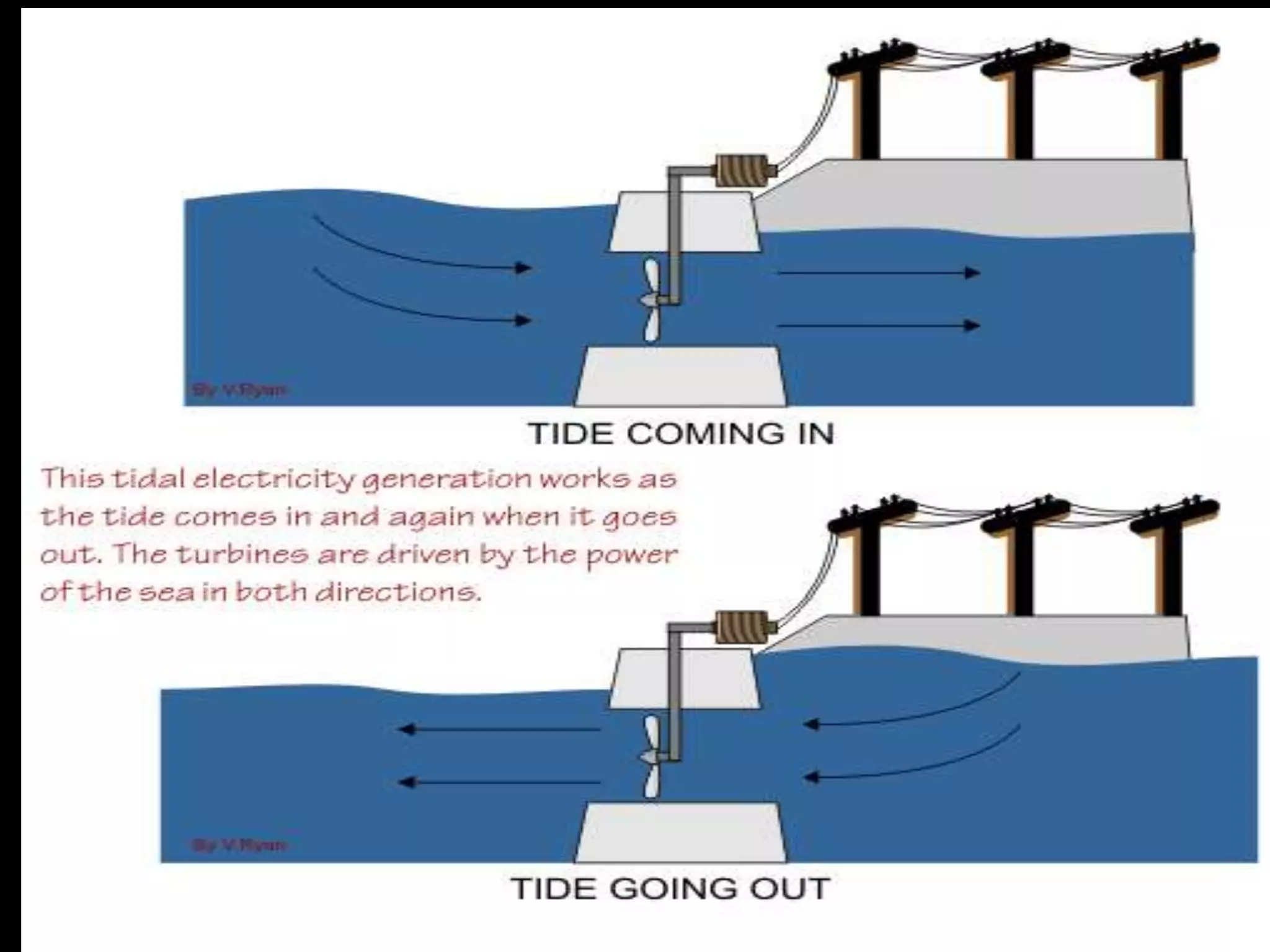
energy. Tidal energy is harnessed by constructing a 
dam across a narrow opening to the sea. A turbine 
fixed at the opening of the dam converts tidal energy 
to electricity. As you can guess, the locations were 
such dams can be built are limited.
3 Ways of Using the Tidal Power of the Ocean 
There are three basic ways to tap the ocean for its 
energy. We can use the ocean's waves, we can use 
the ocean's high and low tides, or we can use 
temperature differences in the water.
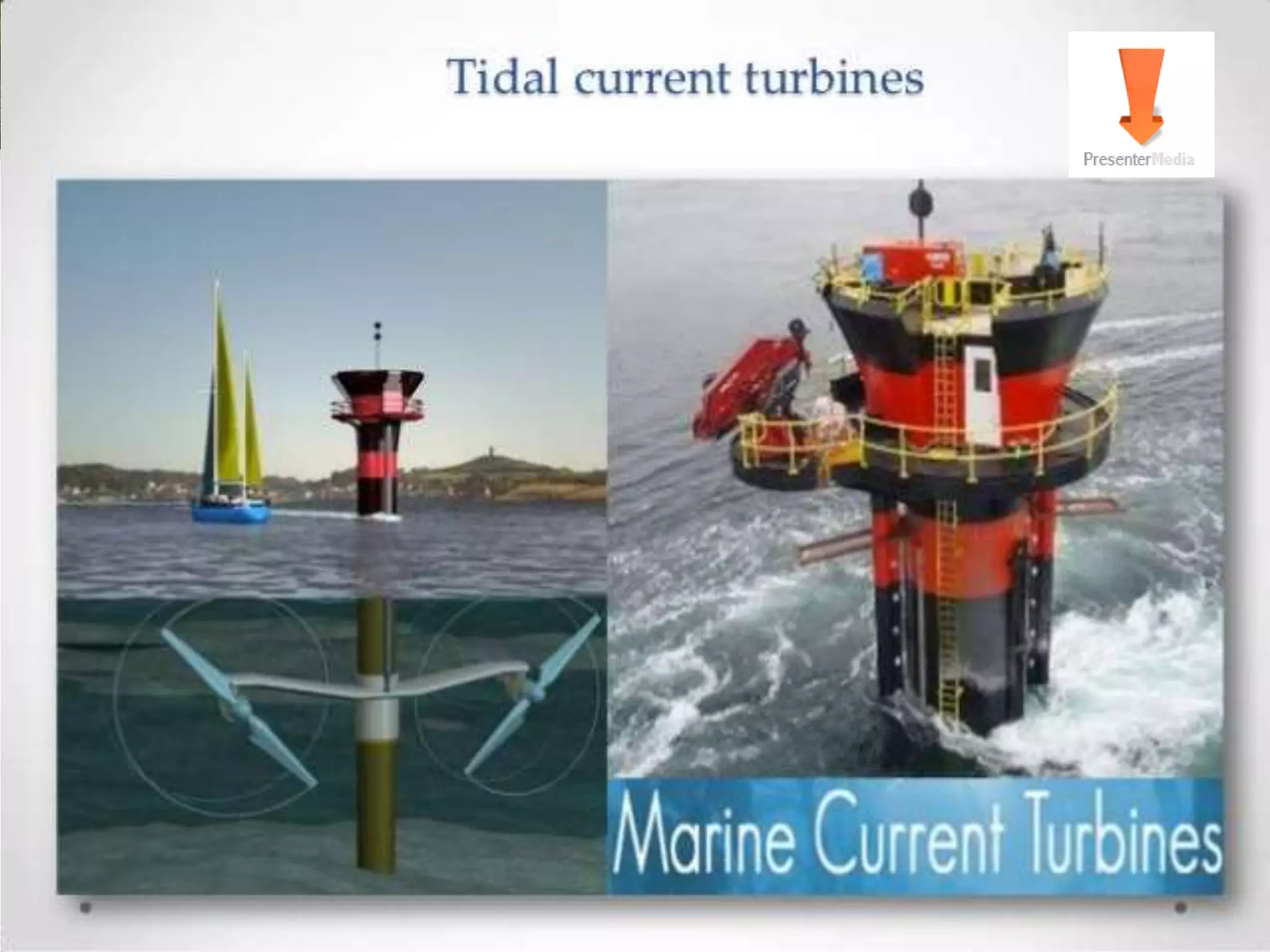
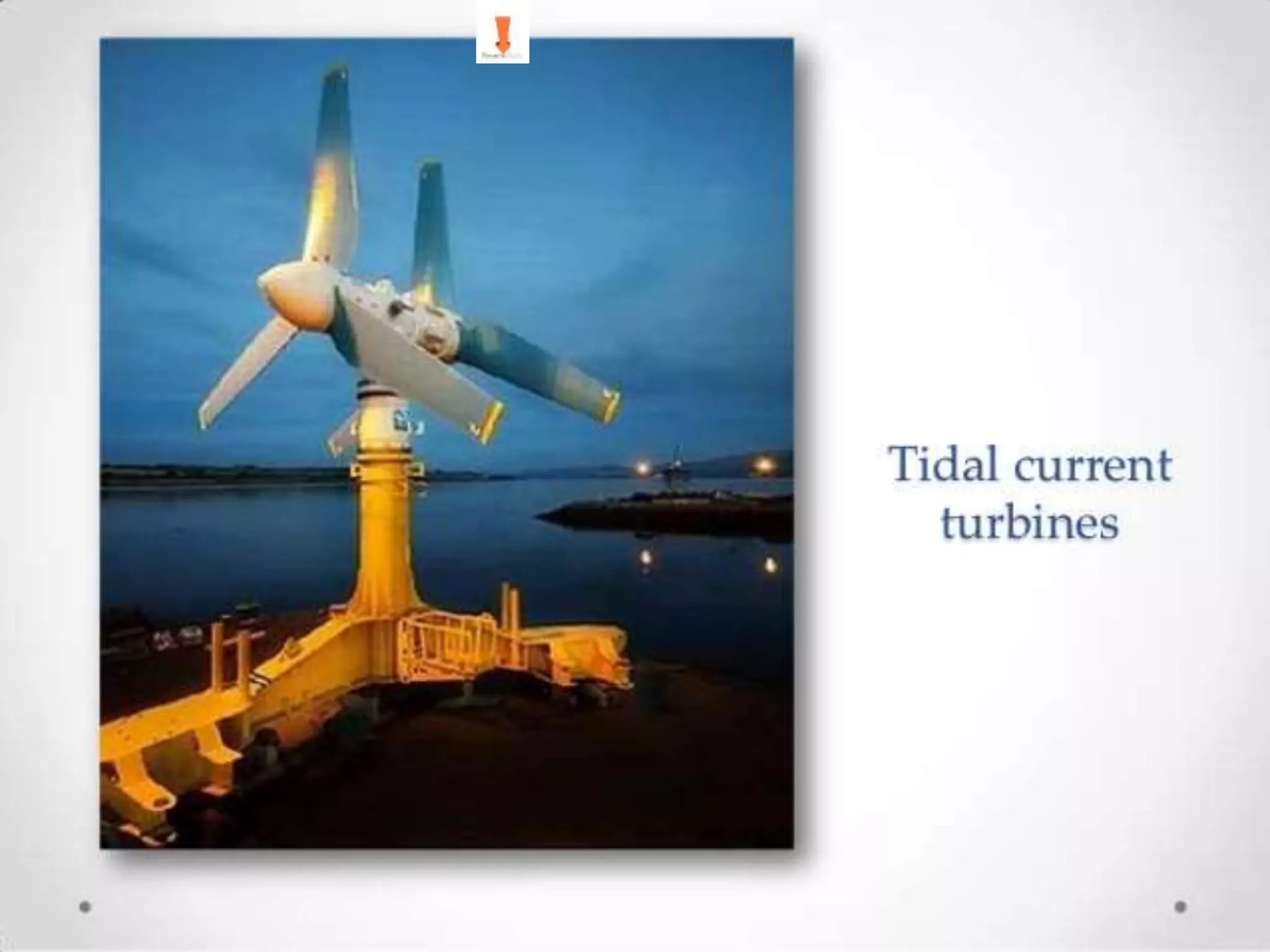
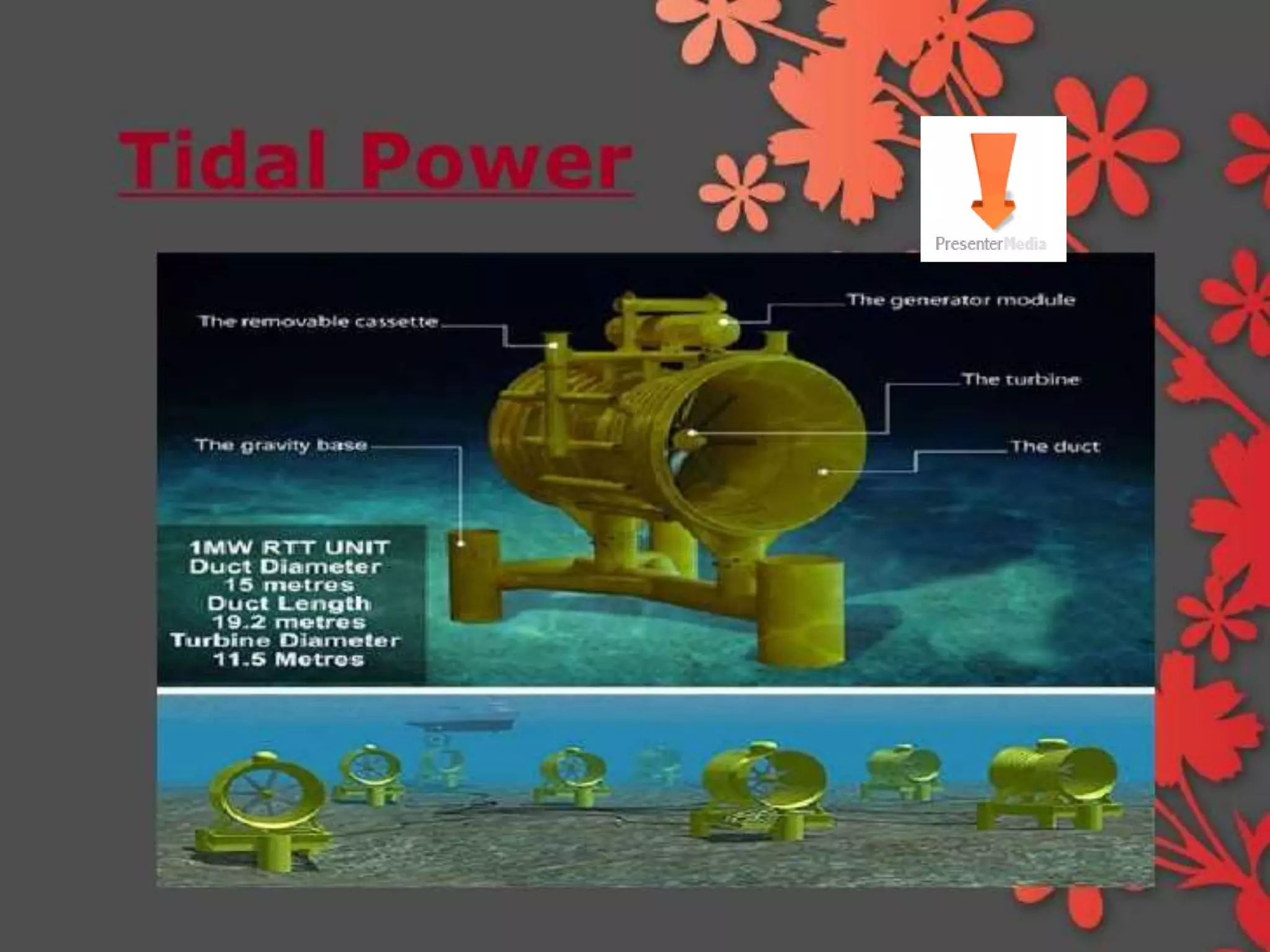
Tidal stream generator 
A tidal stream generator, often referred to as a tidal 
energy converter (TEC) is a machine that 

extracts energy from moving masses of water, in 
particular tides, although the term is often used in 
reference to machines designed to extract energy from run 
of river or tidal estuarine sites. Certain types of these 
machines function very much like underwater wind 
turbines, and are thus often referred to as tidal turbines. 
They were first conceived in the 1970s during the oil crisis. 
Tidal stream generators are the cheapest and the least 
ecologically damaging among the three main forms of tidal 
power generation.
Tidal barrage 
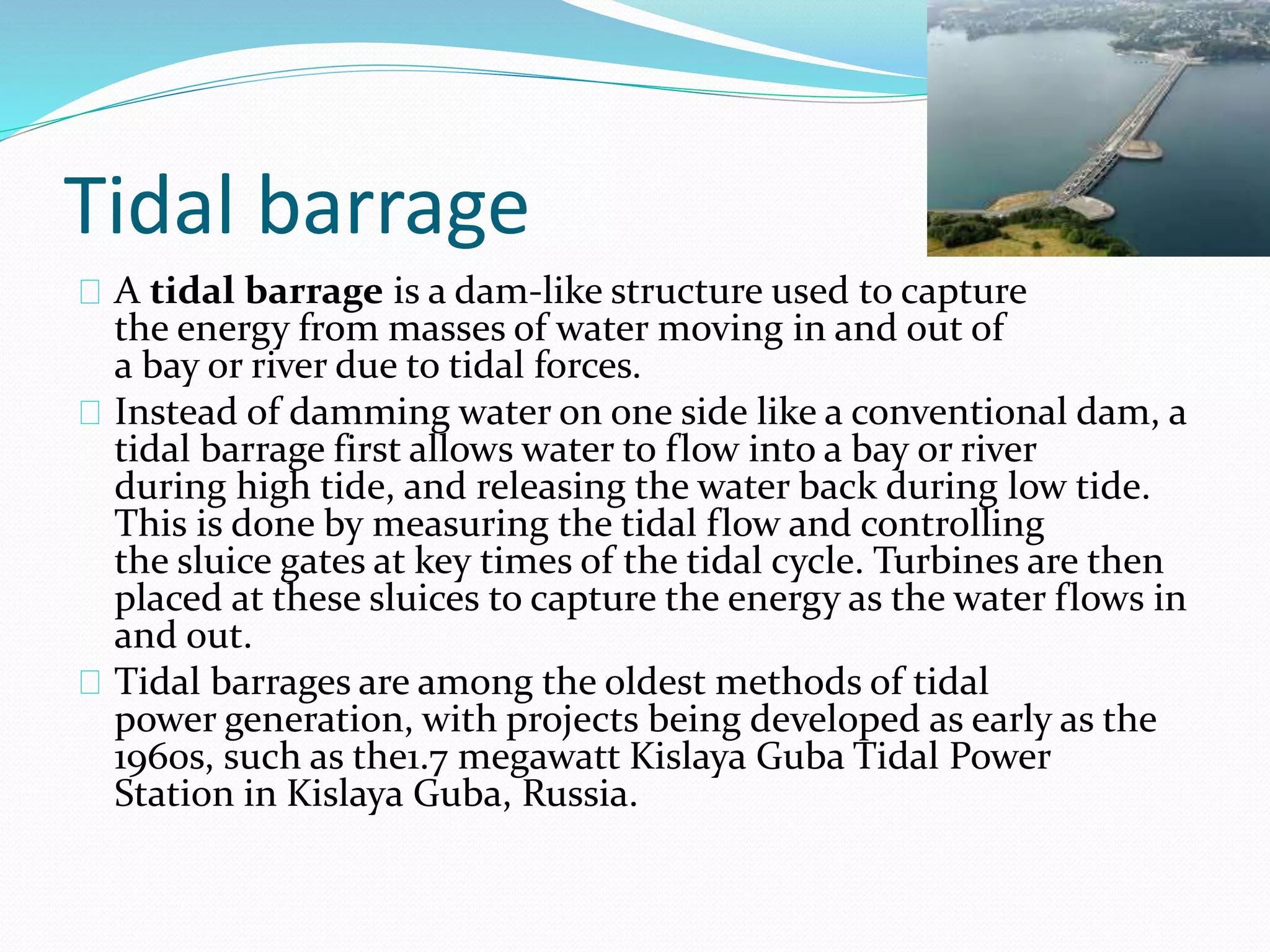
A tidal barrage is a dam-like structure used to capture 
the energy from masses of water moving in and out of 
a bay or river due to tidal forces. 
Instead of damming water on one side like a conventional dam, a 
tidal barrage first allows water to flow into a bay or river 
during high tide, and releasing the water back during low tide. 
This is done by measuring the tidal flow and controlling 
the sluice gates at key times of the tidal cycle. Turbines are then 
placed at these sluices to capture the energy as the water flows in 
and out. 
Tidal barrages are among the oldest methods of tidal 
power generation, with projects being developed as early as the 
1960s, such as the1.7 megawatt Kislaya Guba Tidal Power 
Station in Kislaya Guba, Russia.
Dynamic tidal power 
Dynamic tidal power or DTP is an untried but promising 
technology for tidal power generation. It would involve 
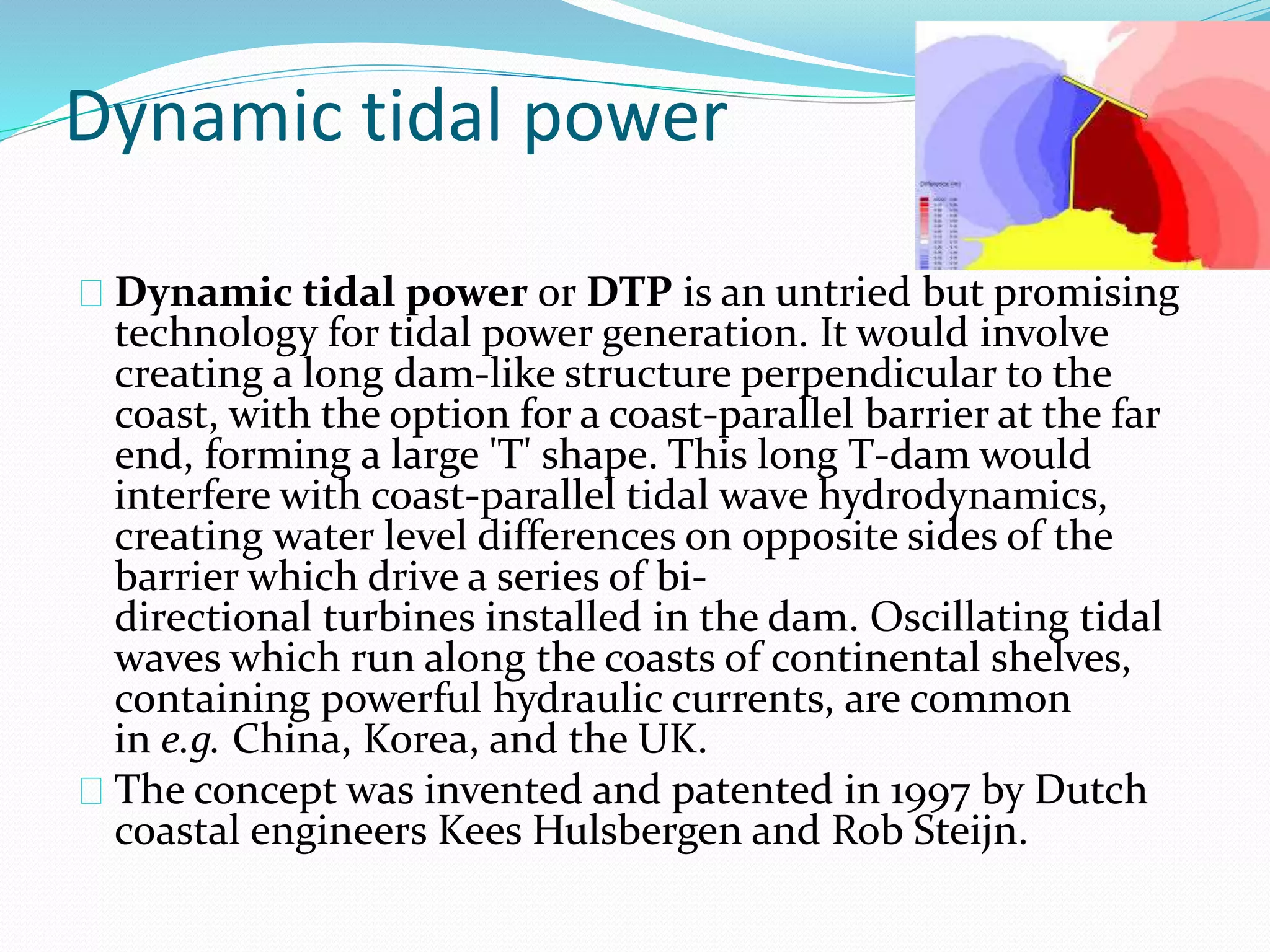
creating a long dam-like structure perpendicular to the 
coast, with the option for a coast-parallel barrier at the far 
end, forming a large 'T' shape. This long T-dam would 
interfere with coast-parallel tidal wave hydrodynamics, 
creating water level differences on opposite sides of the 
barrier which drive a series of bi-directional 
turbines installed in the dam. Oscillating tidal 
waves which run along the coasts of continental shelves, 
containing powerful hydraulic currents, are common 
in e.g. China, Korea, and the UK. 
The concept was invented and patented in 1997 by Dutch 
coastal engineers Kees Hulsbergen and Rob Steijn.
How is Ocean Tidal Energy 
Converted to Electricity? 
Tidal energy extraction is complex and many device designs have been 
proposed. It is helpful to 
introduce these designs in terms of their physical arrangements and energy 
conversion mechanisms. 
Water turbines, like wind turbines, are generally grouped into two types: 
Vertical-axis turbines, in which the axis of rotation is vertical with respect to 
the ground (and 
roughly perpendicular to the water stream), 
Horizontal-axis turbines, in which the axis of rotation is horizontal with 
respect to the ground 
(and roughly parallel to the water stream.) 
1. 
2. 
The figure illustrates the two types of turbines and typical subsystems for an 
electricity generation 
application.
 The first tidal power station was the Rance tidal power plant built over a period of 6 years 
from 1960 to 1966 at La Rance, France. It has 240 MW installed capacity. 
 254 MW Sihwa Lake Tidal Power Plant in South Korea is the largest tidal power 
installation in the world. Construction was completed in 2011. 
 The first tidal power site in North America is the Annapolis Royal Generating Station, 
Annapolis Royal, Nova Scotia, which opened in 1984 on an inlet of the Bay of Fundy. It has 
20 MW installed capacity. 
 The Jiangxia Tidal Power Station, south of Hangzhou in China has been operational since 
1985, with current installed capacity of 3.2 MW. More tidal power is planned near the mouth 
of the Yalu River. 
10/26/2014
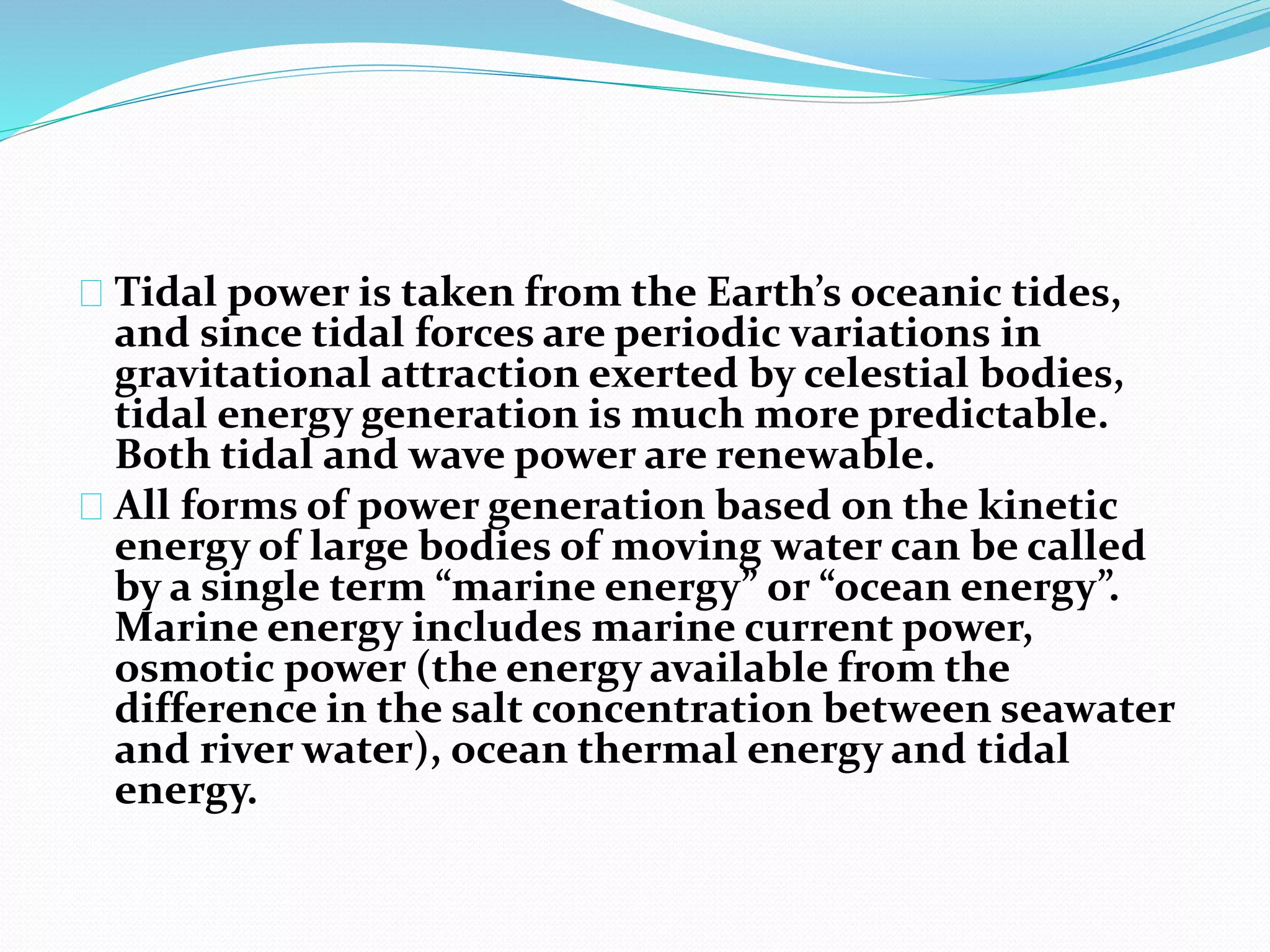
Tidal power is taken from the Earth’s oceanic tides, 
and since tidal forces are periodic variations in 
gravitational attraction exerted by celestial bodies, 
tidal energy generation is much more predictable. 
Both tidal and wave power are renewable. 
All forms of power generation based on the kinetic 
energy of large bodies of moving water can be called 
by a single term “marine energy” or “ocean energy”. 
Marine energy includes marine current power, 
osmotic power (the energy available from the 
difference in the salt concentration between seawater 
and river water), ocean thermal energy and tidal 
energy.
Advantages of tidal power 
1) It is an inexhaustible source of energy. 
2) Tidal energy is environment friendly energy and doesn't produce 
greenhouse gases. 
3) As 71% of Earth’s surface is covered by water, there is scope to 
generate this energy on large scale. 
4) We can predict the rise and fall of tides as they follow cyclic fashion. 
5) Efficiency of tidal power is far greater as compared to coal, solar or 
wind energy. Its efficiency is around 80%. 
6) Although cost of construction of tidal power is high but 
maintenance costs are relatively low. 
7) Tidal Energy doesn’t require any kind of fuel to run. 
8) The life of tidal energy power plant is very long. 
9) The energy density of tidal energy is relatively higher than other 
renewable energy sources.
Disadvantages of tidal energy 
1) Cost of construction of tidal power plant is high. 
2) There are very few ideal locations for construction of 
plant and they too are localized to coastal regions only. 
3) Intensity of sea waves is unpredictable and there can 
be damage to power generation units. 
4) Influences aquatic life adversely and can disrupt 
migration of fish. 
5) The actual generation is for a short period of time. The 
tides only happen twice a day so electricity can be 
produced only for that time. 
6) Frozen sea, low or weak tides, straight shorelines, low 
tidal rise or fall are some of the obstructions. 
7) This technology is still not cost effective and more 
technological advancements are required to make it 
commercially viable.
Nuclear Energy
10/26/2014
Wave Energy 
Wave energy is an irregular and oscillating low-frequency energy 
source that can be converted to a 60-Hertz frequency and can then 
be added to the electric utility grid. The energy in waves comes 
from the movement of the ocean and the changing heights and 
speed of the swells. 
Waves get their energy from the wind. Wind comes from solar energy. 
Waves gather, store, and transmit this energy thousands of miles with 
little loss. As long as the sun shines, wave energy will never be 
depleted. 
The first wave-power patent was for a 1799 proposal by a Parisian named 
Monsieur Girard and his son to use direct mechanical action to drive 
pumps, saws, mills, or other heavy machinery. Installations have been 
built or are under construction in a number of countries, including 
Scotland, Portugal, Norway, the U.S.A., China, Japan, Australia and India
` 
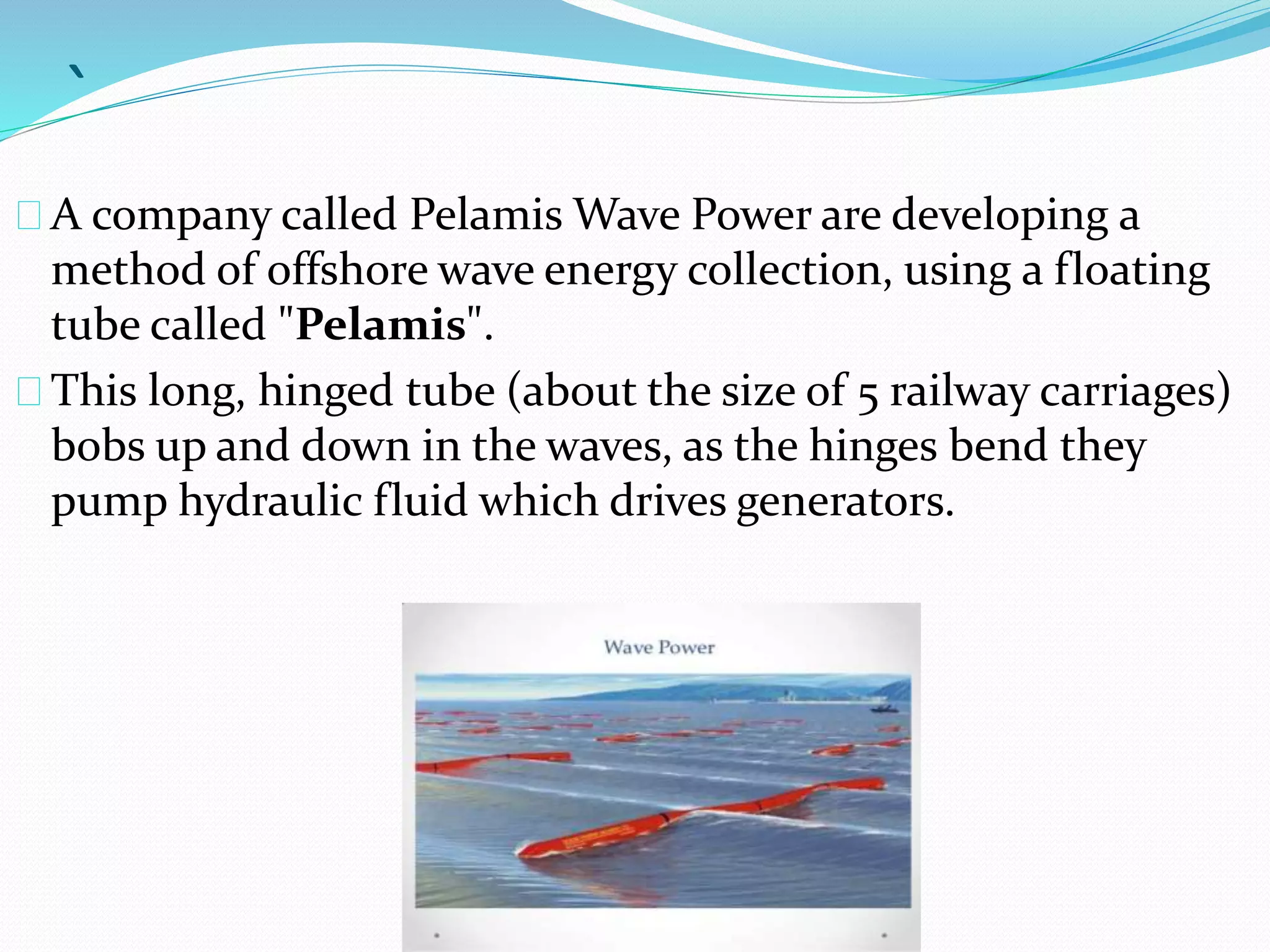
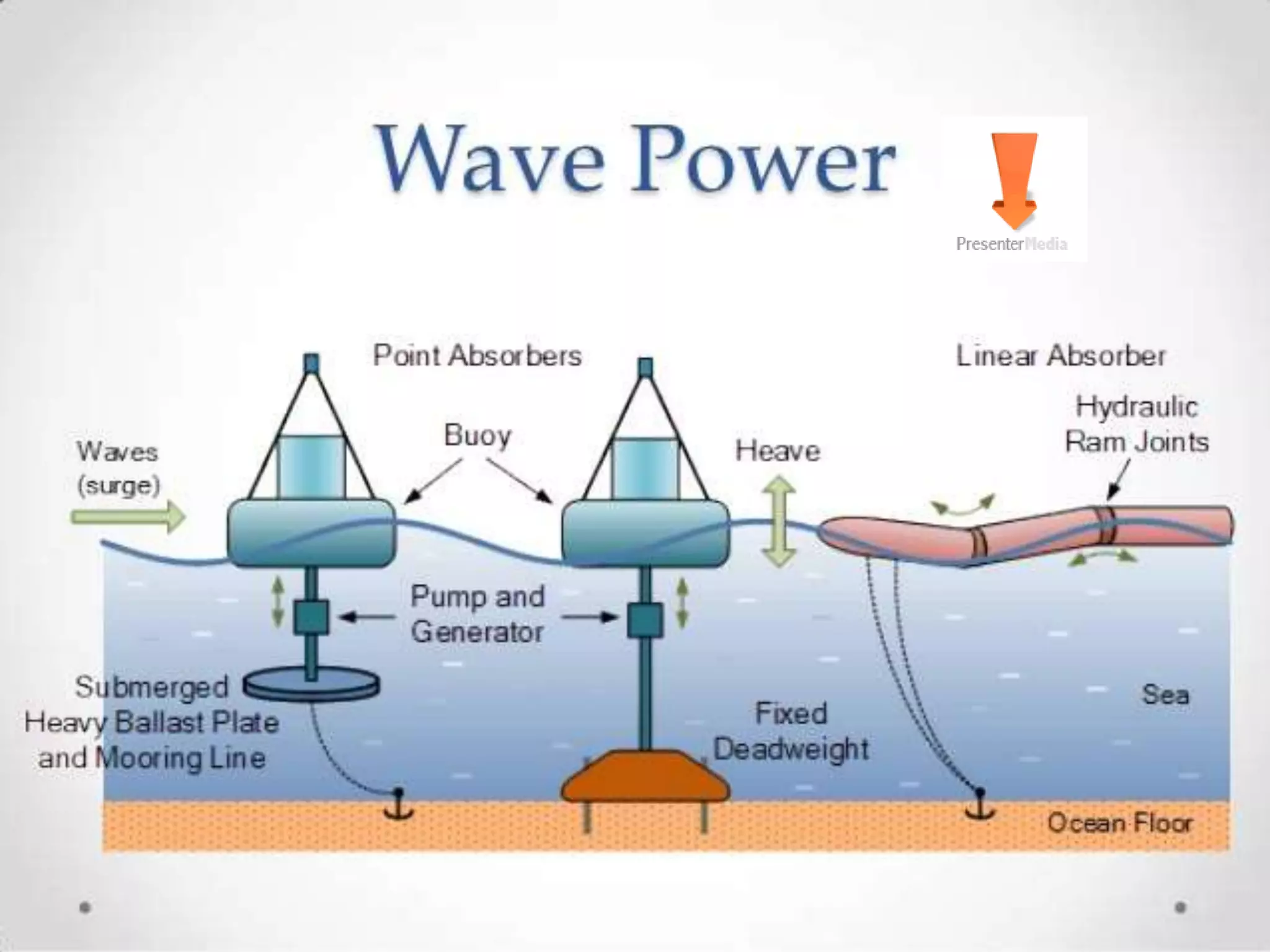
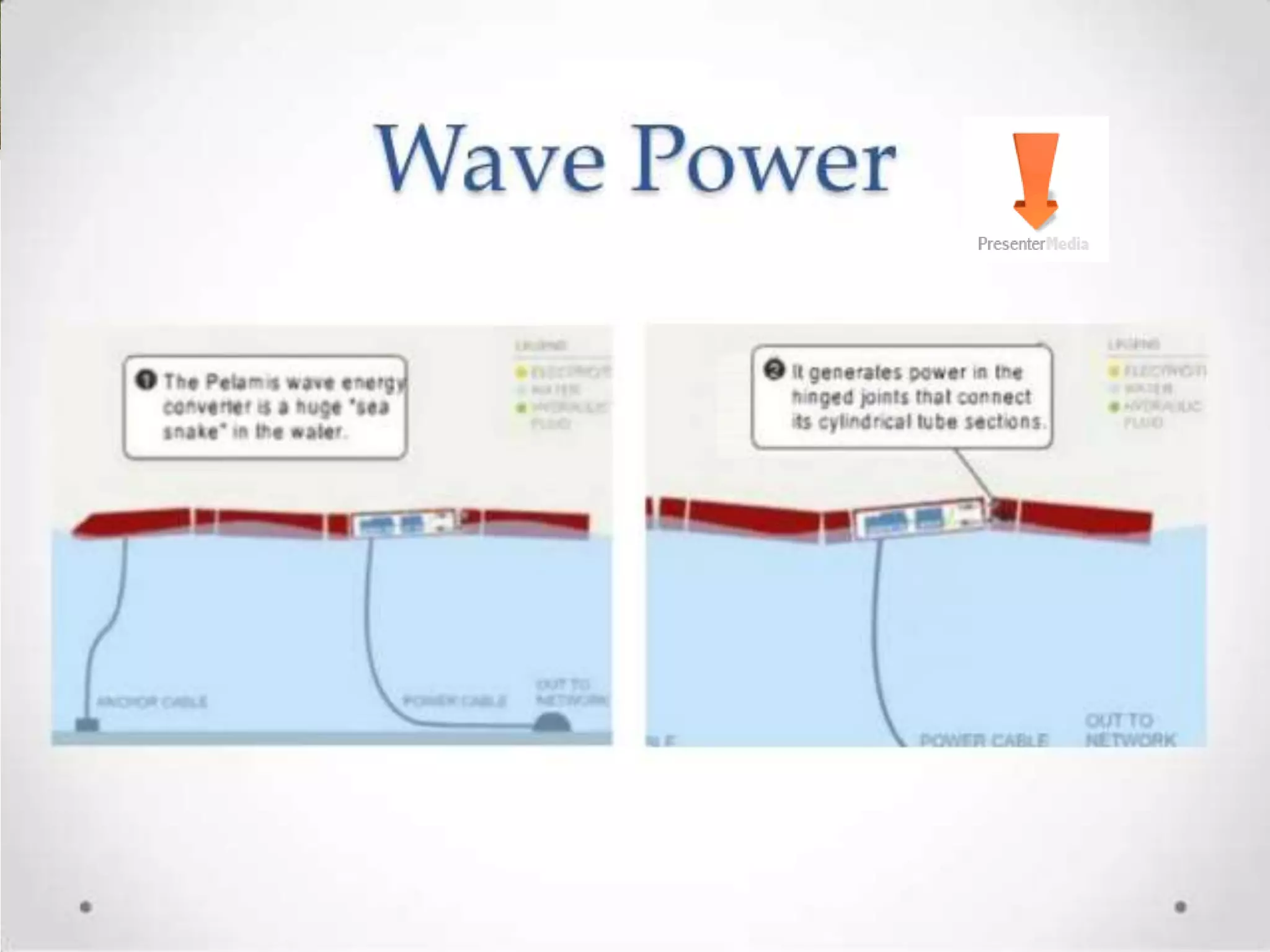
A company called PelamisWave Power are developing a 
method of offshore wave energy collection, using a floating 
tube called "Pelamis". 
This long, hinged tube (about the size of 5 railway carriages) 
bobs up and down in the waves, as the hinges bend they 
pump hydraulic fluid which drives generators.
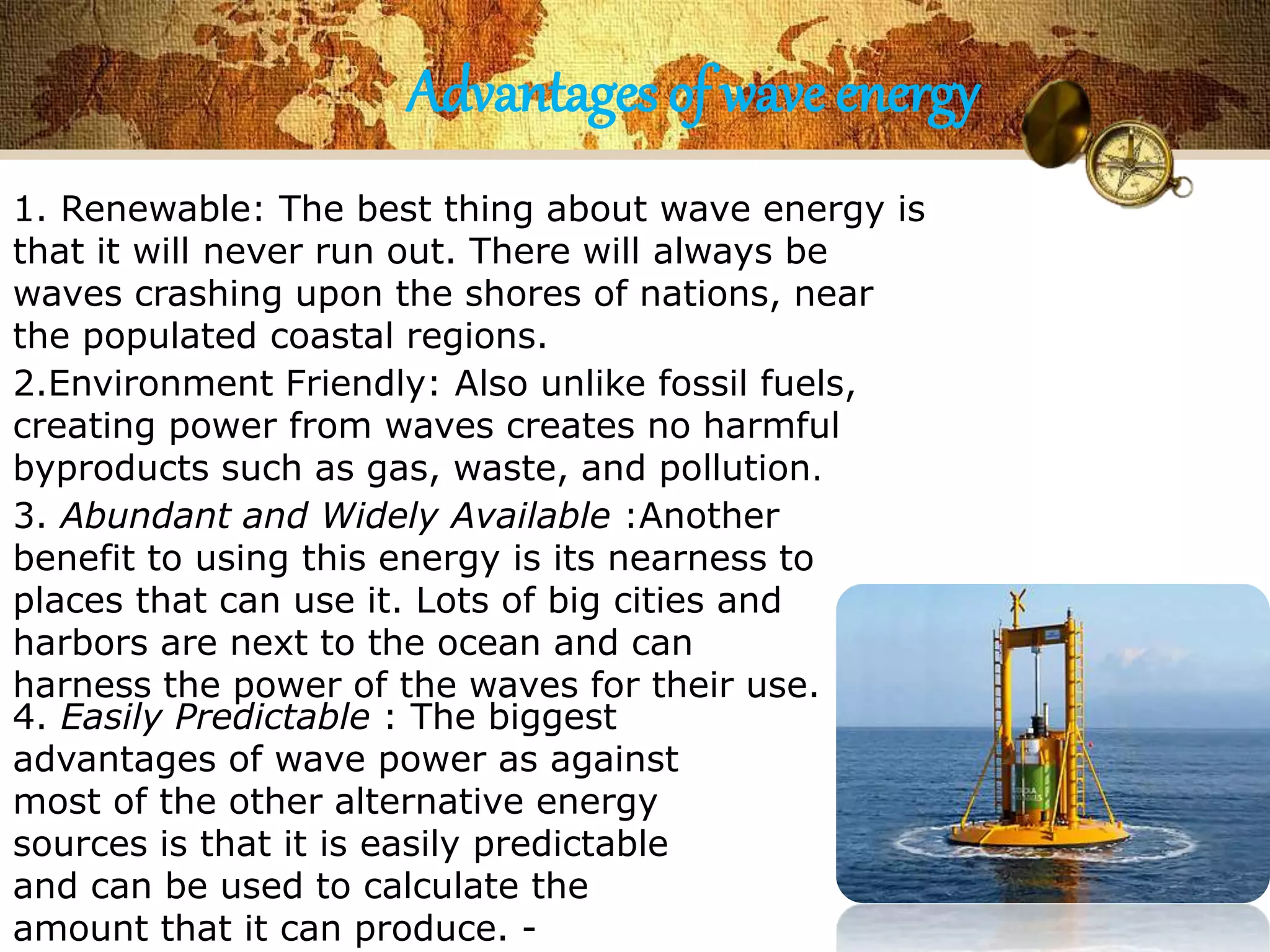
Advantages of wave energy 
1. Renewable: The best thing about wave energy is 
that it will never run out. There will always be 
waves crashing upon the shores of nations, near 
the populated coastal regions. 
2.Environment Friendly: Also unlike fossil fuels, 
creating power from waves creates no harmful 
byproducts such as gas, waste, and pollution. 
3. Abundant and Widely Available :Another 
benefit to using this energy is its nearness to 
places that can use it. Lots of big cities and 
harbors are next to the ocean and can 
harness the power of the waves for their use. 
4. Easily Predictable : The biggest 
advantages of wave power as against 
most of the other alternative energy 
sources is that it is easily predictable 
and can be used to calculate the 
amount that it can produce. -
Disadvantages of wave energy 
1. Suitable to Certain Locations : The biggest 
disadvantage to getting your energy from the waves 
is location. Only power plants and towns near the 
ocean will benefit directly from it. Because of its 
source, wave energy is not a viable power source for 
everyone. 
2. Effect on marine Ecosystem : As clean as wave 
energy is, it still creates hazards for some of the 
creatures near it. Large machines have to be put 
near and in the water to gather energy from the 
waves. These machines disturb the seafloor, change 
the habitat of near-shore creatures 
3. Weak Performance in Rough Weather : The 
performance of wave power drops significantly during 
rough weather. They must withstand rough weather. - 
4. Noise and Visual pollution : Wave energy generators may be 
unpleasant for some who live close to coastal regions. They look 
like large machines working in the middle of the ocean and 
destroy the beauty of the ocean. They also generate noise 
pollution but the noise is often covered by the noise of waves 
which is much more than that of wave generators.
Mathematics
Calculating tidal energy 
• Energy calculations 
• The energy available from barrage is dependent on the volume 
of water. The potential energy contained in a volume of water is: 
E=1/2 Apgh2 
where: 
h is the vertical tidal range, 
A is the horizontal area of the barrage basin, 
ρ is the density of water = 1025 kg per cubic meter (seawater 
varies between 1021 and 1030 kg per cubic meter) and 
g is the acceleration due to the Earth's gravity = 9.81 meters per 
second squared.
Example calculation of tidal power generation 
Let us assume that the tidal range of tide is 32 feet = 10 m (approx) 
The surface of the tidal energy harnessing plant is 9 km² (3 km × 3 km)= 3000 m × 
3000 m = 9 × 10⁶ m2 
Specific density of sea water = 1025.18 kg/m3 
Mass of the water = volume of water × specific gravity 
= (area × tidal range) of water × mass density 
= (9 × 10⁶ m2 × 10 m) × 1025.18 kg/m3 
= 92 × 109 kg (approx) 
Potential energy content of the water in the basin at high tide = ½ × area × density × 
gravitational acceleration × tidal range squared 
= ½ × 9 × 10⁶ m2 × 1025 kg/m3 × 9.81 m/s2 × (10 m)2 
=4.5 × 10¹² J (approx) 
Now we have 2 high and 2 low tides every day. At low tide the potential energy is 
zero. 
Therefore the total energy potential per day = Energy for a single high tide × 2 
= 4.5 × 1012 J × 2 
= 9 × 10¹² J 
Therefore, the mean power generation potential = Energy generation potential / 
time in 1 day 
= 9 × 10¹² J / 86400 s 
= 104 MW
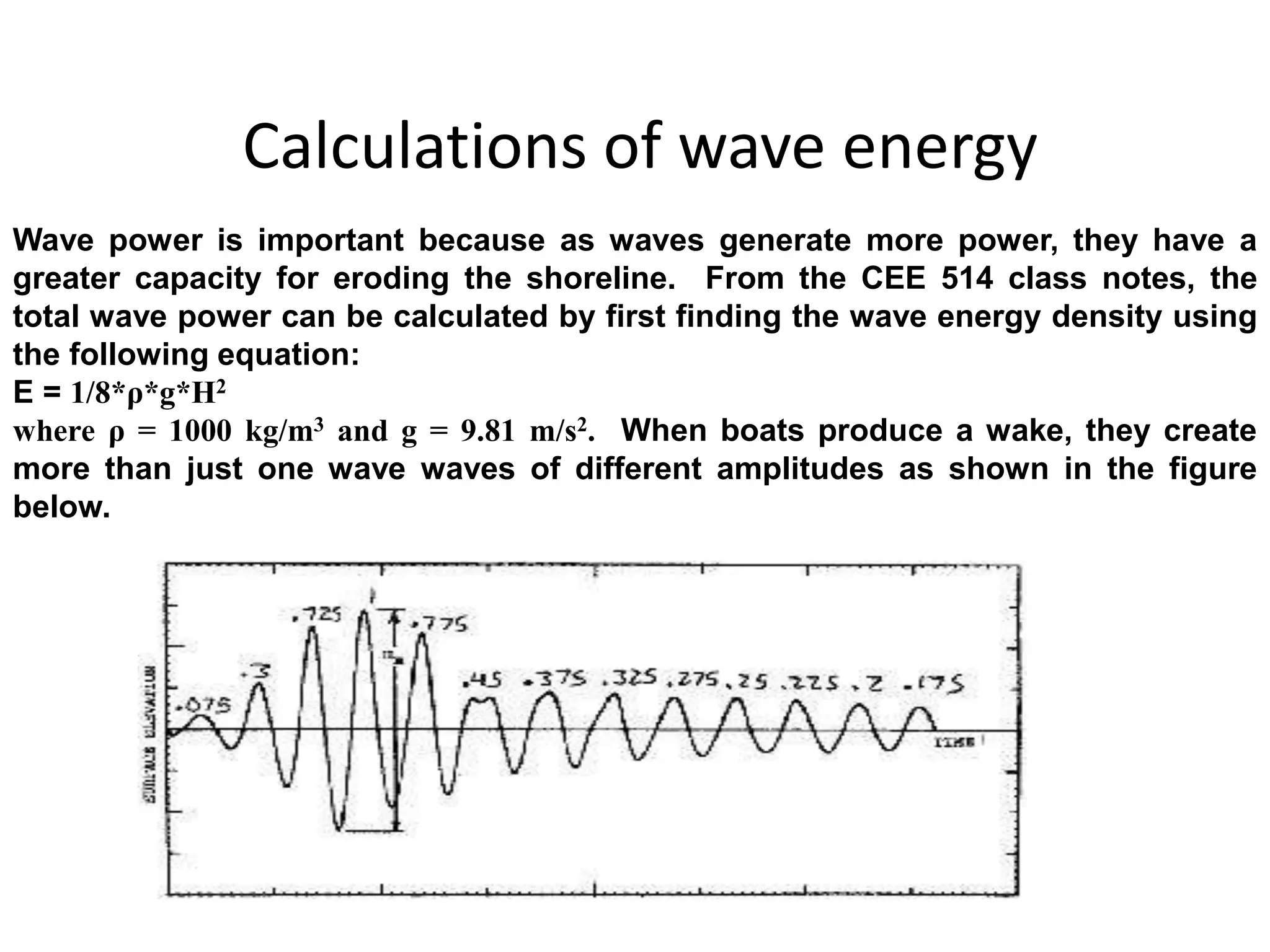
Calculations of wave energy 
Wave power is important because as waves generate more power, they have a 
greater capacity for eroding the shoreline. From the CEE 514 class notes, the 
total wave power can be calculated by first finding the wave energy density using 
the following equation: 
E = 1/8*ρ*g*H2 
where ρ = 1000 kg/m3 and g = 9.81 m/s2. When boats produce a wake, they create 
more than just one wave waves of different amplitudes as shown in the figure 
below.
Poem on conservation of energy 
They say we are having an energy crisis today; 
That we are running out of resources in such a way; 
That gas and oil prices are going to be sky-high; 
That families will no longer be able to go bye-bye 
We fought the Gulf War in the hot blazing sun 
And put at risk the lives of many who where young 
We ejected the aggressor and put out the fires 
For a supply of oil that we hoped would not expire 
But those nations don't see things our way anymore 
Now that we have departed their far flung shores 
They produce less oil so the price will rise 
Banking the profits on our sacrifice 
We need gas and oil to transverse this great land 
And we should all join together and take a stand 
America must increase it's energy production 
And we must work to reduce future consumption
History behind the tidal energy 
Harvesting energy from the tides is a surprisingly old method; the 
technology has improved and changed through time but the 
general concept of using the waxing and waning of the moon and 
the correlating tides has remained constant. 
Europe during the early Middle Ages is the one of the first 
recorded use of tide mills but recent archaeological information 
has also indicated that the Roman Era many have also used tide 
mills, predating the Middle Ages by about 400 years. The 
evidence of Roman tidal mills comes from a single archaeological 
site along the River Fleet in London, England; unfortunately, due 
to heavy continuous habitation and construction impacting the 
ancient site the archaeological evidence is difficult to fully 
interpret. 
A tide mill is a dam with a sluice was constructed across a tidal 
inlet turning the estuary into a reservoir. At high tide sea water 
flowered into the reservoir through a one way gate and then it 
closed automatically when the tide started to fall. When the tide 
was low enough, the stored water was released to turn a water 
wheel which would then turn the millstone.
At one time there were 750 tide mills operating along the shores of the Atlantic 
Ocean: approximately 300 in North America, 200 in the British Isles, and 100 in 
France. By the mid 20th Century the use of water mills had declined 
dramatically. In 1938, an investigation by Rex Wailes found that of the 23 
remaining tidal mills in England, only 10 were still working without modern 
electrical power. 
Modern tidal energy dates to the 1920s in France but the first attempt was 
ultimately abandoned due to insufficient funds. Later, in 1966, the Rance Tidal 
Power Station on the Rance River in France became the world’s first tidal 
power station. The first (and only) tidal generating station in North America 
was built in 1984 and is the Annapolis Royal Generating Station in Nova Scotia, 
Canada. 
To date, six modern tidal power stations have been constructed. The most 
recent is located in South Korea which has two more tidal power stations under 
construction. Various types of construction and concepts are currently being 
employed through these power stations and only the long-term will prove 
which concept, perhaps all, is the most sustainable form of renewable energy 
from the tides.
Tidal and wave power 
Tidal power technologies harvest energy from 
tidal currents, while wave power technologies 
use ocean surface waves to generate power. 
Ramboll has experience of both tidal 
stream power, drawing on our market leading 
offshore wind turbine expertise, and wave 
power. We provide expert advice and analysis 
throughout the lifetime of the projects, from tidal 
and wave energy resource studies to concept 
development and design.
CONCLUSION 
• Imagination is more important than knowledge, for knowledge is limited, 
whereas imagination embraces the entire world – stimulating progress, 
giving birth to evolution. 
— Albert Einstein 
• To make sure we have plenty of energy in the future, it's up to all of us to 
use energy wisely. 
• We must all conserve energy and use it efficiently. It's also up to those who 
will create the new energy technologies of the future. 
• All energy sources have an impact on the environment. Concerns about the 
greenhouse effect and global warming, air pollution, and energy security 
have led to increasing interest and more development in renewable energy 
sources such as solar, wind, geothermal, wave power and hydrogen. 
• But we'll need to continue to use fossil fuels and nuclear energy until new, 
cleaner technologies can replace them. One of you who is reading this 
might be another Albert Einstein or Marie Curie and find a new source of 
energy. Until then, it's up to all of us. 
• The future is ours, but we need energy to get there.
www.google.com 
www.wikipedia.com
non conventional sources of energy

non conventional sources of energy

  • 3.
    Index Tidal energy Wind Energy HYDRO POWER Nuclear Energy Wave Energy Calculating tidal energy Calculations of wave energy Poem on conservation of energy History behind the tidal energy CONCLUSION
  • 4.
    Acknowledgement • Forthe successful completion of the project, I would like to thank first to our teachers [Mrs. Rama mam, Mrs.Gavathri mam, Mr.Jaiswal sir, Mrs.Jesna mam, Mrs. Alka mam] who introduced me to this project and incepted me with the idea of how to proceed with the project. This project definitely would have not been a successful project without his assistance and vigilance. There are many other people whom I would like to thank. First I would like to thank our parents for helping me in the project with their own ideas and suggestions. Again, I would like to thank the above mentioned people. Without them, this project could not have been the way it is. • I hope you'd enjoy the project.
  • 5.
    Preface • Weknow that the energy is very important. Man is surrounded by an ocean of energy but he has been able to tap only a fraction of it. The most colossal dynamo of all energy is the sun, an unimaginable vast powerhouse which affects everything on earth. • But then, why do we hear about energy crisis? We know that energy can be converted from one form to another and that energy can neither be created nor be destroyed. But in all processes whether it is a physical process or a chemical one we observe that the energy in the usable form is dissipated to the surroundings in less usable forms. Hence, any source of energy we use, to do work, is consumed and cannot be used again. • The term 'energy' used here has thus a slightly different meaning. The term 'energy' actually means 'the useful energy' or 'the energy that we can use'; for cooking, operating machines, to run vehicles and so on. And we get this useful energy only from specific sources, which we call 'sources of energy
  • 7.
    Tidal Energy Dueto the gravitational pull of mainly the moon on the spinning earth, the level of water in the sea rises and falls. The phenomenon is called high and low tides and the difference in sea- levels gives us tidal energy. Tidal energy is harnessed by constructing a dam across a narrow opening to the sea. A turbine fixed at the opening of the dam converts tidal energy to electricity. As you can guess, the locations were such dams can be built are limited.
  • 8.
    3 Ways ofUsing the Tidal Power of the Ocean There are three basic ways to tap the ocean for its energy. We can use the ocean's waves, we can use the ocean's high and low tides, or we can use temperature differences in the water.
  • 10.
    Tidal stream generator A tidal stream generator, often referred to as a tidal energy converter (TEC) is a machine that extracts energy from moving masses of water, in particular tides, although the term is often used in reference to machines designed to extract energy from run of river or tidal estuarine sites. Certain types of these machines function very much like underwater wind turbines, and are thus often referred to as tidal turbines. They were first conceived in the 1970s during the oil crisis. Tidal stream generators are the cheapest and the least ecologically damaging among the three main forms of tidal power generation.
  • 11.
    Tidal barrage Atidal barrage is a dam-like structure used to capture the energy from masses of water moving in and out of a bay or river due to tidal forces. Instead of damming water on one side like a conventional dam, a tidal barrage first allows water to flow into a bay or river during high tide, and releasing the water back during low tide. This is done by measuring the tidal flow and controlling the sluice gates at key times of the tidal cycle. Turbines are then placed at these sluices to capture the energy as the water flows in and out. Tidal barrages are among the oldest methods of tidal power generation, with projects being developed as early as the 1960s, such as the1.7 megawatt Kislaya Guba Tidal Power Station in Kislaya Guba, Russia.
  • 12.
    Dynamic tidal power Dynamic tidal power or DTP is an untried but promising technology for tidal power generation. It would involve creating a long dam-like structure perpendicular to the coast, with the option for a coast-parallel barrier at the far end, forming a large 'T' shape. This long T-dam would interfere with coast-parallel tidal wave hydrodynamics, creating water level differences on opposite sides of the barrier which drive a series of bi-directional turbines installed in the dam. Oscillating tidal waves which run along the coasts of continental shelves, containing powerful hydraulic currents, are common in e.g. China, Korea, and the UK. The concept was invented and patented in 1997 by Dutch coastal engineers Kees Hulsbergen and Rob Steijn.
  • 14.
    How is OceanTidal Energy Converted to Electricity? Tidal energy extraction is complex and many device designs have been proposed. It is helpful to introduce these designs in terms of their physical arrangements and energy conversion mechanisms. Water turbines, like wind turbines, are generally grouped into two types: Vertical-axis turbines, in which the axis of rotation is vertical with respect to the ground (and roughly perpendicular to the water stream), Horizontal-axis turbines, in which the axis of rotation is horizontal with respect to the ground (and roughly parallel to the water stream.) 1. 2. The figure illustrates the two types of turbines and typical subsystems for an electricity generation application.
  • 16.
     The firsttidal power station was the Rance tidal power plant built over a period of 6 years from 1960 to 1966 at La Rance, France. It has 240 MW installed capacity.  254 MW Sihwa Lake Tidal Power Plant in South Korea is the largest tidal power installation in the world. Construction was completed in 2011.  The first tidal power site in North America is the Annapolis Royal Generating Station, Annapolis Royal, Nova Scotia, which opened in 1984 on an inlet of the Bay of Fundy. It has 20 MW installed capacity.  The Jiangxia Tidal Power Station, south of Hangzhou in China has been operational since 1985, with current installed capacity of 3.2 MW. More tidal power is planned near the mouth of the Yalu River. 10/26/2014
  • 18.
    Tidal power istaken from the Earth’s oceanic tides, and since tidal forces are periodic variations in gravitational attraction exerted by celestial bodies, tidal energy generation is much more predictable. Both tidal and wave power are renewable. All forms of power generation based on the kinetic energy of large bodies of moving water can be called by a single term “marine energy” or “ocean energy”. Marine energy includes marine current power, osmotic power (the energy available from the difference in the salt concentration between seawater and river water), ocean thermal energy and tidal energy.
  • 19.
    Advantages of tidalpower 1) It is an inexhaustible source of energy. 2) Tidal energy is environment friendly energy and doesn't produce greenhouse gases. 3) As 71% of Earth’s surface is covered by water, there is scope to generate this energy on large scale. 4) We can predict the rise and fall of tides as they follow cyclic fashion. 5) Efficiency of tidal power is far greater as compared to coal, solar or wind energy. Its efficiency is around 80%. 6) Although cost of construction of tidal power is high but maintenance costs are relatively low. 7) Tidal Energy doesn’t require any kind of fuel to run. 8) The life of tidal energy power plant is very long. 9) The energy density of tidal energy is relatively higher than other renewable energy sources.
  • 21.
    Disadvantages of tidalenergy 1) Cost of construction of tidal power plant is high. 2) There are very few ideal locations for construction of plant and they too are localized to coastal regions only. 3) Intensity of sea waves is unpredictable and there can be damage to power generation units. 4) Influences aquatic life adversely and can disrupt migration of fish. 5) The actual generation is for a short period of time. The tides only happen twice a day so electricity can be produced only for that time. 6) Frozen sea, low or weak tides, straight shorelines, low tidal rise or fall are some of the obstructions. 7) This technology is still not cost effective and more technological advancements are required to make it commercially viable.
  • 22.
  • 23.
  • 25.
    Wave Energy Waveenergy is an irregular and oscillating low-frequency energy source that can be converted to a 60-Hertz frequency and can then be added to the electric utility grid. The energy in waves comes from the movement of the ocean and the changing heights and speed of the swells. Waves get their energy from the wind. Wind comes from solar energy. Waves gather, store, and transmit this energy thousands of miles with little loss. As long as the sun shines, wave energy will never be depleted. The first wave-power patent was for a 1799 proposal by a Parisian named Monsieur Girard and his son to use direct mechanical action to drive pumps, saws, mills, or other heavy machinery. Installations have been built or are under construction in a number of countries, including Scotland, Portugal, Norway, the U.S.A., China, Japan, Australia and India
  • 26.
    ` A companycalled PelamisWave Power are developing a method of offshore wave energy collection, using a floating tube called "Pelamis". This long, hinged tube (about the size of 5 railway carriages) bobs up and down in the waves, as the hinges bend they pump hydraulic fluid which drives generators.
  • 30.
    Advantages of waveenergy 1. Renewable: The best thing about wave energy is that it will never run out. There will always be waves crashing upon the shores of nations, near the populated coastal regions. 2.Environment Friendly: Also unlike fossil fuels, creating power from waves creates no harmful byproducts such as gas, waste, and pollution. 3. Abundant and Widely Available :Another benefit to using this energy is its nearness to places that can use it. Lots of big cities and harbors are next to the ocean and can harness the power of the waves for their use. 4. Easily Predictable : The biggest advantages of wave power as against most of the other alternative energy sources is that it is easily predictable and can be used to calculate the amount that it can produce. -
  • 31.
    Disadvantages of waveenergy 1. Suitable to Certain Locations : The biggest disadvantage to getting your energy from the waves is location. Only power plants and towns near the ocean will benefit directly from it. Because of its source, wave energy is not a viable power source for everyone. 2. Effect on marine Ecosystem : As clean as wave energy is, it still creates hazards for some of the creatures near it. Large machines have to be put near and in the water to gather energy from the waves. These machines disturb the seafloor, change the habitat of near-shore creatures 3. Weak Performance in Rough Weather : The performance of wave power drops significantly during rough weather. They must withstand rough weather. - 4. Noise and Visual pollution : Wave energy generators may be unpleasant for some who live close to coastal regions. They look like large machines working in the middle of the ocean and destroy the beauty of the ocean. They also generate noise pollution but the noise is often covered by the noise of waves which is much more than that of wave generators.
  • 32.
  • 33.
    Calculating tidal energy • Energy calculations • The energy available from barrage is dependent on the volume of water. The potential energy contained in a volume of water is: E=1/2 Apgh2 where: h is the vertical tidal range, A is the horizontal area of the barrage basin, ρ is the density of water = 1025 kg per cubic meter (seawater varies between 1021 and 1030 kg per cubic meter) and g is the acceleration due to the Earth's gravity = 9.81 meters per second squared.
  • 34.
    Example calculation oftidal power generation Let us assume that the tidal range of tide is 32 feet = 10 m (approx) The surface of the tidal energy harnessing plant is 9 km² (3 km × 3 km)= 3000 m × 3000 m = 9 × 10⁶ m2 Specific density of sea water = 1025.18 kg/m3 Mass of the water = volume of water × specific gravity = (area × tidal range) of water × mass density = (9 × 10⁶ m2 × 10 m) × 1025.18 kg/m3 = 92 × 109 kg (approx) Potential energy content of the water in the basin at high tide = ½ × area × density × gravitational acceleration × tidal range squared = ½ × 9 × 10⁶ m2 × 1025 kg/m3 × 9.81 m/s2 × (10 m)2 =4.5 × 10¹² J (approx) Now we have 2 high and 2 low tides every day. At low tide the potential energy is zero. Therefore the total energy potential per day = Energy for a single high tide × 2 = 4.5 × 1012 J × 2 = 9 × 10¹² J Therefore, the mean power generation potential = Energy generation potential / time in 1 day = 9 × 10¹² J / 86400 s = 104 MW
  • 35.
    Calculations of waveenergy Wave power is important because as waves generate more power, they have a greater capacity for eroding the shoreline. From the CEE 514 class notes, the total wave power can be calculated by first finding the wave energy density using the following equation: E = 1/8*ρ*g*H2 where ρ = 1000 kg/m3 and g = 9.81 m/s2. When boats produce a wake, they create more than just one wave waves of different amplitudes as shown in the figure below.
  • 37.
    Poem on conservationof energy They say we are having an energy crisis today; That we are running out of resources in such a way; That gas and oil prices are going to be sky-high; That families will no longer be able to go bye-bye We fought the Gulf War in the hot blazing sun And put at risk the lives of many who where young We ejected the aggressor and put out the fires For a supply of oil that we hoped would not expire But those nations don't see things our way anymore Now that we have departed their far flung shores They produce less oil so the price will rise Banking the profits on our sacrifice We need gas and oil to transverse this great land And we should all join together and take a stand America must increase it's energy production And we must work to reduce future consumption
  • 38.
    History behind thetidal energy Harvesting energy from the tides is a surprisingly old method; the technology has improved and changed through time but the general concept of using the waxing and waning of the moon and the correlating tides has remained constant. Europe during the early Middle Ages is the one of the first recorded use of tide mills but recent archaeological information has also indicated that the Roman Era many have also used tide mills, predating the Middle Ages by about 400 years. The evidence of Roman tidal mills comes from a single archaeological site along the River Fleet in London, England; unfortunately, due to heavy continuous habitation and construction impacting the ancient site the archaeological evidence is difficult to fully interpret. A tide mill is a dam with a sluice was constructed across a tidal inlet turning the estuary into a reservoir. At high tide sea water flowered into the reservoir through a one way gate and then it closed automatically when the tide started to fall. When the tide was low enough, the stored water was released to turn a water wheel which would then turn the millstone.
  • 39.
    At one timethere were 750 tide mills operating along the shores of the Atlantic Ocean: approximately 300 in North America, 200 in the British Isles, and 100 in France. By the mid 20th Century the use of water mills had declined dramatically. In 1938, an investigation by Rex Wailes found that of the 23 remaining tidal mills in England, only 10 were still working without modern electrical power. Modern tidal energy dates to the 1920s in France but the first attempt was ultimately abandoned due to insufficient funds. Later, in 1966, the Rance Tidal Power Station on the Rance River in France became the world’s first tidal power station. The first (and only) tidal generating station in North America was built in 1984 and is the Annapolis Royal Generating Station in Nova Scotia, Canada. To date, six modern tidal power stations have been constructed. The most recent is located in South Korea which has two more tidal power stations under construction. Various types of construction and concepts are currently being employed through these power stations and only the long-term will prove which concept, perhaps all, is the most sustainable form of renewable energy from the tides.
  • 40.
    Tidal and wavepower Tidal power technologies harvest energy from tidal currents, while wave power technologies use ocean surface waves to generate power. Ramboll has experience of both tidal stream power, drawing on our market leading offshore wind turbine expertise, and wave power. We provide expert advice and analysis throughout the lifetime of the projects, from tidal and wave energy resource studies to concept development and design.
  • 41.
    CONCLUSION • Imaginationis more important than knowledge, for knowledge is limited, whereas imagination embraces the entire world – stimulating progress, giving birth to evolution. — Albert Einstein • To make sure we have plenty of energy in the future, it's up to all of us to use energy wisely. • We must all conserve energy and use it efficiently. It's also up to those who will create the new energy technologies of the future. • All energy sources have an impact on the environment. Concerns about the greenhouse effect and global warming, air pollution, and energy security have led to increasing interest and more development in renewable energy sources such as solar, wind, geothermal, wave power and hydrogen. • But we'll need to continue to use fossil fuels and nuclear energy until new, cleaner technologies can replace them. One of you who is reading this might be another Albert Einstein or Marie Curie and find a new source of energy. Until then, it's up to all of us. • The future is ours, but we need energy to get there.
  • 42.