THEEM COLLEGE OF ENGINEERING
 NAME:- NAYAN DIPAK GAYKWAD
 CLASS :- S.Y.MECH
 DIV :- B
 ROLL NO:- 22207
 SUB:- THERMAL ENGINEERING
TIDAL ENERGY
INTRODUCTION
1.Alternative Energy Sources/Renewable Energy
2.TIDES OR TIDAL POWER
3.WAVE POWER
4.ADVANTEGES & DISADVANTAGES
5.CONCLUSION
1.Alternative Energy Sources/Renewable Energy
Use of any given energy source in human society encounters limits to
expansion. At the beginning of the 21st century some issues have
achieved global dimension. Principal fossil energy sources, such as oil
and natural gas are approaching exhaustion that may occur within the
span of a generation
Closely linked to energy development are concerns about the
environmental effects of fossil fuel energy use, such as global
warming, and health issues due to air pollution. Energy development
issues are part of the much debated sustainable development
problem.
Canada and the United States have incredibly high energy
consumption per capita
Renewable Energy
Renewable energy sources capture their energy from existing flows of energy,
from on-going natural processes, such as sunshine, wind, flowing water
(hydropower), biological processes, and geothermal heat flows.
Renewable energy is from an energy resource that is replaced rapidly by a
natural process such as power generated from the sun or from the wind.
Examples of Renewable Energy Sources:
WIND SOLAR Hydroelectric
2.TIDES OR TIDAL POWER
1)Tidal power generators derive their energy from movement of the tides.
2)Obviously requires large bodies of water nearby. Not viable on the prairies for
example.
3)Has potential for generation of very large amounts of electricity, or can be used
in smaller scale.
4)Tidal power is not a new concept and has been used since at least the 11th
Century in Britain and France for the milling of grains.
5)There are a number of places around the world that have adopted pilot projects
for different types of tidal generators
Bulb Type
Tubular Type
Rim Type
•In systems with a bulb turbine, water flows around the turbine,
making access for maintenance difficult, as the water must be
prevented from flowing past the turbine.
•Rim turbines reduce these problems as the generator is mounted
in the barrage, at right angles to the turbine blades. Unfortunately,
it is difficult to regulate the performance of these turbines and it is
unsuitable for use in pumping.
•Tubular turbines have been proposed for use some UK projects. In
this configuration, the blades are connected to a long shaft and
orientated at an angle so that the generator is sitting on top of the
barrage.
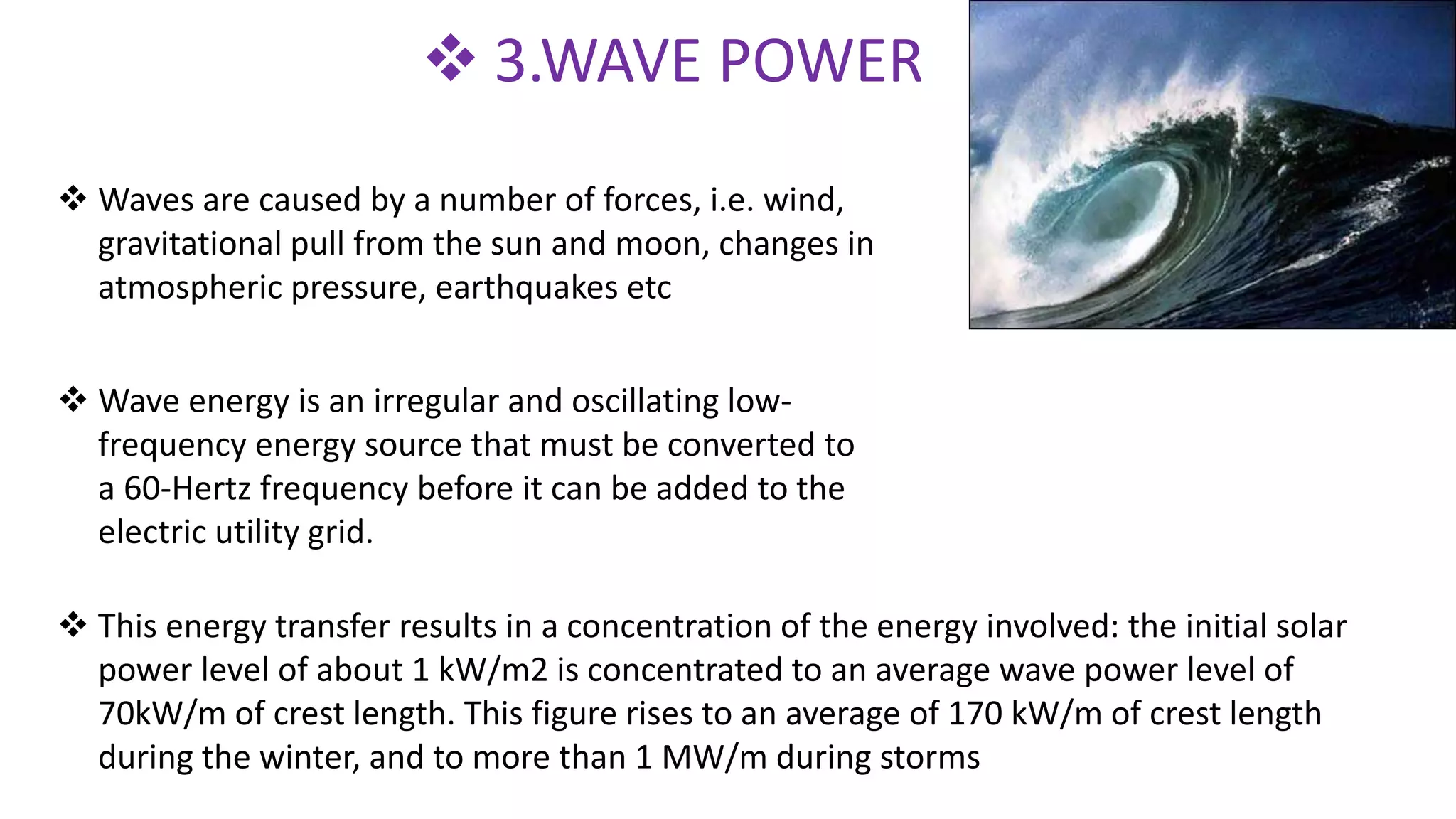
 3.WAVE POWER
 Waves are caused by a number of forces, i.e. wind,
gravitational pull from the sun and moon, changes in
atmospheric pressure, earthquakes etc
 Wave energy is an irregular and oscillating low-
frequency energy source that must be converted to
a 60-Hertz frequency before it can be added to the
electric utility grid.
 This energy transfer results in a concentration of the energy involved: the initial solar
power level of about 1 kW/m2 is concentrated to an average wave power level of
70kW/m of crest length. This figure rises to an average of 170 kW/m of crest length
during the winter, and to more than 1 MW/m during storms
4.1.Advantages
1)No pollution
2)Renewable resource
3)More efficient than wind because of the density of
water
4)Predictable source of energy vs. wind and solar
5)Second generation has very few disadvantages
Does not affect wildlife
Does not affect silt deposits
Less costly – both in building and maintenance
4.2.Disadvantages
1)Presently costly
Expensive to build and maintain
A 1085MW facility could cost as much as 1.2 billion dollars to construct
and run
2)Connection to the grid
3)Technology is not fully developed
4)Barrage style only produces energy for about 10 hours out of
the day
5)Barrage style has environmental affects
Such as fish and plant migration
Silt deposits
Local tides change- affects still under study
5.Conclusions
1)Tidal power is a renewable, potentially zero emission (during
operation) energy source.
2)Tides have the advantage of being completely predictable, unlike
solar and wind power.
3)Different types of Tidal Generators suit different areas and energy
needs.
4)There are environmental concerns that need to be addressed when
developing this technology further.
THANK YOU

Tidal energy

  • 1.
    THEEM COLLEGE OFENGINEERING  NAME:- NAYAN DIPAK GAYKWAD  CLASS :- S.Y.MECH  DIV :- B  ROLL NO:- 22207  SUB:- THERMAL ENGINEERING
  • 2.
  • 3.
    INTRODUCTION 1.Alternative Energy Sources/RenewableEnergy 2.TIDES OR TIDAL POWER 3.WAVE POWER 4.ADVANTEGES & DISADVANTAGES 5.CONCLUSION
  • 4.
    1.Alternative Energy Sources/RenewableEnergy Use of any given energy source in human society encounters limits to expansion. At the beginning of the 21st century some issues have achieved global dimension. Principal fossil energy sources, such as oil and natural gas are approaching exhaustion that may occur within the span of a generation Closely linked to energy development are concerns about the environmental effects of fossil fuel energy use, such as global warming, and health issues due to air pollution. Energy development issues are part of the much debated sustainable development problem. Canada and the United States have incredibly high energy consumption per capita
  • 5.
    Renewable Energy Renewable energysources capture their energy from existing flows of energy, from on-going natural processes, such as sunshine, wind, flowing water (hydropower), biological processes, and geothermal heat flows. Renewable energy is from an energy resource that is replaced rapidly by a natural process such as power generated from the sun or from the wind. Examples of Renewable Energy Sources: WIND SOLAR Hydroelectric
  • 6.
    2.TIDES OR TIDALPOWER 1)Tidal power generators derive their energy from movement of the tides. 2)Obviously requires large bodies of water nearby. Not viable on the prairies for example. 3)Has potential for generation of very large amounts of electricity, or can be used in smaller scale. 4)Tidal power is not a new concept and has been used since at least the 11th Century in Britain and France for the milling of grains. 5)There are a number of places around the world that have adopted pilot projects for different types of tidal generators
  • 7.
  • 8.
    •In systems witha bulb turbine, water flows around the turbine, making access for maintenance difficult, as the water must be prevented from flowing past the turbine. •Rim turbines reduce these problems as the generator is mounted in the barrage, at right angles to the turbine blades. Unfortunately, it is difficult to regulate the performance of these turbines and it is unsuitable for use in pumping. •Tubular turbines have been proposed for use some UK projects. In this configuration, the blades are connected to a long shaft and orientated at an angle so that the generator is sitting on top of the barrage.
  • 9.
     3.WAVE POWER Waves are caused by a number of forces, i.e. wind, gravitational pull from the sun and moon, changes in atmospheric pressure, earthquakes etc  Wave energy is an irregular and oscillating low- frequency energy source that must be converted to a 60-Hertz frequency before it can be added to the electric utility grid.  This energy transfer results in a concentration of the energy involved: the initial solar power level of about 1 kW/m2 is concentrated to an average wave power level of 70kW/m of crest length. This figure rises to an average of 170 kW/m of crest length during the winter, and to more than 1 MW/m during storms
  • 10.
    4.1.Advantages 1)No pollution 2)Renewable resource 3)Moreefficient than wind because of the density of water 4)Predictable source of energy vs. wind and solar 5)Second generation has very few disadvantages Does not affect wildlife Does not affect silt deposits Less costly – both in building and maintenance
  • 11.
    4.2.Disadvantages 1)Presently costly Expensive tobuild and maintain A 1085MW facility could cost as much as 1.2 billion dollars to construct and run 2)Connection to the grid 3)Technology is not fully developed 4)Barrage style only produces energy for about 10 hours out of the day 5)Barrage style has environmental affects Such as fish and plant migration Silt deposits Local tides change- affects still under study
  • 12.
    5.Conclusions 1)Tidal power isa renewable, potentially zero emission (during operation) energy source. 2)Tides have the advantage of being completely predictable, unlike solar and wind power. 3)Different types of Tidal Generators suit different areas and energy needs. 4)There are environmental concerns that need to be addressed when developing this technology further.
  • 13.