Ocean Energy
1.Tidal Energy
2.Wave Energy
3.Ocean Thermal Energy
•
• TYPES
Introduction
1>Form of hydropower
2>Converts energy from tides into useful form
3>Tides are predictable
4>Produced twice a day by low and high tides
5>Combine gravitation of moon , sun and
earth’s centrifugal force
6>Renewable form of energy
History
• First tide mill was established in 619.It was
discovered in the Northern Ireland
Monastery Island. It was used for grinding
grains and then they become popular in the
middle ages. Until the 18th century there were
750 tide mills working at the shore of Atlantic
ocean including 300 on North American
shore. About 200 in Isles and about 100 in
France. In 19th century process of using tidal
power to generate electricity was introduced
in US and Europe.
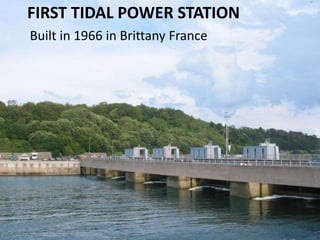
FIRST TIDAL POWER STATION
Built in 1966 in Brittany France
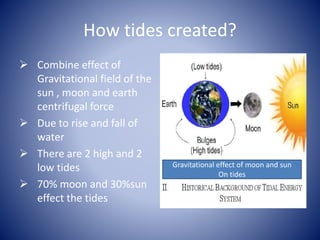
How tides created?
 Combine effect of
Gravitational field of the
sun , moon and earth
centrifugal force
 Due to rise and fall of
water
 There are 2 high and 2
low tides
 70% moon and 30%sun
effect the tides
Gravitational effect of moon and sun
On tides
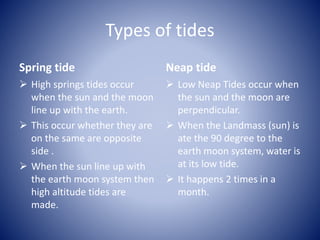
Types of tides
Spring tide
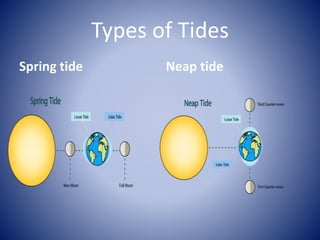
 High springs tides occur
when the sun and the moon
line up with the earth.
 This occur whether they are
on the same are opposite
side .
 When the sun line up with
the earth moon system then
high altitude tides are
made.
Neap tide
 Low Neap Tides occur when
the sun and the moon are
perpendicular.
 When the Landmass (sun) is
ate the 90 degree to the
earth moon system, water is
at its low tide.
 It happens 2 times in a
month.
Types of Tides
Spring tide Neap tide
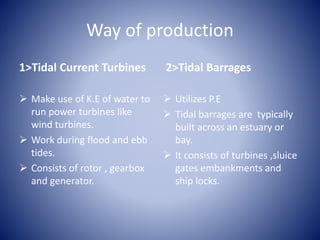
Way of production
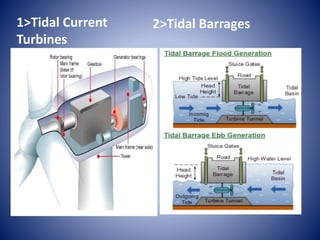
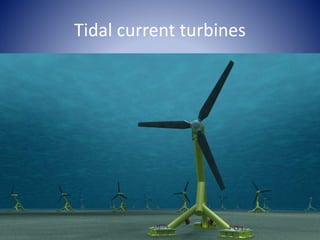
1>Tidal Current Turbines
 Make use of K.E of water to
run power turbines like
wind turbines.
 Work during flood and ebb
tides.
 Consists of rotor , gearbox
and generator.
2>Tidal Barrages
 Utilizes P.E
 Tidal barrages are typically
built across an estuary or
bay.
 It consists of turbines ,sluice
gates embankments and
ship locks.
1>Tidal Current
Turbines
2>Tidal Barrages
Tidal current turbines
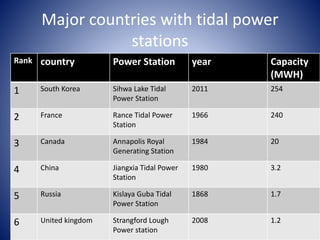
Major countries with tidal power
stations
Rank country Power Station year Capacity
(MWH)
1 South Korea Sihwa Lake Tidal
Power Station
2011 254
2 France Rance Tidal Power
Station
1966 240
3 Canada Annapolis Royal
Generating Station
1984 20
4 China Jiangxia Tidal Power
Station
1980 3.2
5 Russia Kislaya Guba Tidal
Power Station
1868 1.7
6 United kingdom Strangford Lough
Power station
2008 1.2
Cost for the project installation and
maintenance
For establishing the tidal power station we
need $105 million USD. It indicates costs
electricity about $197/MWH or $19.7 cents
USD per KWH.
It is expensive then any electricity produced
by thermal , wind and solar or even nuclear
power stations.
It costs about 15 cents USD per KWH by NPP.
Merits
 Renewable energy
source
 More predicable then
energy from sun and
wind
 Green tidal power is an
Environmental friendly
energy source
 Effective at low speed
of 10 mph or 8.6 knots
 Long life span
 Protect coastal areas
from bad weather and
storms by small dams
and barrages
 Reduce fuel importation
from foreign
 No green house gas
emission
Demerits
 Highly expensive
 Few places availability
 Disrupt the natural
movement of marine
animals and growth of
plants
 Tide surges 10h/day
there should be energy
storage
 Point of production is
far away from the point
of consumption
 New technology with
less advancements
 Less funding
 Expertise are less
 A huge evalution
required before
practical
Future in and out of PAKISTAN
In
 Although not yet widely
used , tidal energy has
potential for future
electricity production in
Pakistan
 It is a predictable source of
energy so like other
countries Pakistan will
adopt it in future soon.
 It is not operational in
Pakistan due to high cost.
Out
 Other developed countries
have adopt this technology
and they are continually
progressing in this field
 It is huge amount of energy
that can be gathered
 It is estimated that there is
1 terawatt of power in
ocean that can be used to
light 10 billions bulbs of 100
watt at once
Questions?
Tidal energy

Tidal energy

  • 2.
    Ocean Energy 1.Tidal Energy 2.WaveEnergy 3.Ocean Thermal Energy • • TYPES
  • 3.
    Introduction 1>Form of hydropower 2>Convertsenergy from tides into useful form 3>Tides are predictable 4>Produced twice a day by low and high tides 5>Combine gravitation of moon , sun and earth’s centrifugal force 6>Renewable form of energy
  • 4.
    History • First tidemill was established in 619.It was discovered in the Northern Ireland Monastery Island. It was used for grinding grains and then they become popular in the middle ages. Until the 18th century there were 750 tide mills working at the shore of Atlantic ocean including 300 on North American shore. About 200 in Isles and about 100 in France. In 19th century process of using tidal power to generate electricity was introduced in US and Europe.
  • 6.
    FIRST TIDAL POWERSTATION Built in 1966 in Brittany France
  • 7.
    How tides created? Combine effect of Gravitational field of the sun , moon and earth centrifugal force  Due to rise and fall of water  There are 2 high and 2 low tides  70% moon and 30%sun effect the tides Gravitational effect of moon and sun On tides
  • 8.
    Types of tides Springtide  High springs tides occur when the sun and the moon line up with the earth.  This occur whether they are on the same are opposite side .  When the sun line up with the earth moon system then high altitude tides are made. Neap tide  Low Neap Tides occur when the sun and the moon are perpendicular.  When the Landmass (sun) is ate the 90 degree to the earth moon system, water is at its low tide.  It happens 2 times in a month.
  • 9.
    Types of Tides Springtide Neap tide
  • 10.
    Way of production 1>TidalCurrent Turbines  Make use of K.E of water to run power turbines like wind turbines.  Work during flood and ebb tides.  Consists of rotor , gearbox and generator. 2>Tidal Barrages  Utilizes P.E  Tidal barrages are typically built across an estuary or bay.  It consists of turbines ,sluice gates embankments and ship locks.
  • 11.
  • 12.
  • 14.
    Major countries withtidal power stations Rank country Power Station year Capacity (MWH) 1 South Korea Sihwa Lake Tidal Power Station 2011 254 2 France Rance Tidal Power Station 1966 240 3 Canada Annapolis Royal Generating Station 1984 20 4 China Jiangxia Tidal Power Station 1980 3.2 5 Russia Kislaya Guba Tidal Power Station 1868 1.7 6 United kingdom Strangford Lough Power station 2008 1.2
  • 15.
    Cost for theproject installation and maintenance For establishing the tidal power station we need $105 million USD. It indicates costs electricity about $197/MWH or $19.7 cents USD per KWH. It is expensive then any electricity produced by thermal , wind and solar or even nuclear power stations. It costs about 15 cents USD per KWH by NPP.
  • 16.
    Merits  Renewable energy source More predicable then energy from sun and wind  Green tidal power is an Environmental friendly energy source  Effective at low speed of 10 mph or 8.6 knots  Long life span  Protect coastal areas from bad weather and storms by small dams and barrages  Reduce fuel importation from foreign  No green house gas emission
  • 17.
    Demerits  Highly expensive Few places availability  Disrupt the natural movement of marine animals and growth of plants  Tide surges 10h/day there should be energy storage  Point of production is far away from the point of consumption  New technology with less advancements  Less funding  Expertise are less  A huge evalution required before practical
  • 18.
    Future in andout of PAKISTAN In  Although not yet widely used , tidal energy has potential for future electricity production in Pakistan  It is a predictable source of energy so like other countries Pakistan will adopt it in future soon.  It is not operational in Pakistan due to high cost. Out  Other developed countries have adopt this technology and they are continually progressing in this field  It is huge amount of energy that can be gathered  It is estimated that there is 1 terawatt of power in ocean that can be used to light 10 billions bulbs of 100 watt at once
  • 19.