Overview of Ocean Energy
-ocean energy is replenished by the sun and through tidal influences of the
moon’s and sun’s gravitational forces
-near-surface winds induce wave action and cause wind-blown currents at
about 3% of the wind speed
-tides cause strong currents into and out of coastal basins and rivers
-ocean surface heating by some 70% of the incoming sunlight adds to the
surface water thermal energy, causing expansion and flow
-wind energy is stronger over the ocean due to less drag, although
technically, only seabreezes are from ocean energy
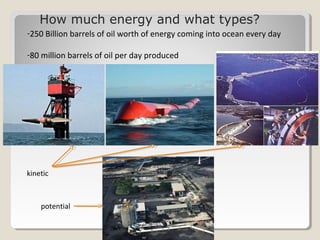
How much energy and what types?
-250 Billion barrels of oil worth of energy coming into ocean every day
-80 million barrels of oil per day produced
kinetic
potential
-250 Billion barrels of oil worth of energy coming into ocean every day
-80 million barrels of oil per day produced
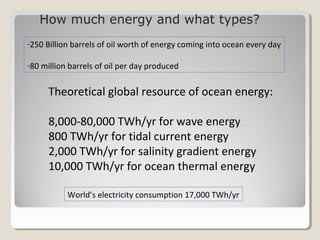
How much energy and what types?
Theoretical global resource of ocean energy:
8,000-80,000 TWh/yr for wave energy
800 TWh/yr for tidal current energy
2,000 TWh/yr for salinity gradient energy
10,000 TWh/yr for ocean thermal energy
World’s electricity consumption 17,000 TWh/yr
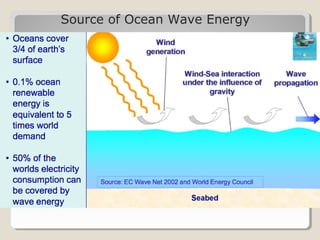
Source of Ocean Wave Energy
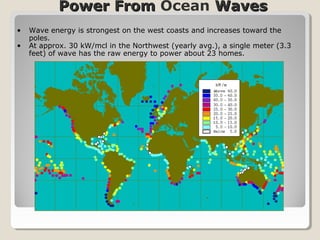
Power FromPower From Ocean WavesWaves
• Wave energy is strongest on the west coasts and increases toward the
poles.
• At approx. 30 kW/mcl in the Northwest (yearly avg.), a single meter (3.3
feet) of wave has the raw energy to power about 23 homes.
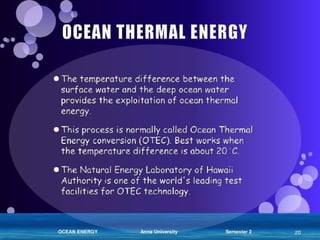
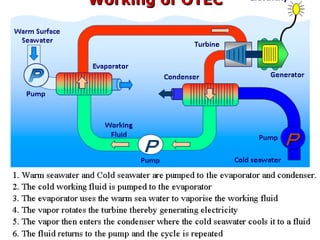
Working of OTECWorking of OTEC
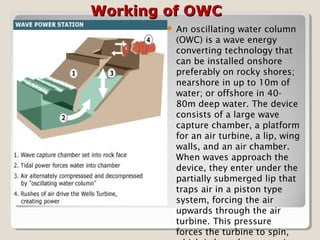
Working of OWCWorking of OWC
 An oscillating water column
(OWC) is a wave energy
converting technology that
can be installed onshore
preferably on rocky shores;
nearshore in up to 10m of
water; or offshore in 40-
80m deep water. The device
consists of a large wave
capture chamber, a platform
for an air turbine, a lip, wing
walls, and an air chamber.
When waves approach the
device, they enter under the
partially submerged lip that
traps air in a piston type
system, forcing the air
upwards through the air
turbine. This pressure
forces the turbine to spin,
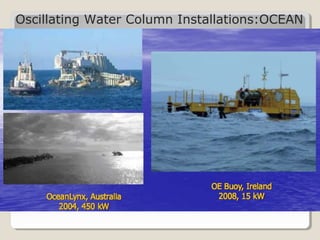
Oscillating Water Column Installations:OCEAN
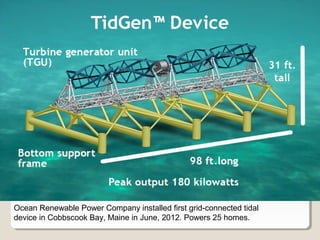
Ocean Renewable Power Company installed first grid-connected tidal
device in Cobbscook Bay, Maine in June, 2012. Powers 25 homes.
Tidal Energy
Tidal power, also called tidal energy, is a form of
hydropower that converts the energy of tides into
useful forms of power - mainly electricity.
Tides are the waves caused due to the gravitational
pull of the moon and also sun(though its pull is very
low).
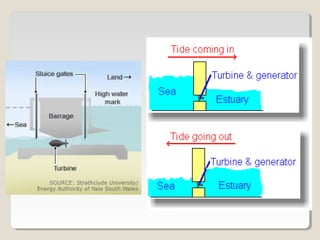
During high tide, the water flows into the dam and
during low tide, water flows out which result in turning
the turbine.
Ocean tides are the periodic rise and fall of ocean water level
occurs twice in each lunar day.
During one lunar day (24.83 H) the ocean water level rises twice
and fall twice.
Time interval between a consecutive low tide and high tide is
6.207 hrs.
Tidal range is the difference between the consecutive high tide
and low tide.
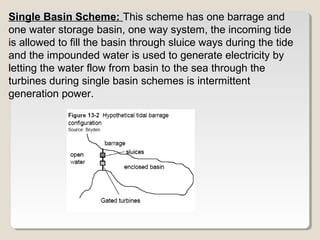
Single Basin Scheme: This scheme has one barrage and
one water storage basin, one way system, the incoming tide
is allowed to fill the basin through sluice ways during the tide
and the impounded water is used to generate electricity by
letting the water flow from basin to the sea through the
turbines during single basin schemes is intermittent
generation power.
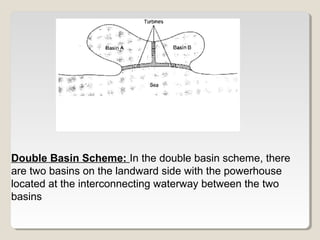
Double Basin Scheme: In the double basin scheme, there
are two basins on the landward side with the powerhouse
located at the interconnecting waterway between the two
basins
Advantages of Tidal Energy
1) It is an inexhaustible source of energy.
2) Tidal energy is environment friendly energy and doesn't
produce greenhouse gases.
3) As 71% of Earth’s surface is covered by water, there is
scope to generate this energy on large scale.
4) We can predict the rise and fall of tides as they follow
cyclic fashion.
5) Efficiency of tidal power is far greater as compared to coal,
solar or wind energy. Its efficiency is around 80%.
6) Although cost of construction of tidal power is high but
maintenance costs are relatively low.
7) Tidal Energy doesn’t require any kind of fuel to run.
8) The life of tidal energy power plant is very long.
9) The energy density of tidal energy is relatively higher than
other renewable energy sources.
Disadvantages of Tidal Energy
1) Cost of construction of tidal power plant is high.
2) There are very few ideal locations for construction of plant
and they too are localized to coastal regions only.
3) Intensity of sea waves is unpredictable and there can be
damage to power generation units.
4) Influences aquatic life adversely and can disrupt migration
of fish.
5) The actual generation is for a short period of time. The
tides only happen twice a day so electricity can be produced
only for that time.
6) Frozen sea, low or weak tides, straight shorelines, low
tidal rise or fall are some of the obstructions.
7) Usually the places where tidal energy is produced are far
away from the places where it is consumed. This
transmission is expensive and difficult.
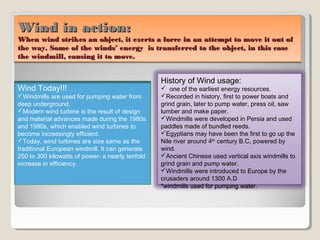
Wind in action:Wind in action:
When wind strikes an object, it exerts a force in an attempt to move it out ofWhen wind strikes an object, it exerts a force in an attempt to move it out of
the way. Some of the winds’ energy is transferred to the object, in this casethe way. Some of the winds’ energy is transferred to the object, in this case
the windmill, causing it to move.the windmill, causing it to move.
Wind in action:Wind in action:
When wind strikes an object, it exerts a force in an attempt to move it out ofWhen wind strikes an object, it exerts a force in an attempt to move it out of
the way. Some of the winds’ energy is transferred to the object, in this casethe way. Some of the winds’ energy is transferred to the object, in this case
the windmill, causing it to move.the windmill, causing it to move.
History of Wind usage:
 one of the earliest energy resources.
Recorded in history, first to power boats and
grind grain, later to pump water, press oil, saw
lumber and make paper.
Windmills were developed in Persia and used
paddles made of bundled reeds.
Egyptians may have been the first to go up the
Nile river around 4th
century B.C, powered by
wind.
Ancient Chinese used vertical axis windmills to
grind grain and pump water.
Windmills were introduced to Europe by the
crusaders around 1300 A.D
*windmills used for pumping water.
Wind Today!!!
Windmills are used for pumping water from
deep underground.
Modern wind turbine is the result of design
and material advances made during the 1980s
and 1990s, which enabled wind turbines to
become increasingly efficient.
Today, wind turbines are size same as the
traditional European windmill. It can generate
250 to 300 kilowatts of power- a nearly tenfold
increase in efficiency.
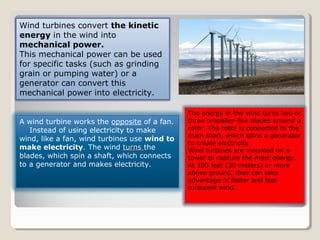
Wind turbines convert the kinetic
energy in the wind into
mechanical power.
This mechanical power can be used
for specific tasks (such as grinding
grain or pumping water) or a
generator can convert this
mechanical power into electricity.
A wind turbine works the opposite of a fan.
Instead of using electricity to make
wind, like a fan, wind turbines use wind to
make electricity. The wind turnsturns the
blades, which spin a shaft, which connects
to a generator and makes electricity.
The energy in the wind turns two or
three propeller-like blades around a
rotor. The rotor is connected to the
main shaft, which spins a generator
to create electricity.
Wind turbines are mounted on a
tower to capture the most energy.
At 100 feet (30 meters) or more
above ground, they can take
advantage of faster and less
turbulent wind.
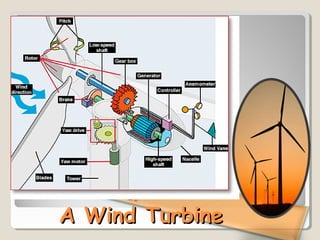
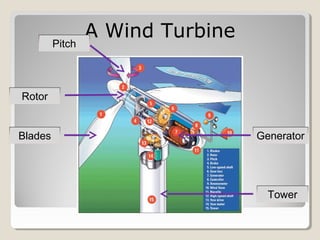
A Wind TurbineA Wind Turbine
A Wind Turbine
Blades
Tower
Pitch
Generator
Rotor
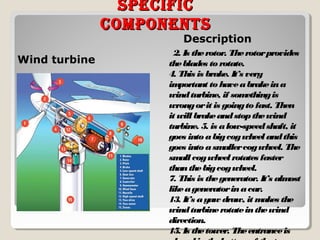
SpecificSpecific
componentScomponentS
Wind turbine
Description
2. Is therotor. Therotorprovides
theblades to rotate.
4. This is brake. It’s very
important to haveabrakeina
windturbine, if somethingis
wrongorit is goingto fast. Then
it will brakeandstopthewind
turbine. 5. is alow-speedshaft, it
goes intoabigcogwheel andthis
goes intoasmallercogwheel. The
small cogwheel rotates faster
thanthebigcogwheel.
7. This is thegenerator. It’s almost
likeageneratorinacar.
13. It’s ayaw draw, it makes the
windturbinerotateinthewind
direction.
15. Is thetower. Theentranceis
How the does a wind turbineHow the does a wind turbine
works?works?
Wind turbines operate on a simple principle:
The energy in the wind turns the propeller-like blades around
a rotor. The pitch of the blades makes optimum use of the
wind direction.
The rotor is connected to the main drive shaft, which spins a
generator to create electricity.
Wind turbines are mounted on a tower to capture the most
energy. At 30 metres or more above ground, they can take
advantage of faster and less turbulent wind.
Wind turbines can be used to produce electricity for a single
home or building, or they can be connected to an electricity
grid for more widespread electricity distribution.
Disadvantages:
Depending on how energetic a wind site
is, the wind farm may or may not be cost
competitive.
Wind energy cannot be stored (unless
batteries are used)
Good wind sites are often located in
remote locations
Wind resource development may
compete with other uses for the land and
those alternative uses may be more highly
valued than electricity generation.
sometimes birds have been killed by
flying into the rotors
Advantages:
No pollution.
Lowest prices renewable
resources
Don’t produce atmospheric
emissions that cause acid
rains and green house
effects.
Advantages:
No pollution.
Lowest prices renewable
resources
Don’t produce atmospheric
emissions that cause acid
rains and green house
effects.
ADVANTAGES &ADVANTAGES &
DISADVANTAGESDISADVANTAGES
isalmer wind farmsalmer wind farm
The 2 largest off shore wind farm in the world]he 2 largest off shore wind farm in the world]
London ArrayLondon Array
[[WorldsWorlds largest on shore wind farm]largest on shore wind farm]
GENERAL ADVANTAGESGENERAL ADVANTAGES
Wind energy is friendly to the surrounding
environment, as no fossil fuels are burnt to generate
electricity from wind energy
Wind turbines requires less space than average
power stations.
When combined with solar electricity, this energy
source is great for developed and developing
countries to provide a steady, reliable supply of
electricity
GENERAL DISADVANTAGESGENERAL DISADVANTAGES
The main disadvantage regarding wind power is
down to the winds unreliability factor. In many
areas, the winds strength is not enough to support a
wind turbine
Wind turbines generally produce allot less
electricity than the average fossil fuelled power
station, which means that multiple wind turbines
are needed to make an impact.

Ocean,Tidal and Wind Energy

  • 3.
    Overview of OceanEnergy -ocean energy is replenished by the sun and through tidal influences of the moon’s and sun’s gravitational forces -near-surface winds induce wave action and cause wind-blown currents at about 3% of the wind speed -tides cause strong currents into and out of coastal basins and rivers -ocean surface heating by some 70% of the incoming sunlight adds to the surface water thermal energy, causing expansion and flow -wind energy is stronger over the ocean due to less drag, although technically, only seabreezes are from ocean energy
  • 4.
    How much energyand what types? -250 Billion barrels of oil worth of energy coming into ocean every day -80 million barrels of oil per day produced kinetic potential
  • 5.
    -250 Billion barrelsof oil worth of energy coming into ocean every day -80 million barrels of oil per day produced How much energy and what types? Theoretical global resource of ocean energy: 8,000-80,000 TWh/yr for wave energy 800 TWh/yr for tidal current energy 2,000 TWh/yr for salinity gradient energy 10,000 TWh/yr for ocean thermal energy World’s electricity consumption 17,000 TWh/yr
  • 6.
    Source of OceanWave Energy
  • 7.
    Power FromPower FromOcean WavesWaves • Wave energy is strongest on the west coasts and increases toward the poles. • At approx. 30 kW/mcl in the Northwest (yearly avg.), a single meter (3.3 feet) of wave has the raw energy to power about 23 homes.
  • 9.
  • 10.
    Working of OWCWorkingof OWC  An oscillating water column (OWC) is a wave energy converting technology that can be installed onshore preferably on rocky shores; nearshore in up to 10m of water; or offshore in 40- 80m deep water. The device consists of a large wave capture chamber, a platform for an air turbine, a lip, wing walls, and an air chamber. When waves approach the device, they enter under the partially submerged lip that traps air in a piston type system, forcing the air upwards through the air turbine. This pressure forces the turbine to spin,
  • 11.
    Oscillating Water ColumnInstallations:OCEAN
  • 12.
    Ocean Renewable PowerCompany installed first grid-connected tidal device in Cobbscook Bay, Maine in June, 2012. Powers 25 homes.
  • 14.
    Tidal Energy Tidal power,also called tidal energy, is a form of hydropower that converts the energy of tides into useful forms of power - mainly electricity. Tides are the waves caused due to the gravitational pull of the moon and also sun(though its pull is very low). During high tide, the water flows into the dam and during low tide, water flows out which result in turning the turbine.
  • 15.
    Ocean tides arethe periodic rise and fall of ocean water level occurs twice in each lunar day. During one lunar day (24.83 H) the ocean water level rises twice and fall twice. Time interval between a consecutive low tide and high tide is 6.207 hrs. Tidal range is the difference between the consecutive high tide and low tide.
  • 17.
    Single Basin Scheme:This scheme has one barrage and one water storage basin, one way system, the incoming tide is allowed to fill the basin through sluice ways during the tide and the impounded water is used to generate electricity by letting the water flow from basin to the sea through the turbines during single basin schemes is intermittent generation power.
  • 18.
    Double Basin Scheme:In the double basin scheme, there are two basins on the landward side with the powerhouse located at the interconnecting waterway between the two basins
  • 19.
    Advantages of TidalEnergy 1) It is an inexhaustible source of energy. 2) Tidal energy is environment friendly energy and doesn't produce greenhouse gases. 3) As 71% of Earth’s surface is covered by water, there is scope to generate this energy on large scale. 4) We can predict the rise and fall of tides as they follow cyclic fashion. 5) Efficiency of tidal power is far greater as compared to coal, solar or wind energy. Its efficiency is around 80%. 6) Although cost of construction of tidal power is high but maintenance costs are relatively low. 7) Tidal Energy doesn’t require any kind of fuel to run. 8) The life of tidal energy power plant is very long. 9) The energy density of tidal energy is relatively higher than other renewable energy sources.
  • 20.
    Disadvantages of TidalEnergy 1) Cost of construction of tidal power plant is high. 2) There are very few ideal locations for construction of plant and they too are localized to coastal regions only. 3) Intensity of sea waves is unpredictable and there can be damage to power generation units. 4) Influences aquatic life adversely and can disrupt migration of fish. 5) The actual generation is for a short period of time. The tides only happen twice a day so electricity can be produced only for that time. 6) Frozen sea, low or weak tides, straight shorelines, low tidal rise or fall are some of the obstructions. 7) Usually the places where tidal energy is produced are far away from the places where it is consumed. This transmission is expensive and difficult.
  • 22.
    Wind in action:Windin action: When wind strikes an object, it exerts a force in an attempt to move it out ofWhen wind strikes an object, it exerts a force in an attempt to move it out of the way. Some of the winds’ energy is transferred to the object, in this casethe way. Some of the winds’ energy is transferred to the object, in this case the windmill, causing it to move.the windmill, causing it to move. Wind in action:Wind in action: When wind strikes an object, it exerts a force in an attempt to move it out ofWhen wind strikes an object, it exerts a force in an attempt to move it out of the way. Some of the winds’ energy is transferred to the object, in this casethe way. Some of the winds’ energy is transferred to the object, in this case the windmill, causing it to move.the windmill, causing it to move. History of Wind usage:  one of the earliest energy resources. Recorded in history, first to power boats and grind grain, later to pump water, press oil, saw lumber and make paper. Windmills were developed in Persia and used paddles made of bundled reeds. Egyptians may have been the first to go up the Nile river around 4th century B.C, powered by wind. Ancient Chinese used vertical axis windmills to grind grain and pump water. Windmills were introduced to Europe by the crusaders around 1300 A.D *windmills used for pumping water. Wind Today!!! Windmills are used for pumping water from deep underground. Modern wind turbine is the result of design and material advances made during the 1980s and 1990s, which enabled wind turbines to become increasingly efficient. Today, wind turbines are size same as the traditional European windmill. It can generate 250 to 300 kilowatts of power- a nearly tenfold increase in efficiency.
  • 23.
    Wind turbines convertthe kinetic energy in the wind into mechanical power. This mechanical power can be used for specific tasks (such as grinding grain or pumping water) or a generator can convert this mechanical power into electricity. A wind turbine works the opposite of a fan. Instead of using electricity to make wind, like a fan, wind turbines use wind to make electricity. The wind turnsturns the blades, which spin a shaft, which connects to a generator and makes electricity. The energy in the wind turns two or three propeller-like blades around a rotor. The rotor is connected to the main shaft, which spins a generator to create electricity. Wind turbines are mounted on a tower to capture the most energy. At 100 feet (30 meters) or more above ground, they can take advantage of faster and less turbulent wind.
  • 24.
    A Wind TurbineAWind Turbine
  • 25.
  • 26.
    SpecificSpecific componentScomponentS Wind turbine Description 2. Istherotor. Therotorprovides theblades to rotate. 4. This is brake. It’s very important to haveabrakeina windturbine, if somethingis wrongorit is goingto fast. Then it will brakeandstopthewind turbine. 5. is alow-speedshaft, it goes intoabigcogwheel andthis goes intoasmallercogwheel. The small cogwheel rotates faster thanthebigcogwheel. 7. This is thegenerator. It’s almost likeageneratorinacar. 13. It’s ayaw draw, it makes the windturbinerotateinthewind direction. 15. Is thetower. Theentranceis
  • 27.
    How the doesa wind turbineHow the does a wind turbine works?works? Wind turbines operate on a simple principle: The energy in the wind turns the propeller-like blades around a rotor. The pitch of the blades makes optimum use of the wind direction. The rotor is connected to the main drive shaft, which spins a generator to create electricity. Wind turbines are mounted on a tower to capture the most energy. At 30 metres or more above ground, they can take advantage of faster and less turbulent wind. Wind turbines can be used to produce electricity for a single home or building, or they can be connected to an electricity grid for more widespread electricity distribution.
  • 28.
    Disadvantages: Depending on howenergetic a wind site is, the wind farm may or may not be cost competitive. Wind energy cannot be stored (unless batteries are used) Good wind sites are often located in remote locations Wind resource development may compete with other uses for the land and those alternative uses may be more highly valued than electricity generation. sometimes birds have been killed by flying into the rotors Advantages: No pollution. Lowest prices renewable resources Don’t produce atmospheric emissions that cause acid rains and green house effects. Advantages: No pollution. Lowest prices renewable resources Don’t produce atmospheric emissions that cause acid rains and green house effects. ADVANTAGES &ADVANTAGES & DISADVANTAGESDISADVANTAGES
  • 29.
    isalmer wind farmsalmerwind farm The 2 largest off shore wind farm in the world]he 2 largest off shore wind farm in the world]
  • 30.
    London ArrayLondon Array [[WorldsWorldslargest on shore wind farm]largest on shore wind farm]
  • 31.
    GENERAL ADVANTAGESGENERAL ADVANTAGES Windenergy is friendly to the surrounding environment, as no fossil fuels are burnt to generate electricity from wind energy Wind turbines requires less space than average power stations. When combined with solar electricity, this energy source is great for developed and developing countries to provide a steady, reliable supply of electricity
  • 32.
    GENERAL DISADVANTAGESGENERAL DISADVANTAGES Themain disadvantage regarding wind power is down to the winds unreliability factor. In many areas, the winds strength is not enough to support a wind turbine Wind turbines generally produce allot less electricity than the average fossil fuelled power station, which means that multiple wind turbines are needed to make an impact.