PRESENTATION
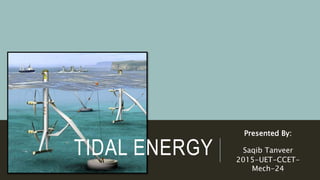
TIDAL ENERGY
Presented By:
Saqib Tanveer
2015-UET-CCET-
Mech-24
CONTENTS
 Introduction & History
 Tide
 Tidal Force
 Tidal Power
 Principal of Tidal Power
 Components of Tidal Power plant
 Operation Method
 Advantages & Disadvantages
 Global Environment Impact
INTRODUCTION & HISTORY
 Tidal power, also called tidal energy, is a form of hydropower that
converts the energy of tides into useful forms of power - mainly electricity.
This is the only form of energy whose source is the moon.
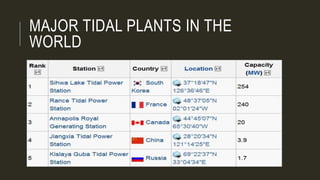
 The first tidal power station was the Rance tidal power plant built over
a period of 6 years from 1960 to 1966 at La Rance, France. It has
240 MW installed capacity.
 Also the world's second biggest tidal power station.
 With a peak rating of 240 Megawatts, generated by its 24 turbines, it
supplies 0.012% of the power demand of France.
MAJOR TIDAL PLANTS IN THE
WORLD
WHAT IS A TIDE ?
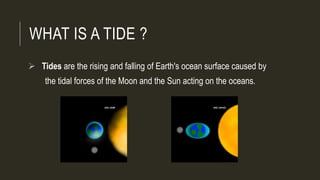
 Tides are the rising and falling of Earth's ocean surface caused by
the tidal forces of the Moon and the Sun acting on the oceans.
WHAT IS THE TIDAL FORCE ?
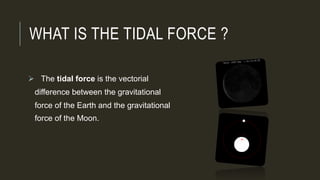
 The tidal force is the vectorial
difference between the gravitational
force of the Earth and the gravitational
force of the Moon.
ABOUT TIDAL POWER
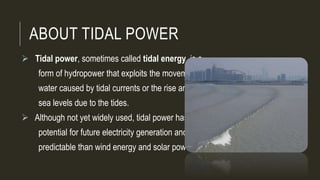
 Tidal power, sometimes called tidal energy, is a
form of hydropower that exploits the movement of
water caused by tidal currents or the rise and fall in
sea levels due to the tides.
 Although not yet widely used, tidal power has
potential for future electricity generation and is more
predictable than wind energy and solar power.
PRINCIPLE OF TIDAL POWER
STATIONS
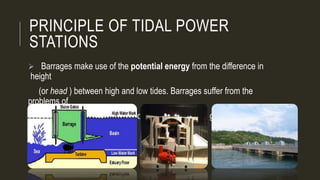
 Barrages make use of the potential energy from the difference in
height
(or head ) between high and low tides. Barrages suffer from the
problems of
very high civil infrastructure costs, few viable sites globally and
environmental issues.
PRINCIPLE OF TIDAL POWER
STATIONS
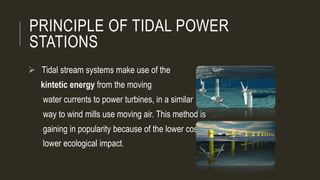
 Tidal stream systems make use of the
kintetic energy from the moving
water currents to power turbines, in a similar
way to wind mills use moving air. This method is
gaining in popularity because of the lower cost and
lower ecological impact.
COMPONENTS OF TIDAL POWER
PLANT
 Gates & Locks:-
Tidal power basins have to be filled and emptied gates are open
regularly and frequently, but heads are vary in highest and on the sides
where they occurs which is not the case with the conventional river
projects . The gates must be opened and closed rapidly and this
operation should use a power.
 Power House:-
Because small heads only available large size turbine are hence
power house is also large structure. Both the French and soviet operating
use the bulb type of turbine the propeller type with the reversible blades.
COMPONENTS OF TIDAL POWER
PLANT
 Bulb Type Turbine:-
A bulb type turbine is example of flow turbine. The bulb set
resembling in appearance a small submarine is made up of an ague
shape steel contains a horizontal duct in which alternator and a Kaplan
turbine is placed and entirely surrounding by water.
 Rim Type Turbine:-
Different types of turbine are under study usually mention are include
shaft turbine rim type turbine or straight flow turbine where the gear is
attached on the turbine blade arrangement that couples two turbine of
conventional type to one generator and a hydraulic system in which six
turbine are to hydrostatic pumps. The main problems in rim type turbine in
which the rotor surrounded the turbine the runner and rim.
COMPONENTS OF TIDAL POWER
PLANT
 Sluices:-
Sluices gates are the ones responsible for the flow of water through
the barrage.
 Embankment:-
They era caissons made out of concrete to prevent water from
flowing at certain parts of the dam and to help maintenance work and
electrical wiring to be connected or used to move equipment or cars over
it.
OPERATION METHODS
 Electricity generation requires certain heads difference of water flow.
The concept have been advised for operation hydraulic turbine.
I. Single basin system
II. Double basin system
I. SINGLE BASIN SYSTEM
 In this system there is only one interaction with the sequence.
The two are separated by dam and flow between through sluice
valves.
The generation of power is by……..
 EBB Method
 Flood Method
 Two Way Power Generation
SINGLE BASIN SYSTEM
 EBB METHOD:-
• Water starts to ebb or go toward the sea.
• The gates are left closed keeping the water trapped in basin to
increase its
level.
• Then water is released out toward the sea rotating turbines creating
electrical energy.
 FLOOD METHOD:-
• Water is let into the basin when it is empty.
• As the turbines are rotated the electrical energy is created.
SINGLE BASIN SYSTEM
 TWO WAY POWER GENERATION:-
• Starting with the basin full the gates are opened letting water flow out
generating energy.
• The turbines are reversed as the flow will be reversed.
• The gates are closed when the flood period or cycle starts.
• Water starts to build up behind the dam.
• When a sufficient head is achieved the gates are opened to start flood
generation cycle as the water flows into the basin.
• Electric power is generated once in every six hours 12.5 min.
II. DOUBLE BASIN SYSTEM
 Two basins are built one called a high-level basin and the other is the
low-level basin.
 The turbines are placed in the wall dividing the two basins.
 The high level basin is filled at high tide or flood period.
 Then the low-level basin is filled through the turbines from the high
level basin.
 The low level basin is emptied at low tide ebb period.
ADVANTAGES OF TIDAL ENERGY
 It is inexhaustible source of energy.
 Tidal energy is environment friendly and doesn`t produce greenhouse gases.
 As 71% of Earth is covered by water, there is scope of generate this energy
on large scale.
 We can predict the rise & fall of tides as they follow cyclic fashion.
 Efficiency of tidal power is far greater as compared to coal, solar or wind
energy.
 Its maintenance cost is very low.
 Doesn`t require any kind of fuel to run.
DISADVANTAGES OF TIDAL ENERGY
 Cost of construction of tidal power plant is high.
 Very few locations for construction of plant and they are localized to
coastal regions.
 Intensity of sea waves is unpredictable and there can be damage to
power generation units.
 Influences aquatic life adversely and can disrupt migration of fish.
 The actual generation is for a short period of time.
 Some obstructions like frozen sea, low or weak tides, straight
shorelines etc.
 Its transmission is expensive and difficult because the tidal energy is
GLOBAL ENVIRONMENT IMPACT
 A tidal power scheme is a long-term source of electricity. A proposal for
the Severn Barrage, if built, has been projected to save 18 million tonnes
of coal per year of operation. This decreases the output of greenhouse
gases into the atmosphere.
 If fossil fuel resource is likely to decline during the 21st century, as
predicted by Hubbert peak theory, tidal power is one of the alternative
source of energy that will need to be developed to satisfy the human
demand for energy.
THANK YOU

Tidal energy

  • 1.
  • 2.
    TIDAL ENERGY Presented By: SaqibTanveer 2015-UET-CCET- Mech-24
  • 3.
    CONTENTS  Introduction &History  Tide  Tidal Force  Tidal Power  Principal of Tidal Power  Components of Tidal Power plant  Operation Method  Advantages & Disadvantages  Global Environment Impact
  • 4.
    INTRODUCTION & HISTORY Tidal power, also called tidal energy, is a form of hydropower that converts the energy of tides into useful forms of power - mainly electricity. This is the only form of energy whose source is the moon.  The first tidal power station was the Rance tidal power plant built over a period of 6 years from 1960 to 1966 at La Rance, France. It has 240 MW installed capacity.  Also the world's second biggest tidal power station.  With a peak rating of 240 Megawatts, generated by its 24 turbines, it supplies 0.012% of the power demand of France.
  • 5.
    MAJOR TIDAL PLANTSIN THE WORLD
  • 6.
    WHAT IS ATIDE ?  Tides are the rising and falling of Earth's ocean surface caused by the tidal forces of the Moon and the Sun acting on the oceans.
  • 7.
    WHAT IS THETIDAL FORCE ?  The tidal force is the vectorial difference between the gravitational force of the Earth and the gravitational force of the Moon.
  • 8.
    ABOUT TIDAL POWER Tidal power, sometimes called tidal energy, is a form of hydropower that exploits the movement of water caused by tidal currents or the rise and fall in sea levels due to the tides.  Although not yet widely used, tidal power has potential for future electricity generation and is more predictable than wind energy and solar power.
  • 9.
    PRINCIPLE OF TIDALPOWER STATIONS  Barrages make use of the potential energy from the difference in height (or head ) between high and low tides. Barrages suffer from the problems of very high civil infrastructure costs, few viable sites globally and environmental issues.
  • 10.
    PRINCIPLE OF TIDALPOWER STATIONS  Tidal stream systems make use of the kintetic energy from the moving water currents to power turbines, in a similar way to wind mills use moving air. This method is gaining in popularity because of the lower cost and lower ecological impact.
  • 11.
    COMPONENTS OF TIDALPOWER PLANT  Gates & Locks:- Tidal power basins have to be filled and emptied gates are open regularly and frequently, but heads are vary in highest and on the sides where they occurs which is not the case with the conventional river projects . The gates must be opened and closed rapidly and this operation should use a power.  Power House:- Because small heads only available large size turbine are hence power house is also large structure. Both the French and soviet operating use the bulb type of turbine the propeller type with the reversible blades.
  • 12.
    COMPONENTS OF TIDALPOWER PLANT  Bulb Type Turbine:- A bulb type turbine is example of flow turbine. The bulb set resembling in appearance a small submarine is made up of an ague shape steel contains a horizontal duct in which alternator and a Kaplan turbine is placed and entirely surrounding by water.  Rim Type Turbine:- Different types of turbine are under study usually mention are include shaft turbine rim type turbine or straight flow turbine where the gear is attached on the turbine blade arrangement that couples two turbine of conventional type to one generator and a hydraulic system in which six turbine are to hydrostatic pumps. The main problems in rim type turbine in which the rotor surrounded the turbine the runner and rim.
  • 13.
    COMPONENTS OF TIDALPOWER PLANT  Sluices:- Sluices gates are the ones responsible for the flow of water through the barrage.  Embankment:- They era caissons made out of concrete to prevent water from flowing at certain parts of the dam and to help maintenance work and electrical wiring to be connected or used to move equipment or cars over it.
  • 14.
    OPERATION METHODS  Electricitygeneration requires certain heads difference of water flow. The concept have been advised for operation hydraulic turbine. I. Single basin system II. Double basin system
  • 15.
    I. SINGLE BASINSYSTEM  In this system there is only one interaction with the sequence. The two are separated by dam and flow between through sluice valves. The generation of power is by……..  EBB Method  Flood Method  Two Way Power Generation
  • 16.
    SINGLE BASIN SYSTEM EBB METHOD:- • Water starts to ebb or go toward the sea. • The gates are left closed keeping the water trapped in basin to increase its level. • Then water is released out toward the sea rotating turbines creating electrical energy.  FLOOD METHOD:- • Water is let into the basin when it is empty. • As the turbines are rotated the electrical energy is created.
  • 17.
    SINGLE BASIN SYSTEM TWO WAY POWER GENERATION:- • Starting with the basin full the gates are opened letting water flow out generating energy. • The turbines are reversed as the flow will be reversed. • The gates are closed when the flood period or cycle starts. • Water starts to build up behind the dam. • When a sufficient head is achieved the gates are opened to start flood generation cycle as the water flows into the basin. • Electric power is generated once in every six hours 12.5 min.
  • 18.
    II. DOUBLE BASINSYSTEM  Two basins are built one called a high-level basin and the other is the low-level basin.  The turbines are placed in the wall dividing the two basins.  The high level basin is filled at high tide or flood period.  Then the low-level basin is filled through the turbines from the high level basin.  The low level basin is emptied at low tide ebb period.
  • 19.
    ADVANTAGES OF TIDALENERGY  It is inexhaustible source of energy.  Tidal energy is environment friendly and doesn`t produce greenhouse gases.  As 71% of Earth is covered by water, there is scope of generate this energy on large scale.  We can predict the rise & fall of tides as they follow cyclic fashion.  Efficiency of tidal power is far greater as compared to coal, solar or wind energy.  Its maintenance cost is very low.  Doesn`t require any kind of fuel to run.
  • 20.
    DISADVANTAGES OF TIDALENERGY  Cost of construction of tidal power plant is high.  Very few locations for construction of plant and they are localized to coastal regions.  Intensity of sea waves is unpredictable and there can be damage to power generation units.  Influences aquatic life adversely and can disrupt migration of fish.  The actual generation is for a short period of time.  Some obstructions like frozen sea, low or weak tides, straight shorelines etc.  Its transmission is expensive and difficult because the tidal energy is
  • 21.
    GLOBAL ENVIRONMENT IMPACT A tidal power scheme is a long-term source of electricity. A proposal for the Severn Barrage, if built, has been projected to save 18 million tonnes of coal per year of operation. This decreases the output of greenhouse gases into the atmosphere.  If fossil fuel resource is likely to decline during the 21st century, as predicted by Hubbert peak theory, tidal power is one of the alternative source of energy that will need to be developed to satisfy the human demand for energy.
  • 22.