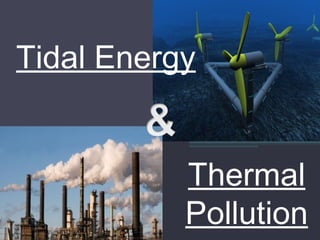
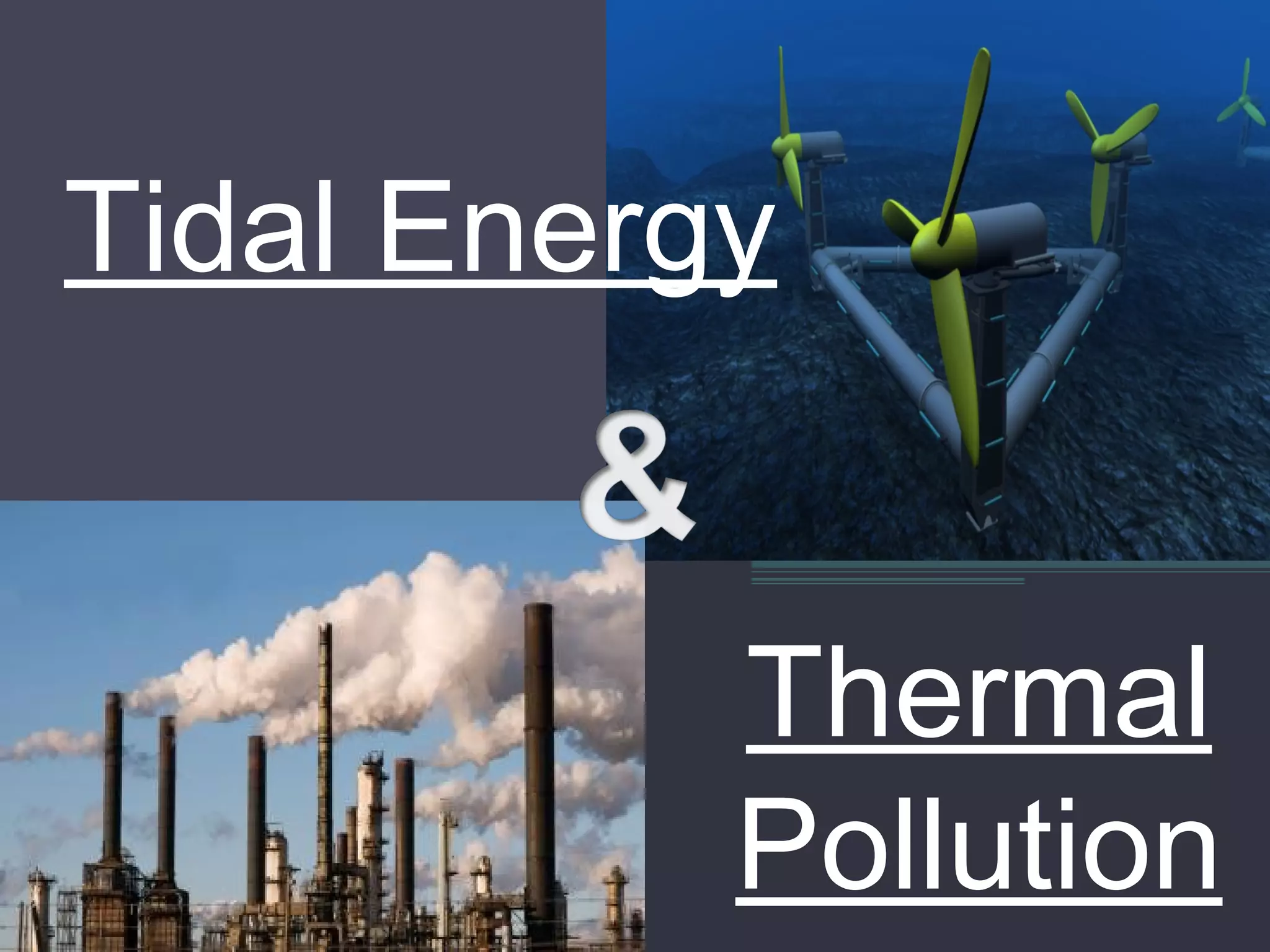



Tidal Energy
Thermal
Pollution
Group members….
• 1. Bikash Kumar Singh. BSM/12/16
• 2. Mandeep Singh. BSM/12/34
• 3. Deepak Kumar. BSM/12/05
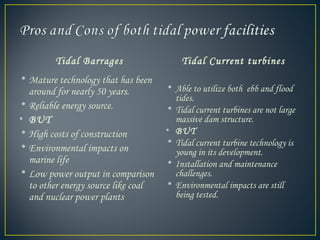
Tidal Barrages

Tidal Current turbines

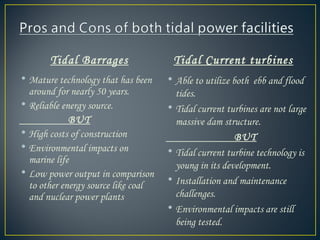
• Mature technology that has been
around for nearly 50 years.
• Reliable energy source.
• BUT
• High costs of construction
• Environmental impacts on
marine life
• Low power output in comparison
to other energy source like coal
and nuclear power plants

• Able to utilize both ebb and flood
tides.
• Tidal current turbines are not large
massive dam structure.
• BUT
• Tidal current turbine technology is
young in its development.
• Installation and maintenance
challenges.
• Environmental impacts are still
being tested.
Tidal energy, also called tidal power, is a form
of hydropower that converts the energy
of tides into useful forms of power - mainly
electricity. This is the only form of energy
whose source is the moon.
Basic physics of tides
• Gravitational pull of the sun and moon
and,
• The pull of the centrifugal force of rotation
of the earth-moon system.
• There are two high tides and two low
tides during each period of rotation of
the earth.
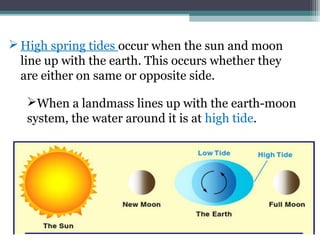
 High spring tides occur when the sun and moon
line up with the earth. This occurs whether they
are either on same or opposite side.
When a landmass lines up with the earth-moon
system, the water around it is at high tide.
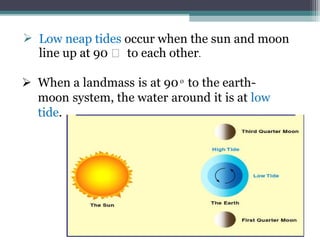
 Low neap tides occur when the sun and moon
line up at 90 ͦ to each other.
Two types of tidal plant facilities.

•Tidal barrages
•Tidal current turbines
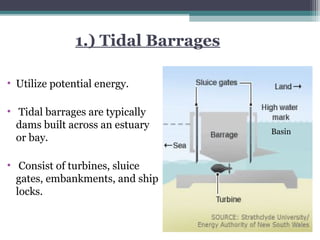
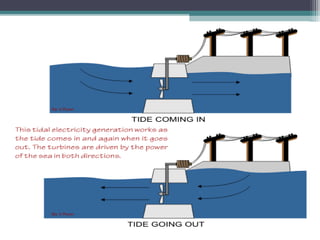
1.) Tidal Barrages
• Utilize potential energy.
• Tidal barrages are typically
dams built across an estuary
or bay.
• Consist of turbines, sluice
gates, embankments, and ship
locks.

Basin
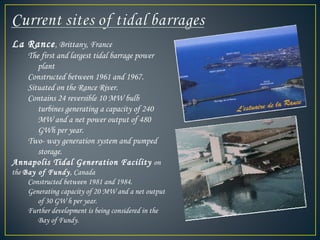
La Rance , Brittany, France
The first and largest tidal barrage power
plant
Constructed between 1961 and 1967.
Situated on the Rance River.
Contains 24 reversible 10 MW bulb
turbines generating a capacity of 240
MW and a net power output of 480
GWh per year.
Two- way generation system and pumped
storage.
Annapolis Tidal Generation Facility on
the Bay of Fundy, Canada
Constructed between 1981 and 1984.
Generating capacity of 20 MW and a net output
of 30 GW h per year.
Further development is being considered in the
Bay of Fundy.
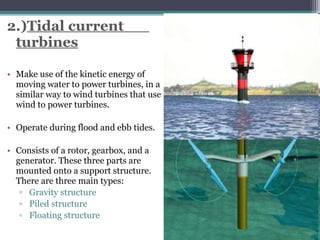
2.)Tidal current
turbines
• Make use of the kinetic energy of
moving water to power turbines, in a
similar way to wind turbines that use
wind to power turbines.
• Operate during flood and ebb tides.
• Consists of a rotor, gearbox, and a
generator. These three parts are
mounted onto a support structure.
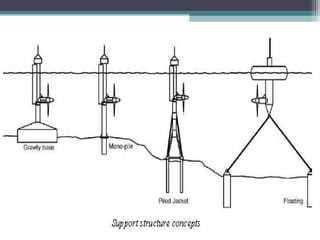
There are three main types:
▫ Gravity structure
▫ Piled structure
▫ Floating structure
Tidal Barrages

Tidal Current turbines

• Mature technology that has been
around for nearly 50 years.
• Reliable energy source.
BUT
• High costs of construction
• Environmental impacts on
marine life
• Low power output in comparison
to other energy source like coal
and nuclear power plants

• Able to utilize both ebb and flood
tides.
• Tidal current turbines are not large
massive dam structure.
BUT
• Tidal current turbine technology is
young in its development.
• Installation and maintenance
challenges.
• Environmental impacts are still
being tested.
Significant benefits
from using Tidal
Energy include:
include
• Electrification of isolated communities
• Generation for the grid
•Regrowth of coral reefs using
mineral accretion technology
• Substitution of imported petroleum
used to generate electricity
ENVIRONMENTAL FRIENDLINESS
• Tidal energy use involving dams creates many of
the same environmental concerns as damming
rivers. Tidal dams restrict fish migration and
cause silt build up which affects tidal basin
ecosystems in negative ways.
• Systems that take advantage of natural narrow
channels with high tidal flow rates have less
negative environmental impact than dammed
systems. But they are not without environmental
problems.
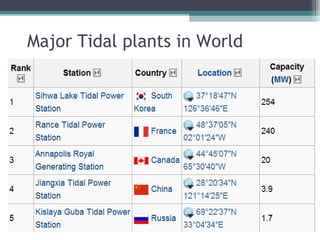
Major Tidal plants in World
Tidal plants in India
• West Bengal Renewable Energy Development
Agency in sunderbans.
• The Indian state of Gujarat is planning to host
South Asia's first commercial-scale tidal power
station. The company Atlantis Resources is to
install a 50MW tidal farm in the Gulf of Kutch
on India's west coast, with construction starting
early in 2012. later on it is decided to increase
the capacity up to 250MW plants.
Tidal plants in Kerala
•  Situated near the breakwaters of Vizhinjam Port 
which is about 20 km 
from Thiruvananthapuram city. The station 
started its commercial operation in 1991. This 
oscillating water column (OWC) produces about 
150 kw of power.
Economics
• Tidal energy is not cost competitive because it 
is generally not commercially available.
• When selecting a spot to set up a tidal energy 
station it is important to make sure that it will 
be economically feasible.
• To set up a tidal facility with an average 
annual output of 1050 MW would cost about 
1.2 billion dollars, not including maintenance 
and running costs.
• This is far more expensive than coal and oil.
FUTURE?
• In a society with increasing energy needs, it is 
becoming more and more important to have 
alternative sources of power to keep up with the 
ever growing energy demand.
• The capacity of tidal energy exceeds that of coal 
and oil and is renewable.
• The Department of Energy has shown great 
enthusiasm in regards to tidal power as the 
perfect energy source for the future.
THERMAL POLLUTION
DEFINITION
ADDITION OF EXCESS OF
UNDESIRABLE HEAT TO WATER
THAT MAKES IT HARMFUL TO
MAN, ANIMAL OR AQUATIC LIFE.
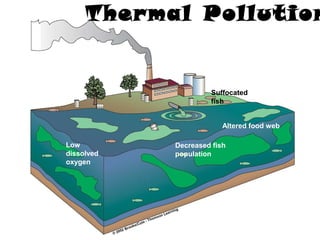
Thermal Pollution

Suffocated
fish
Altered food web
Low
dissolved
oxygen

Decreased fish
population
CAUSES..!!!
Discharge Of Heated Water Or Hot Waste Material Into
Water Bodies From Water –
 NUCLEAR

POWER PLANTS
 INDUSTRIAL EFFLUENTS
 DOMESTIC SEWAGE
 HYDRO-ELECTRIC POWER
 COAL FIRED POWER PLANTS
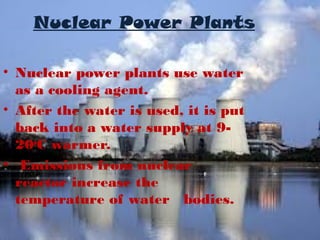
Nuclear Power Plants
• Nuclear power plants use water
as a cooling agent.
• After the water is used, it is put
back into a water supply at 920oC warmer.
• Emissions from nuclear
reactor increase the
temperature of water bodies.
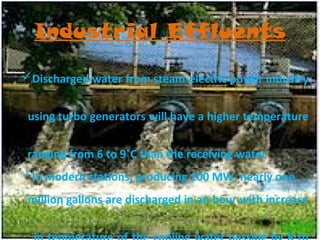
Industrial Effluents
Discharged water from steam-electric power industry
using turbo generators will have a higher temperature
ranging from 6 to 9˚C than the receiving water
In modern stations, producing 100 MW, nearly one
million gallons are discharged in an hour with increase
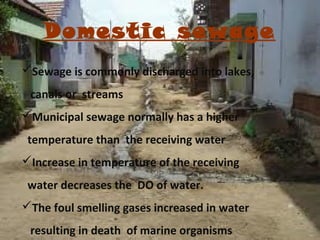
Domestic sewage
Sewage is commonly discharged into lakes,
canals or streams
Municipal sewage normally has a higher
temperature than the receiving water
Increase in temperature of the receiving
water decreases the DO of water.
The foul smelling gases increased in water
resulting in death of marine organisms
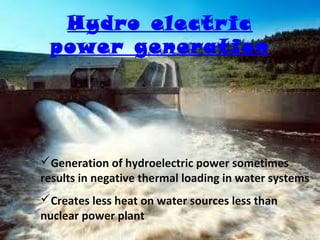
Hydro electr ic
power generation

Generation of hydroelectric power sometimes
results in negative thermal loading in water systems
Creates less heat on water sources less than
nuclear power plant
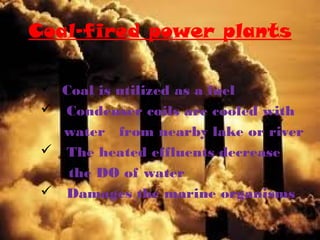
Coal-fired power plants
 Coal is utilized as a fuel
 Condenser coils are cooled with
water from nearby lake or river
 The heated effluents decrease
the DO of water
 Damages the marine organisms
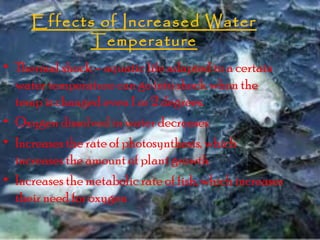
Effects of Increased Water
Temperature
• Thermal shock – aquatic life adapted to a certain
water temperature can go into shock when the
temp is changed even 1 or 2 degrees.
• Oxygen dissolved in water decreases
• Increases the rate of photosynthesis, which
increases the amount of plant growth
• Increases the metabolic rate of fish, which increases
their need for oxygen
Control of thermal
pollution
• Cooling ponds, man-made bodies of water
designed for cooling
by evaporation, convection, and radiation
• Cooling towers, which transfer waste heat to
the atmosphere through evaporation
and/or heat transfer
• Cogeneration, a process where waste heat is
recycled for domestic and/or industrial
heating purposes
Tidal energy nd thermal pollution

Tidal energy nd thermal pollution

  • 1.
  • 2.
    Group members…. • 1.Bikash Kumar Singh. BSM/12/16 • 2. Mandeep Singh. BSM/12/34 • 3. Deepak Kumar. BSM/12/05
  • 3.
    Tidal Barrages Tidal Currentturbines • Mature technology that has been around for nearly 50 years. • Reliable energy source. • BUT • High costs of construction • Environmental impacts on marine life • Low power output in comparison to other energy source like coal and nuclear power plants • Able to utilize both ebb and flood tides. • Tidal current turbines are not large massive dam structure. • BUT • Tidal current turbine technology is young in its development. • Installation and maintenance challenges. • Environmental impacts are still being tested.
  • 4.
    Tidal energy, alsocalled tidal power, is a form of hydropower that converts the energy of tides into useful forms of power - mainly electricity. This is the only form of energy whose source is the moon.
  • 5.
    Basic physics oftides • Gravitational pull of the sun and moon and, • The pull of the centrifugal force of rotation of the earth-moon system. • There are two high tides and two low tides during each period of rotation of the earth.
  • 6.
     High springtides occur when the sun and moon line up with the earth. This occurs whether they are either on same or opposite side. When a landmass lines up with the earth-moon system, the water around it is at high tide.
  • 7.
     Low neaptides occur when the sun and moon line up at 90 ͦ to each other.
  • 8.
    Two types oftidal plant facilities. •Tidal barrages •Tidal current turbines
  • 9.
    1.) Tidal Barrages •Utilize potential energy. • Tidal barrages are typically dams built across an estuary or bay. • Consist of turbines, sluice gates, embankments, and ship locks. Basin
  • 11.
    La Rance ,Brittany, France The first and largest tidal barrage power plant Constructed between 1961 and 1967. Situated on the Rance River. Contains 24 reversible 10 MW bulb turbines generating a capacity of 240 MW and a net power output of 480 GWh per year. Two- way generation system and pumped storage. Annapolis Tidal Generation Facility on the Bay of Fundy, Canada Constructed between 1981 and 1984. Generating capacity of 20 MW and a net output of 30 GW h per year. Further development is being considered in the Bay of Fundy.
  • 12.
    2.)Tidal current turbines • Makeuse of the kinetic energy of moving water to power turbines, in a similar way to wind turbines that use wind to power turbines. • Operate during flood and ebb tides. • Consists of a rotor, gearbox, and a generator. These three parts are mounted onto a support structure. There are three main types: ▫ Gravity structure ▫ Piled structure ▫ Floating structure
  • 14.
    Tidal Barrages Tidal Currentturbines • Mature technology that has been around for nearly 50 years. • Reliable energy source. BUT • High costs of construction • Environmental impacts on marine life • Low power output in comparison to other energy source like coal and nuclear power plants • Able to utilize both ebb and flood tides. • Tidal current turbines are not large massive dam structure. BUT • Tidal current turbine technology is young in its development. • Installation and maintenance challenges. • Environmental impacts are still being tested.
  • 15.
    Significant benefits from usingTidal Energy include: include • Electrification of isolated communities • Generation for the grid •Regrowth of coral reefs using mineral accretion technology • Substitution of imported petroleum used to generate electricity
  • 16.
    ENVIRONMENTAL FRIENDLINESS • Tidalenergy use involving dams creates many of the same environmental concerns as damming rivers. Tidal dams restrict fish migration and cause silt build up which affects tidal basin ecosystems in negative ways. • Systems that take advantage of natural narrow channels with high tidal flow rates have less negative environmental impact than dammed systems. But they are not without environmental problems.
  • 17.
  • 18.
    Tidal plants inIndia • West Bengal Renewable Energy Development Agency in sunderbans. • The Indian state of Gujarat is planning to host South Asia's first commercial-scale tidal power station. The company Atlantis Resources is to install a 50MW tidal farm in the Gulf of Kutch on India's west coast, with construction starting early in 2012. later on it is decided to increase the capacity up to 250MW plants.
  • 19.
    Tidal plants inKerala •  Situated near the breakwaters of Vizhinjam Port  which is about 20 km  from Thiruvananthapuram city. The station  started its commercial operation in 1991. This  oscillating water column (OWC) produces about  150 kw of power.
  • 20.
    Economics • Tidal energy is not cost competitive because it  is generally not commercially available. • When selecting a spot to set up a tidal energy  station it is important to make sure that it will  be economically feasible. •To set up a tidal facility with an average  annual output of 1050 MW would cost about  1.2 billion dollars, not including maintenance  and running costs. • This is far more expensive than coal and oil.
  • 21.
  • 22.
  • 23.
    DEFINITION ADDITION OF EXCESSOF UNDESIRABLE HEAT TO WATER THAT MAKES IT HARMFUL TO MAN, ANIMAL OR AQUATIC LIFE.
  • 24.
    Thermal Pollution Suffocated fish Altered foodweb Low dissolved oxygen Decreased fish population
  • 25.
    CAUSES..!!! Discharge Of HeatedWater Or Hot Waste Material Into Water Bodies From Water –  NUCLEAR POWER PLANTS  INDUSTRIAL EFFLUENTS  DOMESTIC SEWAGE  HYDRO-ELECTRIC POWER  COAL FIRED POWER PLANTS
  • 26.
    Nuclear Power Plants •Nuclear power plants use water as a cooling agent. • After the water is used, it is put back into a water supply at 920oC warmer. • Emissions from nuclear reactor increase the temperature of water bodies.
  • 27.
    Industrial Effluents Discharged waterfrom steam-electric power industry using turbo generators will have a higher temperature ranging from 6 to 9˚C than the receiving water In modern stations, producing 100 MW, nearly one million gallons are discharged in an hour with increase
  • 28.
    Domestic sewage Sewage iscommonly discharged into lakes, canals or streams Municipal sewage normally has a higher temperature than the receiving water Increase in temperature of the receiving water decreases the DO of water. The foul smelling gases increased in water resulting in death of marine organisms
  • 29.
    Hydro electr ic powergeneration Generation of hydroelectric power sometimes results in negative thermal loading in water systems Creates less heat on water sources less than nuclear power plant
  • 30.
    Coal-fired power plants Coal is utilized as a fuel  Condenser coils are cooled with water from nearby lake or river  The heated effluents decrease the DO of water  Damages the marine organisms
  • 31.
    Effects of IncreasedWater Temperature • Thermal shock – aquatic life adapted to a certain water temperature can go into shock when the temp is changed even 1 or 2 degrees. • Oxygen dissolved in water decreases • Increases the rate of photosynthesis, which increases the amount of plant growth • Increases the metabolic rate of fish, which increases their need for oxygen
  • 32.
    Control of thermal pollution •Cooling ponds, man-made bodies of water designed for cooling by evaporation, convection, and radiation • Cooling towers, which transfer waste heat to the atmosphere through evaporation and/or heat transfer • Cogeneration, a process where waste heat is recycled for domestic and/or industrial heating purposes