Tidal energy harnesses the power of ocean tides and converts it into electricity. There are two main types of tidal power plants - tidal barrages and tidal stream generators. Tidal barrages use dams and turbines across tidal estuaries and bays to capture potential energy from high and low tides. Tidal stream generators are underwater turbines similar to wind turbines that capture kinetic energy directly from moving tidal currents. While tidal power is a renewable source with predictable generation, the construction of tidal plants can be costly and impact aquatic environments. However, some countries like France and South Korea have operational tidal power stations, and India is exploring developing tidal power in the Gulf of Kutch.
Introduction to tidal energy and its significance, including a presentation outline.
Definition of tidal energy and tides; explanation of tidal forces due to the Moon and Sun.
Detailed explanation on how tidal power is generated using underwater turbines and barrages. Different types of tidal plants including barrages and stream generators, and categories of generation methods.
Basic formula for potential energy in tidal power and calculation of power generated by turbines.
Advantages of tidal barrage and stream generators, alongside the challenges and disadvantages they face.
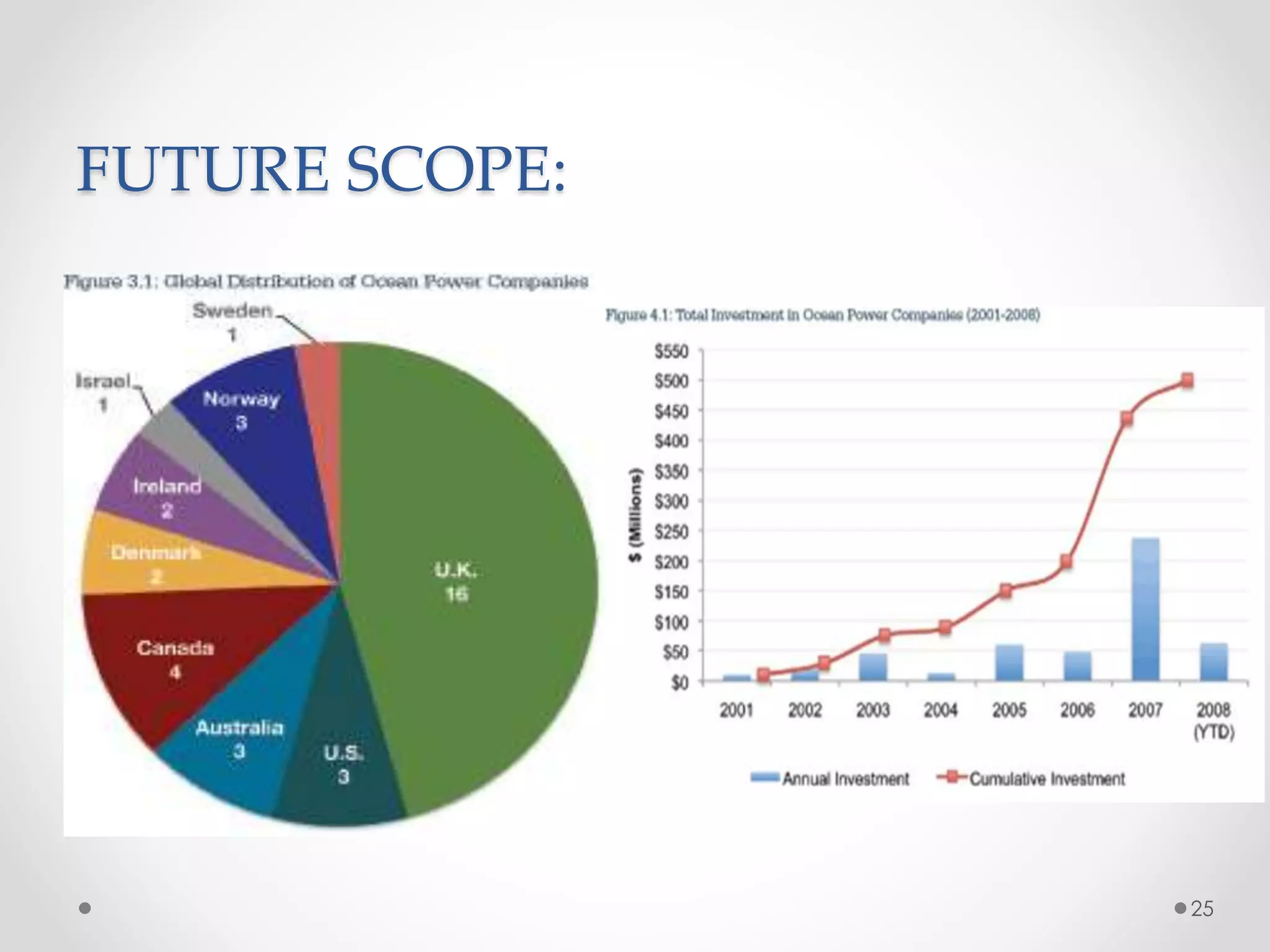
Discussion on the future scope and potential of tidal energy, particularly in India.
USAGE OF TIDALENERGY
A.MANOJ CHOWDARY
AM.EN.U4EEE12001
1
2.
Index
• Introduction
• Tides
•Tidal power
• How it works
• Types of tidal plants
• Generation using various methods.
• Advantages and Disadvantages of Tidal Power
• Currents sites of tidal power plants
• Future scope
• conclusion
2
3.
Introduction
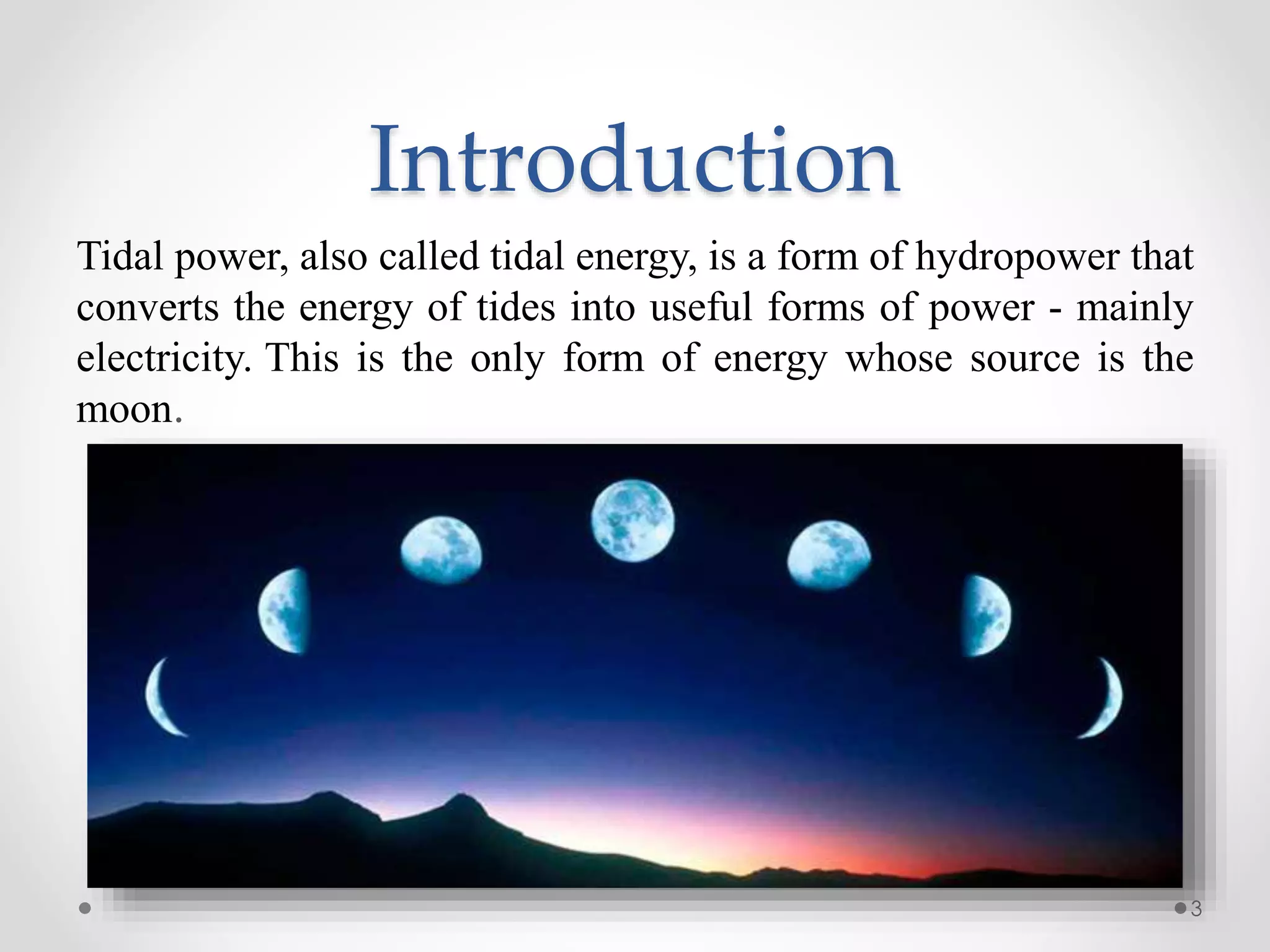
Tidal power, alsocalled tidal energy, is a form of hydropower that
converts the energy of tides into useful forms of power - mainly
electricity. This is the only form of energy whose source is the
moon.
3
4.
WHAT IS ATIDE ?
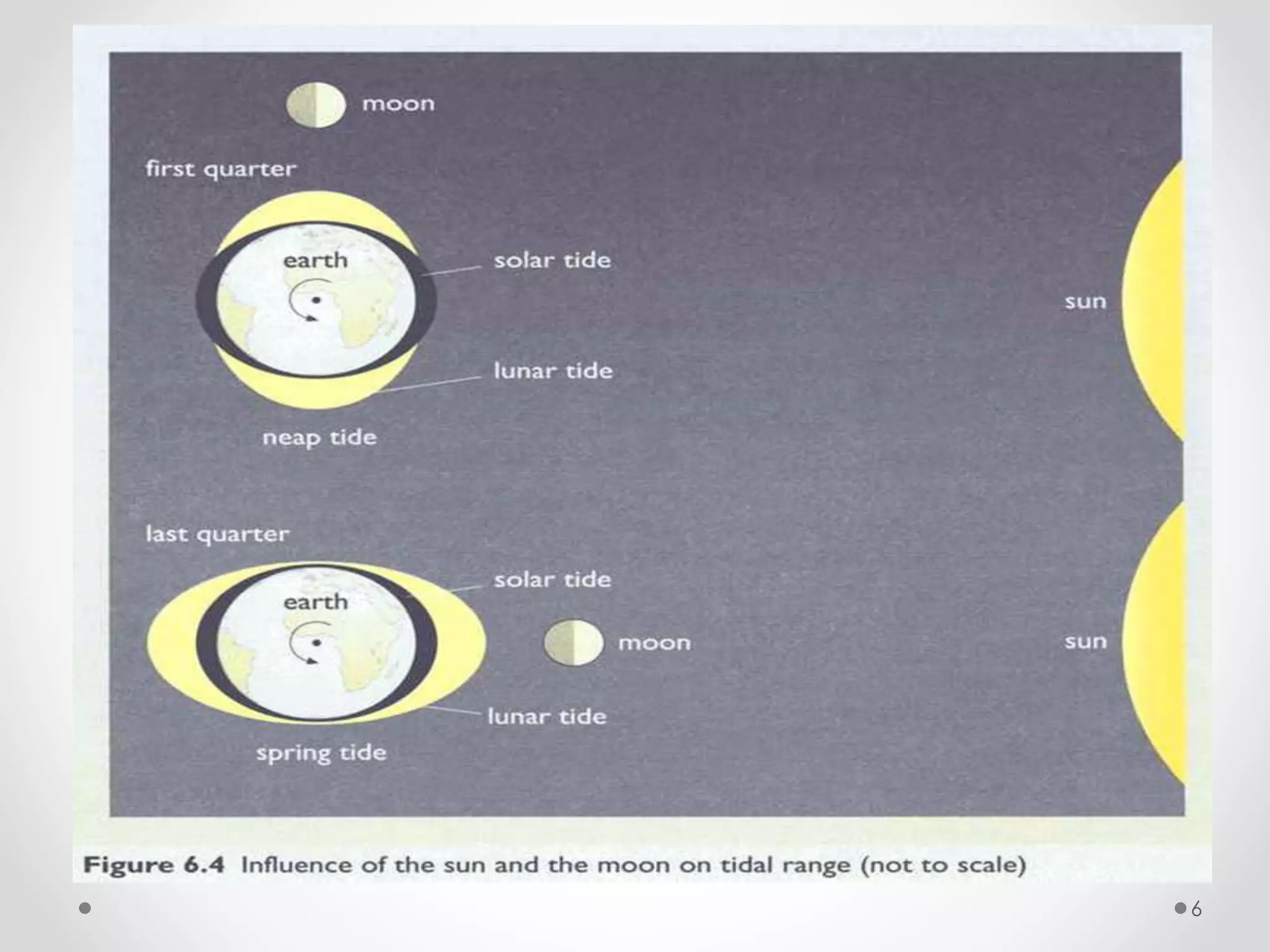
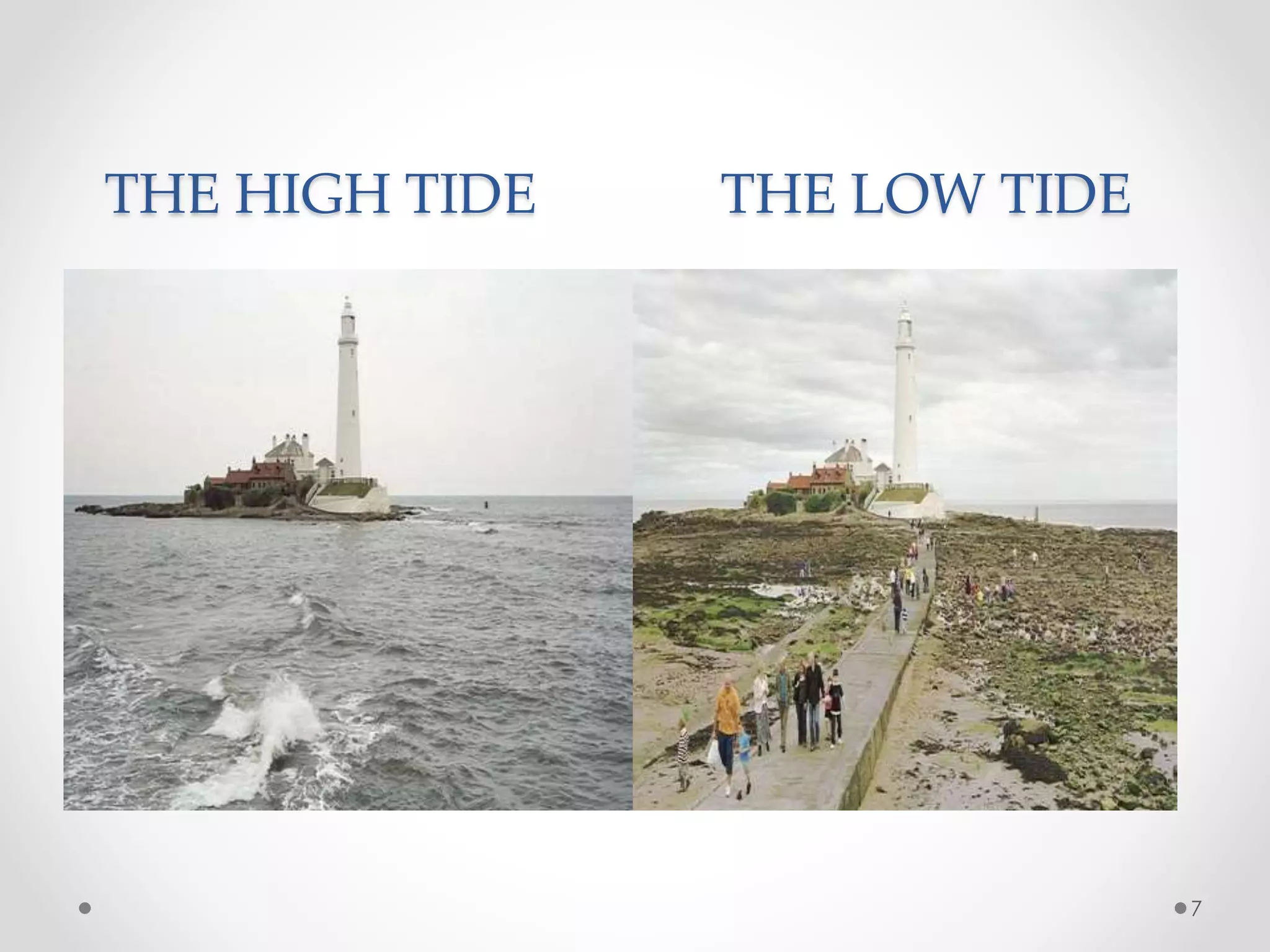
• Tides are the rising and falling of Earth's ocean surface
caused by the tidal forces of the Moon and the Sun
acting on the oceans
4
5.
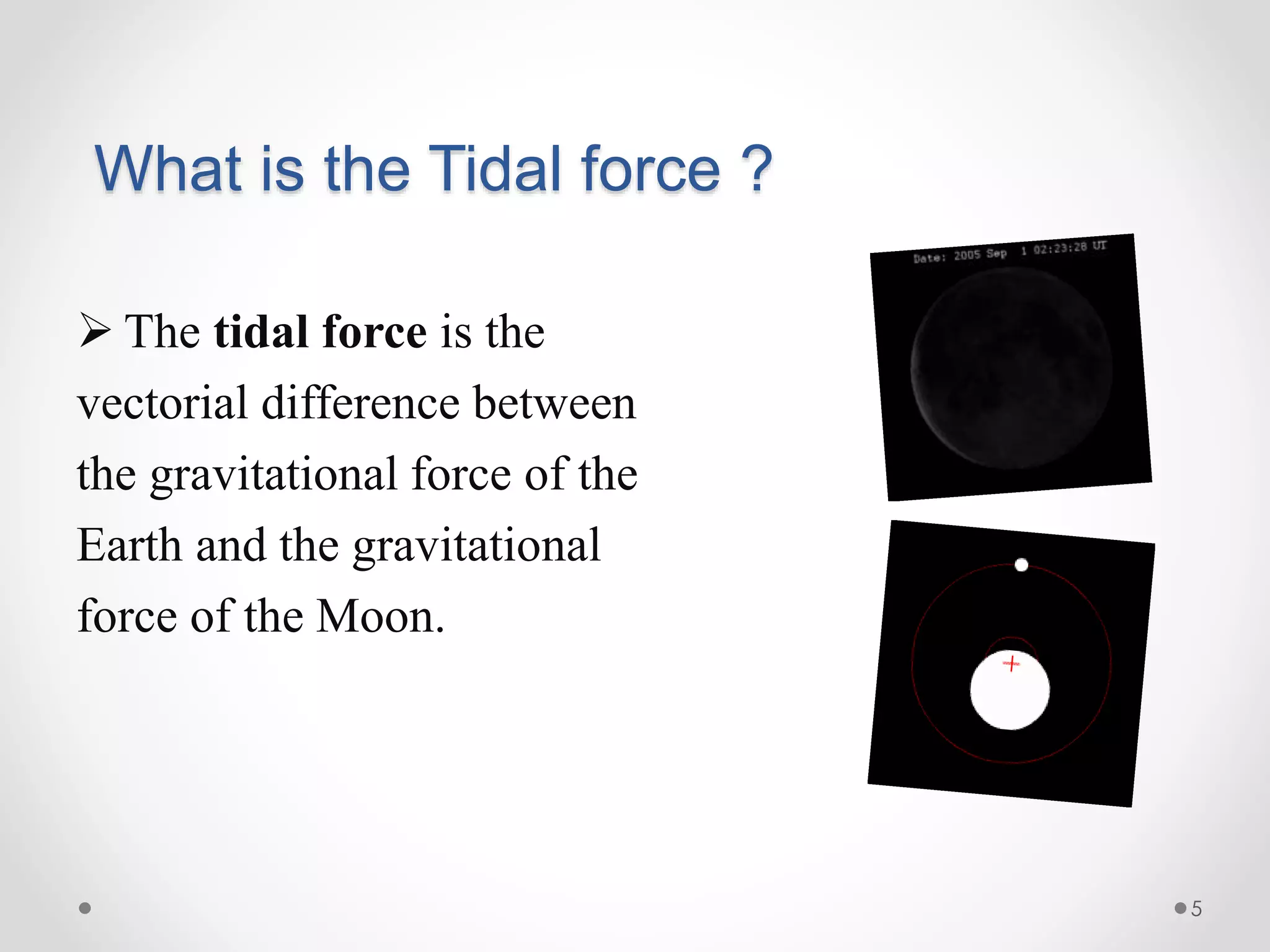
What is theTidal force ?
The tidal force is the
vectorial difference between
the gravitational force of the
Earth and the gravitational
force of the Moon.
5
Tidal Power
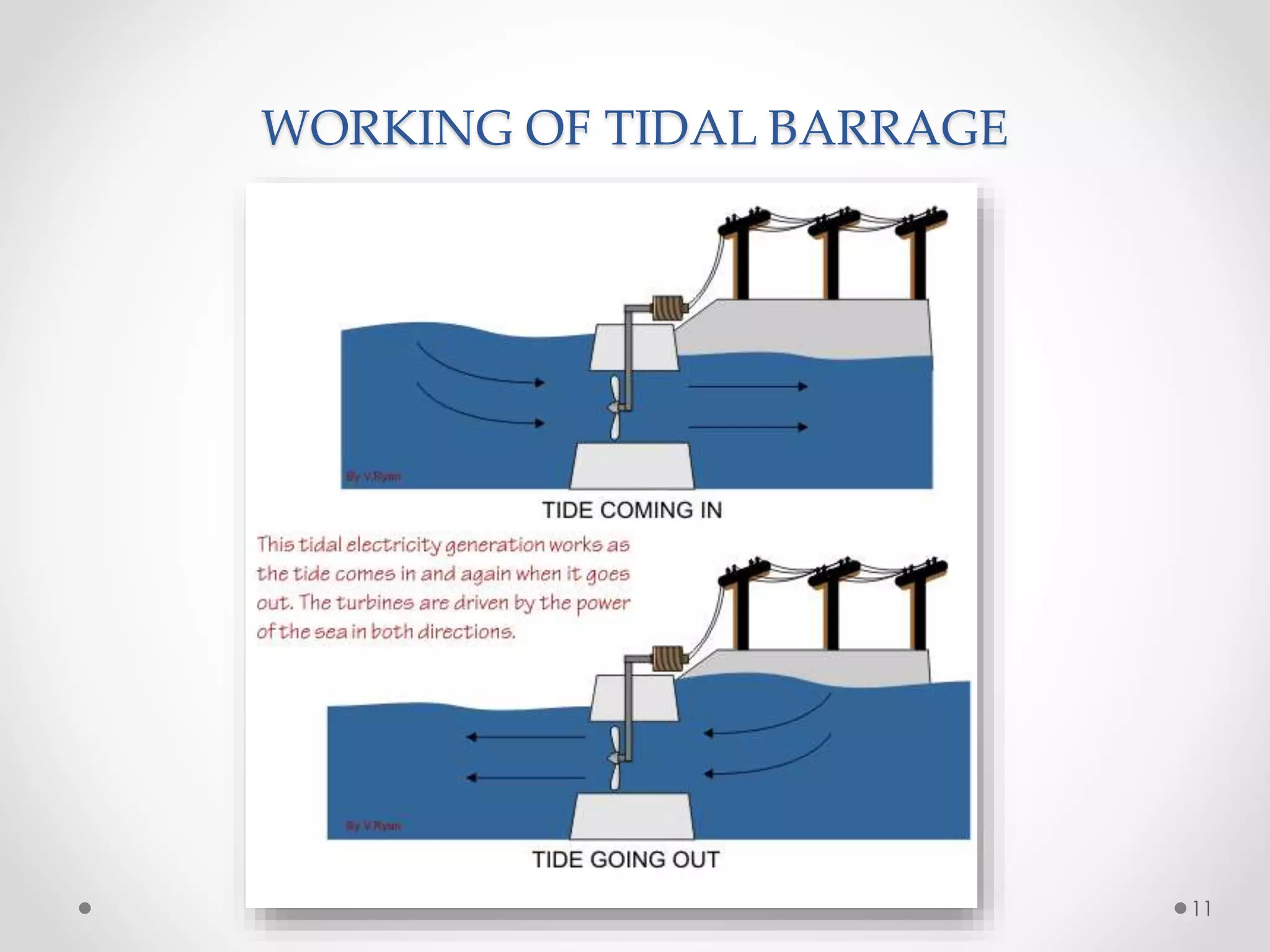
Tidalpower is generated by a turbine under water that
spins making the mechanical energy to electrical
through a generator that send the electrical energy to
the shore.
Tidal power has potential for future electricity
generation and is more predictable than wind energy
and solar power
8
9.
Types of tidalplants
Tidal Barrage Tidal stream generator
Are Typically dams,
built across on estuary
of bay
Make use of the kinetic
energy of moving water to
power turbines in a
similar way to wind
turbines that use wind to
power turbines
9
10.
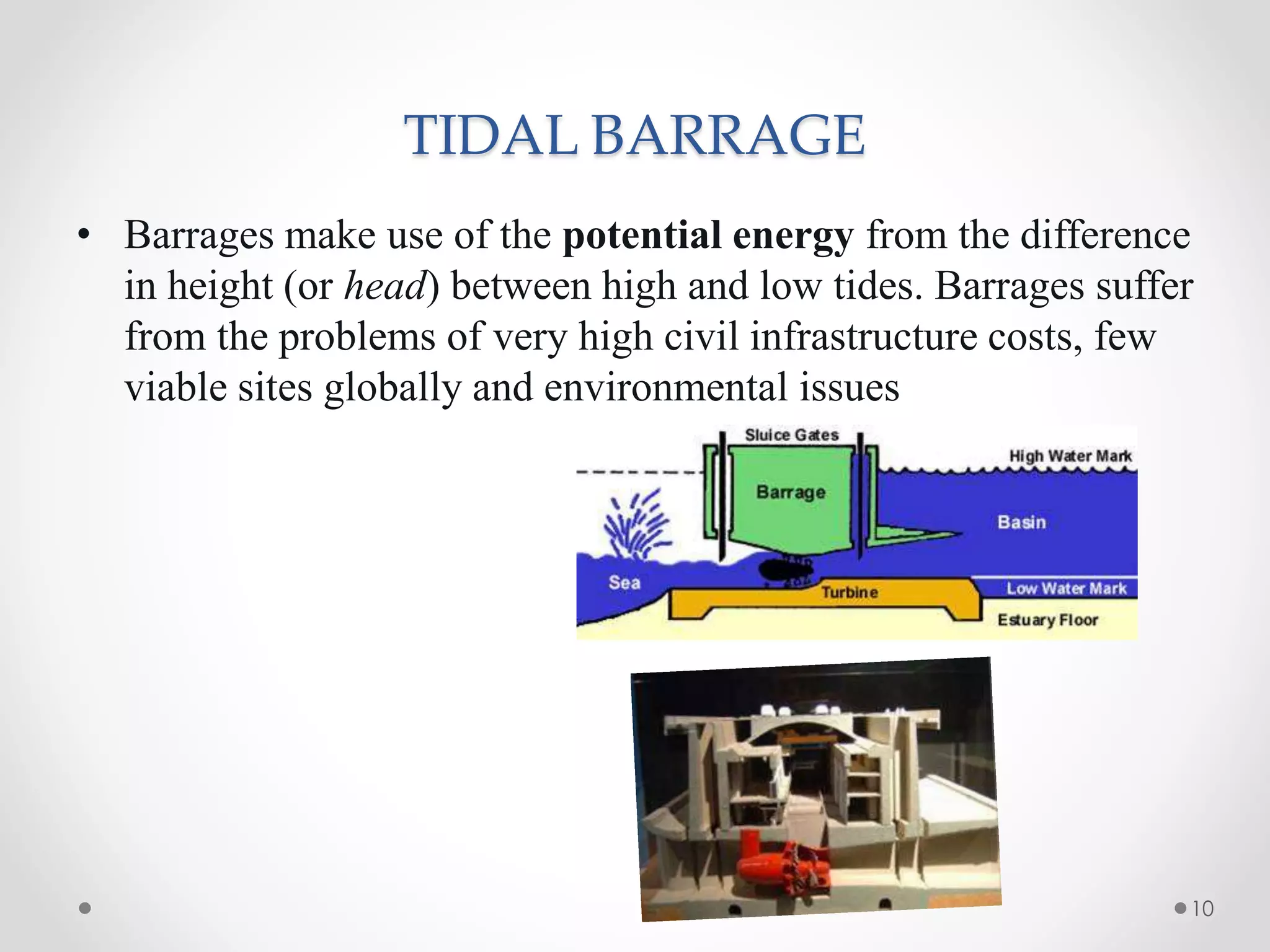
TIDAL BARRAGE
• Barragesmake use of the potential energy from the difference
in height (or head) between high and low tides. Barrages suffer
from the problems of very high civil infrastructure costs, few
viable sites globally and environmental issues.
10
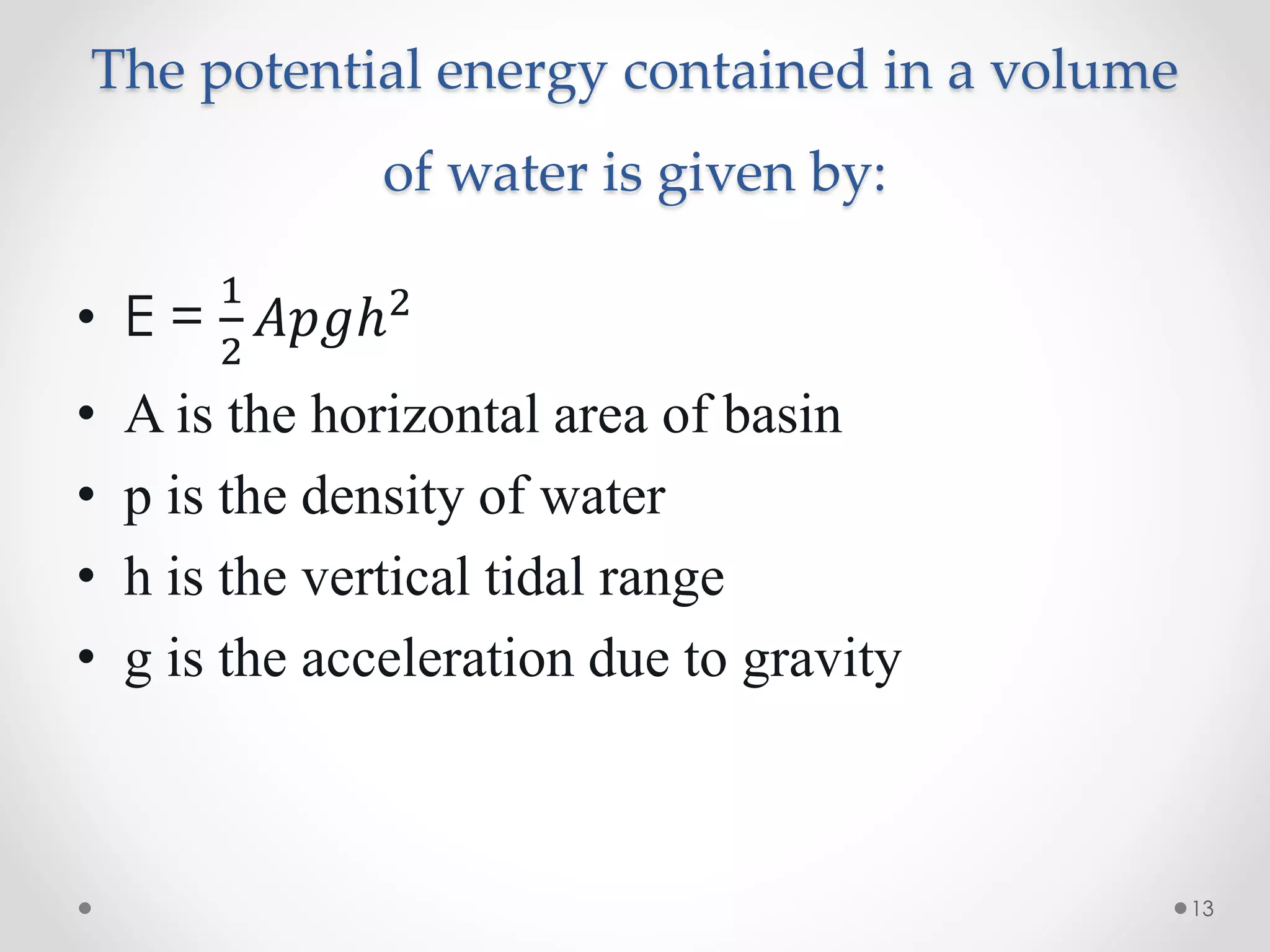
The potential energycontained in a volume
of water is given by:
13
• E =
1
2
𝐴𝑝𝑔ℎ2
• A is the horizontal area of basin
• p is the density of water
• h is the vertical tidal range
• g is the acceleration due to gravity
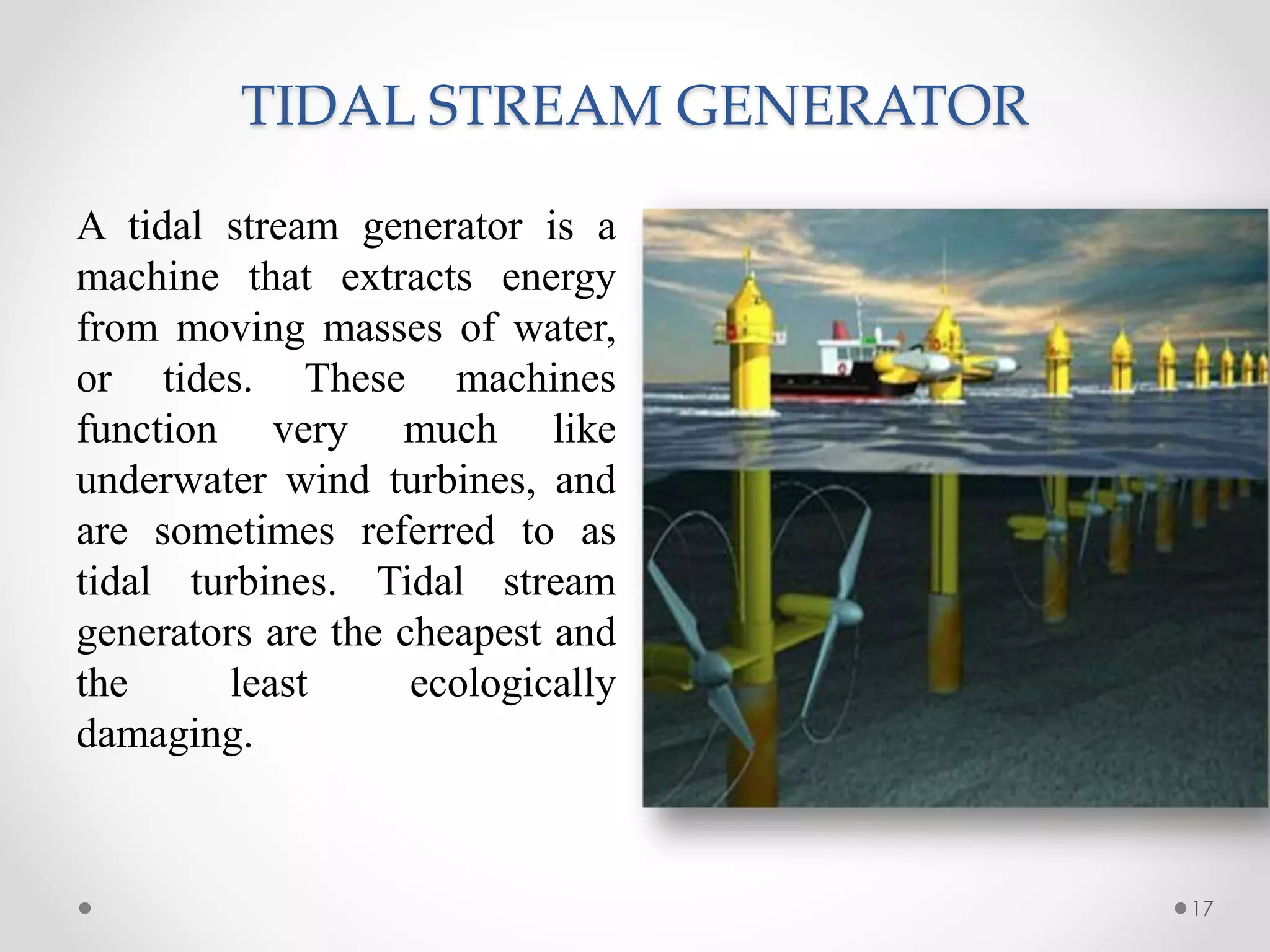
TIDAL STREAM GENERATOR
17
Atidal stream generator is a
machine that extracts energy
from moving masses of water,
or tides. These machines
function very much like
underwater wind turbines, and
are sometimes referred to as
tidal turbines. Tidal stream
generators are the cheapest and
the least ecologically
damaging.
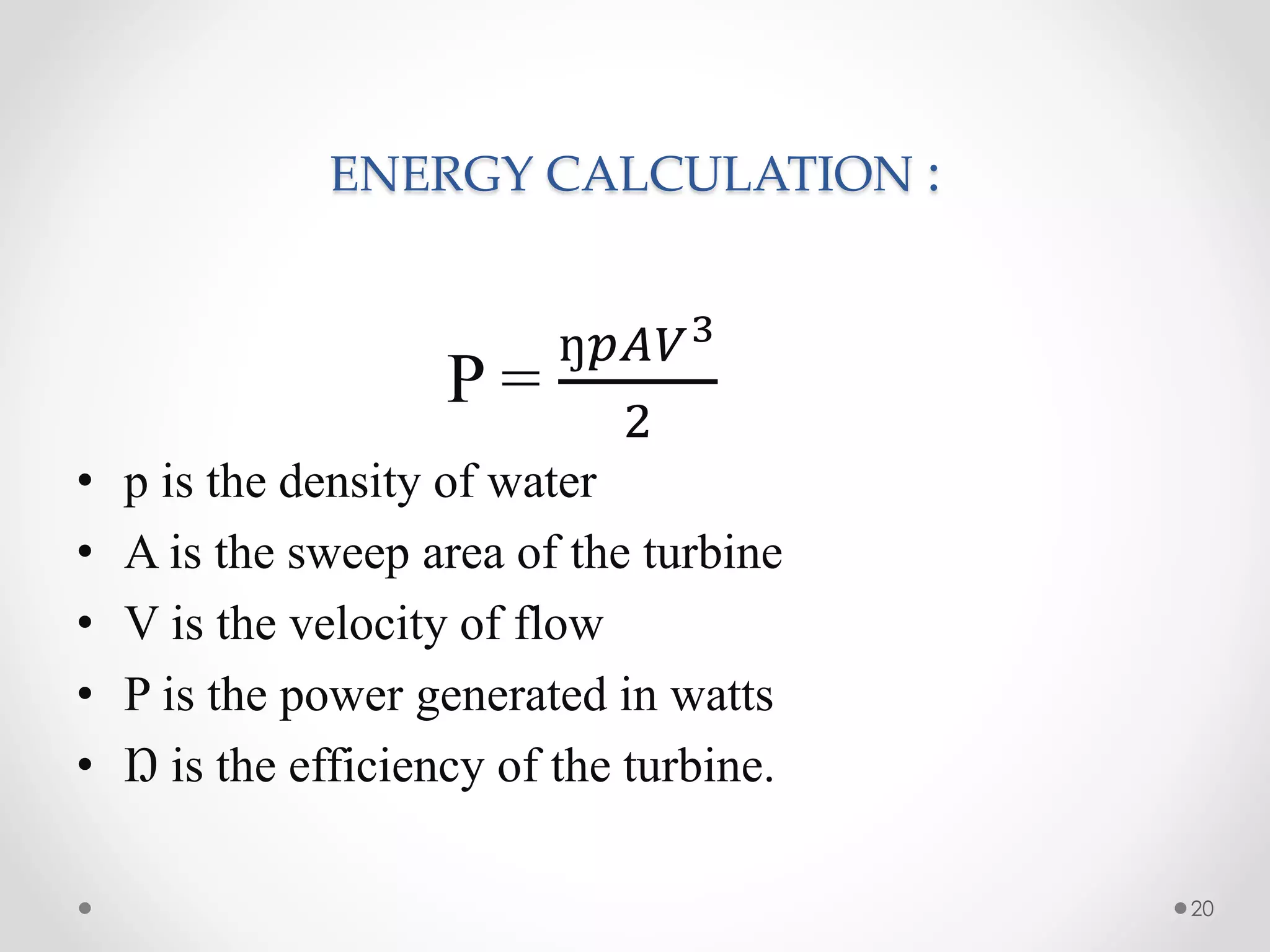
ENERGY CALCULATION :
P=
ŋ𝑝𝐴𝑉3
2
• p is the density of water
• A is the sweep area of the turbine
• V is the velocity of flow
• P is the power generated in watts
• Ŋ is the efficiency of the turbine.
20
21.
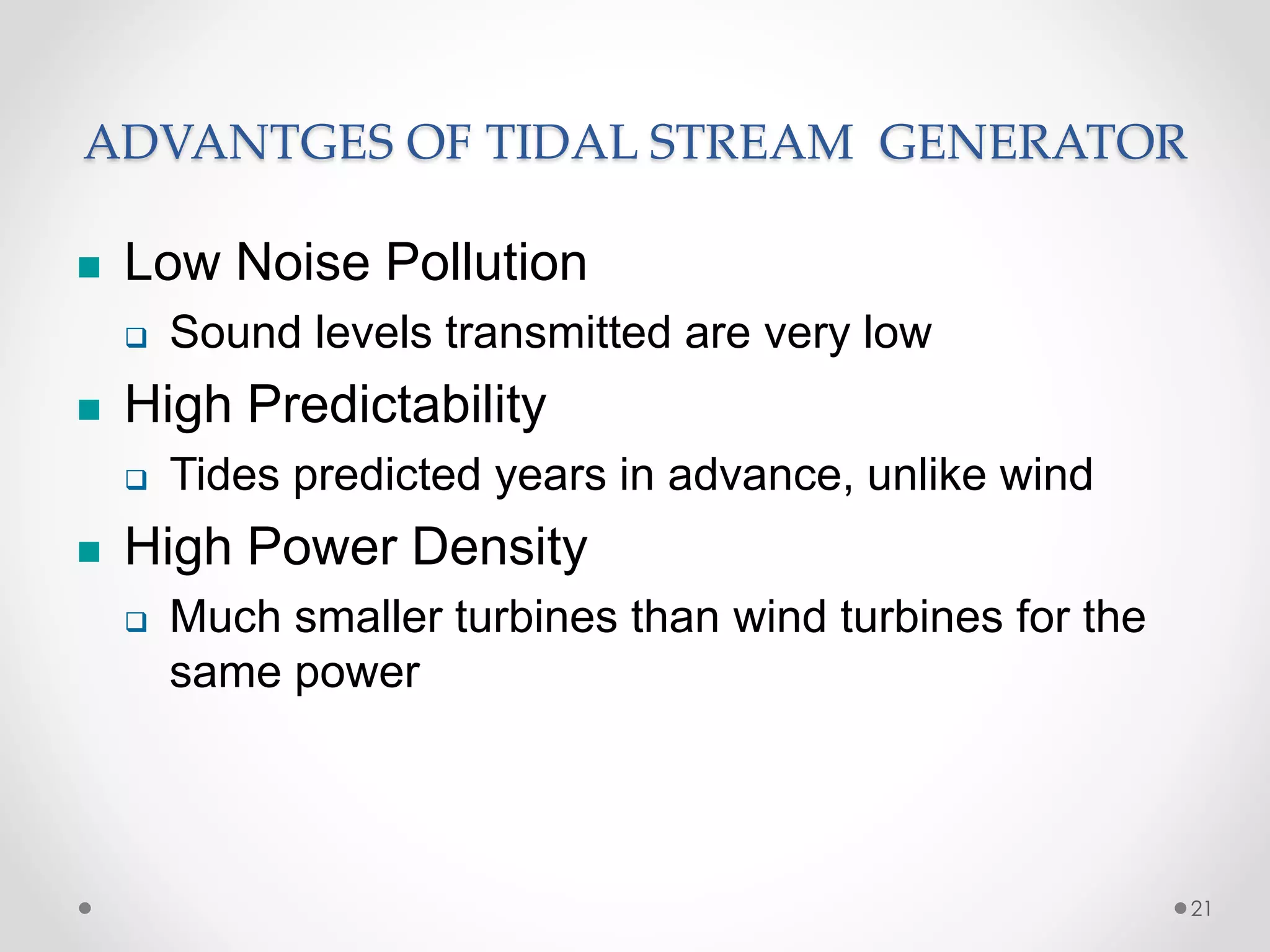
ADVANTGES OF TIDALSTREAM GENERATOR
Low Noise Pollution
Sound levels transmitted are very low
High Predictability
Tides predicted years in advance, unlike wind
High Power Density
Much smaller turbines than wind turbines for the
same power
21
22.
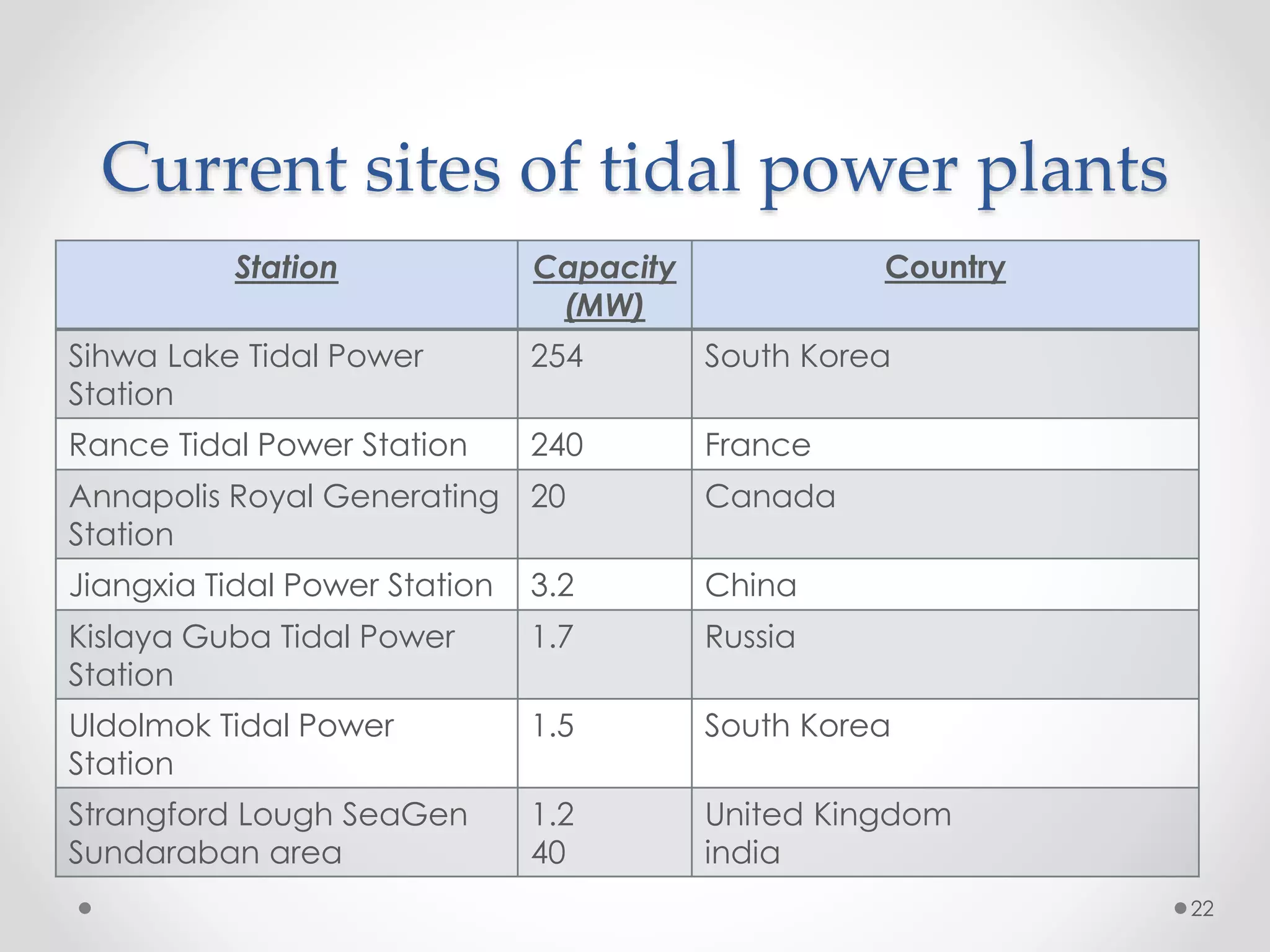
Current sites oftidal power plants
Station Capacity
(MW)
Country
Sihwa Lake Tidal Power
Station
254 South Korea
Rance Tidal Power Station 240 France
Annapolis Royal Generating
Station
20 Canada
Jiangxia Tidal Power Station 3.2 China
Kislaya Guba Tidal Power
Station
1.7 Russia
Uldolmok Tidal Power
Station
1.5 South Korea
Strangford Lough SeaGen
Sundaraban area
1.2
40
United Kingdom
india
22
23.
ADVANTAGES
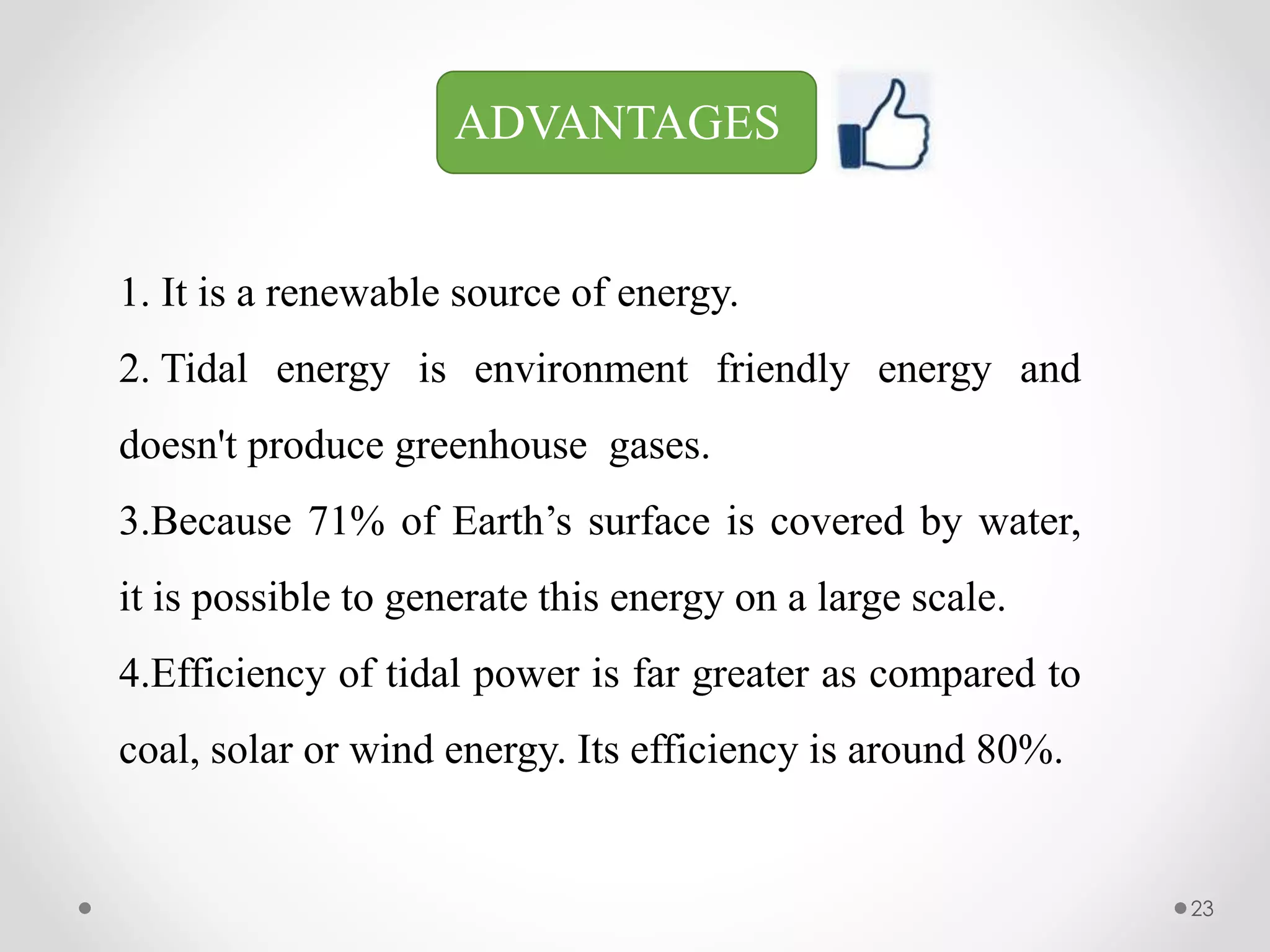
1. It isa renewable source of energy.
2. Tidal energy is environment friendly energy and
doesn't produce greenhouse gases.
3.Because 71% of Earth’s surface is covered by water,
it is possible to generate this energy on a large scale.
4.Efficiency of tidal power is far greater as compared to
coal, solar or wind energy. Its efficiency is around 80%.
23
24.
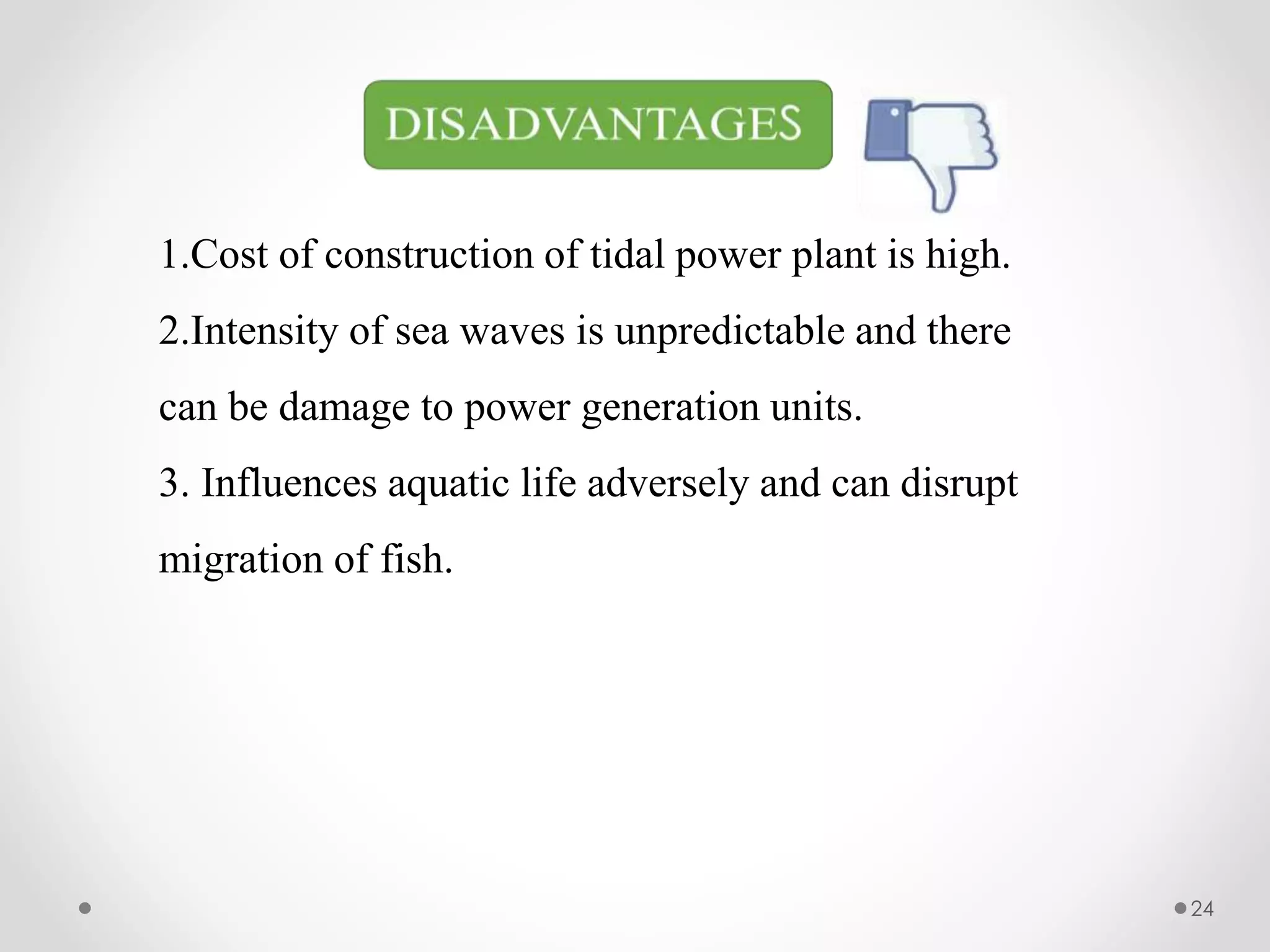
1.Cost of constructionof tidal power plant is high.
2.Intensity of sea waves is unpredictable and there
can be damage to power generation units.
3. Influences aquatic life adversely and can disrupt
migration of fish.
24
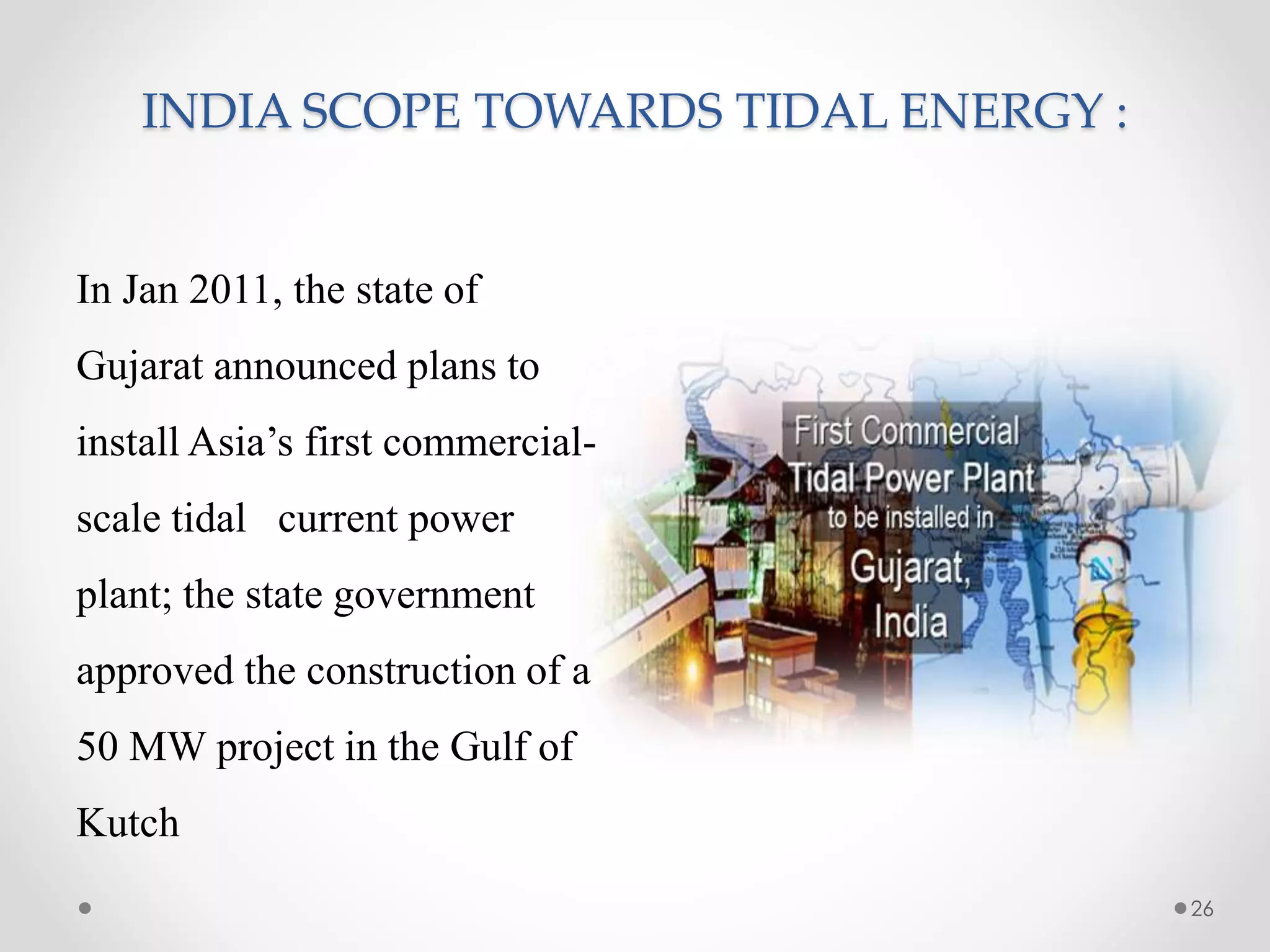
INDIA SCOPE TOWARDSTIDAL ENERGY :
26
In Jan 2011, the state of
Gujarat announced plans to
install Asia’s first commercial-
scale tidal current power
plant; the state government
approved the construction of a
50 MW project in the Gulf of
Kutch
27.
27
Tides play avery important role in the formation of
global climate as well as the ecosystems for ocean
habitants.
At the same time, tides are a substantial potential
source of clean renewable energy for future human
generations.
Depleting oil reserves, the emission of greenhouse
gases by burning coal, oil and other fossil fuels,
nuclear waste will inevitably force people to replace
most of our traditional energy sources with
renewable energy in the future. Tidal energy is one
of the best candidates for this