



LEARNING
What is learning?
  The acquisition of knowledge or
skills through experiences,
practice, or study, or by being
taught.
  A process which bring about a
change in the individual’s way of
responding as result of practice or
other experiences.
  A relatively change in behavior.
Theories of Learning
Ivan Pavlov (1849-1936)
Classical Conditioning
BF Skinner(1948 )
Operant Conditioning
Thorndike Laws of Learning
Law of Effect
Law of Exercise
Law of Readiness
Albert Bandura
Social Learning
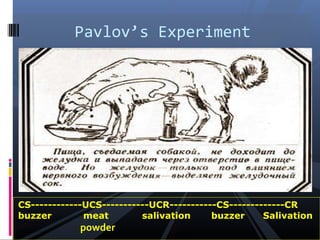
Pavlovian conditioning
 or respondent conditioning
Reflexive or automatic type of
learning in which a stimulus
acquires the capacity to evoke
a response that was originally
evoked by another stimulus.
Pavlov’s Experiment


CS------------UCS-----------UCR-----------CS-------------CR
buzzer        meat        salivation     buzzer     Salivation
             powder
Burrhus Frederick Skinner(1904-
1990)
BF Skinners Operant conditioning
 States that consequences or rewards
can influence how often a behavior
will occur. A behavior followed by a
punishment is less likely occur again.
However, a behavior followed by a
reward is more likely to occur.
“Skinner Box” which was
similar to Thorndike’s puzzle
box.
Three types of responses or operant
 that can follow behavior.
• Neutral operants: responses from the
environment that neither increase nor
decrease the probability of a behavior being
repeated.
• Reinforcers: Responses from the
environment that increase the probability of
a behavior being repeated. Reinforcers can
be either positive or negative.
• Punishers: Response from the environment
that decrease the likelihood of a behavior
being repeated. Punishment weakens
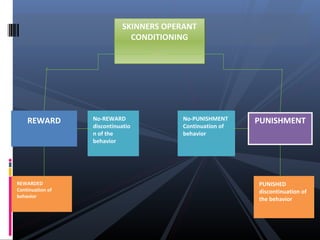
SKINNERS OPERANT
                              CONDITIONING


    REWARD        No-REWARD             No-PUNISHMENT     PUNISHMENT
                  discontinuatio        Continuation of
                  n of the              behavior
                  behavior


REWARDED                                                  PUNISHED
Continuation of                                           discontinuation of
behavior
                                                          the behavior
Thorndike Laws of
Learning Effect
 The Law of
  The law of effect is a principle of the
psychology of learning described by
Edward Thorndike (1911): It holds that
responses that produce a satisfying or
pleasant state of affairs in a particular
situation are more likely to occur again in
a similar situation.
 The Law of Exercise
Practice strengthens the
connection, disuse weakens it.
We learn by doing We forget by
not doing.

 The Law of Readiness
if physically ready, the
connection is satisfying for the
organism. When someone is ready
Albert Bandura -Social
Learning
  Social learning theory
focuses on the learning that
occurs within a social
context. It considers that
people learn from one
another, including such
concepts as observational
learning, imitation, and
modeling.
General Principles of social
  learning theory follows:
1. People can learn by observing the
behavior is of others and the outcomes of
those behaviors.
2. Learning can occur without a change in
behavior. Behaviorists say that learning has
to be represented by a permanent change in
behavior; in contrast social learning theorists
say that because people can learn
through observation alone, their learning
may not necessarily be shown in their
performance. Learning may or may not result
3. Cognition plays a role in learning.
Over the last 30 years social learning
theory has become increasingly
cognitive in its interpretation of human
learning. Awareness and expectations of
future reinforcements or punishments
can have a major effect on the behaviors
that people exhibit.

4. Social learning theory can be
considered a bridge or
a transition between behaviorist learning
theories and cognitive learning theories.
Educational implications of
social learning theory:
1. Students often learn a great deal
   simply by observing other people.
2. Teachers and parents
   must model appropriate
   behaviors and take care that they
   do not model inappropriate
   behaviors.
3. Discussing with learners about
   the rewards and consequences of
Thank You and
   God bless!!!!!!

Learning

  • 1.
  • 2.
    What is learning? The acquisition of knowledge or skills through experiences, practice, or study, or by being taught. A process which bring about a change in the individual’s way of responding as result of practice or other experiences. A relatively change in behavior.
  • 3.
    Theories of Learning IvanPavlov (1849-1936) Classical Conditioning BF Skinner(1948 ) Operant Conditioning Thorndike Laws of Learning Law of Effect Law of Exercise Law of Readiness Albert Bandura Social Learning
  • 4.
    Pavlovian conditioning or respondentconditioning Reflexive or automatic type of learning in which a stimulus acquires the capacity to evoke a response that was originally evoked by another stimulus.
  • 5.
  • 6.
    Burrhus Frederick Skinner(1904- 1990) BFSkinners Operant conditioning States that consequences or rewards can influence how often a behavior will occur. A behavior followed by a punishment is less likely occur again. However, a behavior followed by a reward is more likely to occur.
  • 7.
    “Skinner Box” whichwas similar to Thorndike’s puzzle box.
  • 8.
    Three types ofresponses or operant that can follow behavior. • Neutral operants: responses from the environment that neither increase nor decrease the probability of a behavior being repeated. • Reinforcers: Responses from the environment that increase the probability of a behavior being repeated. Reinforcers can be either positive or negative. • Punishers: Response from the environment that decrease the likelihood of a behavior being repeated. Punishment weakens
  • 9.
    SKINNERS OPERANT CONDITIONING REWARD No-REWARD No-PUNISHMENT PUNISHMENT discontinuatio Continuation of n of the behavior behavior REWARDED PUNISHED Continuation of discontinuation of behavior the behavior
  • 10.
    Thorndike Laws of LearningEffect  The Law of The law of effect is a principle of the psychology of learning described by Edward Thorndike (1911): It holds that responses that produce a satisfying or pleasant state of affairs in a particular situation are more likely to occur again in a similar situation.
  • 11.
     The Lawof Exercise Practice strengthens the connection, disuse weakens it. We learn by doing We forget by not doing.  The Law of Readiness if physically ready, the connection is satisfying for the organism. When someone is ready
  • 12.
    Albert Bandura -Social Learning Social learning theory focuses on the learning that occurs within a social context. It considers that people learn from one another, including such concepts as observational learning, imitation, and modeling.
  • 13.
    General Principles ofsocial learning theory follows: 1. People can learn by observing the behavior is of others and the outcomes of those behaviors. 2. Learning can occur without a change in behavior. Behaviorists say that learning has to be represented by a permanent change in behavior; in contrast social learning theorists say that because people can learn through observation alone, their learning may not necessarily be shown in their performance. Learning may or may not result
  • 14.
    3. Cognition playsa role in learning. Over the last 30 years social learning theory has become increasingly cognitive in its interpretation of human learning. Awareness and expectations of future reinforcements or punishments can have a major effect on the behaviors that people exhibit. 4. Social learning theory can be considered a bridge or a transition between behaviorist learning theories and cognitive learning theories.
  • 15.
    Educational implications of sociallearning theory: 1. Students often learn a great deal simply by observing other people. 2. Teachers and parents must model appropriate behaviors and take care that they do not model inappropriate behaviors. 3. Discussing with learners about the rewards and consequences of
  • 16.
    Thank You and God bless!!!!!!