


INTRODUCTION
•WHAT IS EDUCATION?
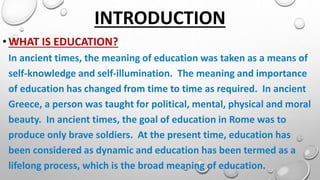
In ancient times, the meaning of education was taken as a means of
self-knowledge and self-illumination. The meaning and importance
of education has changed from time to time as required. In ancient
Greece, a person was taught for political, mental, physical and moral
beauty. In ancient times, the goal of education in Rome was to
produce only brave soldiers. At the present time, education has
been considered as dynamic and education has been termed as a
lifelong process, which is the broad meaning of education.
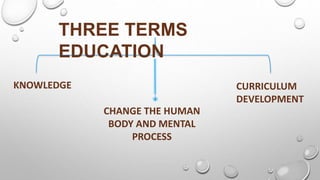
KNOWLEDGE
CHANGE THE HUMAN
BODY AND MENTAL
PROCESS
CURRICULUM
DEVELOPMENT
THREE TERMS
EDUCATION
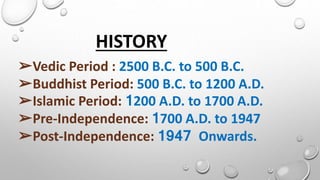
HISTORY
➢Vedic Period : 2500 B.C. to 500 B.C.
➢Buddhist Period: 500 B.C. to 1200 A.D.
➢Islamic Period: 1200 A.D. to 1700 A.D.
➢Pre-Independence: 1700 A.D. to 1947
➢Post-Independence: 1947 Onwards.
MODERN EDUCATION
➢East India Company Period: 1700-1857
➢British Period:1858-1947
➢Indian Period: 1947 Onwards
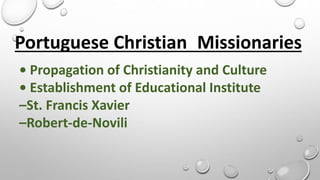
Portuguese Christian Missionaries
• Propagation of Christianity and Culture
• Establishment of Educational Institute
–St. Francis Xavier
–Robert-de-Novili
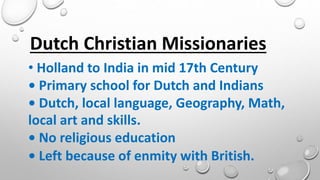
• Holland to India in mid 17th Century
• Primary school for Dutch and Indians
• Dutch, local language, Geography, Math,
local art and skills.
• No religious education
• Left because of enmity with British.
Dutch Christian Missionaries
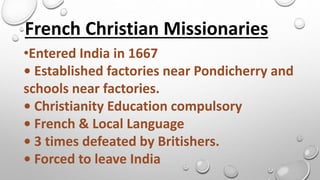
•Entered India in 1667
• Established factories near Pondicherry and
schools near factories.
• Christianity Education compulsory
• French & Local Language
• 3 times defeated by Britishers.
• Forced to leave India
French Christian Missionaries
HUNTER COMMISSION
Hunter Education Commission was a landmark
commission appointed by Viceroy Lord Ripon with
objectives to look into the complaints of the non-
implementation of the Wood’s Dispatch of 1854; the
contemporary status of elementary education in the
British territories; and suggest means by which this can
be extended and improved. This commission, headed
by Sir William Wilson Hunter, had submitted its report
in 1882.
RECOMMENDATIONS OF HUNTER COMMISSION
• The govt. should leave the responsibility of
primary education on Local bodies and that of
secondary and higher education on private
organizations.
• Should adopt liberal policy in grant-in-aid.
MERITS OF HUNTER COMMISSION
• Job oriented curriculum of secondary
education.
• Concrete suggestions regarding women.
education, education for Muslim children,
backwards caste and backward regions.
• Establishment of training schools and
colleges for primary & secondary teachers.
Thank you!
The end
Nishat Anjum,
Research Scholar,
MJPRU, Bareilly.

HUNTER COMMISSION

  • 2.
    INTRODUCTION •WHAT IS EDUCATION? Inancient times, the meaning of education was taken as a means of self-knowledge and self-illumination. The meaning and importance of education has changed from time to time as required. In ancient Greece, a person was taught for political, mental, physical and moral beauty. In ancient times, the goal of education in Rome was to produce only brave soldiers. At the present time, education has been considered as dynamic and education has been termed as a lifelong process, which is the broad meaning of education.
  • 3.
    KNOWLEDGE CHANGE THE HUMAN BODYAND MENTAL PROCESS CURRICULUM DEVELOPMENT THREE TERMS EDUCATION
  • 4.
    HISTORY ➢Vedic Period :2500 B.C. to 500 B.C. ➢Buddhist Period: 500 B.C. to 1200 A.D. ➢Islamic Period: 1200 A.D. to 1700 A.D. ➢Pre-Independence: 1700 A.D. to 1947 ➢Post-Independence: 1947 Onwards.
  • 5.
    MODERN EDUCATION ➢East IndiaCompany Period: 1700-1857 ➢British Period:1858-1947 ➢Indian Period: 1947 Onwards
  • 6.
    Portuguese Christian Missionaries •Propagation of Christianity and Culture • Establishment of Educational Institute –St. Francis Xavier –Robert-de-Novili
  • 7.
    • Holland toIndia in mid 17th Century • Primary school for Dutch and Indians • Dutch, local language, Geography, Math, local art and skills. • No religious education • Left because of enmity with British. Dutch Christian Missionaries
  • 8.
    •Entered India in1667 • Established factories near Pondicherry and schools near factories. • Christianity Education compulsory • French & Local Language • 3 times defeated by Britishers. • Forced to leave India French Christian Missionaries
  • 9.
    HUNTER COMMISSION Hunter EducationCommission was a landmark commission appointed by Viceroy Lord Ripon with objectives to look into the complaints of the non- implementation of the Wood’s Dispatch of 1854; the contemporary status of elementary education in the British territories; and suggest means by which this can be extended and improved. This commission, headed by Sir William Wilson Hunter, had submitted its report in 1882.
  • 10.
    RECOMMENDATIONS OF HUNTERCOMMISSION • The govt. should leave the responsibility of primary education on Local bodies and that of secondary and higher education on private organizations. • Should adopt liberal policy in grant-in-aid.
  • 11.
    MERITS OF HUNTERCOMMISSION • Job oriented curriculum of secondary education. • Concrete suggestions regarding women. education, education for Muslim children, backwards caste and backward regions. • Establishment of training schools and colleges for primary & secondary teachers.
  • 12.
    Thank you! The end NishatAnjum, Research Scholar, MJPRU, Bareilly.