Downloaded 71 times
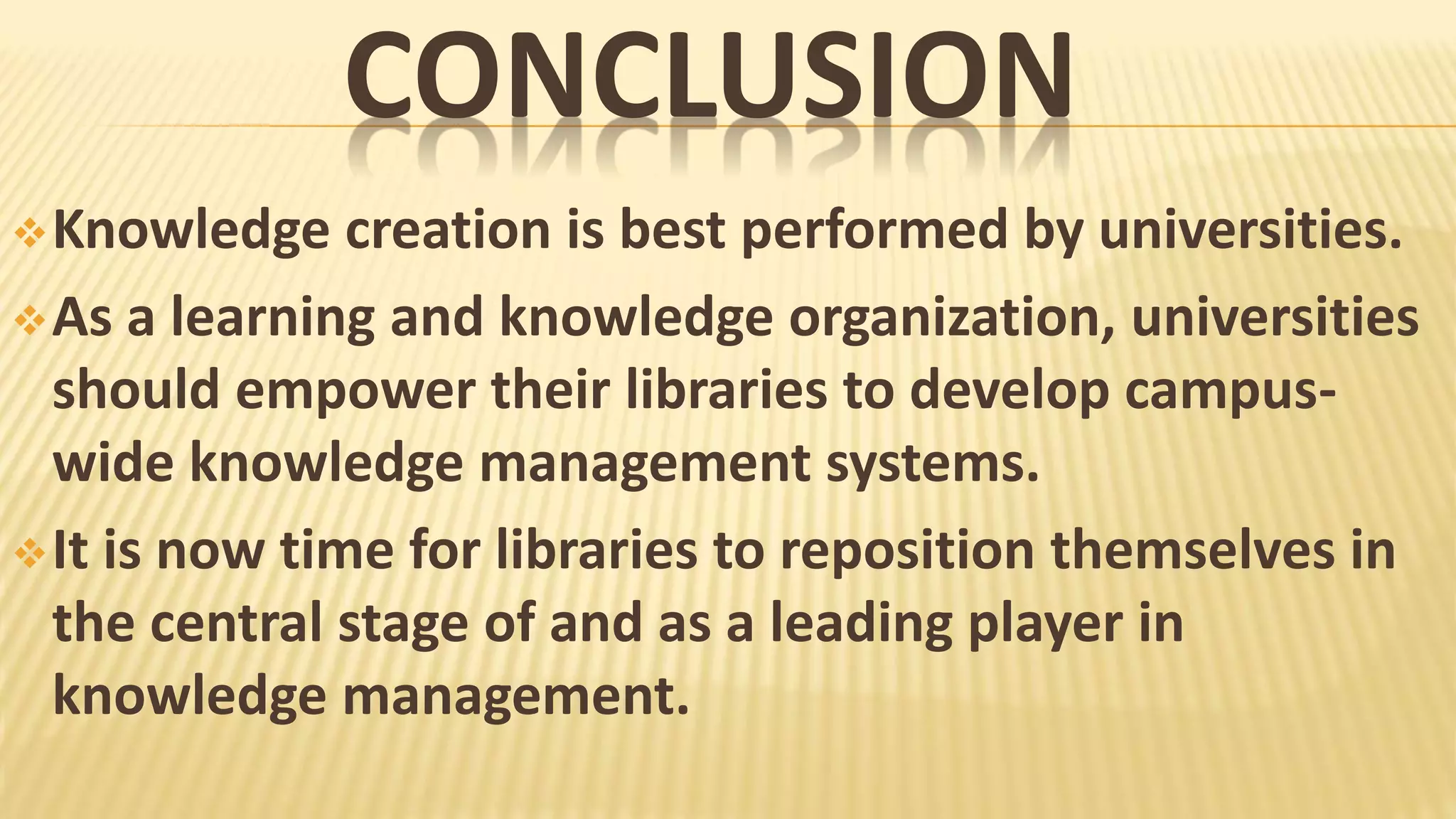


This document defines and discusses different types of knowledge. It begins by defining knowledge as facts, information, and skills acquired through experience or education, as well as understanding of a subject gained through familiarity. It notes that knowledge is meaningful relationships between facts. It then discusses the importance of knowledge and some characteristics like its ability to grow and never decay. The document outlines two main types of knowledge: a priori knowledge gained independently of experience, and a posteriori knowledge gained through empirical observation and experience. It concludes by advocating for universities and libraries to take a leading role in knowledge management.


