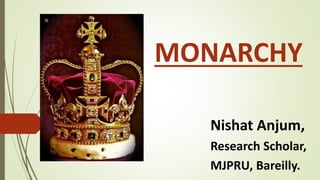
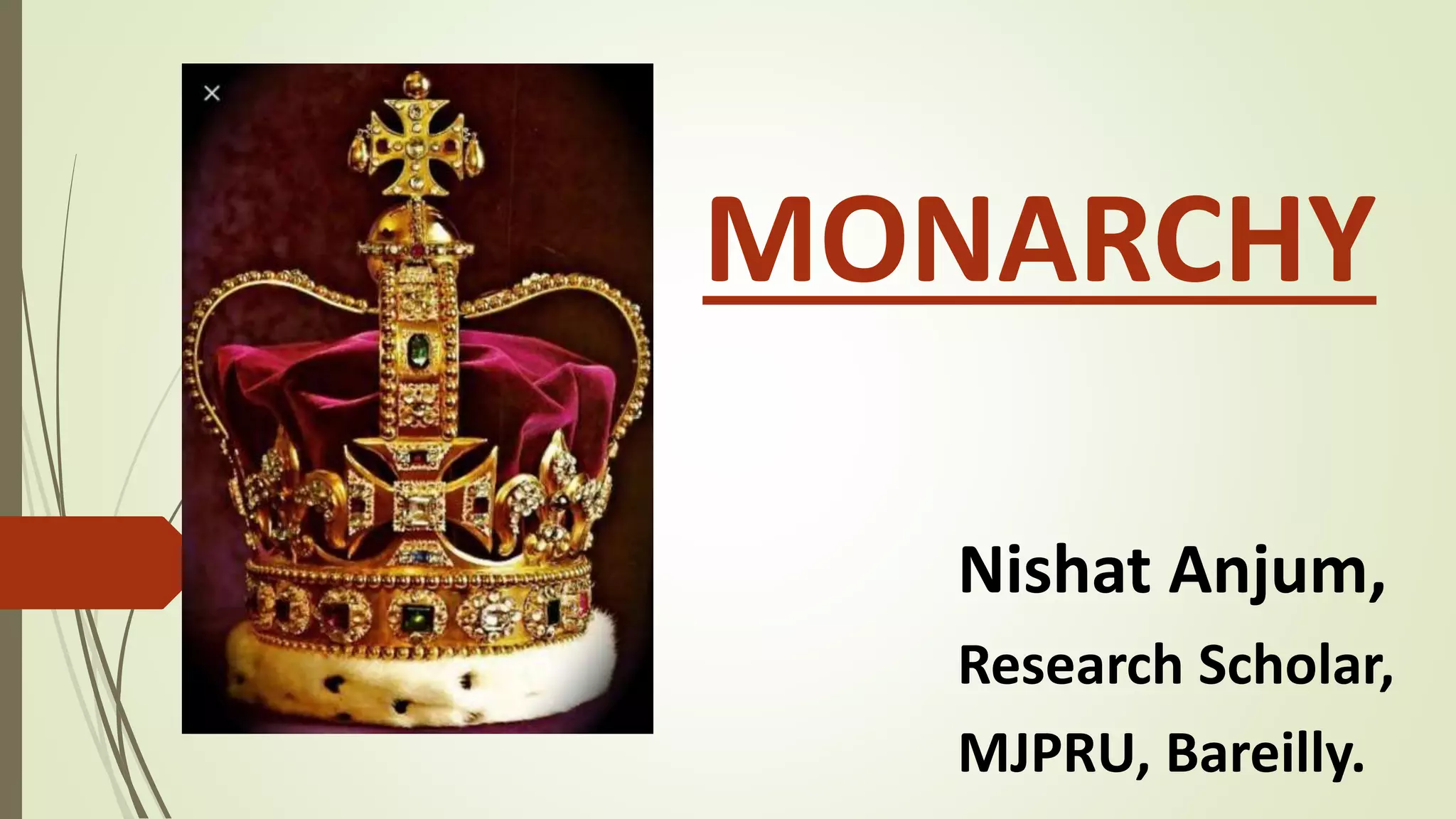
MONARCHY
Nishat Anjum,
Research Scholar,
MJPRU, Bareilly.
Monarchy is a form of government
where the ruler is a monarch who
comes from the royal family having
the paramount power of the state.
MEANING
MONARCHY: CLASSIFICATION.
LIMITED MONARCHY
ABSOLUTE MONARCHY
ABSOLUTE MONARCHY
In this type of monarchial
government, the monarch
exercises absolute powers.
In absolute monarchy, the monarch:
Wields executive, legislative, and judicial
power;
Rules with an iron hand; and
Holds the throne by hereditary right.
CHARACTERSTICS
LIMITED MONARCHY
In this type of monarchial
government, the monarch is
willing to part with some of his
powers and delegates them to
some government agencies.
In a limited monarchy, the monarch is:
The ceremonial head of the state;
A titular leader who symbolises the unity
of their people; and
Supported by a royal family that usually
radiates inspiration through civic works to
the people,and in preserving tradition
CHARACTERISTICS
Advantages of monarchy
Immediate corruption is reduced within a
monarchy.
Rulers are trained from birth for their position.
Decision are made with more speed within a
monarchy.
It is a form of government which still allows for
balance.
Disadvantages of monarchy
Single ruler who remains in power for Life.
Ruler may have absolute power.
No citizen participation or influence in
government.
Decision making is made in the interest of the
monarch not generally in the interest of the
people.
Nishat Anjum,
Research Scholar,
MJPRU, Bareilly.

Monarchy