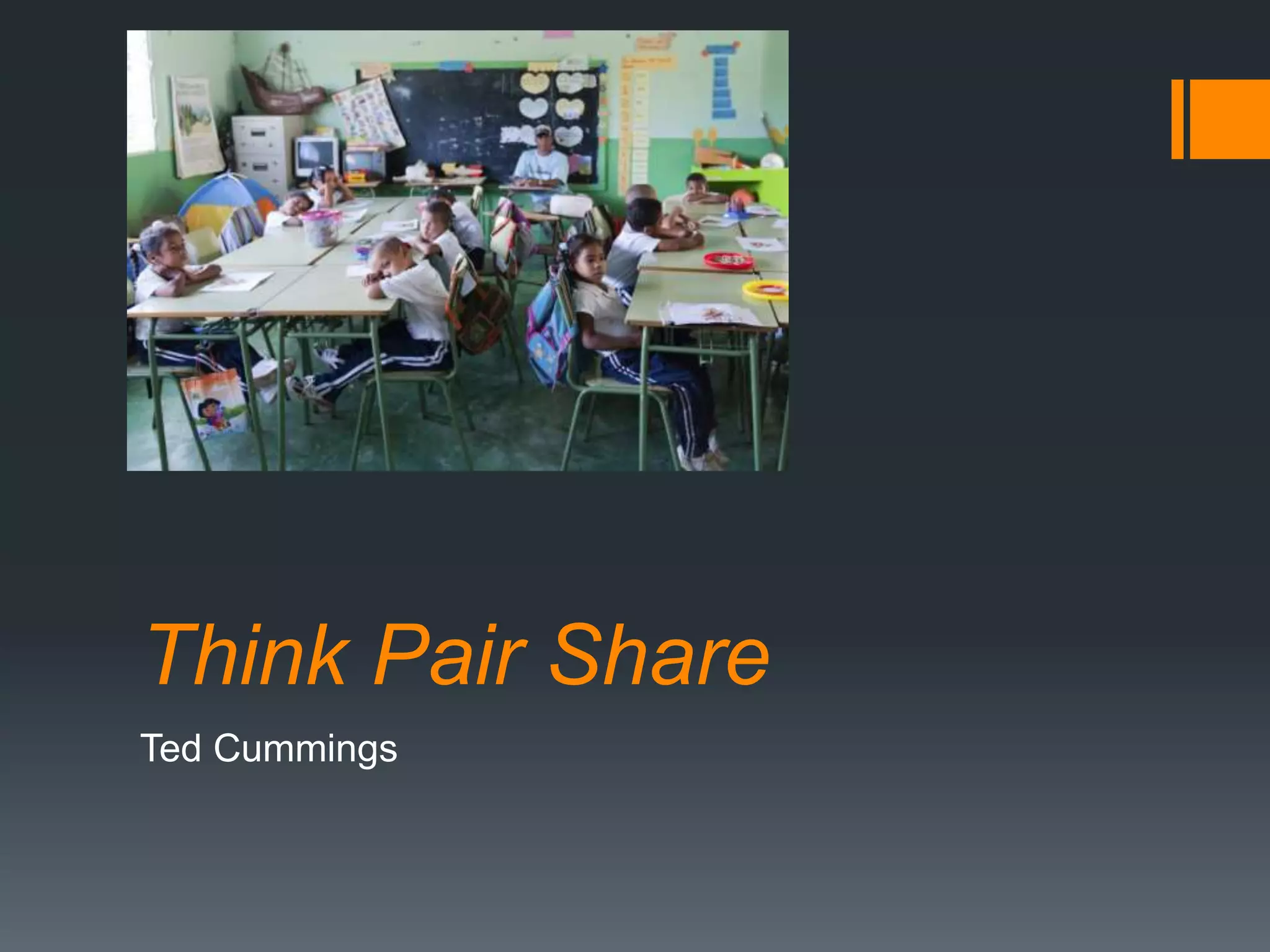
Think Pair Share 
Ted Cummings
What is Think Pair Share 
Think: Students think independently about the 
question that has been posed, forming ideas of 
their own. 
Pair: Students are grouped in pairs to discuss their 
thoughts. This step allows students to articulate 
their ideas and to consider those of others. 
Share: Student pairs share their ideas with a larger 
group, such as the whole class or a group smaller 
than an entire class.
Using Think Pair Share in the 
Classroom 
Describe the strategy and its purpose with your 
students, and provide guidelines for discussions 
that will take place. 
Explain to students that they will (1) think 
individually about a topic or answer to a 
question;(2) pair with a partner and discuss the 
topic or question; and (3) share ideas with the rest 
of the class.
TPS in the Classroom, cont’d 
Using a student or student(s) from your 
classroom, MODEL the procedure to 
ensure that students understand how to 
use the strategy. 
 Allow time for students to ask questions 
that clarify their use of the technique.
TPS in the Classroom, cont’d 
Once students have a firm understanding 
of the expectations surrounding the 
strategy, monitor and support students as 
they work through the steps below. 
Teachers may also ask students to write or 
diagram their responses while doing the 
Think-Pair-Share activity.
THINK in the Classroom 
 Think: Teachers begin by asking a specific higher-level 
question about the text or topic students will be discussing. 
Students "think" about what they know or have learned about 
the topic for a given amount of time (usually 1-3 minutes).
PAIR in the Classroom 
Pair: Each student should be paired with another 
student. Teachers may choose whether to assign 
pairs or let students pick their own partner. 
Be sensitive to learners' needs (reading skills, 
attention skills, language skills) when creating 
pairs. 
 Students share their thinking with their partner, 
discuss ideas, and ask questions of their partner 
about their thoughts on the topic (2-5 minutes).
SHARE in the Classroom 
 Share: Once partners have had ample time to share 
their thoughts and have a discussion, teachers expand 
the "share" into a whole-class discussion. 
 Allow each group to choose who will present their 
thoughts, ideas, and questions they had to the rest of 
the class. 
 After the class “share,” you may choose to have pairs 
reconvene to talk about how their thinking perhaps 
changed as a result of the “share” element.
Pros & Cons 
PROS 
Total involvement – highly collaborative. 
 Generates a lot of ideas quickly. 
 Small groups can have quality discussions. 
 Highly inclusive of all members. 
CONS 
Can be very noisy. 
Because of noise, may lose control of class. 
 puts time pressure on some
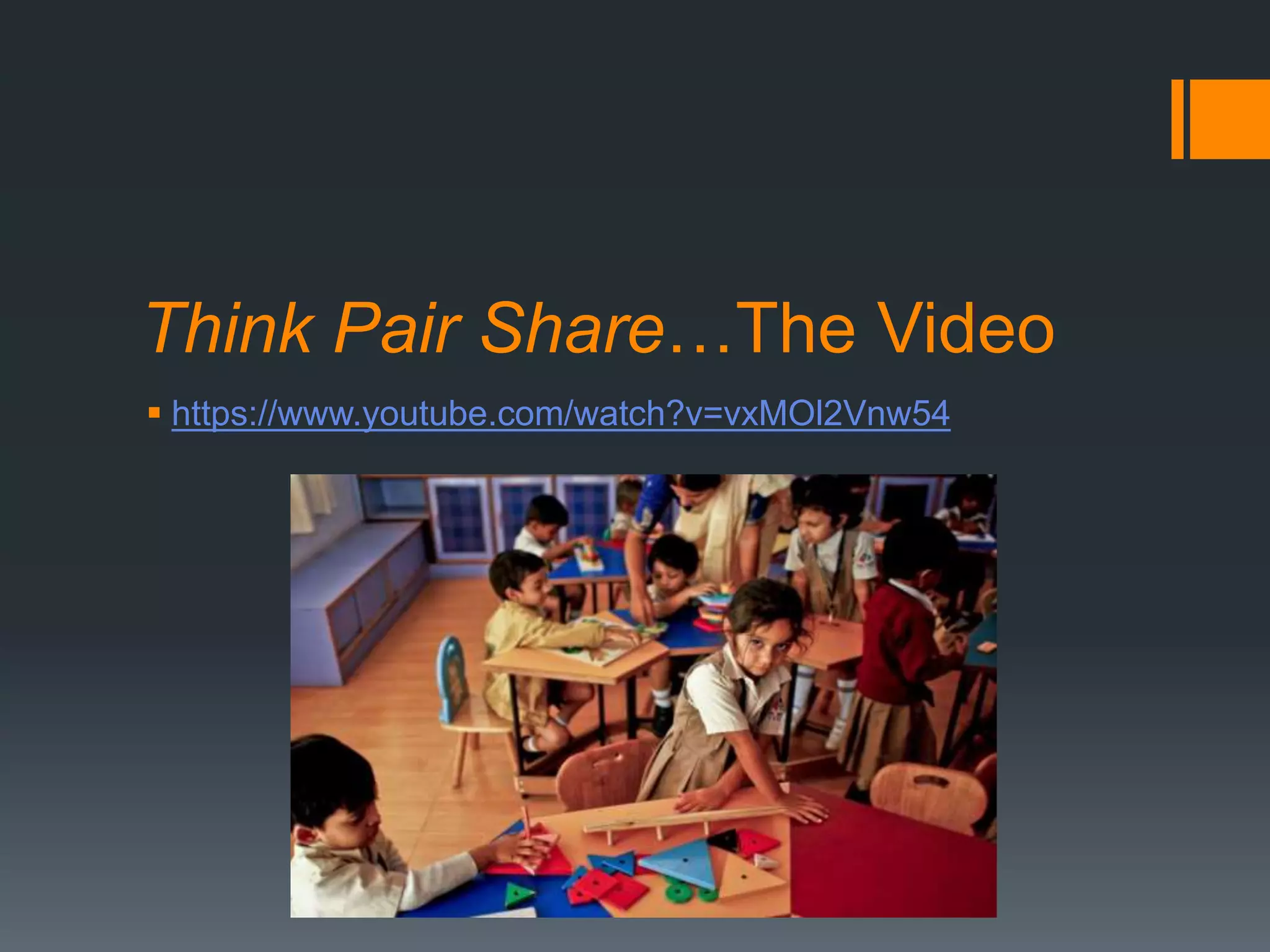
Think Pair Share…The Video 
 https://www.youtube.com/watch?v=vxMOl2Vnw54
CONCLUSION 
Think-Pair-Share (TPS) gets everyone involved. 
TPS extracts the best ideas. 
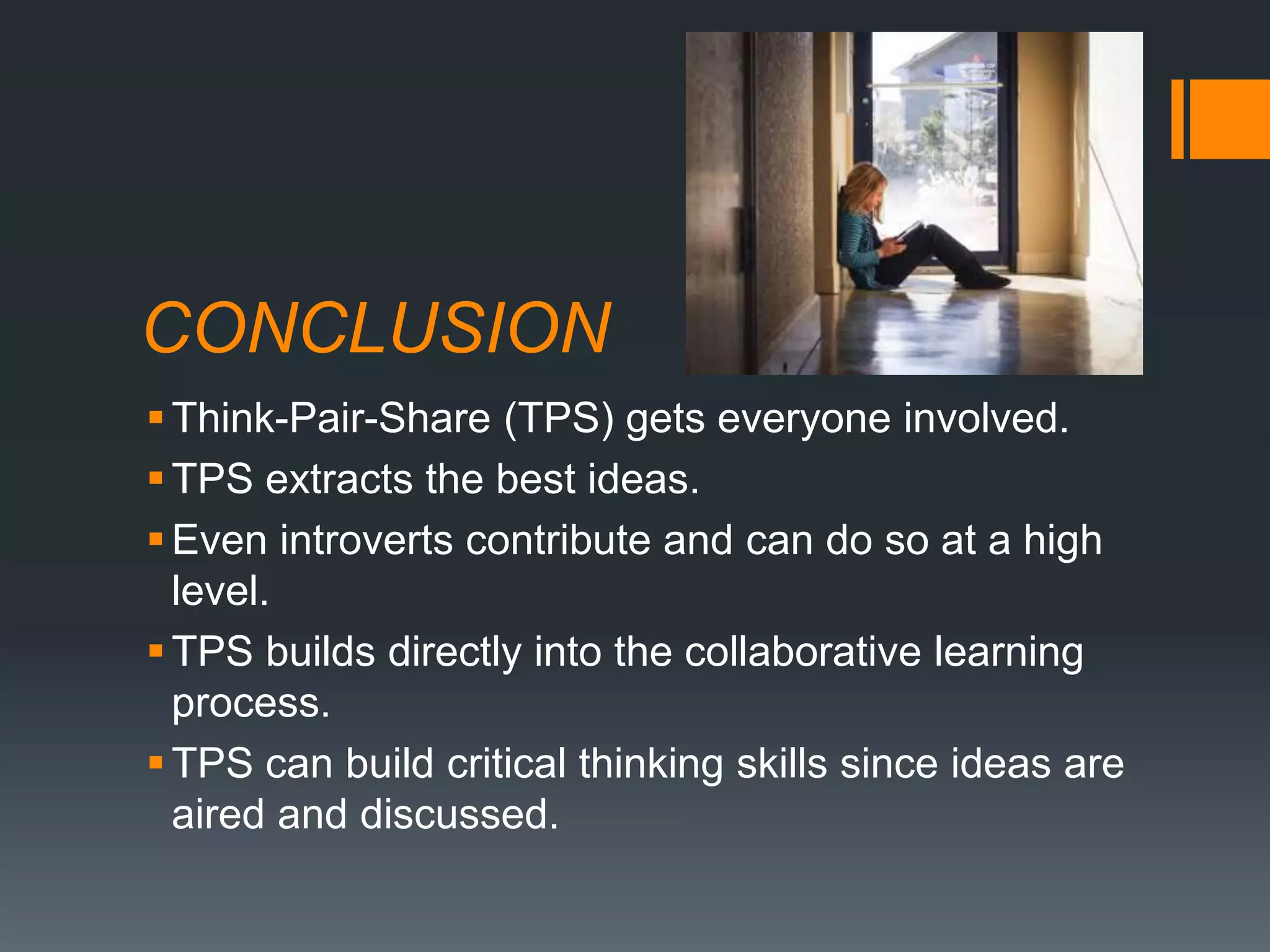
Even introverts contribute and can do so at a high 
level. 
TPS builds directly into the collaborative learning 
process. 
TPS can build critical thinking skills since ideas are 
aired and discussed.

THINK PAIR SHARE PRESENTATION - TPC

  • 1.
    Think Pair Share Ted Cummings
  • 2.
    What is ThinkPair Share Think: Students think independently about the question that has been posed, forming ideas of their own. Pair: Students are grouped in pairs to discuss their thoughts. This step allows students to articulate their ideas and to consider those of others. Share: Student pairs share their ideas with a larger group, such as the whole class or a group smaller than an entire class.
  • 3.
    Using Think PairShare in the Classroom Describe the strategy and its purpose with your students, and provide guidelines for discussions that will take place. Explain to students that they will (1) think individually about a topic or answer to a question;(2) pair with a partner and discuss the topic or question; and (3) share ideas with the rest of the class.
  • 4.
    TPS in theClassroom, cont’d Using a student or student(s) from your classroom, MODEL the procedure to ensure that students understand how to use the strategy.  Allow time for students to ask questions that clarify their use of the technique.
  • 5.
    TPS in theClassroom, cont’d Once students have a firm understanding of the expectations surrounding the strategy, monitor and support students as they work through the steps below. Teachers may also ask students to write or diagram their responses while doing the Think-Pair-Share activity.
  • 6.
    THINK in theClassroom  Think: Teachers begin by asking a specific higher-level question about the text or topic students will be discussing. Students "think" about what they know or have learned about the topic for a given amount of time (usually 1-3 minutes).
  • 7.
    PAIR in theClassroom Pair: Each student should be paired with another student. Teachers may choose whether to assign pairs or let students pick their own partner. Be sensitive to learners' needs (reading skills, attention skills, language skills) when creating pairs.  Students share their thinking with their partner, discuss ideas, and ask questions of their partner about their thoughts on the topic (2-5 minutes).
  • 8.
    SHARE in theClassroom  Share: Once partners have had ample time to share their thoughts and have a discussion, teachers expand the "share" into a whole-class discussion.  Allow each group to choose who will present their thoughts, ideas, and questions they had to the rest of the class.  After the class “share,” you may choose to have pairs reconvene to talk about how their thinking perhaps changed as a result of the “share” element.
  • 9.
    Pros & Cons PROS Total involvement – highly collaborative.  Generates a lot of ideas quickly.  Small groups can have quality discussions.  Highly inclusive of all members. CONS Can be very noisy. Because of noise, may lose control of class.  puts time pressure on some
  • 10.
    Think Pair Share…TheVideo  https://www.youtube.com/watch?v=vxMOl2Vnw54
  • 11.
    CONCLUSION Think-Pair-Share (TPS)gets everyone involved. TPS extracts the best ideas. Even introverts contribute and can do so at a high level. TPS builds directly into the collaborative learning process. TPS can build critical thinking skills since ideas are aired and discussed.