Think Pair Share
Learning Strategy
Learning Context & Problem
   Often students are called to collaboratively solve
    challenging and open-ended problems and come up with
    creative solutions.
   However, they might be new to collaborative learning &
    brainstorming. Thus, the teacher should try to
       foster discussion in order that students’ view an open-ended
        problem from various angles
       promote the feeling that team members need each other to
        succeed (positive interdependence)
       give students a chance to formulate answers that will be peer
        reviewed
       promote the acquisition of presentation an d communication skills
The “Think Pair Share” Solution
   Use the learning strategy of “Think-Pair-Share” (TPS) which is a
    collaborative brainstorming strategy.
   At the start of the learning process the teacher presents a problem
    that demands a solution. Each learner thinks on his own and records
    his ideas about the situation.
   Then the learners are split into groups of two, interchange ideas
    about the problem and result into a common solution.
   Finally they present and discuss their conclusions at a plenary
    session in order to get feedback from their peers.
   This strategy helps the learners intensively work on producing
    creative solutions to given problems, share their ideas and justify
    their position in front of their peers and get/offer feedback.
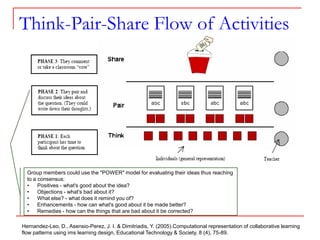
Think-Pair-Share Flow of Activities


  Group members could use the "POWER" model for evaluating their ideas thus reaching
  to a consensus:
  •    Positives - what's good about the idea?
  •    Objections - what's bad about it?
  •    What else? - what does it remind you of?
  •    Enhancements - how can what's good about it be made better?
  •    Remedies - how can the things that are bad about it be corrected?

Hernandez-Leo, D., Asensio-Perez, J. I. & Dimitriadis, Y. (2005).Computational representation of collaborative learning
flow patterns using ims learning design, Educational Technology & Society, 8 (4), 75-89.
An example of the TPS strategy:
"Punishment: Death Penalty. Yes or no?
   Course: Modern Greek Language
   Grade: Third Grade of Lyceum (students’ age: 16-17)
   Task: Write a mock editorial for the local paper in and choose a side of the death penalty
    to defend by assuming a persona directly related to a scheduled execution
   Goals/Objectives: Learners acquire knowledge about the death penalty and the
    arguments that support it and the arguments against it. They develop own opinions and
    exchange various viewpoints on death penalty. They practice their writing skills by editing
    a mock editorial for the local paper that deals with a scheduled execution.
   Learning Material/Tools
   Online newspaper articles about death penalty
   Concept Questions: e.g.
       What are the different viewpoints for and against the Death Penalty?
       What determines who is killed under the Death penalty?
       Do you think the death penalty acts as a deterrent keeps crime at a lower rate?
       Both the USA and Saudi Arabia has the death penalty but crime is so much lower in Saudi. Why
        is that?
       Should people who commit crimes against humanity be given the death penalty
   Editorial evaluation rubric
An example of the TPS strategy: Flow of
    activities
   Phase 1:
       Teacher presents the scope, the goal and the overall structure of learning session
       Learners individually study the learning material
       Learners are asked to briefly write and upload to a shared workspace their impressions
        of the articles given by individually writing a paragraph or two on how they would feel
        about the death penalty.
   Phase 2:
       Teacher forms pair groups, presents the concept questions that could help learners to
        identify different arguments for or against the death penalty
       Teacher offers some extra learning material and the evaluation rubric of the students’
        assignment (editorial rubric)
       Learners share their initial ideas and discuss the concept questions
       Learners collaboratively write an editorial article in a wiki
   Phase 3:
       Learners read the editorials of the pair groups
       Learners vote for or against the death penalty
       Teacher evaluates the assignments and gives a summary of the learning session

ThinkPairShare learning strategy

  • 1.
  • 2.
    Learning Context &Problem  Often students are called to collaboratively solve challenging and open-ended problems and come up with creative solutions.  However, they might be new to collaborative learning & brainstorming. Thus, the teacher should try to  foster discussion in order that students’ view an open-ended problem from various angles  promote the feeling that team members need each other to succeed (positive interdependence)  give students a chance to formulate answers that will be peer reviewed  promote the acquisition of presentation an d communication skills
  • 3.
    The “Think PairShare” Solution  Use the learning strategy of “Think-Pair-Share” (TPS) which is a collaborative brainstorming strategy.  At the start of the learning process the teacher presents a problem that demands a solution. Each learner thinks on his own and records his ideas about the situation.  Then the learners are split into groups of two, interchange ideas about the problem and result into a common solution.  Finally they present and discuss their conclusions at a plenary session in order to get feedback from their peers.  This strategy helps the learners intensively work on producing creative solutions to given problems, share their ideas and justify their position in front of their peers and get/offer feedback.
  • 4.
    Think-Pair-Share Flow ofActivities Group members could use the "POWER" model for evaluating their ideas thus reaching to a consensus: • Positives - what's good about the idea? • Objections - what's bad about it? • What else? - what does it remind you of? • Enhancements - how can what's good about it be made better? • Remedies - how can the things that are bad about it be corrected? Hernandez-Leo, D., Asensio-Perez, J. I. & Dimitriadis, Y. (2005).Computational representation of collaborative learning flow patterns using ims learning design, Educational Technology & Society, 8 (4), 75-89.
  • 5.
    An example ofthe TPS strategy: "Punishment: Death Penalty. Yes or no?  Course: Modern Greek Language  Grade: Third Grade of Lyceum (students’ age: 16-17)  Task: Write a mock editorial for the local paper in and choose a side of the death penalty to defend by assuming a persona directly related to a scheduled execution  Goals/Objectives: Learners acquire knowledge about the death penalty and the arguments that support it and the arguments against it. They develop own opinions and exchange various viewpoints on death penalty. They practice their writing skills by editing a mock editorial for the local paper that deals with a scheduled execution.  Learning Material/Tools  Online newspaper articles about death penalty  Concept Questions: e.g.  What are the different viewpoints for and against the Death Penalty?  What determines who is killed under the Death penalty?  Do you think the death penalty acts as a deterrent keeps crime at a lower rate?  Both the USA and Saudi Arabia has the death penalty but crime is so much lower in Saudi. Why is that?  Should people who commit crimes against humanity be given the death penalty  Editorial evaluation rubric
  • 6.
    An example ofthe TPS strategy: Flow of activities  Phase 1:  Teacher presents the scope, the goal and the overall structure of learning session  Learners individually study the learning material  Learners are asked to briefly write and upload to a shared workspace their impressions of the articles given by individually writing a paragraph or two on how they would feel about the death penalty.  Phase 2:  Teacher forms pair groups, presents the concept questions that could help learners to identify different arguments for or against the death penalty  Teacher offers some extra learning material and the evaluation rubric of the students’ assignment (editorial rubric)  Learners share their initial ideas and discuss the concept questions  Learners collaboratively write an editorial article in a wiki  Phase 3:  Learners read the editorials of the pair groups  Learners vote for or against the death penalty  Teacher evaluates the assignments and gives a summary of the learning session

Editor's Notes

  • #2 Good morning My name is Mary Katsamani, I am from the University of Piraeus in Greece and I will present you our work “Making Learning Designs in layers: The CADMOS approach”.