B Y N A Z I A A S H R A F
B Y N A Z I A . A S H R A F 1 5 3 6 @ G M A I L . C O M
DISCUSSION METHOD
DEFINITION
"An activity in which people talk together in order to
share information a topic or problem or to seek
possible available evidence or a. It is used more and
more in student-centered learning venues as a
means of engaging students in the “active”
construction of learning collaboration and the
exchange of perspectives”.
CLASSROOM DISCUSSION
“Discussion is thought to be a useful teaching technique
for developing higher order thinking skills that enable
students to interpret, analyze, and information. Students
explain their ideas and thoughts, rather than merely
recount, or recite, memorized facts and details. During
discussion learners are not passive recipients of
information that is transmitted from a teacher. Rather,
learners are active participants.
Discussion, when combined with probing, open-ended
questions, requires students to organize available
information for the purpose of arriving at their own
defensible answers.”
CLASSROOM DISCUSSION
1. Task Functions
2. Direction giver
3. Social Functions
CHARACTERISTICS OF THE DISCUSSION
METHOD
1. Experiential Learning
2. Emphasis on Students
3. Focus on Critical Thinking
4. Identification phase
5. Focusing Phase
6. Application Phase
7. Use of Questions
TYPES OF CLASSROOM DISCUSSION
• Small Groups
• Buzz Groups
• Talking Circle /
Word Wheels
• Talking Tickets
• Think-Pair-Share
• Problem
• Think
• Share
• Write Around
• Guided Discussion
Method
• Objectives
• Introduction
• Discussion
• Summary
• Conclusion
• Reflective
Discussion Method
TYPES OF CLASSROOM DISCUSSION
• Turn to Your
Neighbor
• Round Robin
• Line-Ups
• Value Lines
• Jigsaw
• Sharing Limited
Resources
• Sharing Limited
Resources
• Question and Answer Pairs
• Advanced Preparation Pairs
PLANNING THE DISCUSSION
Arends (2004, Pp 431-437)
1. Consider Purpose
2. Consider Students
• Recitations
• Inquiry or Problem-Based Discussion
• Sharing-Based Discussion
ORGANIZING THE DISCUSSION
1. Teacher as a Facilitator
• Creating Classroom Community
• Accommodate Multiple Learning Styles:
• Remain Objective: Focus on Student Contributions:
• Be Honest: Criticize Constructively
2. Stay on Track
• Plan “Goal‐Oriented” Discussions
• Ask “Goal‐Oriented” Questions
• Avoid Being Derailed
• Deal Irrelevant Questions and Comment
• Refocus Attention: Write to Learn
ORGANIZING THE DISCUSSION
3. Thinking on Your Feet
• Be Well Prepared
• Learn to Stall
• Be Honest
• Don’t Fear the Silence: Respect and Use It
4. Gauging Comprehension
• Avoid Yes or No Questions
• Summarizing and Paraphrasing
• Using Quizzes
ORGANIZING THE DISCUSSION
• 5. Suggestions to Organize Classroom Discussion
• Give the students a chance to be prepared for discussion
• Give yourself plenty of preparation time before class
• Ask questions at a variety of taxonomic levels during class
• Provide encouragement and praise for correct answers
• Occasionally the use of a blind quiz will help to encourage class
review
• Maintain a warm, outgoing, friendly atmosphere in class
• Summarizing the main points
PRACTICING IN ASKING QUESTIONS
• Questions According to Bloom’s Taxonomy
• Knowledge
• Comprehension
• Application
• Analysis:
• Synthesis:
• Evaluation
PROBING QUESTIONS
1. Challenge questions
2. Relational questions
3. Diagnostic questions
4. Action questions
5. Cause-and-effect question
6. Extension questions
7. Hypothetical questions
8. Priority questions
9. Summary questions
TIPS TO ASK EFFECTIVE QUESTIONS
Discuss the Elements of
a Successful Discussion
Brainstorm
Rearrange Your
Classroom
Pause
Avoid unproductive
questions
Recall questions
Rhetorical questions
Give students the
opportunity to lead a
discussion
Yes or no questions
Leading questions
Guess What I’m Thinking
questions
Ask the kinds of
questions that stimulate
discussion
Facilitate, don’t
orchestrate
Encourage students to
respond to one another:
Build in reflection.
ASSESSING THE DISCUSSION
1. Follow-Up Discussions
2. Grading Classroom Discussion
RULES FOR DISCUSSION
• Explain the ground rules for
participation.
• Ask students what makes an
excellent class discussion.
• Give pointers on how to
participate in class discussion.
• Ask students to think of some
principles for discussion, which
they think everyone should follow.
• Teacher should write all of these
suggested principles where every
student can see
• them. If suggestions are not
obtained from students, teacher
can suggest some of
• the following principles for the
students:
• Pay attention to the participant
who is speaking
• Only one participant speaks at a
time
• Before saying something, raise
hand
• When someone is speaking, don’t
interrupt
• In case of disagreement with a
response, be careful that there
should be criticism on
• the response, not on the person
• Don't mock on the person who is
responding during discussion;
• Give confidence to every student
to participate
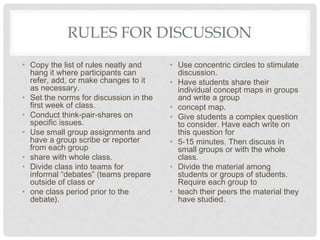
RULES FOR DISCUSSION
• Copy the list of rules neatly and
hang it where participants can
refer, add, or make changes to it
as necessary.
• Set the norms for discussion in the
first week of class.
• Conduct think-pair-shares on
specific issues.
• Use small group assignments and
have a group scribe or reporter
from each group
• share with whole class.
• Divide class into teams for
informal “debates” (teams prepare
outside of class or
• one class period prior to the
debate).
• Use concentric circles to stimulate
discussion.
• Have students share their
individual concept maps in groups
and write a group
• concept map.
• Give students a complex question
to consider. Have each write on
this question for
• 5-15 minutes. Then discuss in
small groups or with the whole
class.
• Divide the material among
students or groups of students.
Require each group to
• teach their peers the material they
have studied.

Discussion method

  • 1.
    B Y NA Z I A A S H R A F B Y N A Z I A . A S H R A F 1 5 3 6 @ G M A I L . C O M DISCUSSION METHOD
  • 2.
    DEFINITION "An activity inwhich people talk together in order to share information a topic or problem or to seek possible available evidence or a. It is used more and more in student-centered learning venues as a means of engaging students in the “active” construction of learning collaboration and the exchange of perspectives”.
  • 3.
    CLASSROOM DISCUSSION “Discussion isthought to be a useful teaching technique for developing higher order thinking skills that enable students to interpret, analyze, and information. Students explain their ideas and thoughts, rather than merely recount, or recite, memorized facts and details. During discussion learners are not passive recipients of information that is transmitted from a teacher. Rather, learners are active participants. Discussion, when combined with probing, open-ended questions, requires students to organize available information for the purpose of arriving at their own defensible answers.”
  • 4.
    CLASSROOM DISCUSSION 1. TaskFunctions 2. Direction giver 3. Social Functions
  • 5.
    CHARACTERISTICS OF THEDISCUSSION METHOD 1. Experiential Learning 2. Emphasis on Students 3. Focus on Critical Thinking 4. Identification phase 5. Focusing Phase 6. Application Phase 7. Use of Questions
  • 6.
    TYPES OF CLASSROOMDISCUSSION • Small Groups • Buzz Groups • Talking Circle / Word Wheels • Talking Tickets • Think-Pair-Share • Problem • Think • Share • Write Around • Guided Discussion Method • Objectives • Introduction • Discussion • Summary • Conclusion • Reflective Discussion Method
  • 7.
    TYPES OF CLASSROOMDISCUSSION • Turn to Your Neighbor • Round Robin • Line-Ups • Value Lines • Jigsaw • Sharing Limited Resources • Sharing Limited Resources • Question and Answer Pairs • Advanced Preparation Pairs
  • 8.
    PLANNING THE DISCUSSION Arends(2004, Pp 431-437) 1. Consider Purpose 2. Consider Students • Recitations • Inquiry or Problem-Based Discussion • Sharing-Based Discussion
  • 9.
    ORGANIZING THE DISCUSSION 1.Teacher as a Facilitator • Creating Classroom Community • Accommodate Multiple Learning Styles: • Remain Objective: Focus on Student Contributions: • Be Honest: Criticize Constructively 2. Stay on Track • Plan “Goal‐Oriented” Discussions • Ask “Goal‐Oriented” Questions • Avoid Being Derailed • Deal Irrelevant Questions and Comment • Refocus Attention: Write to Learn
  • 10.
    ORGANIZING THE DISCUSSION 3.Thinking on Your Feet • Be Well Prepared • Learn to Stall • Be Honest • Don’t Fear the Silence: Respect and Use It 4. Gauging Comprehension • Avoid Yes or No Questions • Summarizing and Paraphrasing • Using Quizzes
  • 11.
    ORGANIZING THE DISCUSSION •5. Suggestions to Organize Classroom Discussion • Give the students a chance to be prepared for discussion • Give yourself plenty of preparation time before class • Ask questions at a variety of taxonomic levels during class • Provide encouragement and praise for correct answers • Occasionally the use of a blind quiz will help to encourage class review • Maintain a warm, outgoing, friendly atmosphere in class • Summarizing the main points
  • 12.
    PRACTICING IN ASKINGQUESTIONS • Questions According to Bloom’s Taxonomy • Knowledge • Comprehension • Application • Analysis: • Synthesis: • Evaluation
  • 13.
    PROBING QUESTIONS 1. Challengequestions 2. Relational questions 3. Diagnostic questions 4. Action questions 5. Cause-and-effect question 6. Extension questions 7. Hypothetical questions 8. Priority questions 9. Summary questions
  • 14.
    TIPS TO ASKEFFECTIVE QUESTIONS Discuss the Elements of a Successful Discussion Brainstorm Rearrange Your Classroom Pause Avoid unproductive questions Recall questions Rhetorical questions Give students the opportunity to lead a discussion Yes or no questions Leading questions Guess What I’m Thinking questions Ask the kinds of questions that stimulate discussion Facilitate, don’t orchestrate Encourage students to respond to one another: Build in reflection.
  • 15.
    ASSESSING THE DISCUSSION 1.Follow-Up Discussions 2. Grading Classroom Discussion
  • 16.
    RULES FOR DISCUSSION •Explain the ground rules for participation. • Ask students what makes an excellent class discussion. • Give pointers on how to participate in class discussion. • Ask students to think of some principles for discussion, which they think everyone should follow. • Teacher should write all of these suggested principles where every student can see • them. If suggestions are not obtained from students, teacher can suggest some of • the following principles for the students: • Pay attention to the participant who is speaking • Only one participant speaks at a time • Before saying something, raise hand • When someone is speaking, don’t interrupt • In case of disagreement with a response, be careful that there should be criticism on • the response, not on the person • Don't mock on the person who is responding during discussion; • Give confidence to every student to participate
  • 17.
    RULES FOR DISCUSSION •Copy the list of rules neatly and hang it where participants can refer, add, or make changes to it as necessary. • Set the norms for discussion in the first week of class. • Conduct think-pair-shares on specific issues. • Use small group assignments and have a group scribe or reporter from each group • share with whole class. • Divide class into teams for informal “debates” (teams prepare outside of class or • one class period prior to the debate). • Use concentric circles to stimulate discussion. • Have students share their individual concept maps in groups and write a group • concept map. • Give students a complex question to consider. Have each write on this question for • 5-15 minutes. Then discuss in small groups or with the whole class. • Divide the material among students or groups of students. Require each group to • teach their peers the material they have studied.