Cooperative
Learning
By: Jesuitas, Mary France R.
01
Table of Contents
Research Evidences
Advantages and
Disadvantages
03
Five Elements
of Cooperative Learning
inside the classroom
Differentiate
Cooperation vs.
Competition vs.
Individualistic Efforts
04
Different Techniques
that can be employed
inside the classroom
02
 Educational approach which aims to
organize classroom activities into academic
and social learning experiences
 Positive interdependence
 Demanding, Creative, Open-ended, and
involve Higher Order Thinking Tasks
(Ross & Smyth, 1995)
What is Cooperative Learning?
Why use Cooperative Learning?
FIVE ELEMENTS
of Cooperative Learning
01
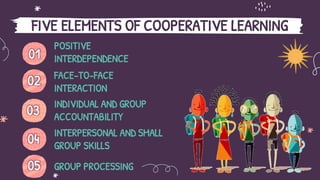
FIVE ELEMENTS OF COOPERATIVE LEARNING
POSITIVE
INTERDEPENDENCE
FACE-TO-FACE
INTERACTION
GROUP PROCESSING
INDIVIDUAL AND GROUP
ACCOUNTABILITY
INTERPERSONAL AND SMALL
GROUP SKILLS
01
02
03
04
05
01
 IS MY GAIN YOUR GAIN?
 I CAN'T DO IT WITHOUT
YOU.
SWIM OR SINK TOGETHER?
02
PROMOTE EACH OTHER SUCCESS
 WE WORK WITH A PARTNER OR AS
A TEAM
 I NEED YOUR HELP AND YOU NEED
MY HELP
03
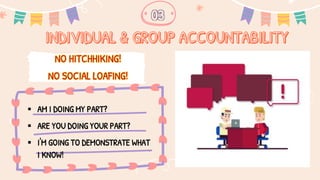
NO HITCHHIKING!
NO SOCIAL LOAFING!
 AM I DOING MY PART?
 ARE YOU DOING YOUR PART?
 I'M GOING TO DEMONSTRATE WHAT
I KNOW!
04
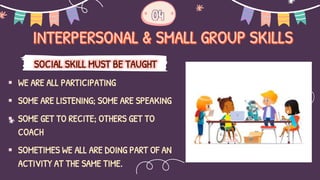
SOCIAL SKILL MUST BE TAUGHT
 WE ARE ALL PARTICIPATING
 SOME ARE LISTENING; SOME ARE SPEAKING
 SOME GET TO RECITE; OTHERS GET TO
COACH
 SOMETIMES WE ALL ARE DOING PART OF AN
ACTIVITY AT THE SAME TIME.
04
SKILLS ALSO INCLUDES:
effective communication, interpersonal and group skills:
4. Friendship- development
5. Communication
6. Conflict-management skills
1. Leadership
2. Decision-making
3. Trust-building
05
GROUP DECISION: CHANGE OR
CONTINUE THAT BEHAVIOUR?
 Reflect on which member
actions were helpful
 Make decision about which
actions to continue or change
DIFFERENT
TECHNIQUES
02
that can be used inside the classroom
 Cooperative-learning techniques revolve
around the use of a particular tool.
 SMALL GROUPS
 It can be used with almost any educational
strategy
How to use Cooperative Learning?
TECHNIQUES
THINK-PAIR-SHARE
01
Developed by: Frank T. Lyman in 1981
 Allows for students to contemplate a
posed question or problem silently
 Individuals think, then pair up and then
share their responses
TECHNIQUES
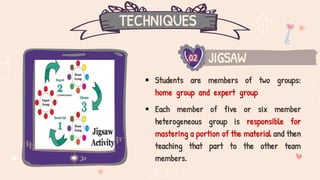
JIGSAW
02
 Students are members of two groups:
home group and expert group
 Each member of five or six member
heterogeneous group is responsible for
mastering a portion of the material and then
teaching that part to the other team
members.
TECHNIQUES
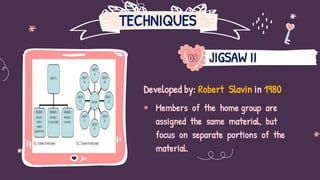
JIGSAW II
03
Developed by: Robert Slavin in 1980
 Members of the home group are
assigned the same material, but
focus on separate portions of the
material.
TECHNIQUES
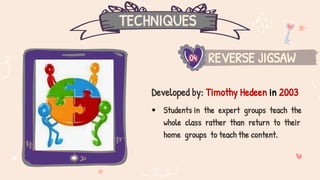
REVERSE JIGSAW
04
Developed by: Timothy Hedeen in 2003
 Students in the expert groups teach the
whole class rather than return to their
home groups to teach the content.
TECHNIQUES
INSIDE-OUTSIDE CIRCLE
05
 Students form two concentric
circles and take turns on rotation
to face new partners to answer
or discuss the teacher’s questions
TECHNIQUES
RECIPROCAL TEACHING
06
Developed by: Brown & Paliscar in 1982
 Allows for student pairs to participate in
a dialogue about text. Partners take turns
reading and asking questions of each
other, receiving immediate feedback
TECHNIQUES
THE WILLIAMS
07
 Students collaborate to answer a big
question
 Each group has differentiated questions that
increases in cognitive ability to allow
students to progress and meet the learning
objective
TECHNIQUES
STAD
08
 Student-Teams-Achievement Divisions
 Students are placed in small groups (or teams).
 Students in heterogeneous groups of four to five
members use study devices to master academic
material and then help each other learn the
material through tutoring, quizzing and team
discussions
TECHNIQUES
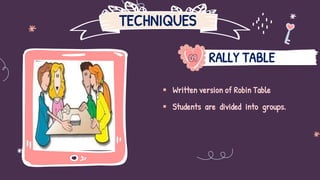
RALLY TABLE
09
 Written version of Robin Table
 Students are divided into groups.
TECHNIQUES
TGT
10
 TEAM GAME TOURNAMENT
 Students are placed into small groups to
study and prepare for a trivia game.
RESEARCH EVIDENCE
Advantages and Disadvantages
03
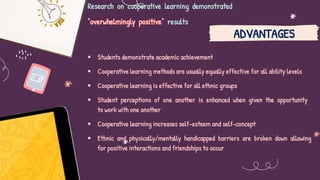
Research on cooperative learning demonstrated
“overwhelmingly positive” results
 Students demonstrate academic achievement
 Cooperative learning methods are usually equally effective for all ability levels
 Cooperative learning is effective for all ethnic groups
 Student perceptions of one another is enhanced when given the opportunity
to work with one another
 Cooperative learning increases self-esteem and self-concept
 Ethnic and physically/mentally handicapped barriers are broken down allowing
for positive interactions and friendships to occur
ADVANTAGES
 Teachers may become confused and lack complete understanding of
the method
 Teachers can get into the habit of relying on cooperative learning
as a way to keep students busy
 Teachers may also be challenged with resistance and hostility from
students who believe that they are being held back by their slower
teammates
DISADVANTAGES
DIFFERENTIATION
04
Cooperation vs. Competition vs. Individualistic Efforts
Cooperation vs. Competition vs. Individualistic
COOPERATION COMPETITION INDIVIDUALISTIC
 students work against
each other to achieve
a good grade and only
some of them succeed
 students work
independently to achieve
learning goals unrelated
to those of other
students
 students work and
discover a new
concept together as
well as helping each
other to learn
Resources
Cooperative Learning. Retrieved January 12, 2021 from https://www.slideshare.net/ahmedabbas1121/cooperative-
learning-62463910
Differences Among Cooperative, Competitive, and Individualistic Learning. Retrieved January 13, 2021 from
https://intime.uni.edu/differences-among-cooperative-competitive-and-individualistic-learning
Gallagher, M. (2017). Educational Technology for Teaching and Learning. New York: Library Press
THANK
YOU!

Cooperative Learning

  • 1.
  • 2.
    01 Table of Contents ResearchEvidences Advantages and Disadvantages 03 Five Elements of Cooperative Learning inside the classroom Differentiate Cooperation vs. Competition vs. Individualistic Efforts 04 Different Techniques that can be employed inside the classroom 02
  • 3.
     Educational approachwhich aims to organize classroom activities into academic and social learning experiences  Positive interdependence  Demanding, Creative, Open-ended, and involve Higher Order Thinking Tasks (Ross & Smyth, 1995) What is Cooperative Learning?
  • 4.
  • 5.
  • 6.
    FIVE ELEMENTS OFCOOPERATIVE LEARNING POSITIVE INTERDEPENDENCE FACE-TO-FACE INTERACTION GROUP PROCESSING INDIVIDUAL AND GROUP ACCOUNTABILITY INTERPERSONAL AND SMALL GROUP SKILLS 01 02 03 04 05
  • 7.
    01  IS MYGAIN YOUR GAIN?  I CAN'T DO IT WITHOUT YOU. SWIM OR SINK TOGETHER?
  • 8.
    02 PROMOTE EACH OTHERSUCCESS  WE WORK WITH A PARTNER OR AS A TEAM  I NEED YOUR HELP AND YOU NEED MY HELP
  • 9.
    03 NO HITCHHIKING! NO SOCIALLOAFING!  AM I DOING MY PART?  ARE YOU DOING YOUR PART?  I'M GOING TO DEMONSTRATE WHAT I KNOW!
  • 10.
    04 SOCIAL SKILL MUSTBE TAUGHT  WE ARE ALL PARTICIPATING  SOME ARE LISTENING; SOME ARE SPEAKING  SOME GET TO RECITE; OTHERS GET TO COACH  SOMETIMES WE ALL ARE DOING PART OF AN ACTIVITY AT THE SAME TIME.
  • 11.
    04 SKILLS ALSO INCLUDES: effectivecommunication, interpersonal and group skills: 4. Friendship- development 5. Communication 6. Conflict-management skills 1. Leadership 2. Decision-making 3. Trust-building
  • 12.
    05 GROUP DECISION: CHANGEOR CONTINUE THAT BEHAVIOUR?  Reflect on which member actions were helpful  Make decision about which actions to continue or change
  • 13.
    DIFFERENT TECHNIQUES 02 that can beused inside the classroom
  • 14.
     Cooperative-learning techniquesrevolve around the use of a particular tool.  SMALL GROUPS  It can be used with almost any educational strategy How to use Cooperative Learning?
  • 15.
    TECHNIQUES THINK-PAIR-SHARE 01 Developed by: FrankT. Lyman in 1981  Allows for students to contemplate a posed question or problem silently  Individuals think, then pair up and then share their responses
  • 16.
    TECHNIQUES JIGSAW 02  Students aremembers of two groups: home group and expert group  Each member of five or six member heterogeneous group is responsible for mastering a portion of the material and then teaching that part to the other team members.
  • 17.
    TECHNIQUES JIGSAW II 03 Developed by:Robert Slavin in 1980  Members of the home group are assigned the same material, but focus on separate portions of the material.
  • 18.
    TECHNIQUES REVERSE JIGSAW 04 Developed by:Timothy Hedeen in 2003  Students in the expert groups teach the whole class rather than return to their home groups to teach the content.
  • 19.
    TECHNIQUES INSIDE-OUTSIDE CIRCLE 05  Studentsform two concentric circles and take turns on rotation to face new partners to answer or discuss the teacher’s questions
  • 20.
    TECHNIQUES RECIPROCAL TEACHING 06 Developed by:Brown & Paliscar in 1982  Allows for student pairs to participate in a dialogue about text. Partners take turns reading and asking questions of each other, receiving immediate feedback
  • 21.
    TECHNIQUES THE WILLIAMS 07  Studentscollaborate to answer a big question  Each group has differentiated questions that increases in cognitive ability to allow students to progress and meet the learning objective
  • 22.
    TECHNIQUES STAD 08  Student-Teams-Achievement Divisions Students are placed in small groups (or teams).  Students in heterogeneous groups of four to five members use study devices to master academic material and then help each other learn the material through tutoring, quizzing and team discussions
  • 23.
    TECHNIQUES RALLY TABLE 09  Writtenversion of Robin Table  Students are divided into groups.
  • 24.
    TECHNIQUES TGT 10  TEAM GAMETOURNAMENT  Students are placed into small groups to study and prepare for a trivia game.
  • 25.
  • 26.
    Research on cooperativelearning demonstrated “overwhelmingly positive” results  Students demonstrate academic achievement  Cooperative learning methods are usually equally effective for all ability levels  Cooperative learning is effective for all ethnic groups  Student perceptions of one another is enhanced when given the opportunity to work with one another  Cooperative learning increases self-esteem and self-concept  Ethnic and physically/mentally handicapped barriers are broken down allowing for positive interactions and friendships to occur ADVANTAGES
  • 27.
     Teachers maybecome confused and lack complete understanding of the method  Teachers can get into the habit of relying on cooperative learning as a way to keep students busy  Teachers may also be challenged with resistance and hostility from students who believe that they are being held back by their slower teammates DISADVANTAGES
  • 28.
  • 29.
    Cooperation vs. Competitionvs. Individualistic COOPERATION COMPETITION INDIVIDUALISTIC  students work against each other to achieve a good grade and only some of them succeed  students work independently to achieve learning goals unrelated to those of other students  students work and discover a new concept together as well as helping each other to learn
  • 30.
    Resources Cooperative Learning. RetrievedJanuary 12, 2021 from https://www.slideshare.net/ahmedabbas1121/cooperative- learning-62463910 Differences Among Cooperative, Competitive, and Individualistic Learning. Retrieved January 13, 2021 from https://intime.uni.edu/differences-among-cooperative-competitive-and-individualistic-learning Gallagher, M. (2017). Educational Technology for Teaching and Learning. New York: Library Press
  • 31.