Small Group
Discussion
and
Cooperative
Learning 1
2
Group Activities
In various kinds of
group activities, the
teacher’s role moves from
engineer or director to
facilitator or resource
person, and many
leadership functions
transfer from the teacher
to the students.
3
Uses of Group Activities
1.Help the teachers deal with
many kinds of group
activities
2.Provide opportunity for the
students to plan and develop
special projects on which
groups can work together
3.Increase the student
interaction and socialization
4
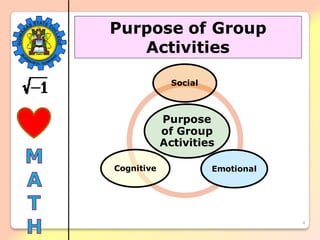
Purpose of Group
Activities
Purpose
of Group
Activities
Social
EmotionalCognitive
5
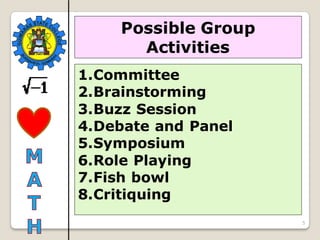
Possible Group
Activities
1.Committee
2.Brainstorming
3.Buzz Session
4.Debate and Panel
5.Symposium
6.Role Playing
7.Fish bowl
8.Critiquing
6
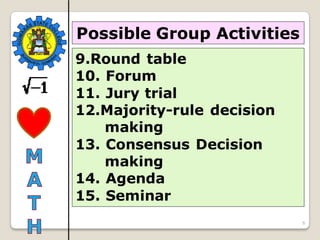
Possible Group Activities
9.Round table
10. Forum
11. Jury trial
12.Majority-rule decision
making
13. Consensus Decision
making
14. Agenda
15. Seminar
7
Collaborative learning is
a method of teaching and
learning in which
students team together
to explore a significant
question or create a
meaningful knowledge.
COOPERATIVE AND
COLLABORATIVE LEARNING
8
a specific kind of
collaborative learning
where students work
together in small groups
on a structured activity.
They are individually
accountable for their
work,
COOPERATIVE
LEARNING
9
and the work of the
group as a whole is also
assessed.
Cooperative groups work
face-to-face and learn to
work as a team.
10
Paradigm shift of education
CALLS for the departure
from the traditional
teaching methods which
are primarily Teacher-
Centered into a Student-
Centered Learning
Environment.
Why cooperative and
collaborative learning?
11
There are plenty of models
for cooperative and
collaborative teaching
strategies such as JIGSAW
PUZZLE and THINK-PAIR-
SHARE which will be
discussed later on…
Model for cooperative
and collaborative
Learning
12
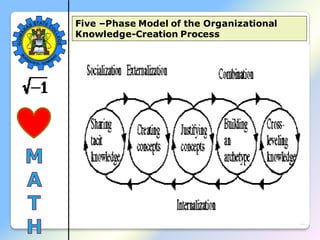
a. Socialization
b. Externalization
c. Combination
d. Internalization
Emphasis on the
following:
13
What is the feature of
each integrated process?
Socialization-involves the
sharing of knowledge
between individuals.
Externalization- this
requires the expression of tacit
knowledge and its translation
into comprehensible forms
that can be understood by
others.
14
Combination-involves the
conversion of explicit
knowledge into more complex
sets of explicit knowledge. This
is fitting the elements of
knowledge together.
Internalization -where newly
created knowledge is
converted from explicit
knowledge into the
organization’s tacit knowledge.
15
How does spiral model
described the model
integration?
--Knowledge creation is a
spiraling process of
interactions between
explicit and tacit knowledge.
--The interactions between
these kinds of knowledge
lead to the creation of new
knowledge.
16
Five –Phase Model of the Organizational
Knowledge-Creation Process
17
Tacit knowledge is highly
personal and hard to formalize.
Subjective insight, intuitions,
and hunches are examples of
tacit knowledge.
Explicit knowledge are the
ones that are learned in the
school. These knowledge are
created thru classroom
session, on the job training and
field trips.
18
Learning activity:
Socialization
Students will form a team
with 5 members, and they will
discuss the Special Products
and Factoring as a preparation
for the problem to be posted
by the teacher on the board
which the group will have to
solve.
Example:
19
Learning activity:
Externalization
The teacher will then
post a problem on the board
and the students will solve
and form a consensus on
the solution they will make
and present it during the
group presentation.
20
Learning activity:
Combination
The agreed solution of
the entire group will then
be written on the paper,
this will be the solution
that they will present to
the class later
on.
21
Learning activity:
Internalization
Aside from the group
solution, each student will
be required to submit
their individual solution to
the problem written in a
piece of paper.
22
Jigsaw method is a
cooperative learning technique
in which students work in small
groups. Jigsaw can be used in a
variety of ways for a variety of
goals, but it is primarily used
for the acquisition and
presentation of new material,
review, or informed debate.
This in invented by Elliot
Aronson in 1971.
Jigsaw Method
23
To become an "EXPERT”
In this method, each group
member is assigned to become an
"expert" on some aspect of a unit of
study.
After reading about their area
of expertise, the experts from
different groups meet to discuss
their topic, and then return to their
groups and take turns teaching their
topics to their group mates.
24
This Strategy allows for:
An efficient way to learn
content.
*Development of
listening, engagement,
and empathy skills.
*A way for students to
work independently.
* Interaction among all
students.
25
Classroom application of
the Jigsaw Puzzle Model
EDUCATIONAL GOAL:
The students will be able
to solve 2 problems that would
require them to find the mean,
median, mode and range of
the given data.
OBE Objective can also be used.
26
Learning Objective:
1. To be able to solve 2 problems
that would require them to find the
mean, median, mode and range from
the given data.
2. Divide students into 5- or 6-
person jigsaw groups. The groups
should be diverse in terms of
gender, ethnicity, race, and ability.
3. Appoint one student from each
group as the leader. Initially, this
person should be the most mature
student in the group.
27
Divide the lesson into
4 segments:
(1) Solving for the mean from
grouped, ungrouped data
(2) solving for median from the
given grouped, ungrouped
data
(3) solving for the mode of the
given grouped, ungrouped
data
(4) finding the range of the
given data.
28
Assign each student to learn
one segment, making sure students
have direct access only to their own
segment.
Give students time to read over
their segment at least twice and
become familiar with it. There is no
need for them to memorize it.
29
Form temporary "expert
groups" by having one student
from each jigsaw group join other
students assigned to the same
segment.
Give students in these expert
groups time to discuss the main
points of their segment and to
rehearse the presentations they
will make to their jigsaw group.
30
Bring the students back
into their jigsaw groups.
Ask each student to
present her or his segment to
the group. Encourage others in
the group to ask questions for
clarification.
31
Float from group to group,
observing the process. If any group
is having trouble (e.g., a member is
dominating or disruptive), make an
appropriate
intervention.
Eventually, it's best for the
group leader to handle this task.
Leaders can be trained by
whispering an instruction on how to
intervene, until the leader gets the
hang of it.
Observing the process.
32
Not just fun and games
At the end of the session,
give a quiz on the material so
that students quickly come to
realize that these sessions are
not just fun and games but
really count.
33
Think-Pair-Share
It is a cooperative
discussion strategy developed
by Frank Lyman and his
colleagues in Maryland.
It gets its name from the
three stages of student
action, with emphasis on what
students are to be DOING at
each of those stages.
34
How Does It Work?
The teacher provokes
students’ thinking with a question
or prompt or observation.
The students should take a few
moments (probably not minutes)
just to THINK about the question.
1) Think
35
Using designated
partners, nearby neighbors, or
a desk mate, students PAIR up
to talk about the answer each
came up with. They compare
their mental or written notes
and identify the answers they
think are best, most
convincing, or most unique.
2) Pair
36
3) Share
After students talk in pairs for
a few moments, the teacher calls for
pairs to SHARE their
thinking with the rest of the class.
They can do this by going
around in round-robin fashion,
calling on each pair; or the can take
answers as they are called out (or as
hands are raised).
Often, the teacher or a
designated helper will record these
responses on the board or on the
overhead.
37
Learning Task:
The teacher will provide a
worded problem involving an
area.
Think:
The teacher will allow the
students to individually solve
the problem first.
Example:
38
Pair:
After 5 minutes, the
teacher will ask the students
to find a partner, and discuss
their solutions to each other.
They should come up with a
single solution for the given
problem. While partners are
discussing their solutions, the
teacher will roam around to
see which partnered students
were able to make it correctly
and which are not.
39
Share:
The teacher will randomly
select a partner to share
their solutions to the class by
explaining it in front and
solving it using the
chalkboard.
40
Thank you
for
listening!
41
Book references:
Acero,Victorina O. et.al., Principles and Strategies
of Teaching.Manila:Rex Book Store,Inc.,2000
Corpuz,Brenda B. and Gloria G.Salandanan.
Principles and Strategies of Teaching.Quezon
City: Lorimar Publishing Company,Inc.,2003
Lardizabal,Amparo S. et.al., Principles and
Methods of Teaching.Quezon City: Phoenix
Publishing House,Inc.,1991
Weseley, Allyson J. and Robert McEntarffer.
Psychology.USA:Barron’s Educational
Series,Inc.,2007
42
Portable Document
Format (PDF)
Reference:
mathstrat2.pdf

Small group discussion

  • 1.
  • 2.
    2 Group Activities In variouskinds of group activities, the teacher’s role moves from engineer or director to facilitator or resource person, and many leadership functions transfer from the teacher to the students.
  • 3.
    3 Uses of GroupActivities 1.Help the teachers deal with many kinds of group activities 2.Provide opportunity for the students to plan and develop special projects on which groups can work together 3.Increase the student interaction and socialization
  • 4.
    4 Purpose of Group Activities Purpose ofGroup Activities Social EmotionalCognitive
  • 5.
    5 Possible Group Activities 1.Committee 2.Brainstorming 3.Buzz Session 4.Debateand Panel 5.Symposium 6.Role Playing 7.Fish bowl 8.Critiquing
  • 6.
    6 Possible Group Activities 9.Roundtable 10. Forum 11. Jury trial 12.Majority-rule decision making 13. Consensus Decision making 14. Agenda 15. Seminar
  • 7.
    7 Collaborative learning is amethod of teaching and learning in which students team together to explore a significant question or create a meaningful knowledge. COOPERATIVE AND COLLABORATIVE LEARNING
  • 8.
    8 a specific kindof collaborative learning where students work together in small groups on a structured activity. They are individually accountable for their work, COOPERATIVE LEARNING
  • 9.
    9 and the workof the group as a whole is also assessed. Cooperative groups work face-to-face and learn to work as a team.
  • 10.
    10 Paradigm shift ofeducation CALLS for the departure from the traditional teaching methods which are primarily Teacher- Centered into a Student- Centered Learning Environment. Why cooperative and collaborative learning?
  • 11.
    11 There are plentyof models for cooperative and collaborative teaching strategies such as JIGSAW PUZZLE and THINK-PAIR- SHARE which will be discussed later on… Model for cooperative and collaborative Learning
  • 12.
    12 a. Socialization b. Externalization c.Combination d. Internalization Emphasis on the following:
  • 13.
    13 What is thefeature of each integrated process? Socialization-involves the sharing of knowledge between individuals. Externalization- this requires the expression of tacit knowledge and its translation into comprehensible forms that can be understood by others.
  • 14.
    14 Combination-involves the conversion ofexplicit knowledge into more complex sets of explicit knowledge. This is fitting the elements of knowledge together. Internalization -where newly created knowledge is converted from explicit knowledge into the organization’s tacit knowledge.
  • 15.
    15 How does spiralmodel described the model integration? --Knowledge creation is a spiraling process of interactions between explicit and tacit knowledge. --The interactions between these kinds of knowledge lead to the creation of new knowledge.
  • 16.
    16 Five –Phase Modelof the Organizational Knowledge-Creation Process
  • 17.
    17 Tacit knowledge ishighly personal and hard to formalize. Subjective insight, intuitions, and hunches are examples of tacit knowledge. Explicit knowledge are the ones that are learned in the school. These knowledge are created thru classroom session, on the job training and field trips.
  • 18.
    18 Learning activity: Socialization Students willform a team with 5 members, and they will discuss the Special Products and Factoring as a preparation for the problem to be posted by the teacher on the board which the group will have to solve. Example:
  • 19.
    19 Learning activity: Externalization The teacherwill then post a problem on the board and the students will solve and form a consensus on the solution they will make and present it during the group presentation.
  • 20.
    20 Learning activity: Combination The agreedsolution of the entire group will then be written on the paper, this will be the solution that they will present to the class later on.
  • 21.
    21 Learning activity: Internalization Aside fromthe group solution, each student will be required to submit their individual solution to the problem written in a piece of paper.
  • 22.
    22 Jigsaw method isa cooperative learning technique in which students work in small groups. Jigsaw can be used in a variety of ways for a variety of goals, but it is primarily used for the acquisition and presentation of new material, review, or informed debate. This in invented by Elliot Aronson in 1971. Jigsaw Method
  • 23.
    23 To become an"EXPERT” In this method, each group member is assigned to become an "expert" on some aspect of a unit of study. After reading about their area of expertise, the experts from different groups meet to discuss their topic, and then return to their groups and take turns teaching their topics to their group mates.
  • 24.
    24 This Strategy allowsfor: An efficient way to learn content. *Development of listening, engagement, and empathy skills. *A way for students to work independently. * Interaction among all students.
  • 25.
    25 Classroom application of theJigsaw Puzzle Model EDUCATIONAL GOAL: The students will be able to solve 2 problems that would require them to find the mean, median, mode and range of the given data. OBE Objective can also be used.
  • 26.
    26 Learning Objective: 1. Tobe able to solve 2 problems that would require them to find the mean, median, mode and range from the given data. 2. Divide students into 5- or 6- person jigsaw groups. The groups should be diverse in terms of gender, ethnicity, race, and ability. 3. Appoint one student from each group as the leader. Initially, this person should be the most mature student in the group.
  • 27.
    27 Divide the lessoninto 4 segments: (1) Solving for the mean from grouped, ungrouped data (2) solving for median from the given grouped, ungrouped data (3) solving for the mode of the given grouped, ungrouped data (4) finding the range of the given data.
  • 28.
    28 Assign each studentto learn one segment, making sure students have direct access only to their own segment. Give students time to read over their segment at least twice and become familiar with it. There is no need for them to memorize it.
  • 29.
    29 Form temporary "expert groups"by having one student from each jigsaw group join other students assigned to the same segment. Give students in these expert groups time to discuss the main points of their segment and to rehearse the presentations they will make to their jigsaw group.
  • 30.
    30 Bring the studentsback into their jigsaw groups. Ask each student to present her or his segment to the group. Encourage others in the group to ask questions for clarification.
  • 31.
    31 Float from groupto group, observing the process. If any group is having trouble (e.g., a member is dominating or disruptive), make an appropriate intervention. Eventually, it's best for the group leader to handle this task. Leaders can be trained by whispering an instruction on how to intervene, until the leader gets the hang of it. Observing the process.
  • 32.
    32 Not just funand games At the end of the session, give a quiz on the material so that students quickly come to realize that these sessions are not just fun and games but really count.
  • 33.
    33 Think-Pair-Share It is acooperative discussion strategy developed by Frank Lyman and his colleagues in Maryland. It gets its name from the three stages of student action, with emphasis on what students are to be DOING at each of those stages.
  • 34.
    34 How Does ItWork? The teacher provokes students’ thinking with a question or prompt or observation. The students should take a few moments (probably not minutes) just to THINK about the question. 1) Think
  • 35.
    35 Using designated partners, nearbyneighbors, or a desk mate, students PAIR up to talk about the answer each came up with. They compare their mental or written notes and identify the answers they think are best, most convincing, or most unique. 2) Pair
  • 36.
    36 3) Share After studentstalk in pairs for a few moments, the teacher calls for pairs to SHARE their thinking with the rest of the class. They can do this by going around in round-robin fashion, calling on each pair; or the can take answers as they are called out (or as hands are raised). Often, the teacher or a designated helper will record these responses on the board or on the overhead.
  • 37.
    37 Learning Task: The teacherwill provide a worded problem involving an area. Think: The teacher will allow the students to individually solve the problem first. Example:
  • 38.
    38 Pair: After 5 minutes,the teacher will ask the students to find a partner, and discuss their solutions to each other. They should come up with a single solution for the given problem. While partners are discussing their solutions, the teacher will roam around to see which partnered students were able to make it correctly and which are not.
  • 39.
    39 Share: The teacher willrandomly select a partner to share their solutions to the class by explaining it in front and solving it using the chalkboard.
  • 40.
  • 41.
    41 Book references: Acero,Victorina O.et.al., Principles and Strategies of Teaching.Manila:Rex Book Store,Inc.,2000 Corpuz,Brenda B. and Gloria G.Salandanan. Principles and Strategies of Teaching.Quezon City: Lorimar Publishing Company,Inc.,2003 Lardizabal,Amparo S. et.al., Principles and Methods of Teaching.Quezon City: Phoenix Publishing House,Inc.,1991 Weseley, Allyson J. and Robert McEntarffer. Psychology.USA:Barron’s Educational Series,Inc.,2007
  • 42.