Collaborative
Learning
Seth Allen, MLIS, MA
Instructional Technologist
South College
tinyurl.com/collab-ed
● Define active learning and identify challenges associated
with collaborative learning activities
● Articulate a set of best practices to ensure successful
collaborative learning experiences
● List strategies to overcome common pitfalls of
collaborative learning
● Identify instructional strategies and tools within Moodle to
facilitate collaborative learning
Workshop Objectives
Collaborative
Learning
Defining Collaborative
Learning and Identifying
Challenges
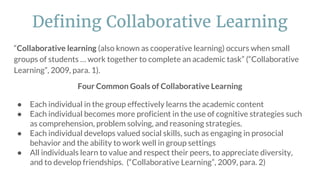
“Collaborative learning (also known as cooperative learning) occurs when small
groups of students … work together to complete an academic task” (“Collaborative
Learning”, 2009, para. 1).
Four Common Goals of Collaborative Learning
● Each individual in the group effectively learns the academic content
● Each individual becomes more proficient in the use of cognitive strategies such
as comprehension, problem solving, and reasoning strategies.
● Each individual develops valued social skills, such as engaging in prosocial
behavior and the ability to work well in group settings
● All individuals learn to value and respect their peers, to appreciate diversity,
and to develop friendships. (“Collaborative Learning”, 2009, para. 2)
Defining Collaborative Learning
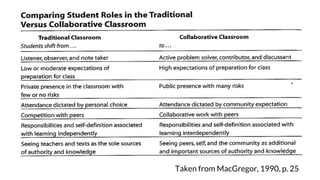
Taken from MacGregor, 1990, p. 25
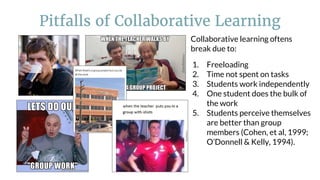
Pitfalls of Collaborative Learning
Collaborative learning oftens
break due to:
1. Freeloading
2. Time not spent on tasks
3. Students work independently
4. One student does the bulk of
the work
5. Students perceive themselves
are better than group
members (Cohen, et al, 1999;
O’Donnell & Kelly, 1994).
Collaborative
Learning
Best Practices for Successful
Cooperative Learning
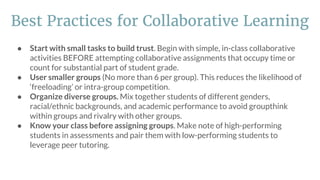
● Start with small tasks to build trust. Begin with simple, in-class collaborative
activities BEFORE attempting collaborative assignments that occupy time or
count for substantial part of student grade.
● User smaller groups (No more than 6 per group). This reduces the likelihood of
‘freeloading’ or intra-group competition.
● Organize diverse groups. Mix together students of different genders,
racial/ethnic backgrounds, and academic performance to avoid groupthink
within groups and rivalry with other groups.
● Know your class before assigning groups. Make note of high-performing
students in assessments and pair them with low-performing students to
leverage peer tutoring.
Best Practices for Collaborative Learning
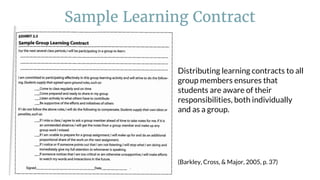
Sample Learning Contract
Distributing learning contracts to all
group members ensures that
students are aware of their
responsibilities, both individually
and as a group.
(Barkley, Cross, & Major, 2005, p. 37)
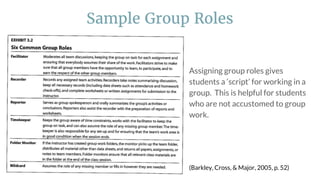
Assigning group roles gives
students a ‘script’ for working in a
group. This is helpful for students
who are not accustomed to group
work.
(Barkley, Cross, & Major, 2005, p. 52)
Sample Group Roles
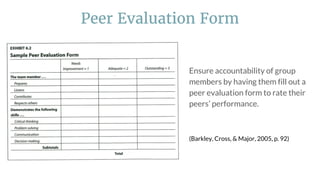
Ensure accountability of group
members by having them fill out a
peer evaluation form to rate their
peers’ performance.
(Barkley, Cross, & Major, 2005, p. 92)
Peer Evaluation Form
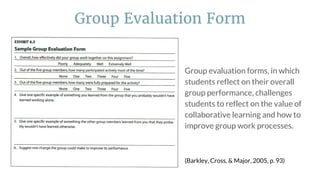
Group evaluation forms, in which
students reflect on their overall
group performance, challenges
students to reflect on the value of
collaborative learning and how to
improve group work processes.
(Barkley, Cross, & Major, 2005, p. 93)
Group Evaluation Form
Collaborative
Learning
Launching Your Own
Collaborative Learning
Activities
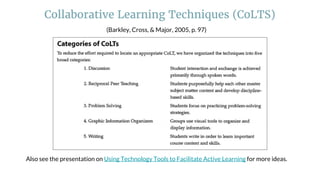
Collaborative Learning Techniques (CoLTS)
(Barkley, Cross, & Major, 2005, p. 97)
Also see the presentation on Using Technology Tools to Facilitate Active Learning for more ideas.
The following activities in Moodle can be used to administer collaborative learning
techniques:
● Workshop
● Database
● Glossary
● Forum
The Workshop activity allows you to create a peer-tutoring assignment. In this
activity, students will submit a work, then grade their peers’ assignments, and
receive a composite grade based on their original submission and the average of
their peers’ assessments.
To see a full tutorial, please visit the ITECH site.
Administering CoLTS in Moodle
Collaborative
Learning
Digging Deeper into the
Theories and Practices
associated with
Collaborative Learning
Barkley, E.E., Cross, P.K., & C.H. Major. (2005). Collaborative learning techniques. San Francisco:
Jossey-Bass.
Cohen, E. G., Lotan, R. A., Scarloss, B. A., & Arellano, A. R. (1999). Complex instruction: Equity in
cooperative learning classrooms. Theory Into Practice, 38(2), 80-86.
Collaborative Learning. (2009). In E. M. Anderman & L. H. Anderman (Eds.), Psychology of Classroom
Learning: An Encyclopedia (Vol. 1, pp. 214-219). Detroit: Macmillan Reference USA. Retrieved from
http://libezp.nmsu.edu:2249/ps/i.do?p=GVRL&sw=w&u=nm_a_nmlascr&v=2.1&it=r&id=GALE%7C
CX3027800065&asid=eebd58405242a251e27746059fa4b65f
MacGregor, J. (1990). Collaborative learning: Shared inquiry as a process of reform. New Directions
for Teaching and Learning, 1990(42), 19-30.
O'Donnell, A. M., & O'Kelly, J. (1994). Learning from peers: Beyond the rhetoric of positive results.
Educational Psychology Review, 6(4), 321.
Works Cited
Goodsell, A. S. (1992). Collaborative learning: A sourcebook for higher education.
University Park, PA: National Center on Postsecondary Teaching, Learning, and
Assessment (NCTLA).
Mazur, E. (1997, March). Peer instruction: Getting students to think in class. In AIP
Conference Proceedings 399(1), pp. 981-988.
Smith, B. L., & Mccann, J. E. (2001). Reinventing ourselves: Interdisciplinary education,
collaborative learning, and experimentation in higher education. Bolton, MA: Anker
Publishing Company.
Slavin, R. E. (1990). Cooperative learning: Theory, research, and practice. Prentice-Hall,.
Stein, R.F., & Hurd, S. (2000). Using student teams in the classroom. Bolton, MA: Anker
Publishing Company.
For Further Reading

Collaborative Learning

  • 1.
    Collaborative Learning Seth Allen, MLIS,MA Instructional Technologist South College tinyurl.com/collab-ed
  • 2.
    ● Define activelearning and identify challenges associated with collaborative learning activities ● Articulate a set of best practices to ensure successful collaborative learning experiences ● List strategies to overcome common pitfalls of collaborative learning ● Identify instructional strategies and tools within Moodle to facilitate collaborative learning Workshop Objectives
  • 3.
  • 4.
    “Collaborative learning (alsoknown as cooperative learning) occurs when small groups of students … work together to complete an academic task” (“Collaborative Learning”, 2009, para. 1). Four Common Goals of Collaborative Learning ● Each individual in the group effectively learns the academic content ● Each individual becomes more proficient in the use of cognitive strategies such as comprehension, problem solving, and reasoning strategies. ● Each individual develops valued social skills, such as engaging in prosocial behavior and the ability to work well in group settings ● All individuals learn to value and respect their peers, to appreciate diversity, and to develop friendships. (“Collaborative Learning”, 2009, para. 2) Defining Collaborative Learning
  • 5.
  • 6.
    Pitfalls of CollaborativeLearning Collaborative learning oftens break due to: 1. Freeloading 2. Time not spent on tasks 3. Students work independently 4. One student does the bulk of the work 5. Students perceive themselves are better than group members (Cohen, et al, 1999; O’Donnell & Kelly, 1994).
  • 7.
    Collaborative Learning Best Practices forSuccessful Cooperative Learning
  • 8.
    ● Start withsmall tasks to build trust. Begin with simple, in-class collaborative activities BEFORE attempting collaborative assignments that occupy time or count for substantial part of student grade. ● User smaller groups (No more than 6 per group). This reduces the likelihood of ‘freeloading’ or intra-group competition. ● Organize diverse groups. Mix together students of different genders, racial/ethnic backgrounds, and academic performance to avoid groupthink within groups and rivalry with other groups. ● Know your class before assigning groups. Make note of high-performing students in assessments and pair them with low-performing students to leverage peer tutoring. Best Practices for Collaborative Learning
  • 9.
    Sample Learning Contract Distributinglearning contracts to all group members ensures that students are aware of their responsibilities, both individually and as a group. (Barkley, Cross, & Major, 2005, p. 37)
  • 10.
    Assigning group rolesgives students a ‘script’ for working in a group. This is helpful for students who are not accustomed to group work. (Barkley, Cross, & Major, 2005, p. 52) Sample Group Roles
  • 11.
    Ensure accountability ofgroup members by having them fill out a peer evaluation form to rate their peers’ performance. (Barkley, Cross, & Major, 2005, p. 92) Peer Evaluation Form
  • 12.
    Group evaluation forms,in which students reflect on their overall group performance, challenges students to reflect on the value of collaborative learning and how to improve group work processes. (Barkley, Cross, & Major, 2005, p. 93) Group Evaluation Form
  • 13.
  • 14.
    Collaborative Learning Techniques(CoLTS) (Barkley, Cross, & Major, 2005, p. 97) Also see the presentation on Using Technology Tools to Facilitate Active Learning for more ideas.
  • 15.
    The following activitiesin Moodle can be used to administer collaborative learning techniques: ● Workshop ● Database ● Glossary ● Forum The Workshop activity allows you to create a peer-tutoring assignment. In this activity, students will submit a work, then grade their peers’ assignments, and receive a composite grade based on their original submission and the average of their peers’ assessments. To see a full tutorial, please visit the ITECH site. Administering CoLTS in Moodle
  • 16.
    Collaborative Learning Digging Deeper intothe Theories and Practices associated with Collaborative Learning
  • 17.
    Barkley, E.E., Cross,P.K., & C.H. Major. (2005). Collaborative learning techniques. San Francisco: Jossey-Bass. Cohen, E. G., Lotan, R. A., Scarloss, B. A., & Arellano, A. R. (1999). Complex instruction: Equity in cooperative learning classrooms. Theory Into Practice, 38(2), 80-86. Collaborative Learning. (2009). In E. M. Anderman & L. H. Anderman (Eds.), Psychology of Classroom Learning: An Encyclopedia (Vol. 1, pp. 214-219). Detroit: Macmillan Reference USA. Retrieved from http://libezp.nmsu.edu:2249/ps/i.do?p=GVRL&sw=w&u=nm_a_nmlascr&v=2.1&it=r&id=GALE%7C CX3027800065&asid=eebd58405242a251e27746059fa4b65f MacGregor, J. (1990). Collaborative learning: Shared inquiry as a process of reform. New Directions for Teaching and Learning, 1990(42), 19-30. O'Donnell, A. M., & O'Kelly, J. (1994). Learning from peers: Beyond the rhetoric of positive results. Educational Psychology Review, 6(4), 321. Works Cited
  • 18.
    Goodsell, A. S.(1992). Collaborative learning: A sourcebook for higher education. University Park, PA: National Center on Postsecondary Teaching, Learning, and Assessment (NCTLA). Mazur, E. (1997, March). Peer instruction: Getting students to think in class. In AIP Conference Proceedings 399(1), pp. 981-988. Smith, B. L., & Mccann, J. E. (2001). Reinventing ourselves: Interdisciplinary education, collaborative learning, and experimentation in higher education. Bolton, MA: Anker Publishing Company. Slavin, R. E. (1990). Cooperative learning: Theory, research, and practice. Prentice-Hall,. Stein, R.F., & Hurd, S. (2000). Using student teams in the classroom. Bolton, MA: Anker Publishing Company. For Further Reading