S
Think-Pair-Share
By:
Francesco Merenda
Think-Pair-Share
S An equity pedagogical best practice to increase and vary
student participation within the classroom that was
developed by Dr. Frank Lyman in 1981.
S Consists of 3 tier system that dissects a question
introduced by the instructor.
S Think-each member silently thinks about question
presented.
S Pair-Two members are paired to discuss their responses.
S Share-Each member may share their response with the
class.
Utilization of Think-Pair-Share
S The strategy can be used in all aspects of a given lesson.
S Pre-reading-notify teacher of student background
knowledge on the subject matter.
S During reading-Used as an excellent form of discussion to
relay ideas to the given subject area.
S Post-reading-Used to sum up the main ideas of the lesson.
S The technique is good for generating class discussion
and sharing of opinions and ideas.
Think-Pair-Share
S Strategy provides students with “think time” to reflect and compose their
answer.
S “Behavioral Rehearsal time” for practicing stating their thoughts without a
classmate.
S “Student discussion” for practicing speaking and creating class
discussions.
S Can be used with all learners K-12 in any content area.
S Group sizes can vary from 2-4 students.
S Strategy can be utilized with all diverse learners (Resource, ELL, etc.)
because of comfort level with one partner and the ability to practice their
ideas.
Think-Pair-Share: Content Area
Ideas
S Foreign Language-To demonstrate different menu options for a
restaurant and share ideas of possible items to include from a
foreign country.
S Science-To demonstrate braking distance importance.
Compare 3 different speeds, how does the stopping distance
change?
S Math-To demonstrate math problem solving abilities, place a
complex math problem on the board and allow students to use
strategies to find answers, but let them discuss their strategies
before revealing answer to question.
Think-Pair-Share: Content Area
Ideas
S Social Science-to demonstrate the understanding of due
process from the United States Constitution.
S P.E.-To demonstrate knowledge of good stretches for
students to avoid injury.
S Art-To demonstrate elements of artistic compositions,
discuss symbolisym in artwork and analyze use of color
and line in works of art.
Think-Pair-Share: Content Area
Ideas
S Music-Identify elements of musical compositions, identify
musical instruments and compare and contrast types of
music.
S English-To demonstrate students can discuss ways to
revise a piece of writing and discuss story ideas for a
selection of writing.
Research Article
S Fitzgerald, D. D. (2013). Employing think-pair-share in
associate degree nursing curriculum. Teaching And
Learning In Nursing, 8(3), 88-90.
doi:10.1016/j.teln.2013.01.006
S Available at:
http://www.sciencedirect.com.ezp.sxu.edu/science/article/
pii/S1557308713000073
Research Article
S Case study of students in an associate degree nursing
program that were introduced to Think-Pair-Share.
S Content Area-Science
S Problem-students found their work to be rigorous, but not
engaging nor interesting.
S Passive learning roles were assumed by many of the
students in the program.
Research Article
S Professor of class decided to utilize Think-Pair-Share to
create a more engaging environment for students.
S Students would receive a list of questions that they would
have to answer. All students would receive 15-20 minutes
to think about questions, then 10-15 minutes to
collaborate with classmates.
S Teacher would use the remaining time of class to
complete step 3 and facilitate a discussion.
Research Article
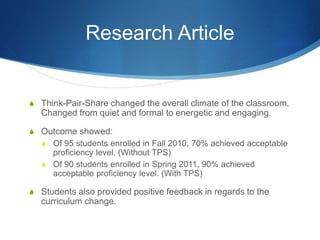
S Think-Pair-Share changed the overall climate of the classroom.
Changed from quiet and formal to energetic and engaging.
S Outcome showed:
S Of 95 students enrolled in Fall 2010, 70% achieved acceptable
proficiency level. (Without TPS)
S Of 90 students enrolled in Spring 2011, 90% achieved
acceptable proficiency level. (With TPS)
S Students also provided positive feedback in regards to the
curriculum change.
Research Article
S Employing think-pair-share improved overall student
classroom engagement and outcomes on proficiency
assessments.
S Increased student preparation for class along with
confidence of students with course material.
S Increased engagement of students has a direct impact on
learning outcomes.
Connection to CCSS
S CCSS.ELA-LITERACY.RL.11-12.1
S Cite strong and thorough textual evidence to support analysis of what
the text says explicitly as well as inferences drawn from the text,
including determining where the text leaves matters uncertain.
S Central ideas must be discussed along with evidence from the
text.
S CCSS.ELA-LITERACY.W.11-12.1
S Write arguments to support claims in an analysis of substantive topics
or texts, using valid reasoning and relevant and sufficient evidence.
S Key for asserting and defending ideas about a particular subject
when working in a group setting.
Connection to CCSS
S CCSS.ELA-LITERACY.SL.11-12.1
S Initiate and participate effectively in a range of collaborative discussions (one-on-one,
in groups, and teacher-led) with diverse partners on grades 11-12 topics, texts, and
issues, building on others' ideas and expressing their own clearly and persuasively.
S Main component of strategy that analyzes understanding of students in relation
to the given information.
S CCSS.ELA-LITERACY.SL.11-12.1.C
S Propel conversations by posing and responding to questions that probe reasoning and
evidence; ensure a hearing for a full range of positions on a topic or issue; clarify,
verify, or challenge ideas and conclusions; and promote divergent and creative
perspectives.
S Students have to continue discussions with their classmates in order to come to
a conclusion and share the information with the class.
Connection to CCSS
S CCSS.ELA-LITERACY.L.11-12.1
S Demonstrate command of the conventions of standard
English grammar and usage when writing or speaking.
S Students have to be able to articulate their ideas to one
another for strategy to be effective.
Additional Resources
S For an in-depth look at Think-Pair-Share in a PowerPoint
format, this file will provide more answers to the specific
strategy.
S pd.dpsnc.net/modules/Adol_Lit/thinkpairshare-nolinks.ppt
S For a great explanation through video of Think-Pair-
Share and elaboration on the strategy, this link will
suffice.
S https://www.youtube.com/watch?v=-9AWNl-A-34
Practicing Think-Pair-Share
S 2 short motivational stories that relate to life.
S After reading the passages, students will write about a
motivational moment in their life that really affected them in a
positive way.
S Students will then gather into groups of 2 or 3 and discuss their
motivational moment.
S Students must also relate their moment to either the Potato,
eggs or coffee beans.
Modifications to Think-Pair-
Share
S Think-Pair-Share (Listen)-Instead of students sharing their own
ideas, they share the ideas of their partner.
S Formulate-Share-Listen-Create-Students formulate their own
question, share their answer, listen to their partner’s answer and
create a new answer that incorporates all the best of ideas.
S Mix-Pair-Share-Students walk around room with no talking
allowed. When teacher says pair, students pair up with the person
closest to them and share their idea.
S Think-Tech-Share-Students can use technology programs such as
Twitter, texting or blogging to complete the same process.
References
S Lyman, F. (1981). The Responsive Classroom Discussion: The
Inclusion of All Students.Mainstreaming Digest. University of
Maryland, College Park, MD.
S Davidson, N., & Worsham, T. (Eds.) (1992). Enhancing thinking
through cooperative learning. New York: Teachers College Press.
S Tyminski, A. M., Richardson, S., & Winarski, E. (2010). Enhancing
think-pair-share. Teaching Children Mathematics, (8), 451.
S Fisher, D., & Frey, N. (2012). Improving adolescent literacy:
Content area strategies at work (3rd edition.). Boston: Allyn &
Bacon.

Think pair-share

  • 1.
  • 2.
    Think-Pair-Share S An equitypedagogical best practice to increase and vary student participation within the classroom that was developed by Dr. Frank Lyman in 1981. S Consists of 3 tier system that dissects a question introduced by the instructor. S Think-each member silently thinks about question presented. S Pair-Two members are paired to discuss their responses. S Share-Each member may share their response with the class.
  • 3.
    Utilization of Think-Pair-Share SThe strategy can be used in all aspects of a given lesson. S Pre-reading-notify teacher of student background knowledge on the subject matter. S During reading-Used as an excellent form of discussion to relay ideas to the given subject area. S Post-reading-Used to sum up the main ideas of the lesson. S The technique is good for generating class discussion and sharing of opinions and ideas.
  • 4.
    Think-Pair-Share S Strategy providesstudents with “think time” to reflect and compose their answer. S “Behavioral Rehearsal time” for practicing stating their thoughts without a classmate. S “Student discussion” for practicing speaking and creating class discussions. S Can be used with all learners K-12 in any content area. S Group sizes can vary from 2-4 students. S Strategy can be utilized with all diverse learners (Resource, ELL, etc.) because of comfort level with one partner and the ability to practice their ideas.
  • 5.
    Think-Pair-Share: Content Area Ideas SForeign Language-To demonstrate different menu options for a restaurant and share ideas of possible items to include from a foreign country. S Science-To demonstrate braking distance importance. Compare 3 different speeds, how does the stopping distance change? S Math-To demonstrate math problem solving abilities, place a complex math problem on the board and allow students to use strategies to find answers, but let them discuss their strategies before revealing answer to question.
  • 6.
    Think-Pair-Share: Content Area Ideas SSocial Science-to demonstrate the understanding of due process from the United States Constitution. S P.E.-To demonstrate knowledge of good stretches for students to avoid injury. S Art-To demonstrate elements of artistic compositions, discuss symbolisym in artwork and analyze use of color and line in works of art.
  • 7.
    Think-Pair-Share: Content Area Ideas SMusic-Identify elements of musical compositions, identify musical instruments and compare and contrast types of music. S English-To demonstrate students can discuss ways to revise a piece of writing and discuss story ideas for a selection of writing.
  • 8.
    Research Article S Fitzgerald,D. D. (2013). Employing think-pair-share in associate degree nursing curriculum. Teaching And Learning In Nursing, 8(3), 88-90. doi:10.1016/j.teln.2013.01.006 S Available at: http://www.sciencedirect.com.ezp.sxu.edu/science/article/ pii/S1557308713000073
  • 9.
    Research Article S Casestudy of students in an associate degree nursing program that were introduced to Think-Pair-Share. S Content Area-Science S Problem-students found their work to be rigorous, but not engaging nor interesting. S Passive learning roles were assumed by many of the students in the program.
  • 10.
    Research Article S Professorof class decided to utilize Think-Pair-Share to create a more engaging environment for students. S Students would receive a list of questions that they would have to answer. All students would receive 15-20 minutes to think about questions, then 10-15 minutes to collaborate with classmates. S Teacher would use the remaining time of class to complete step 3 and facilitate a discussion.
  • 11.
    Research Article S Think-Pair-Sharechanged the overall climate of the classroom. Changed from quiet and formal to energetic and engaging. S Outcome showed: S Of 95 students enrolled in Fall 2010, 70% achieved acceptable proficiency level. (Without TPS) S Of 90 students enrolled in Spring 2011, 90% achieved acceptable proficiency level. (With TPS) S Students also provided positive feedback in regards to the curriculum change.
  • 12.
    Research Article S Employingthink-pair-share improved overall student classroom engagement and outcomes on proficiency assessments. S Increased student preparation for class along with confidence of students with course material. S Increased engagement of students has a direct impact on learning outcomes.
  • 13.
    Connection to CCSS SCCSS.ELA-LITERACY.RL.11-12.1 S Cite strong and thorough textual evidence to support analysis of what the text says explicitly as well as inferences drawn from the text, including determining where the text leaves matters uncertain. S Central ideas must be discussed along with evidence from the text. S CCSS.ELA-LITERACY.W.11-12.1 S Write arguments to support claims in an analysis of substantive topics or texts, using valid reasoning and relevant and sufficient evidence. S Key for asserting and defending ideas about a particular subject when working in a group setting.
  • 14.
    Connection to CCSS SCCSS.ELA-LITERACY.SL.11-12.1 S Initiate and participate effectively in a range of collaborative discussions (one-on-one, in groups, and teacher-led) with diverse partners on grades 11-12 topics, texts, and issues, building on others' ideas and expressing their own clearly and persuasively. S Main component of strategy that analyzes understanding of students in relation to the given information. S CCSS.ELA-LITERACY.SL.11-12.1.C S Propel conversations by posing and responding to questions that probe reasoning and evidence; ensure a hearing for a full range of positions on a topic or issue; clarify, verify, or challenge ideas and conclusions; and promote divergent and creative perspectives. S Students have to continue discussions with their classmates in order to come to a conclusion and share the information with the class.
  • 15.
    Connection to CCSS SCCSS.ELA-LITERACY.L.11-12.1 S Demonstrate command of the conventions of standard English grammar and usage when writing or speaking. S Students have to be able to articulate their ideas to one another for strategy to be effective.
  • 16.
    Additional Resources S Foran in-depth look at Think-Pair-Share in a PowerPoint format, this file will provide more answers to the specific strategy. S pd.dpsnc.net/modules/Adol_Lit/thinkpairshare-nolinks.ppt S For a great explanation through video of Think-Pair- Share and elaboration on the strategy, this link will suffice. S https://www.youtube.com/watch?v=-9AWNl-A-34
  • 17.
    Practicing Think-Pair-Share S 2short motivational stories that relate to life. S After reading the passages, students will write about a motivational moment in their life that really affected them in a positive way. S Students will then gather into groups of 2 or 3 and discuss their motivational moment. S Students must also relate their moment to either the Potato, eggs or coffee beans.
  • 18.
    Modifications to Think-Pair- Share SThink-Pair-Share (Listen)-Instead of students sharing their own ideas, they share the ideas of their partner. S Formulate-Share-Listen-Create-Students formulate their own question, share their answer, listen to their partner’s answer and create a new answer that incorporates all the best of ideas. S Mix-Pair-Share-Students walk around room with no talking allowed. When teacher says pair, students pair up with the person closest to them and share their idea. S Think-Tech-Share-Students can use technology programs such as Twitter, texting or blogging to complete the same process.
  • 19.
    References S Lyman, F.(1981). The Responsive Classroom Discussion: The Inclusion of All Students.Mainstreaming Digest. University of Maryland, College Park, MD. S Davidson, N., & Worsham, T. (Eds.) (1992). Enhancing thinking through cooperative learning. New York: Teachers College Press. S Tyminski, A. M., Richardson, S., & Winarski, E. (2010). Enhancing think-pair-share. Teaching Children Mathematics, (8), 451. S Fisher, D., & Frey, N. (2012). Improving adolescent literacy: Content area strategies at work (3rd edition.). Boston: Allyn & Bacon.