Research
Taylor Fenwick
Terminology
• Circulation
– How many copies of a product have been distributed.
• Hits
– How many times a certain webpage has been viewed.
• Box Office Figures
– How much money the franchise makes off the cinema
screenings for their films.
• Ratings
– How much something has been rated, for example 1-5
stars, etc.
• Sales
– How many products have been sold.
Primary Research
• Definition
- This is when the research is done independently and the audience has a connection with the
researcher. An example of this could be an interview.
• Advantages
- You can find your own research to help with information for your own work.
- You could also ask extra questions in an interview if you had done your research.
• Disadvantages
- Setting up research can take a long time to do, then you have to gather it all together and present it to
the audience.
- Finding the right people can sometimes be a challenge too.
• Example
- An example of this would be a survey/questionnaire.
Secondary Research
• Definition
– Studying research that has already been published and/or using the
same research for your own project.
• Advantages
– The research has already been published for you to copy.
– A wide range of resources can be available.
• Disadvantages
– You are putting all your reliability on someone else’s research.
– It may not be what you was looking for.
– It may not be easy to find.
• Example
- Internet Research
- Library Resources
Quantitative Research
• Definition
– Research that is put into quantities such as fractions, percentages and
numbers.
• Advantages
– You can be more organised with your research if it is placed into
quantities.
• Disadvantages
– Some people find their research put into writing instead of quantities
and statistics.
• Example
- An example of this would be a pie chart of information.
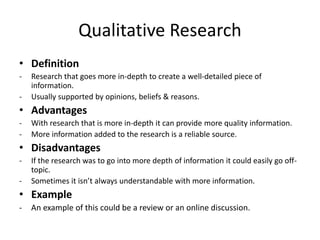
Qualitative Research
• Definition
- Research that goes more in-depth to create a well-detailed piece of
information.
- Usually supported by opinions, beliefs & reasons.
• Advantages
- With research that is more in-depth it can provide more quality information.
- More information added to the research is a reliable source.
• Disadvantages
- If the research was to go into more depth of information it could easily go off-
topic.
- Sometimes it isn’t always understandable with more information.
• Example
- An example of this could be a review or an online discussion.
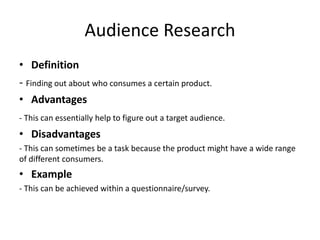
Audience Research
• Definition
- Finding out about who consumes a certain product.
• Advantages
- This can essentially help to figure out a target audience.
• Disadvantages
- This can sometimes be a task because the product might have a wide range
of different consumers.
• Example
- This can be achieved within a questionnaire/survey.
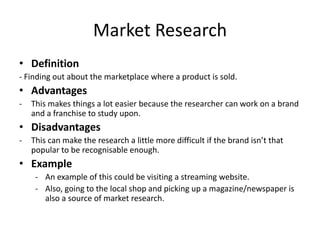
Market Research
• Definition
- Finding out about the marketplace where a product is sold.
• Advantages
- This makes things a lot easier because the researcher can work on a brand
and a franchise to study upon.
• Disadvantages
- This can make the research a little more difficult if the brand isn’t that
popular to be recognisable enough.
• Example
- An example of this could be visiting a streaming website.
- Also, going to the local shop and picking up a magazine/newspaper is
also a source of market research.
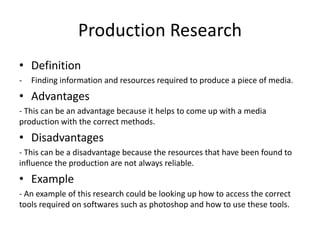
Production Research
• Definition
- Finding information and resources required to produce a piece of media.
• Advantages
- This can be an advantage because it helps to come up with a media
production with the correct methods.
• Disadvantages
- This can be a disadvantage because the resources that have been found to
influence the production are not always reliable.
• Example
- An example of this research could be looking up how to access the correct
tools required on softwares such as photoshop and how to use these tools.
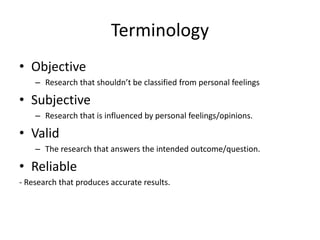
Terminology
• Objective
– Research that shouldn’t be classified from personal feelings
• Subjective
– Research that is influenced by personal feelings/opinions.
• Valid
– The research that answers the intended outcome/question.
• Reliable
- Research that produces accurate results.
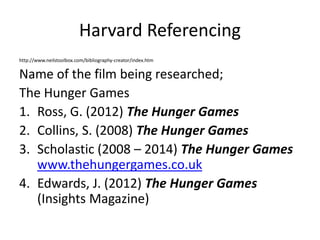
Harvard Referencing
http://www.neilstoolbox.com/bibliography-creator/index.htm
Name of the film being researched;
The Hunger Games
1. Ross, G. (2012) The Hunger Games
2. Collins, S. (2008) The Hunger Games
3. Scholastic (2008 – 2014) The Hunger Games
www.thehungergames.co.uk
4. Edwards, J. (2012) The Hunger Games
(Insights Magazine)

Theory- Meaning Pro

  • 1.
  • 2.
    Terminology • Circulation – Howmany copies of a product have been distributed. • Hits – How many times a certain webpage has been viewed. • Box Office Figures – How much money the franchise makes off the cinema screenings for their films. • Ratings – How much something has been rated, for example 1-5 stars, etc. • Sales – How many products have been sold.
  • 3.
    Primary Research • Definition -This is when the research is done independently and the audience has a connection with the researcher. An example of this could be an interview. • Advantages - You can find your own research to help with information for your own work. - You could also ask extra questions in an interview if you had done your research. • Disadvantages - Setting up research can take a long time to do, then you have to gather it all together and present it to the audience. - Finding the right people can sometimes be a challenge too. • Example - An example of this would be a survey/questionnaire.
  • 4.
    Secondary Research • Definition –Studying research that has already been published and/or using the same research for your own project. • Advantages – The research has already been published for you to copy. – A wide range of resources can be available. • Disadvantages – You are putting all your reliability on someone else’s research. – It may not be what you was looking for. – It may not be easy to find. • Example - Internet Research - Library Resources
  • 5.
    Quantitative Research • Definition –Research that is put into quantities such as fractions, percentages and numbers. • Advantages – You can be more organised with your research if it is placed into quantities. • Disadvantages – Some people find their research put into writing instead of quantities and statistics. • Example - An example of this would be a pie chart of information.
  • 6.
    Qualitative Research • Definition -Research that goes more in-depth to create a well-detailed piece of information. - Usually supported by opinions, beliefs & reasons. • Advantages - With research that is more in-depth it can provide more quality information. - More information added to the research is a reliable source. • Disadvantages - If the research was to go into more depth of information it could easily go off- topic. - Sometimes it isn’t always understandable with more information. • Example - An example of this could be a review or an online discussion.
  • 7.
    Audience Research • Definition -Finding out about who consumes a certain product. • Advantages - This can essentially help to figure out a target audience. • Disadvantages - This can sometimes be a task because the product might have a wide range of different consumers. • Example - This can be achieved within a questionnaire/survey.
  • 8.
    Market Research • Definition -Finding out about the marketplace where a product is sold. • Advantages - This makes things a lot easier because the researcher can work on a brand and a franchise to study upon. • Disadvantages - This can make the research a little more difficult if the brand isn’t that popular to be recognisable enough. • Example - An example of this could be visiting a streaming website. - Also, going to the local shop and picking up a magazine/newspaper is also a source of market research.
  • 9.
    Production Research • Definition -Finding information and resources required to produce a piece of media. • Advantages - This can be an advantage because it helps to come up with a media production with the correct methods. • Disadvantages - This can be a disadvantage because the resources that have been found to influence the production are not always reliable. • Example - An example of this research could be looking up how to access the correct tools required on softwares such as photoshop and how to use these tools.
  • 10.
    Terminology • Objective – Researchthat shouldn’t be classified from personal feelings • Subjective – Research that is influenced by personal feelings/opinions. • Valid – The research that answers the intended outcome/question. • Reliable - Research that produces accurate results.
  • 11.
    Harvard Referencing http://www.neilstoolbox.com/bibliography-creator/index.htm Name ofthe film being researched; The Hunger Games 1. Ross, G. (2012) The Hunger Games 2. Collins, S. (2008) The Hunger Games 3. Scholastic (2008 – 2014) The Hunger Games www.thehungergames.co.uk 4. Edwards, J. (2012) The Hunger Games (Insights Magazine)

Editor's Notes

  • #3 Provide definitions for each term
  • #11 Provide definitions
  • #12 1. Film, 2.Book, 3. Website, 4. Magazine Article