Research
Samuel Nixon
Terminology
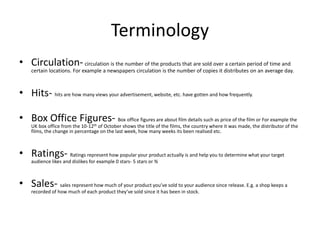
• Circulation-circulation is the number of the products that are sold over a certain period of time and
certain locations. For example a newspapers circulation is the number of copies it distributes on an average day.
• Hits- hits are how many views your advertisement, website, etc. have gotten and how frequently.
• Box Office Figures- Box office figures are about film details such as price of the film or For example the
UK box office from the 10-12th of October shows the title of the films, the country where it was made, the distributor of the
films, the change in percentage on the last week, how many weeks its been realised etc.
• Ratings- Ratings represent how popular your product actually is and help you to determine what your target
audience likes and dislikes for example 0 stars- 5 stars or %
• Sales- sales represent how much of your product you’ve sold to your audience since release. E.g. a shop keeps a
recorded of how much of each product they’ve sold since it has been in stock.
Primary Research
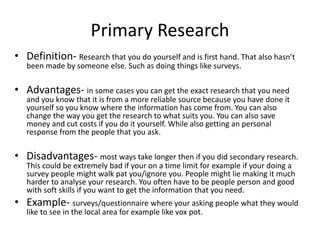
• Definition- Research that you do yourself and is first hand. That also hasn’t
been made by someone else. Such as doing things like surveys.
• Advantages- in some cases you can get the exact research that you need
and you know that it is from a more reliable source because you have done it
yourself so you know where the information has come from. You can also
change the way you get the research to what suits you. You can also save
money and cut costs if you do it yourself. While also getting an personal
response from the people that you ask.
• Disadvantages- most ways take longer then if you did secondary research.
This could be extremely bad if your on a time limit for example if your doing a
survey people might walk pat you/ignore you. People might lie making it much
harder to analyse your research. You often have to be people person and good
with soft skills if you want to get the information that you need.
• Example- surveys/questionnaire where your asking people what they would
like to see in the local area for example like vox pot.
Secondary Research
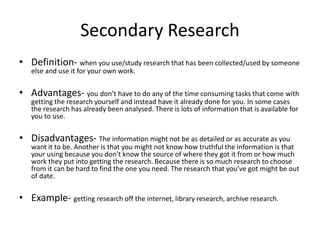
• Definition- when you use/study research that has been collected/used by someone
else and use it for your own work.
• Advantages- you don’t have to do any of the time consuming tasks that come with
getting the research yourself and instead have it already done for you. In some cases
the research has already been analysed. There is lots of information that is available for
you to use.
• Disadvantages- The information might not be as detailed or as accurate as you
want it to be. Another is that you might not know how truthful the information is that
your using because you don’t know the source of where they got it from or how much
work they put into getting the research. Because there is so much research to choose
from it can be hard to find the one you need. The research that you’ve got might be out
of date.
• Example- getting research off the internet, library research, archive research.
Quantitative Research
• Definition- Quantitative research is research that you can put into
numbers, graphs, etc.
• Advantages- it allows the researcher to compare the research that they
have collected easier. It is quick and reliable.
• Disadvantages- a disadvantage of this research is that it isn’t in a lot
of detail. For example if I asked people if they drive a car or not they only
have those two options and cant choose an alternative this is often a yes
or no answer or one word question.
• Example- making a bar chart or pie chart on TV show ratings or something
else where you can turn the data into numbers or percentages so that you can
put it on a graph.
Qualitative Research
• Definition- Qualitative research has a lot of detail about the audience your asking. For
example Quantitative research makes people pick certain options where as this allows them to
say their reasoning behind what they think. This means qualitative research is all about getting
personal information.
• Advantages- it is useful at the start of research when your not sure what to focus on when
researching because you get a range of research to start a foundation. You get a large amount
of information with a large amount of detail with it. People might bring up things that you
didn’t think of allowing you to improve your product so that it attracts more of your target
audience.
• Disadvantages- This data could end up being biased because of the such big role that
the researcher has. It takes a much longer time to analyse your research into a more
quality based research because of the amount of detail in the answers and the fact that
some of the answers might not be accurate.
• Example- reviewing someone, discussion, forums, responses e.g. if a business wants to find
out what people think about their product they might go round asking the public “why do you
like____”
Audience Research
• Definition- finding out about who uses your product and what they like about
it, how often they use it, how it could be improved, etc.
• Advantages- this method gives you a more detailed answer and allows you to
make your product to suit your target audience the best it can not only making
your audience happier but attracting more people to buy your product. Its
easier to marketing your product because you know where your target
audience is based.
• Disadvantages- however this research will take a much longer time then other
methods possibly forcing you to do other important things in a shorter time.
You might end up cutting out features of your product causing you to spend
more time on changing it.
• Example- in the film industry this could mean getting a small group of people
to watch the performance to get a better understanding on how they could
improve it before it is realised into the public. another example could be using
a website that tells you the ratings of what your looking for.
Market Research
• Definition- finding out about the market place where your product is going to be
sold in.
• Advantages- This allows you to know how much competition in this sort of
market you will have to face when trying to sell your product. They can also find out
how to get an advantage over their competitors by finding out what they could have
that their competitors don’t. less risk when you realising your product because you
know your competitors. You are able to see the bad things in the competitors
product and make sure that your product doesn’t have those problems.
• Disadvantages- market research can be expensive depending on the methods
that they use. You could find out there is already an existing product that is like yours
limiting your creativity and not giving you a foothold into the market. It can be time
consuming.
• Example- Pepsi would have had to use a market map to make sure it could
compete with the brand coca cola because of the amount of similarity's they have.
Production Research
• Definition- finding information, resources and tools needed to
produce a peace of media.
• Advantages- it will be quick to make your production because
you have already planned out what you need to do it. You
might find cheaper alternatives so that you can save your
money for a later date when you need it most.
• Disadvantages- one of the peace's of software that you need
could cost a large amount of money that you cant spend.
• Example- you need to find out what resources and tools you
need when creating a film such as scenery, props, actors, etc.
Terminology
• Objective- is when you are describing the factual
things about the product.
• Subjective- when you are describing a product
with your own opinion.
• Valid- something that is correct about the
product or what you are trying to find out.
• Reliable-something that is accurate, truthful and
consistent.
Harvard Referencing
Name of the film being researched; The Hunger
Games
• Ross G and Lawrence F (2012-2015) The Hunger Games, The Hunger
Games Catching fire, The Hunger Games mockingjay part 1, The Hunger
Games mockingjay part 2.
• Collins, S. (2008) The Hunger Games
• Collins, S (2008) The Hunger Games Suzanne Collins
(http://www.thehungergames.co.uk/)
• Leigh, D (2015) How The Hunger Games staged a revolution (theguardian,
arts, film)

Theory research pro-forma

  • 1.
  • 2.
    Terminology • Circulation-circulation isthe number of the products that are sold over a certain period of time and certain locations. For example a newspapers circulation is the number of copies it distributes on an average day. • Hits- hits are how many views your advertisement, website, etc. have gotten and how frequently. • Box Office Figures- Box office figures are about film details such as price of the film or For example the UK box office from the 10-12th of October shows the title of the films, the country where it was made, the distributor of the films, the change in percentage on the last week, how many weeks its been realised etc. • Ratings- Ratings represent how popular your product actually is and help you to determine what your target audience likes and dislikes for example 0 stars- 5 stars or % • Sales- sales represent how much of your product you’ve sold to your audience since release. E.g. a shop keeps a recorded of how much of each product they’ve sold since it has been in stock.
  • 3.
    Primary Research • Definition-Research that you do yourself and is first hand. That also hasn’t been made by someone else. Such as doing things like surveys. • Advantages- in some cases you can get the exact research that you need and you know that it is from a more reliable source because you have done it yourself so you know where the information has come from. You can also change the way you get the research to what suits you. You can also save money and cut costs if you do it yourself. While also getting an personal response from the people that you ask. • Disadvantages- most ways take longer then if you did secondary research. This could be extremely bad if your on a time limit for example if your doing a survey people might walk pat you/ignore you. People might lie making it much harder to analyse your research. You often have to be people person and good with soft skills if you want to get the information that you need. • Example- surveys/questionnaire where your asking people what they would like to see in the local area for example like vox pot.
  • 4.
    Secondary Research • Definition-when you use/study research that has been collected/used by someone else and use it for your own work. • Advantages- you don’t have to do any of the time consuming tasks that come with getting the research yourself and instead have it already done for you. In some cases the research has already been analysed. There is lots of information that is available for you to use. • Disadvantages- The information might not be as detailed or as accurate as you want it to be. Another is that you might not know how truthful the information is that your using because you don’t know the source of where they got it from or how much work they put into getting the research. Because there is so much research to choose from it can be hard to find the one you need. The research that you’ve got might be out of date. • Example- getting research off the internet, library research, archive research.
  • 5.
    Quantitative Research • Definition-Quantitative research is research that you can put into numbers, graphs, etc. • Advantages- it allows the researcher to compare the research that they have collected easier. It is quick and reliable. • Disadvantages- a disadvantage of this research is that it isn’t in a lot of detail. For example if I asked people if they drive a car or not they only have those two options and cant choose an alternative this is often a yes or no answer or one word question. • Example- making a bar chart or pie chart on TV show ratings or something else where you can turn the data into numbers or percentages so that you can put it on a graph.
  • 6.
    Qualitative Research • Definition-Qualitative research has a lot of detail about the audience your asking. For example Quantitative research makes people pick certain options where as this allows them to say their reasoning behind what they think. This means qualitative research is all about getting personal information. • Advantages- it is useful at the start of research when your not sure what to focus on when researching because you get a range of research to start a foundation. You get a large amount of information with a large amount of detail with it. People might bring up things that you didn’t think of allowing you to improve your product so that it attracts more of your target audience. • Disadvantages- This data could end up being biased because of the such big role that the researcher has. It takes a much longer time to analyse your research into a more quality based research because of the amount of detail in the answers and the fact that some of the answers might not be accurate. • Example- reviewing someone, discussion, forums, responses e.g. if a business wants to find out what people think about their product they might go round asking the public “why do you like____”
  • 7.
    Audience Research • Definition-finding out about who uses your product and what they like about it, how often they use it, how it could be improved, etc. • Advantages- this method gives you a more detailed answer and allows you to make your product to suit your target audience the best it can not only making your audience happier but attracting more people to buy your product. Its easier to marketing your product because you know where your target audience is based. • Disadvantages- however this research will take a much longer time then other methods possibly forcing you to do other important things in a shorter time. You might end up cutting out features of your product causing you to spend more time on changing it. • Example- in the film industry this could mean getting a small group of people to watch the performance to get a better understanding on how they could improve it before it is realised into the public. another example could be using a website that tells you the ratings of what your looking for.
  • 8.
    Market Research • Definition-finding out about the market place where your product is going to be sold in. • Advantages- This allows you to know how much competition in this sort of market you will have to face when trying to sell your product. They can also find out how to get an advantage over their competitors by finding out what they could have that their competitors don’t. less risk when you realising your product because you know your competitors. You are able to see the bad things in the competitors product and make sure that your product doesn’t have those problems. • Disadvantages- market research can be expensive depending on the methods that they use. You could find out there is already an existing product that is like yours limiting your creativity and not giving you a foothold into the market. It can be time consuming. • Example- Pepsi would have had to use a market map to make sure it could compete with the brand coca cola because of the amount of similarity's they have.
  • 9.
    Production Research • Definition-finding information, resources and tools needed to produce a peace of media. • Advantages- it will be quick to make your production because you have already planned out what you need to do it. You might find cheaper alternatives so that you can save your money for a later date when you need it most. • Disadvantages- one of the peace's of software that you need could cost a large amount of money that you cant spend. • Example- you need to find out what resources and tools you need when creating a film such as scenery, props, actors, etc.
  • 10.
    Terminology • Objective- iswhen you are describing the factual things about the product. • Subjective- when you are describing a product with your own opinion. • Valid- something that is correct about the product or what you are trying to find out. • Reliable-something that is accurate, truthful and consistent.
  • 11.
    Harvard Referencing Name ofthe film being researched; The Hunger Games • Ross G and Lawrence F (2012-2015) The Hunger Games, The Hunger Games Catching fire, The Hunger Games mockingjay part 1, The Hunger Games mockingjay part 2. • Collins, S. (2008) The Hunger Games • Collins, S (2008) The Hunger Games Suzanne Collins (http://www.thehungergames.co.uk/) • Leigh, D (2015) How The Hunger Games staged a revolution (theguardian, arts, film)

Editor's Notes

  • #3 Provide definitions for each term
  • #11 Provide definitions
  • #12 1. Film, 2.Book, 3. Website, 4. Magazine Article