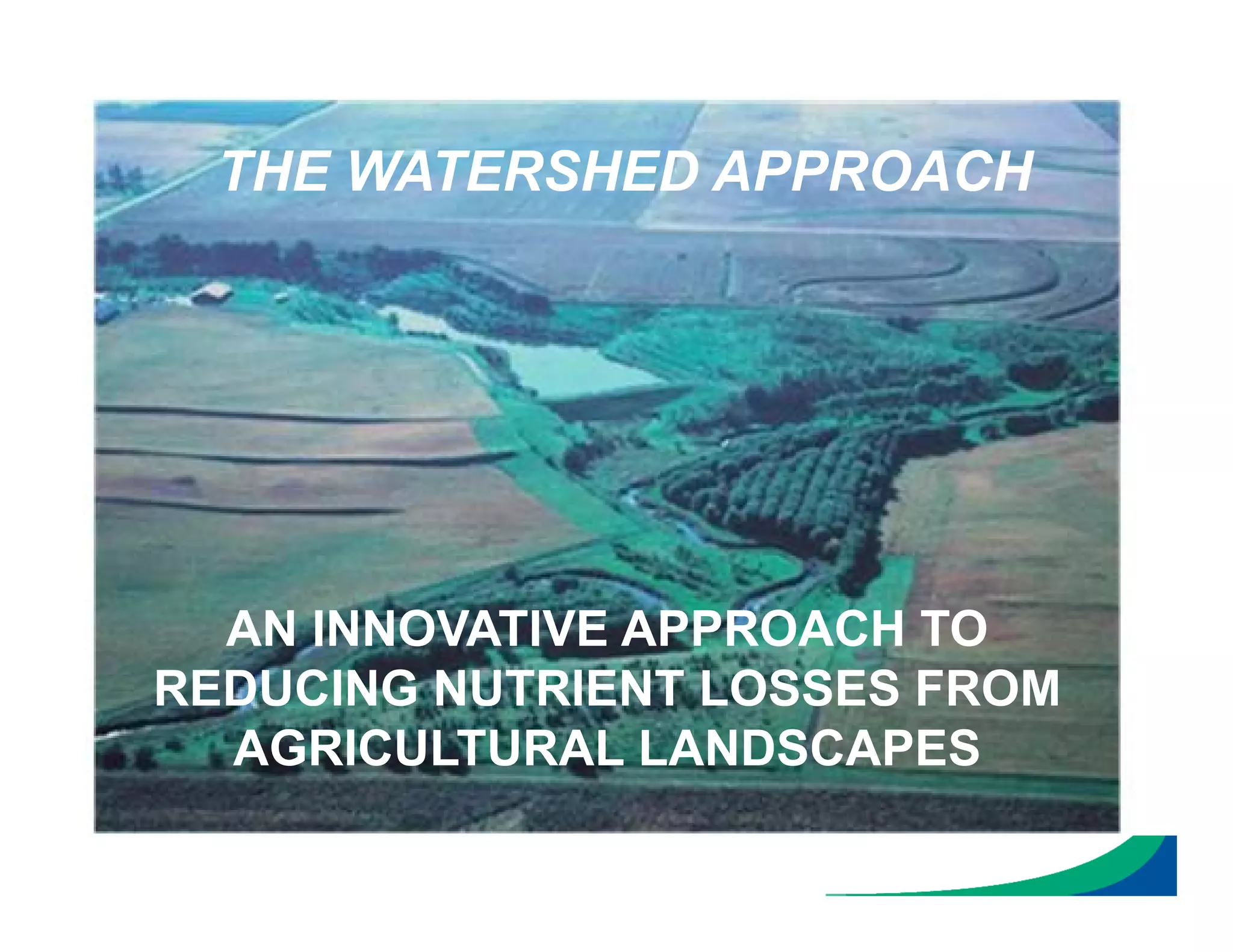
AN INNOVATIVE APPROACH TO
REDUCING NUTRIENT LOSSES FROM
AGRICULTURAL LANDSCAPES
THE WATERSHED APPROACH
Why Do We Need a New Approach to
Conservation?
• Growing awareness of problems associated with nitrogen losses
from agricultural landscapes.
• Reducing nitrogen losses requires a different approach to
agricultural conservation.
• Nitrogen moves primarily with subsurface flows
• Nitrogen-related water quality problems are invisible on the
farm but affect downstream communities at a regional scale
• Past conservation efforts have been very successful in reducing
soil erosion (and phosphorus losses).
• But much more needs to be done to reduce phosphorus losses
from agricultural landscapes.
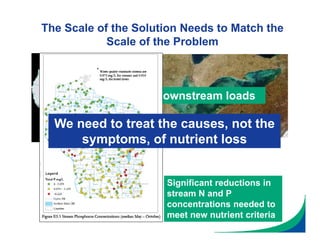
The Scale of the Solution Needs to Match the
Scale of the Problem
45% reduction in downstream loads
Significant reductions in
stream N and P
concentrations needed to
meet new nutrient criteria
We need to treat the causes, not the
symptoms, of nutrient loss
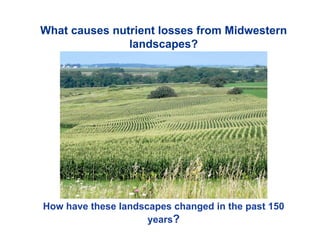
How have these landscapes changed in the past 150
years?
What causes nutrient losses from Midwestern
landscapes?
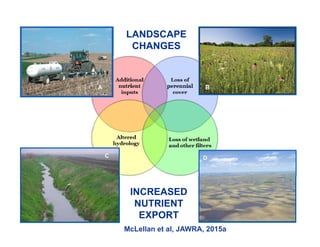
LANDSCAPE
CHANGES
INCREASED
NUTRIENT
EXPORT
McLellan et al, JAWRA, 2015a
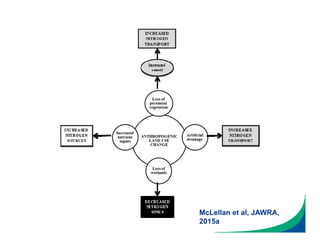
McLellan et al, JAWRA,
2015a
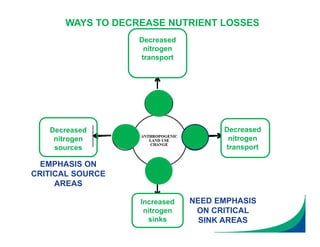
Decreased
nitrogen
transport
Decreased
nitrogen
transport
Decreased
nitrogen
sources
Increased
nitrogen
sinks
WAYS TO DECREASE NUTRIENT LOSSES
EMPHASIS ON
CRITICAL SOURCE
AREAS
NEED EMPHASIS
ON CRITICAL
SINK AREAS
Restoring sinks on 1-2% of the landscape can decrease
downstream nutrient loads by 45% (McLellan et al, JAWRA, 2015)
If we reduce nutrient sources and transport by implementing
improved fertilizer management and cover crops on all
cropland in the Basin, we can reduce downstream nutrient
loads by 30%.
Getting to 45%
Reducing hypoxia in the Gulf of Mexico requires a 45%
reduction in nitrogen loads from the Upper Mississippi-Ohio
River Basin.
Is it realistic to think that all producers in the Basin will
implement improved fertilizer management and cover crops on
all their land?
How do we fill the gap?
McLellan et al, JAWRA, 2015b
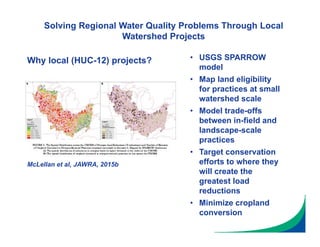
Solving Regional Water Quality Problems Through Local
Watershed Projects
McLellan et al, JAWRA, 2015b
• USGS SPARROW
model
• Map land eligibility
for practices at small
watershed scale
• Model trade-offs
between in-field and
landscape-scale
practices
• Target conservation
efforts to where they
will create the
greatest load
reductions
• Minimize cropland
conversion
Why local (HUC-12) projects?
Decrease N sources:
• Improve nutrient management
• Use extended rotations and/or conservation cover
• Use cover crops
Decrease N transport:
• Use cover crops
• Use conservation tillage (soil water storage)
• Use controlled drainage
• Use water storage structures in the landscape (e.g. ponds, wetlands)
Restore/create N sinks:
• Riparian buffers
• Pothole-type wetlands
• Created wetlands
• Two-stage ditches
• Stream restoration
• Floodplain reconnection
A Systems Approach at Small Watershed Scale
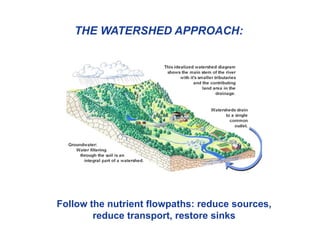
THE WATERSHED APPROACH:
Follow the nutrient flowpaths: reduce sources,
reduce transport, restore sinks
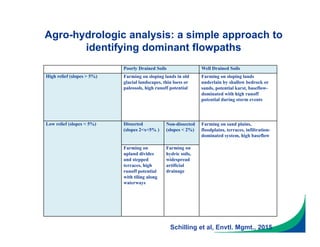
Poorly Drained Soils Well Drained Soils
High relief (slopes > 5%) Farming on sloping lands in old
glacial landscapes, thin loess or
paleosols, high runoff potential
Farming on sloping lands
underlain by shallow bedrock or
sands, potential karst, baseflow-
dominated with high runoff
potential during storm events
Low relief (slopes < 5%) Dissected
(slopes 2<x<5% )
Non-dissected
(slopes < 2%)
Farming on sand plains,
floodplains, terraces, infiltration-
dominated system, high baseflow
Farming on
upland divides
and stepped
terraces, high
runoff potential
with tiling along
waterways
Farming on
hydric soils,
widespread
artificial
drainage
Agro-hydrologic analysis: a simple approach to
identifying dominant flowpaths
Schilling et al, Envtl. Mgmt., 2015
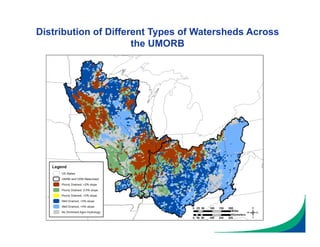
Distribution of Different Types of Watersheds Across
the UMORB
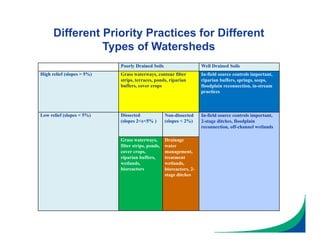
Poorly Drained Soils Well Drained Soils
High relief (slopes > 5%) Grass waterways, contour filter
strips, terraces, ponds, riparian
buffers, cover crops
In-field source controls important,
riparian buffers, springs, seeps,
floodplain reconnection, in-stream
practices
Low relief (slopes < 5%) Dissected
(slopes 2<x<5% )
Non-dissected
(slopes < 2%)
In-field source controls important,
2-stage ditches, floodplain
reconnection, off-channel wetlands
Grass waterways,
filter strips, ponds,
cover crops,
riparian buffers,
wetlands,
bioreactors
Drainage
water
management,
treatment
wetlands,
bioreactors, 2-
stage ditches
Different Priority Practices for Different
Types of Watersheds
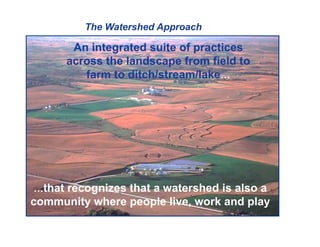
An integrated suite of practices
across the landscape from field to
farm to ditch/stream/lake…
…that recognizes that a watershed is also a
community where people live, work and play
The Watershed Approach
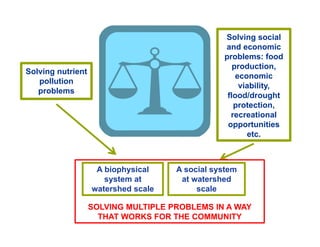
Solving nutrient
pollution
problems
Solving social
and economic
problems: food
production,
economic
viability,
flood/drought
protection,
recreational
opportunities
etc.
A biophysical
system at
watershed scale
A social system
at watershed
scale
SOLVING MULTIPLE PROBLEMS IN A WAY
THAT WORKS FOR THE COMMUNITY
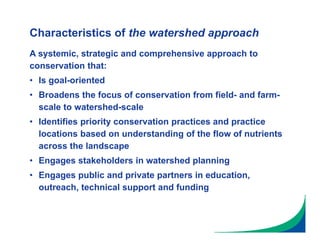
Characteristics of the watershed approach
A systemic, strategic and comprehensive approach to
conservation that:
• Is goal-oriented
• Broadens the focus of conservation from field- and farm-
scale to watershed-scale
• Identifies priority conservation practices and practice
locations based on understanding of the flow of nutrients
across the landscape
• Engages stakeholders in watershed planning
• Engages public and private partners in education,
outreach, technical support and funding
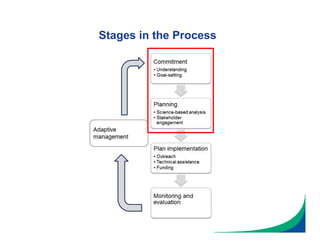
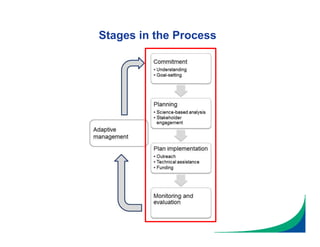
Stages in the Process
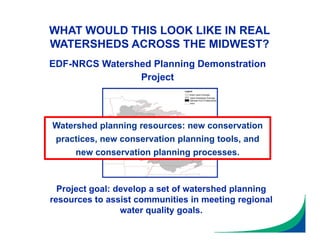
WHAT WOULD THIS LOOK LIKE IN REAL
WATERSHEDS ACROSS THE MIDWEST?
Project goal: develop a set of watershed planning
resources to assist communities in meeting regional
water quality goals.
EDF-NRCS Watershed Planning Demonstration
Project
Watershed planning resources: new conservation
practices, new conservation planning tools, and
new conservation planning processes.
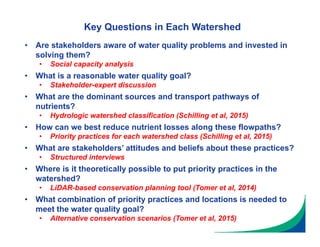
Key Questions in Each Watershed
• Are stakeholders aware of water quality problems and invested in
solving them?
• Social capacity analysis
• What is a reasonable water quality goal?
• Stakeholder-expert discussion
• What are the dominant sources and transport pathways of
nutrients?
• Hydrologic watershed classification (Schilling et al, 2015)
• How can we best reduce nutrient losses along these flowpaths?
• Priority practices for each watershed class (Schilling et al, 2015)
• What are stakeholders’ attitudes and beliefs about these practices?
• Structured interviews
• Where is it theoretically possible to put priority practices in the
watershed?
• LiDAR-based conservation planning tool (Tomer et al, 2014)
• What combination of priority practices and locations is needed to
meet the water quality goal?
• Alternative conservation scenarios (Tomer et al, 2015)
Stages in the Process
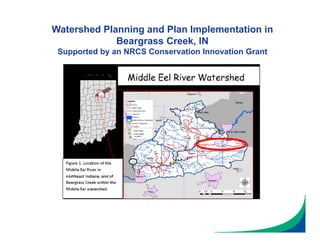
Watershed Planning and Plan Implementation in
Beargrass Creek, IN
Supported by an NRCS Conservation Innovation Grant
The Story Continues…

The watershed approach

  • 1.
    AN INNOVATIVE APPROACHTO REDUCING NUTRIENT LOSSES FROM AGRICULTURAL LANDSCAPES THE WATERSHED APPROACH
  • 2.
    Why Do WeNeed a New Approach to Conservation? • Growing awareness of problems associated with nitrogen losses from agricultural landscapes. • Reducing nitrogen losses requires a different approach to agricultural conservation. • Nitrogen moves primarily with subsurface flows • Nitrogen-related water quality problems are invisible on the farm but affect downstream communities at a regional scale • Past conservation efforts have been very successful in reducing soil erosion (and phosphorus losses). • But much more needs to be done to reduce phosphorus losses from agricultural landscapes.
  • 3.
    The Scale ofthe Solution Needs to Match the Scale of the Problem 45% reduction in downstream loads Significant reductions in stream N and P concentrations needed to meet new nutrient criteria We need to treat the causes, not the symptoms, of nutrient loss
  • 4.
    How have theselandscapes changed in the past 150 years? What causes nutrient losses from Midwestern landscapes?
  • 5.
  • 6.
    McLellan et al,JAWRA, 2015a
  • 7.
    Decreased nitrogen transport Decreased nitrogen transport Decreased nitrogen sources Increased nitrogen sinks WAYS TO DECREASENUTRIENT LOSSES EMPHASIS ON CRITICAL SOURCE AREAS NEED EMPHASIS ON CRITICAL SINK AREAS
  • 8.
    Restoring sinks on1-2% of the landscape can decrease downstream nutrient loads by 45% (McLellan et al, JAWRA, 2015) If we reduce nutrient sources and transport by implementing improved fertilizer management and cover crops on all cropland in the Basin, we can reduce downstream nutrient loads by 30%. Getting to 45% Reducing hypoxia in the Gulf of Mexico requires a 45% reduction in nitrogen loads from the Upper Mississippi-Ohio River Basin. Is it realistic to think that all producers in the Basin will implement improved fertilizer management and cover crops on all their land? How do we fill the gap? McLellan et al, JAWRA, 2015b
  • 9.
    Solving Regional WaterQuality Problems Through Local Watershed Projects McLellan et al, JAWRA, 2015b • USGS SPARROW model • Map land eligibility for practices at small watershed scale • Model trade-offs between in-field and landscape-scale practices • Target conservation efforts to where they will create the greatest load reductions • Minimize cropland conversion Why local (HUC-12) projects?
  • 10.
    Decrease N sources: •Improve nutrient management • Use extended rotations and/or conservation cover • Use cover crops Decrease N transport: • Use cover crops • Use conservation tillage (soil water storage) • Use controlled drainage • Use water storage structures in the landscape (e.g. ponds, wetlands) Restore/create N sinks: • Riparian buffers • Pothole-type wetlands • Created wetlands • Two-stage ditches • Stream restoration • Floodplain reconnection A Systems Approach at Small Watershed Scale
  • 11.
    THE WATERSHED APPROACH: Followthe nutrient flowpaths: reduce sources, reduce transport, restore sinks
  • 12.
    Poorly Drained SoilsWell Drained Soils High relief (slopes > 5%) Farming on sloping lands in old glacial landscapes, thin loess or paleosols, high runoff potential Farming on sloping lands underlain by shallow bedrock or sands, potential karst, baseflow- dominated with high runoff potential during storm events Low relief (slopes < 5%) Dissected (slopes 2<x<5% ) Non-dissected (slopes < 2%) Farming on sand plains, floodplains, terraces, infiltration- dominated system, high baseflow Farming on upland divides and stepped terraces, high runoff potential with tiling along waterways Farming on hydric soils, widespread artificial drainage Agro-hydrologic analysis: a simple approach to identifying dominant flowpaths Schilling et al, Envtl. Mgmt., 2015
  • 13.
    Distribution of DifferentTypes of Watersheds Across the UMORB
  • 14.
    Poorly Drained SoilsWell Drained Soils High relief (slopes > 5%) Grass waterways, contour filter strips, terraces, ponds, riparian buffers, cover crops In-field source controls important, riparian buffers, springs, seeps, floodplain reconnection, in-stream practices Low relief (slopes < 5%) Dissected (slopes 2<x<5% ) Non-dissected (slopes < 2%) In-field source controls important, 2-stage ditches, floodplain reconnection, off-channel wetlands Grass waterways, filter strips, ponds, cover crops, riparian buffers, wetlands, bioreactors Drainage water management, treatment wetlands, bioreactors, 2- stage ditches Different Priority Practices for Different Types of Watersheds
  • 15.
    An integrated suiteof practices across the landscape from field to farm to ditch/stream/lake… …that recognizes that a watershed is also a community where people live, work and play The Watershed Approach
  • 17.
    Solving nutrient pollution problems Solving social andeconomic problems: food production, economic viability, flood/drought protection, recreational opportunities etc. A biophysical system at watershed scale A social system at watershed scale SOLVING MULTIPLE PROBLEMS IN A WAY THAT WORKS FOR THE COMMUNITY
  • 18.
    Characteristics of thewatershed approach A systemic, strategic and comprehensive approach to conservation that: • Is goal-oriented • Broadens the focus of conservation from field- and farm- scale to watershed-scale • Identifies priority conservation practices and practice locations based on understanding of the flow of nutrients across the landscape • Engages stakeholders in watershed planning • Engages public and private partners in education, outreach, technical support and funding
  • 19.
  • 20.
    WHAT WOULD THISLOOK LIKE IN REAL WATERSHEDS ACROSS THE MIDWEST? Project goal: develop a set of watershed planning resources to assist communities in meeting regional water quality goals. EDF-NRCS Watershed Planning Demonstration Project Watershed planning resources: new conservation practices, new conservation planning tools, and new conservation planning processes.
  • 21.
    Key Questions inEach Watershed • Are stakeholders aware of water quality problems and invested in solving them? • Social capacity analysis • What is a reasonable water quality goal? • Stakeholder-expert discussion • What are the dominant sources and transport pathways of nutrients? • Hydrologic watershed classification (Schilling et al, 2015) • How can we best reduce nutrient losses along these flowpaths? • Priority practices for each watershed class (Schilling et al, 2015) • What are stakeholders’ attitudes and beliefs about these practices? • Structured interviews • Where is it theoretically possible to put priority practices in the watershed? • LiDAR-based conservation planning tool (Tomer et al, 2014) • What combination of priority practices and locations is needed to meet the water quality goal? • Alternative conservation scenarios (Tomer et al, 2015)
  • 23.
  • 24.
    Watershed Planning andPlan Implementation in Beargrass Creek, IN Supported by an NRCS Conservation Innovation Grant
  • 25.