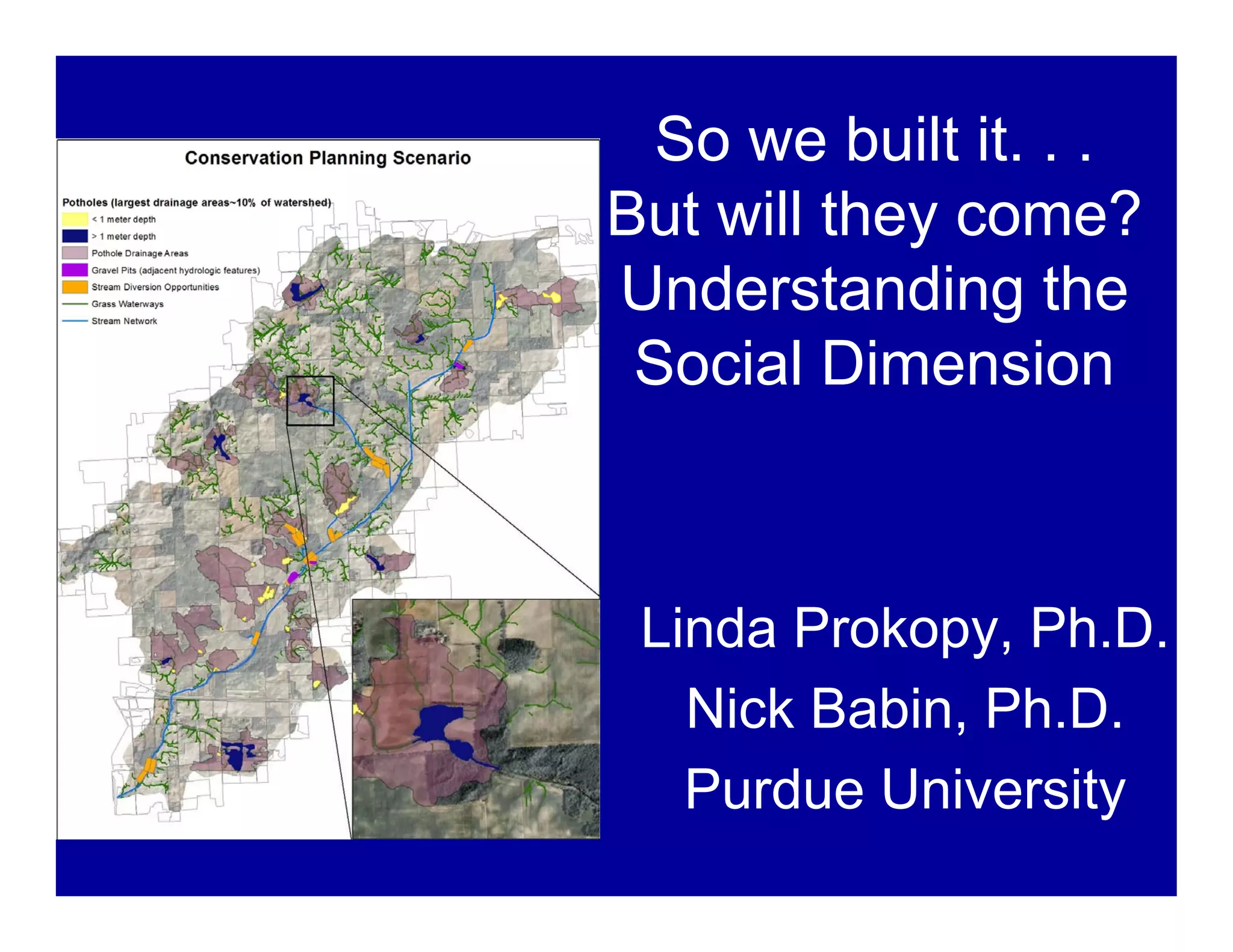
So we built it. . .
But will they come?
Understanding the
Social Dimension
Linda Prokopy, Ph.D.
Nick Babin, Ph.D.
Purdue University
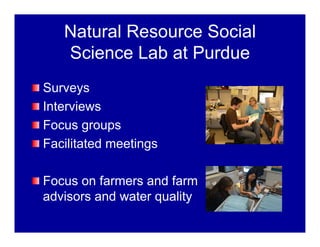
Natural Resource Social
Science Lab at Purdue
Surveys
Interviews
Focus groups
Facilitated meetings
Focus on farmers and farm
advisors and water quality
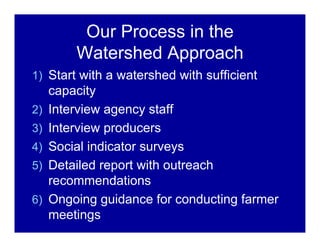
Our Process in the
Watershed Approach
1) Start with a watershed with sufficient
capacity
2) Interview agency staff
3) Interview producers
4) Social indicator surveys
5) Detailed report with outreach
recommendations
6) Ongoing guidance for conducting farmer
meetings
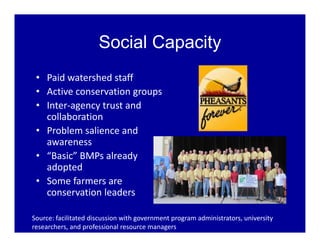
Social Capacity
• Paid watershed staff
• Active conservation groups
• Inter‐agency trust and 
collaboration
• Problem salience and 
awareness
• “Basic” BMPs already 
adopted
• Some farmers are 
conservation leaders
Source: facilitated discussion with government program administrators, university 
researchers, and professional resource managers
Interviews in Matson Ditch
In-depth, qualitative
3 agency/county staff
8 producers:
– 3 non-participants
– 2 past-participants
– 3 active-participants
Lack of ownership of problem
“If it is affecting the lake than it is out of sight, out of
mind.” (Non-participant)
“There is only so much we can do about it, you need to
look at city folk as well.” (Past-participant)
“If the problem is phosphorus and Lake Erie than many
producers will point out the role of golf courses, lawns.”
(Active-participant)
“We wanted clean water but farmers are always getting
blamed. There is too much focus on the agricultural
sector for this pollution.” (Past-participant)
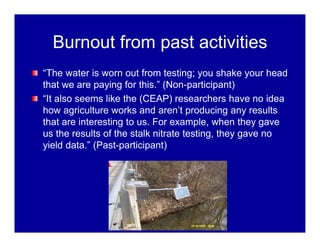
Burnout from past activities
“The water is worn out from testing; you shake your head
that we are paying for this.” (Non-participant)
“It also seems like the (CEAP) researchers have no idea
how agriculture works and aren’t producing any results
that are interesting to us. For example, when they gave
us the results of the stalk nitrate testing, they gave no
yield data.” (Past-participant)
Recommendations
Sell as continuation of old projects not
“new” initiative
Convene advisory group of key farmers
and important actors in watershed
Engage agronomists and Pheasants
Forever
Focus on specific concerns with practices,
e.g. two-stage ditches
Two-stage ditches
“What do they look like in 5-10 years? Will it have to be
dug out and re-seeded every 2 years? Who pays for
that?” (Non-participant)
“I mean yeah they are a great thing but they cost a lot of
money, and where do you put the dirt?” (SWCD
Employee)
“I have to be careful I am not blocking drainage and that
some kind of in-stream or filter practice doesn’t change
the upstream drainage pattern.” (Surveyor)
Nature.org
Our Process
1) Start with a watershed with sufficient
capacity
2) Interview agency staff
3) Interview producers
4) Social indicator surveys
5) Detailed report with outreach
recommendations
6) Ongoing guidance for conducting farmer
meetings
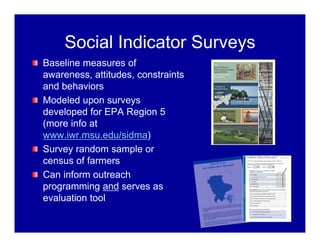
Social Indicator Surveys
Baseline measures of
awareness, attitudes, constraints
and behaviors
Modeled upon surveys
developed for EPA Region 5
(more info at
www.iwr.msu.edu/sidma)
Survey random sample or
census of farmers
Can inform outreach
programming and serves as
evaluation tool
Our Process
1) Start with a watershed with sufficient
capacity
2) Interview agency staff
3) Interview producers
4) Social indicator surveys
5) Detailed report with outreach
recommendations
6) Ongoing guidance for conducting farmer
meetings
Contact Information:
Linda Prokopy
lprokopy@purdue.edu
http://web.ics.purdue.edu/~lprokopy/
Photo credit: nasa.gov
Questions?

Prokopy the watershed approach

  • 1.
    So we builtit. . . But will they come? Understanding the Social Dimension Linda Prokopy, Ph.D. Nick Babin, Ph.D. Purdue University
  • 2.
    Natural Resource Social ScienceLab at Purdue Surveys Interviews Focus groups Facilitated meetings Focus on farmers and farm advisors and water quality
  • 3.
    Our Process inthe Watershed Approach 1) Start with a watershed with sufficient capacity 2) Interview agency staff 3) Interview producers 4) Social indicator surveys 5) Detailed report with outreach recommendations 6) Ongoing guidance for conducting farmer meetings
  • 4.
    Social Capacity • Paid watershed staff •Active conservation groups • Inter‐agency trust and  collaboration • Problem salience and  awareness • “Basic” BMPs already  adopted • Some farmers are  conservation leaders Source: facilitated discussion with government program administrators, university  researchers, and professional resource managers
  • 5.
    Interviews in MatsonDitch In-depth, qualitative 3 agency/county staff 8 producers: – 3 non-participants – 2 past-participants – 3 active-participants
  • 6.
    Lack of ownershipof problem “If it is affecting the lake than it is out of sight, out of mind.” (Non-participant) “There is only so much we can do about it, you need to look at city folk as well.” (Past-participant) “If the problem is phosphorus and Lake Erie than many producers will point out the role of golf courses, lawns.” (Active-participant) “We wanted clean water but farmers are always getting blamed. There is too much focus on the agricultural sector for this pollution.” (Past-participant)
  • 7.
    Burnout from pastactivities “The water is worn out from testing; you shake your head that we are paying for this.” (Non-participant) “It also seems like the (CEAP) researchers have no idea how agriculture works and aren’t producing any results that are interesting to us. For example, when they gave us the results of the stalk nitrate testing, they gave no yield data.” (Past-participant)
  • 8.
    Recommendations Sell as continuationof old projects not “new” initiative Convene advisory group of key farmers and important actors in watershed Engage agronomists and Pheasants Forever Focus on specific concerns with practices, e.g. two-stage ditches
  • 9.
    Two-stage ditches “What dothey look like in 5-10 years? Will it have to be dug out and re-seeded every 2 years? Who pays for that?” (Non-participant) “I mean yeah they are a great thing but they cost a lot of money, and where do you put the dirt?” (SWCD Employee) “I have to be careful I am not blocking drainage and that some kind of in-stream or filter practice doesn’t change the upstream drainage pattern.” (Surveyor) Nature.org
  • 10.
    Our Process 1) Startwith a watershed with sufficient capacity 2) Interview agency staff 3) Interview producers 4) Social indicator surveys 5) Detailed report with outreach recommendations 6) Ongoing guidance for conducting farmer meetings
  • 11.
    Social Indicator Surveys Baselinemeasures of awareness, attitudes, constraints and behaviors Modeled upon surveys developed for EPA Region 5 (more info at www.iwr.msu.edu/sidma) Survey random sample or census of farmers Can inform outreach programming and serves as evaluation tool
  • 12.
    Our Process 1) Startwith a watershed with sufficient capacity 2) Interview agency staff 3) Interview producers 4) Social indicator surveys 5) Detailed report with outreach recommendations 6) Ongoing guidance for conducting farmer meetings
  • 13.