Management of Drainage Water in the Holland
Marsh for Environmental and Agronomic Benefits
Chandra A. Madramootoo Eng., FASABE
Department of Bioresource Engineering
McGill University
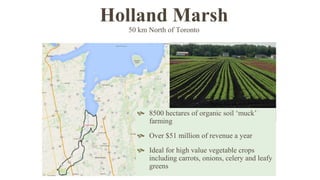
Holland Marsh
50 km North of Toronto
 8500 hectares of organic soil ‘muck’
farming
 Over $51 million of revenue a year
 Ideal for high value vegetable crops
including carrots, onions, celery and leafy
greens
LAKE SIMCOE – Water Quality
 High levels of N and P leading to eutrophication
 P exceeds limits of 0.03mg/l
 Negative ecological effects
 Impacts on aquatic flora and fauna
 Invasive species
 Damage to shoreline
3
-20
-15
-10
-5
0
5
10
15
20
25
30
0
50
100
150
200
250
Jan-2011
Sep-2011
May-2012
Jan-2013
Sep-2013
May-2014
Jan-2015
Sep-2015
May-2016
Jan-2017
Sep-2017
May-2018
Jan-2019
Sep-2019
May-2020
Jan-2021
Average
Monthly
Temperature
Monthly
Precipitation
(mm)
Month
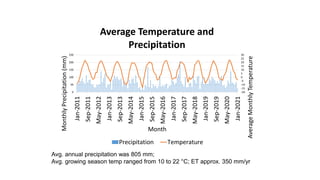
Average Temperature and
Precipitation
Precipitation Temperature
Avg. annual precipitation was 805 mm;
Avg. growing season temp ranged from 10 to 22 °C; ET approx. 350 mm/yr
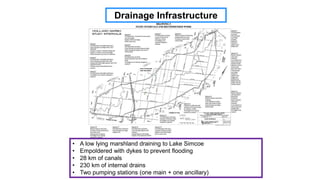
• A low lying marshland draining to Lake Simcoe
• Empoldered with dykes to prevent flooding
• 28 km of canals
• 230 km of internal drains
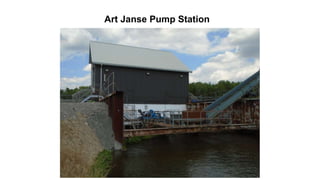
• Two pumping stations (one main + one ancillary)
Drainage Infrastructure
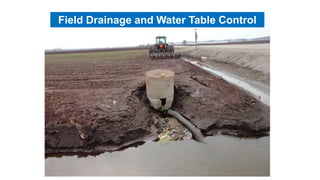
Field Drainage and Water Table Control
Art Janse Pump Station
0
500
1000
1500
2000
2500
3000
3500
0
1000000
2000000
3000000
4000000
5000000
6000000
Jan-2011
Sep-2011
May-2012
Jan-2013
Sep-2013
May-2014
Jan-2015
Sep-2015
May-2016
Jan-2017
Sep-2017
May-2018
Jan-2019
Sep-2019
May-2020
Jan-2021
P
Load
(kg)
Monthly
Discharge
(m3)
Month
Monthly QP [m3] P Load [kg]
Monthly Discharge at Main PS vs P Loads
0
500
1000
1500
2000
2500
3000
3500
4000
0
50000
100000
150000
200000
250000
300000
350000
400000
450000
Daily
Load
(kg
N)
Total
Daily
Discharge
(m3)
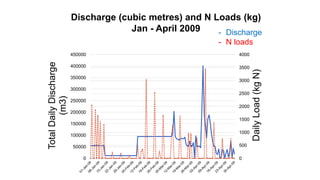
Discharge (cubic metres) and N Loads (kg)
Jan - April 2009 - Discharge
- N loads
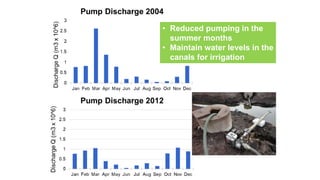
• Reduced pumping in the
summer months
• Maintain water levels in the
canals for irrigation
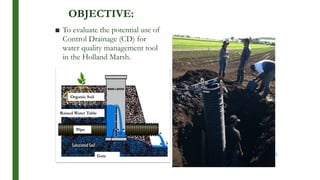
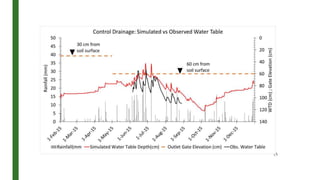
OBJECTIVE:
■ To evaluate the potential use of
Control Drainage (CD) for
water quality management tool
in the Holland Marsh.
11
Organic Soil
Raised Water Table
Pipe
Gate
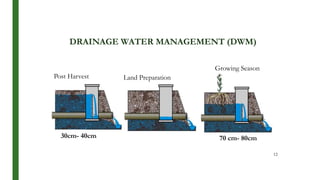
DRAINAGE WATER MANAGEMENT (DWM)
30cm- 40cm
Land Preparation
70 cm- 80cm
Post Harvest
Growing Season
12
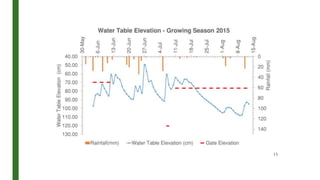
13
14
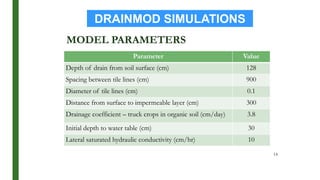
Parameter Value
Depth of drain from soil surface (cm) 128
Spacing between tile lines (cm) 900
Diameter of tile lines (cm) 0.1
Distance from surface to impermeable layer (cm) 300
Drainage coefficient – truck crops in organic soil (cm/day) 3.8
Initial depth to water table (cm) 30
Lateral saturated hydraulic conductivity (cm/hr) 10
MODEL PARAMETERS
DRAINMOD SIMULATIONS
15
16
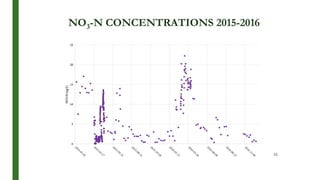
NO3-N CONCENTRATIONS 2015-2016
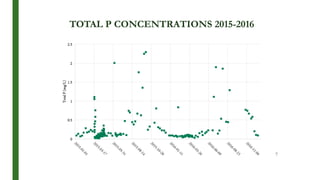
TOTAL P CONCENTRATIONS 2015-2016
17
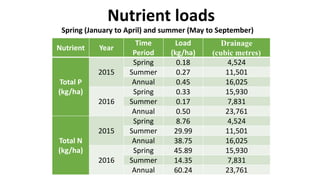
Nutrient loads
Nutrient Year
Time
Period
Load
(kg/ha)
Drainage
(cubic metres)
Total P
(kg/ha)
2015
Spring 0.18 4,524
Summer 0.27 11,501
Annual 0.45 16,025
2016
Spring 0.33 15,930
Summer 0.17 7,831
Annual 0.50 23,761
Total N
(kg/ha)
2015
Spring 8.76 4,524
Summer 29.99 11,501
Annual 38.75 16,025
2016
Spring 45.89 15,930
Summer 14.35 7,831
Annual 60.24 23,761
Spring (January to April) and summer (May to September)
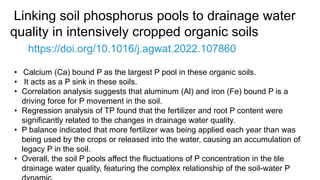
Linking soil phosphorus pools to drainage water
quality in intensively cropped organic soils
https://doi.org/10.1016/j.agwat.2022.107860
• Calcium (Ca) bound P as the largest P pool in these organic soils.
• It acts as a P sink in these soils.
• Correlation analysis suggests that aluminum (Al) and iron (Fe) bound P is a
driving force for P movement in the soil.
• Regression analysis of TP found that the fertilizer and root P content were
significantly related to the changes in drainage water quality.
• P balance indicated that more fertilizer was being applied each year than was
being used by the crops or released into the water, causing an accumulation of
legacy P in the soil.
• Overall, the soil P pools affect the fluctuations of P concentration in the tile
drainage water quality, featuring the complex relationship of the soil-water P
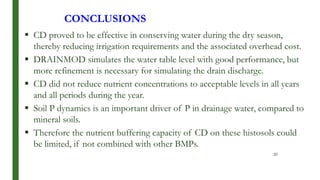
CONCLUSIONS
 CD proved to be effective in conserving water during the dry season,
thereby reducing irrigation requirements and the associated overhead cost.
 DRAINMOD simulates the water table level with good performance, but
more refinement is necessary for simulating the drain discharge.
 CD did not reduce nutrient concentrations to acceptable levels in all years
and all periods during the year.
 Soil P dynamics is an important driver of P in drainage water, compared to
mineral soils.
 Therefore the nutrient buffering capacity of CD on these histosols could
be limited, if not combined with other BMPs.
20
ACKNOWLEDGEMENTS:
• PhD students G. Grenon and B. Singh
• Natural Sciences and Engineering Research
Council of Canada
• Agriculture and Agri-Food Canada
• OMAFRA
• Muck Crops Research Station
THANK YOU!

September 1 - 1030 - Chandra Madramootoo

Editor's Notes

  • #4 Lake Simcoe is once such area where water quality degradation is present.