Prioritizing Maintenance Work in Agricultural
Drainage Ditches: A Procedure
11th International Drainage Symposium
August 31, 2022
Des Moines, Iowa - USA
Daniel B. Aviles R1., Ingrid Wesström2 & Abraham Joel2
1UMSS, Hydraulics Laboratory
2SLU, Soil and Environment
daniel.aviles@fcyt.umss.edu.bo
ingrid.wesstrom@slu.se
abraham.joel@slu.se
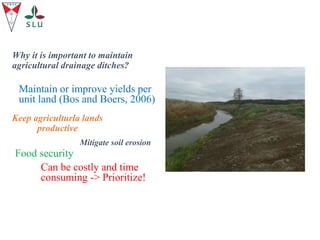
Why it is important to maintain
agricultural drainage ditches?
Maintain or improve yields per
unit land (Bos and Boers, 2006)
Keep agriculturla lands
productive
Food security
Can be costly and time
consuming -> Prioritize!
Mitigate soil erosion
The study was carried out to test and evaluate a procedure
to identify drainage ditch segments that are likely to need
maintenances.
We evaluated an approach for measuring soil
susceptibility to fluvial erosion
Introduction
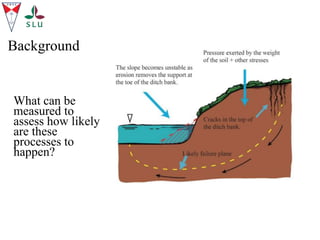
What can be
measured to
assess how likely
are these
processes to
happen?
Background
Fluvial erosion
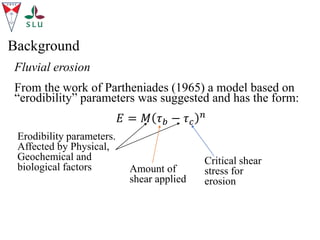
From the work of Partheniades (1965) a model based on
“erodibility” parameters was suggested and has the form:
𝐸 = 𝑀 𝜏𝑏 − 𝜏𝑐
𝑛
Background
Erodibility parameters.
Affected by Physical,
Geochemical and
biological factors Amount of
shear applied
Critical shear
stress for
erosion
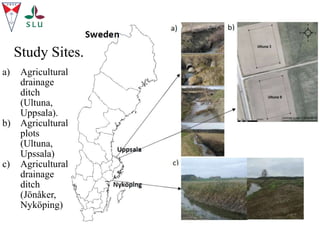
a) Agricultural
drainage
ditch
(Ultuna,
Uppsala).
b) Agricultural
plots
(Ultuna,
Upssala)
c) Agricultural
drainage
ditch
(Jönåker,
Nyköping)
Study Sites.
Materials and Methods
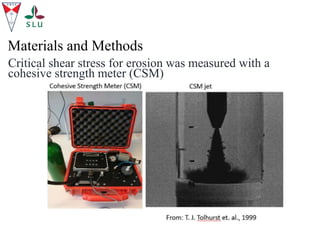
Critical shear stress for erosion was measured with a
cohesive strength meter (CSM)
Materials and Methods
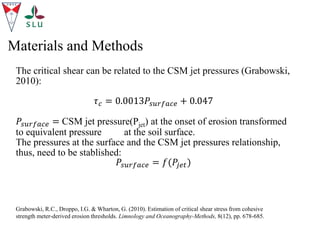
The critical shear can be related to the CSM jet pressures (Grabowski,
2010):
𝜏𝑐 = 0.0013𝑃𝑠𝑢𝑟𝑓𝑎𝑐𝑒 + 0.047
𝑃𝑠𝑢𝑟𝑓𝑎𝑐𝑒 = CSM jet pressure(Pjet) at the onset of erosion transformed
to equivalent pressure at the soil surface.
The pressures at the surface and the CSM jet pressures relationship,
thus, need to be stablished:
𝑃𝑠𝑢𝑟𝑓𝑎𝑐𝑒 = 𝑓(𝑃𝑗𝑒𝑡)
Grabowski, R.C., Droppo, I.G. & Wharton, G. (2010). Estimation of critical shear stress from cohesive
strength meter-derived erosion thresholds. Limnology and Oceanography-Methods, 8(12), pp. 678-685.
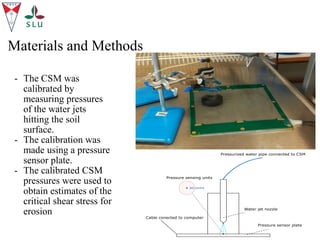
- The CSM was
calibrated by
measuring pressures
of the water jets
hitting the soil
surface.
- The calibration was
made using a pressure
sensor plate.
- The calibrated CSM
pressures were used to
obtain estimates of the
critical shear stress for
erosion
Materials and Methods
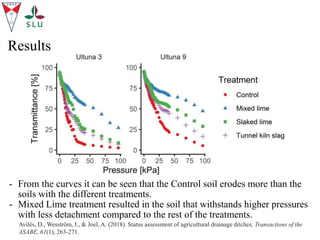
- From the curves it can be seen that the Control soil erodes more than the
soils with the different treatments.
- Mixed Lime treatment resulted in the soil that withstands higher pressures
with less detachment compared to the rest of the treatments.
Results
Avilés, D., Wesström, I., & Joel, A. (2018). Status assessment of agricultural drainage ditches. Transactions of the
ASABE, 61(1), 263-271.
Results
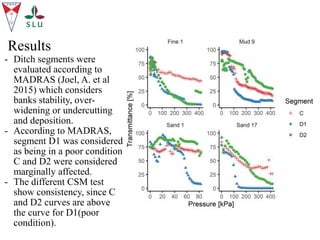
- Ditch segments were
evaluated according to
MADRAS (Joel, A. et al
2015) which considers
banks stability, over-
widening or undercutting
and deposition.
- According to MADRAS,
segment D1 was considered
as being in a poor condition
C and D2 were considered
marginally affected.
- The different CSM test
show consistency, since C
and D2 curves are above
the curve for D1(poor
condition).
Results
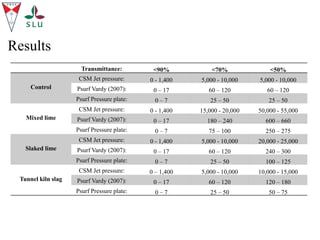
Transmittance: <90% <70% <50%
Control
CSM Jet pressure: 0 - 1,400 5,000 - 10,000 5,000 - 10,000
Psurf Vardy (2007): 0 – 17 60 – 120 60 – 120
Psurf Pressure plate: 0 – 7 25 – 50 25 – 50
Mixed lime
CSM Jet pressure: 0 - 1,400 15,000 - 20,000 50,000 - 55,000
Psurf Vardy (2007): 0 – 17 180 – 240 600 – 660
Psurf Pressure plate: 0 – 7 75 – 100 250 – 275
Slaked lime
CSM Jet pressure: 0 - 1,400 5,000 - 10,000 20,000 - 25,000
Psurf Vardy (2007): 0 – 17 60 – 120 240 – 300
Psurf Pressure plate: 0 – 7 25 – 50 100 – 125
Tunnel kiln slag
CSM Jet pressure: 0 – 1,400 5,000 - 10,000 10,000 - 15,000
Psurf Vardy (2007): 0 – 17 60 – 120 120 – 180
Psurf Pressure plate: 0 – 7 25 – 50 50 – 75
Results
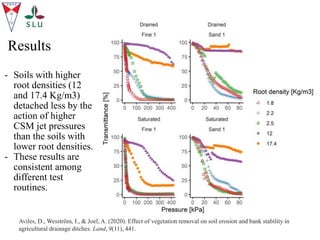
- Soils with higher
root densities (12
and 17.4 Kg/m3)
detached less by the
action of higher
CSM jet pressures
than the soils with
lower root densities.
- These results are
consistent among
different test
routines.
Aviles, D., Wesström, I., & Joel, A. (2020). Effect of vegetation removal on soil erosion and bank stability in
agricultural drainage ditches. Land, 9(11), 441.
Results
- The measured values of pressure
at the surface for the CSM
pressure at the onset of erosion
remain within the same order of
magnitude for the ditch in
Bäcklösa and the Uppsala plots.
- The soil treated with Mixed lime
showed slightly higher pressure at
the surface than the other
treatments.
- For the Jönåker ditch segment,
the pressure at the surface values
were higher for soils with higher
root densities (segment 1 and 3)
than those with lower root
densities (segments 2, 4 and 5.
Psurface [Pa]
Bäcklösa
ditch
Segment C 35.0
Segment D1 4.0
Segment D2 41.0
Uppsala plots
Control 3.4
Mixed lime 7.9
Slaked lime 3.4
Tunnel kiln slag 3.4
Jönåker ditch
Segment 1 (17.4) 13.7
Segment 2 (2.5) 54.5
Segment 3 (12.0) 1236.1
Segment 4 (2.2) 6.9
Segment 5 (1.8) 10.3
Conclusions
- The measured pressures acting on the soil surface are
in the range 0 – 275 Pa, which are, in some cases, one
order of magnitude lower than the estimates obtained
using the relationship proposed by Vardy et al. (2007).
This will likely result in underestimated values
estimates of the critical shear stress for erosion.
- Critical shear stress values were higher for soils with
higher soil root densities, which reinforces the role of
vegetation to control soil erosion.
- CSM tests consistently revealed the strength of the
soils, for the case of soils with different amendments
and soils with different plant root densities
Thank you for your time!

August 31 - 0153 - San Simon

  • 1.
    Prioritizing Maintenance Workin Agricultural Drainage Ditches: A Procedure 11th International Drainage Symposium August 31, 2022 Des Moines, Iowa - USA Daniel B. Aviles R1., Ingrid Wesström2 & Abraham Joel2 1UMSS, Hydraulics Laboratory 2SLU, Soil and Environment daniel.aviles@fcyt.umss.edu.bo ingrid.wesstrom@slu.se abraham.joel@slu.se
  • 2.
    Why it isimportant to maintain agricultural drainage ditches? Maintain or improve yields per unit land (Bos and Boers, 2006) Keep agriculturla lands productive Food security Can be costly and time consuming -> Prioritize! Mitigate soil erosion
  • 3.
    The study wascarried out to test and evaluate a procedure to identify drainage ditch segments that are likely to need maintenances. We evaluated an approach for measuring soil susceptibility to fluvial erosion Introduction
  • 4.
    What can be measuredto assess how likely are these processes to happen? Background
  • 5.
    Fluvial erosion From thework of Partheniades (1965) a model based on “erodibility” parameters was suggested and has the form: 𝐸 = 𝑀 𝜏𝑏 − 𝜏𝑐 𝑛 Background Erodibility parameters. Affected by Physical, Geochemical and biological factors Amount of shear applied Critical shear stress for erosion
  • 6.
    a) Agricultural drainage ditch (Ultuna, Uppsala). b) Agricultural plots (Ultuna, Upssala) c)Agricultural drainage ditch (Jönåker, Nyköping) Study Sites.
  • 7.
    Materials and Methods Criticalshear stress for erosion was measured with a cohesive strength meter (CSM)
  • 8.
    Materials and Methods Thecritical shear can be related to the CSM jet pressures (Grabowski, 2010): 𝜏𝑐 = 0.0013𝑃𝑠𝑢𝑟𝑓𝑎𝑐𝑒 + 0.047 𝑃𝑠𝑢𝑟𝑓𝑎𝑐𝑒 = CSM jet pressure(Pjet) at the onset of erosion transformed to equivalent pressure at the soil surface. The pressures at the surface and the CSM jet pressures relationship, thus, need to be stablished: 𝑃𝑠𝑢𝑟𝑓𝑎𝑐𝑒 = 𝑓(𝑃𝑗𝑒𝑡) Grabowski, R.C., Droppo, I.G. & Wharton, G. (2010). Estimation of critical shear stress from cohesive strength meter-derived erosion thresholds. Limnology and Oceanography-Methods, 8(12), pp. 678-685.
  • 9.
    - The CSMwas calibrated by measuring pressures of the water jets hitting the soil surface. - The calibration was made using a pressure sensor plate. - The calibrated CSM pressures were used to obtain estimates of the critical shear stress for erosion Materials and Methods
  • 10.
    - From thecurves it can be seen that the Control soil erodes more than the soils with the different treatments. - Mixed Lime treatment resulted in the soil that withstands higher pressures with less detachment compared to the rest of the treatments. Results Avilés, D., Wesström, I., & Joel, A. (2018). Status assessment of agricultural drainage ditches. Transactions of the ASABE, 61(1), 263-271.
  • 11.
    Results - Ditch segmentswere evaluated according to MADRAS (Joel, A. et al 2015) which considers banks stability, over- widening or undercutting and deposition. - According to MADRAS, segment D1 was considered as being in a poor condition C and D2 were considered marginally affected. - The different CSM test show consistency, since C and D2 curves are above the curve for D1(poor condition).
  • 12.
    Results Transmittance: <90% <70%<50% Control CSM Jet pressure: 0 - 1,400 5,000 - 10,000 5,000 - 10,000 Psurf Vardy (2007): 0 – 17 60 – 120 60 – 120 Psurf Pressure plate: 0 – 7 25 – 50 25 – 50 Mixed lime CSM Jet pressure: 0 - 1,400 15,000 - 20,000 50,000 - 55,000 Psurf Vardy (2007): 0 – 17 180 – 240 600 – 660 Psurf Pressure plate: 0 – 7 75 – 100 250 – 275 Slaked lime CSM Jet pressure: 0 - 1,400 5,000 - 10,000 20,000 - 25,000 Psurf Vardy (2007): 0 – 17 60 – 120 240 – 300 Psurf Pressure plate: 0 – 7 25 – 50 100 – 125 Tunnel kiln slag CSM Jet pressure: 0 – 1,400 5,000 - 10,000 10,000 - 15,000 Psurf Vardy (2007): 0 – 17 60 – 120 120 – 180 Psurf Pressure plate: 0 – 7 25 – 50 50 – 75
  • 13.
    Results - Soils withhigher root densities (12 and 17.4 Kg/m3) detached less by the action of higher CSM jet pressures than the soils with lower root densities. - These results are consistent among different test routines. Aviles, D., Wesström, I., & Joel, A. (2020). Effect of vegetation removal on soil erosion and bank stability in agricultural drainage ditches. Land, 9(11), 441.
  • 14.
    Results - The measuredvalues of pressure at the surface for the CSM pressure at the onset of erosion remain within the same order of magnitude for the ditch in Bäcklösa and the Uppsala plots. - The soil treated with Mixed lime showed slightly higher pressure at the surface than the other treatments. - For the Jönåker ditch segment, the pressure at the surface values were higher for soils with higher root densities (segment 1 and 3) than those with lower root densities (segments 2, 4 and 5. Psurface [Pa] Bäcklösa ditch Segment C 35.0 Segment D1 4.0 Segment D2 41.0 Uppsala plots Control 3.4 Mixed lime 7.9 Slaked lime 3.4 Tunnel kiln slag 3.4 Jönåker ditch Segment 1 (17.4) 13.7 Segment 2 (2.5) 54.5 Segment 3 (12.0) 1236.1 Segment 4 (2.2) 6.9 Segment 5 (1.8) 10.3
  • 15.
    Conclusions - The measuredpressures acting on the soil surface are in the range 0 – 275 Pa, which are, in some cases, one order of magnitude lower than the estimates obtained using the relationship proposed by Vardy et al. (2007). This will likely result in underestimated values estimates of the critical shear stress for erosion. - Critical shear stress values were higher for soils with higher soil root densities, which reinforces the role of vegetation to control soil erosion. - CSM tests consistently revealed the strength of the soils, for the case of soils with different amendments and soils with different plant root densities
  • 16.
    Thank you foryour time!