©2015 Plastics Pipe Institute
Design and Construction of Corrugated HDPE
and PP Agricultural Mains with Shaped
Trench Bottoms
Joe Babcanec, P.E.
Advanced Drainage Systems
Dan Currence, P.E.
Plastics Pipe Institute
©2015 Plastics Pipe Institute
Standard Practice
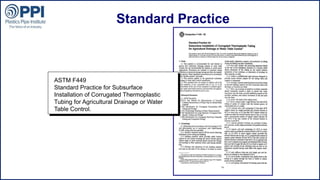
ASTM F449
Standard Practice for Subsurface
Installation of Corrugated Thermoplastic
Tubing for Agricultural Drainage or Water
Table Control.
©2015 Plastics Pipe Institute
Standard Practice
Plastics Pipe Institute
Standard Practice for Installation of
Annular Corrugated Profile Wall
Polyethylene Pipe for Agricultural
Drainage or Water Table Control
©2015 Plastics Pipe Institute
Standard Practice – ASTM F449
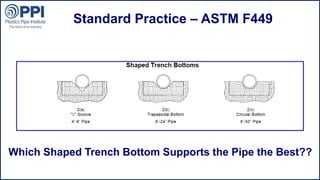
Which Shaped Trench Bottom Supports the Pipe the Best??
©2015 Plastics Pipe Institute
Standard Practice – ASTM F449
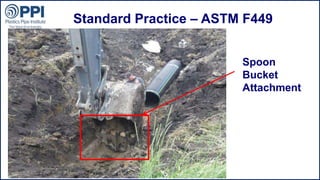
Spoon
Bucket
Attachment
©2015 Plastics Pipe Institute
PPI Ag Installation Research
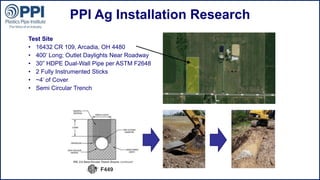
Test Site
• 16432 CR 109, Arcadia, OH 4480
• 400’ Long; Outlet Daylights Near Roadway
• 30ā€ HDPE Dual-Wall Pipe per ASTM F2648
• 2 Fully Instrumented Sticks
• ~4’ of Cover
• Semi Circular Trench
©2015 Plastics Pipe Institute
PPI Ag Installation Research
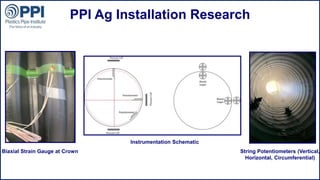
Instrumentation Schematic
Biaxial Strain Gauge at Crown String Potentiometers (Vertical,
Horizontal, Circumferential)
©2015 Plastics Pipe Institute
PPI Ag Installation Research
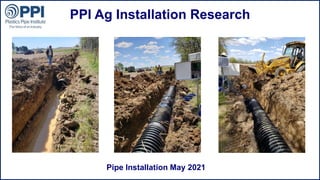
Pipe Installation May 2021
©2015 Plastics Pipe Institute
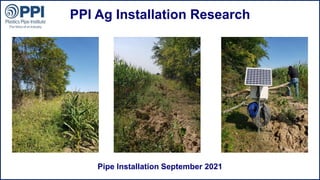
PPI Ag Installation Research
Pipe Installation September 2021
©2015 Plastics Pipe Institute
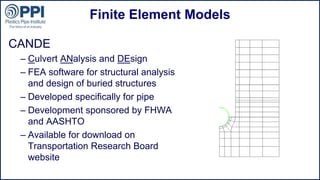
Finite Element Models
CANDE
– Culvert ANalysis and DEsign
– FEA software for structural analysis
and design of buried structures
– Developed specifically for pipe
– Development sponsored by FHWA
and AASHTO
– Available for download on
Transportation Research Board
website
©2015 Plastics Pipe Institute
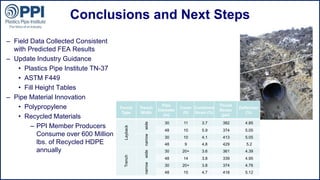
Conclusions and Next Steps
– Field Data Collected Consistent
with Predicted FEA Results
– Update Industry Guidance
• Plastics Pipe Institute TN-37
• ASTM F449
• Fill Height Tables
– Pipe Material Innovation
• Polypropylene
• Recycled Materials
– PPI Member Producers
Consume over 600 Million
lbs. of Recycled HDPE
annually
Trench
Type
Trench
Width
Pipe
Diameter
(in)
Cover
(ft)
Combined
Strain (%)
Thrust
Stress
(psi)
Deflection
(%)
Layback
wide
30 11 3.7 382 4.85
48 10 5.9 374 5.05
narrow
30 10 4.1 413 5.05
48 9 4.8 429 5.2
Trench
wide
30 20+ 3.6 361 4.39
48 14 3.8 339 4.95
narrow
30 20+ 3.8 374 4.76
48 15 4.7 418 5.12
©2015 Plastics Pipe Institute
Thank You!
Joe Babcanec, P.E.
Advanced Drainage Systems
Joe.Babcanec@adspipe.com
Dan Currence, P.E.
Plastics Pipe Institute
dcurrence@plasticpipe.org

August 31 - 1030 - Joseph A. Bubcanec

  • 1.
    ©2015 Plastics PipeInstitute Design and Construction of Corrugated HDPE and PP Agricultural Mains with Shaped Trench Bottoms Joe Babcanec, P.E. Advanced Drainage Systems Dan Currence, P.E. Plastics Pipe Institute
  • 2.
    ©2015 Plastics PipeInstitute Standard Practice ASTM F449 Standard Practice for Subsurface Installation of Corrugated Thermoplastic Tubing for Agricultural Drainage or Water Table Control.
  • 3.
    ©2015 Plastics PipeInstitute Standard Practice Plastics Pipe Institute Standard Practice for Installation of Annular Corrugated Profile Wall Polyethylene Pipe for Agricultural Drainage or Water Table Control
  • 4.
    Ā©2015 Plastics PipeInstitute Standard Practice – ASTM F449 Which Shaped Trench Bottom Supports the Pipe the Best??
  • 5.
    Ā©2015 Plastics PipeInstitute Standard Practice – ASTM F449 Spoon Bucket Attachment
  • 6.
    Ā©2015 Plastics PipeInstitute PPI Ag Installation Research Test Site • 16432 CR 109, Arcadia, OH 4480 • 400’ Long; Outlet Daylights Near Roadway • 30ā€ HDPE Dual-Wall Pipe per ASTM F2648 • 2 Fully Instrumented Sticks • ~4’ of Cover • Semi Circular Trench
  • 7.
    ©2015 Plastics PipeInstitute PPI Ag Installation Research Instrumentation Schematic Biaxial Strain Gauge at Crown String Potentiometers (Vertical, Horizontal, Circumferential)
  • 8.
    ©2015 Plastics PipeInstitute PPI Ag Installation Research Pipe Installation May 2021
  • 9.
    ©2015 Plastics PipeInstitute PPI Ag Installation Research Pipe Installation September 2021
  • 11.
  • 12.
  • 13.
  • 14.
    Ā©2015 Plastics PipeInstitute Finite Element Models CANDE – Culvert ANalysis and DEsign – FEA software for structural analysis and design of buried structures – Developed specifically for pipe – Development sponsored by FHWA and AASHTO – Available for download on Transportation Research Board website
  • 15.
    Ā©2015 Plastics PipeInstitute Conclusions and Next Steps – Field Data Collected Consistent with Predicted FEA Results – Update Industry Guidance • Plastics Pipe Institute TN-37 • ASTM F449 • Fill Height Tables – Pipe Material Innovation • Polypropylene • Recycled Materials – PPI Member Producers Consume over 600 Million lbs. of Recycled HDPE annually Trench Type Trench Width Pipe Diameter (in) Cover (ft) Combined Strain (%) Thrust Stress (psi) Deflection (%) Layback wide 30 11 3.7 382 4.85 48 10 5.9 374 5.05 narrow 30 10 4.1 413 5.05 48 9 4.8 429 5.2 Trench wide 30 20+ 3.6 361 4.39 48 14 3.8 339 4.95 narrow 30 20+ 3.8 374 4.76 48 15 4.7 418 5.12
  • 16.
    ©2015 Plastics PipeInstitute Thank You! Joe Babcanec, P.E. Advanced Drainage Systems Joe.Babcanec@adspipe.com Dan Currence, P.E. Plastics Pipe Institute dcurrence@plasticpipe.org

Editor's Notes

  • #2Ā The overall objective of the research is to perform an engineering analysis, including field verification, with supporting documentation to evaluate 12ā€- 60ā€ corrugated HDPE and PP pipe in agricultural main installations using semicircular shaped trench bottoms. This research will serve as a basis for engineering design that can be referenced by manufacturers, specifiers, and owners. The project encompasses four phases including a literature review, finite element analysis of both HDPE and polypropylene (PP) pipe and monitoring of instrumented field installations. This report documents the instrumented field installations in Phase 4, including the method and results.
  • #3Ā ASTM 449, Standard Practice for Subsurface Installation of Corrugated Thermoplastic Tubing for Agricultural Drainage or Water Table Control is recommended for and limited to gravity flow subsurface drainage systems or water table control, but not recommended for sanitary or storm sewer applications.
  • #6Ā ASTM 449, Standard Practice for Subsurface Installation of Corrugated Thermoplastic Tubing for Agricultural Drainage or Water Table Control is recommended for and limited to gravity flow subsurface drainage systems or water table control, but not recommended for sanitary or storm sewer applications.
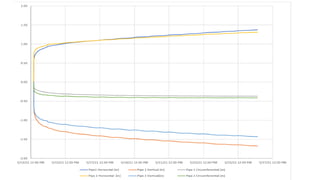
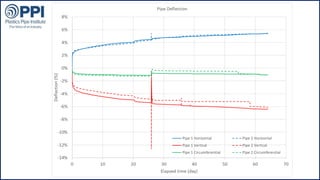
  • #12Ā Figure 11. Pipe deflection graph with linear time scale to first major rain event on July 17 (Day 64). The first rain event on June 8 (Day 26) caused transient spikes in the deflection data, particularly in the vertical deflection, but the water flow was not heavy and the impact was not lasting. The July 16 (Day 64) rain event caused anomalous long-term jumps in the deflection data, due to debris and high water flowing into the pipe above the springline, which affected all the string potentiometers. For this reason, the deflection data after July 16 at 6:00 PM are disregarded, and the deflection data plotted again with a linear time scale in Figure 11 and a logarithmic time scale in Figure 12. In Figure 11, the deflection lines for the two pipes track each other closely, with both pipes having similar deflection values.
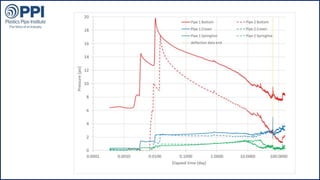
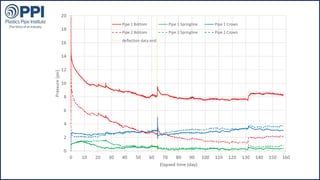
  • #13Ā Soil pressure around pipe graphed with linear time scale for entire duration of experiment, May 13-October 18, 2021 (158 days). Figure 13 plots the pressure data around both pipes for the entire duration of the experiment with a linear time scale. There is a spike on July 17 (Day 64), corresponding to the rain event that ended the deflection data collection, and another on September 22 (Day 132), which is when equipment was operated over the pipe by the farm crew. Figure 14 shows the same pressure data with a logarithmic time scale. This figure shows two pressure peaks in each trace corresponding to the lifts of backfill. Also of note is the high initial pressure at the bottom of Pipe 1. When this pressure cell was installed in sand under the pipe, the surrounding soil at that level was wet, which affected the initial pressure levels. Otherwise the pressure curves show a smooth progression indicating settling of the backfill with small jumps where there was some consolidation, such as from a clump breaking or dissolving. The highest pressure is seen at the bottom of the pipes with the dumping of the final lift of backfill, with the peak of 19.8 psi (137 kPa) at 0.0104 days (14:59 min) for Pipe 1 and 17.1 psi (118 kPa) at 0.0149 days (21:27 minutes). The bottom pressures on September 22 are 7.46 psi (51 kPa) for Pipe 1 and 1.78 psi (12 kPa) for Pipe 2, and at the end of the experiment these are 8.35 psi (58 kPa) and 2.16 psi (15 kPa) for Pipe 1 and Pipe 2 respectively. The springline horizontal pressure was low throughout the experiment, remaining under 2 psi (14 kPa) for the entire duration in both pipes, and going permanently below 1 psi (6.9 kPa) after the first month. The crown pressure started at 2.32 psi (16 kPa) and 2.46 psi (17 kPa) for Pipe 1 and Pipe 2 at the end of the second backfill lift, then increased slightly to 3.05 psi (21 kPa) and 3.66 psi (25 kPa) for Pipe 1 and Pipe 2, respectively. The pattern of the bottom pressure decreasing over time with some increase in the crown is a sign of arching behavior which is expected in this kind of pipe installation.
  • #14Ā Soil pressure around pipe graphed with linear time scale for entire duration of experiment, May 13-October 18, 2021 (158 days). Figure 13 plots the pressure data around both pipes for the entire duration of the experiment with a linear time scale. There is a spike on July 17 (Day 64), corresponding to the rain event that ended the deflection data collection, and another on September 22 (Day 132), which is when equipment was operated over the pipe by the farm crew. Figure 14 shows the same pressure data with a logarithmic time scale. This figure shows two pressure peaks in each trace corresponding to the lifts of backfill. Also of note is the high initial pressure at the bottom of Pipe 1. When this pressure cell was installed in sand under the pipe, the surrounding soil at that level was wet, which affected the initial pressure levels. Otherwise the pressure curves show a smooth progression indicating settling of the backfill with small jumps where there was some consolidation, such as from a clump breaking or dissolving. The highest pressure is seen at the bottom of the pipes with the dumping of the final lift of backfill, with the peak of 19.8 psi (137 kPa) at 0.0104 days (14:59 min) for Pipe 1 and 17.1 psi (118 kPa) at 0.0149 days (21:27 minutes). The bottom pressures on September 22 are 7.46 psi (51 kPa) for Pipe 1 and 1.78 psi (12 kPa) for Pipe 2, and at the end of the experiment these are 8.35 psi (58 kPa) and 2.16 psi (15 kPa) for Pipe 1 and Pipe 2 respectively. The springline horizontal pressure was low throughout the experiment, remaining under 2 psi (14 kPa) for the entire duration in both pipes, and going permanently below 1 psi (6.9 kPa) after the first month. The crown pressure started at 2.32 psi (16 kPa) and 2.46 psi (17 kPa) for Pipe 1 and Pipe 2 at the end of the second backfill lift, then increased slightly to 3.05 psi (21 kPa) and 3.66 psi (25 kPa) for Pipe 1 and Pipe 2, respectively. The pattern of the bottom pressure decreasing over time with some increase in the crown is a sign of arching behavior which is expected in this kind of pipe installation.