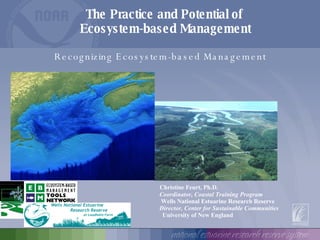
The Practice and Potential of  Ecosystem-based Management Christine Feurt, Ph.D. Coordinator,   Coastal Training Program Wells National Estuarine Research Reserve Director, Center for Sustainable Communities University of New England Recognizing Ecosystem-based Management
Ecosystem Management Meffe et al., 2002 Retain, restore and sustain ecosystem integrity Make the places we live, work and play noticeably better today and in the future. Based upon a collaboratively developed vision of desired future outcomes that integrates ecological, socioeconomic and institutional perspectives Applied within a geographic framework defined primarily by natural ecological boundaries.
Overview of Today’s Presentations Watershed Management, Land Use Regulations, and Headwater Stream Conservation  Steve Burns Coastal Resiliency, Science and Community Planning for Sea Level Rise and the Perfect Storm  Pete Slovinsky Community Viz and Municipal Conservation Planning Judy Colby-George
Overview of Today’s Presentations Beginning with Habitat: Challenges and Tools for Statewide Biodiversity Conservation Bethany Adkins A Model for Science, Stewardship and Adaptive Management in Taunton Bay John Sowles Collaborative Learning for Stakeholder Engagement-Social Science and Ecosystem Management  Chris Feurt
Elements of Ecosystem Management With a Focus on Land Use A collaboratively developed vision of desired future outcomes Indicators of success and a mechanism for tracking progress Interdisciplinary science as a measure of ecosystem sustainability  Identification and engagement of stakeholders Place – a  workable  geographic boundary
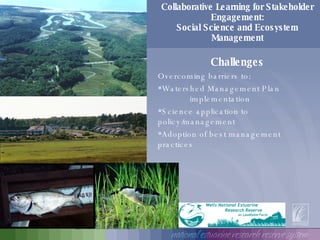
Collaborative Learning for Stakeholder Engagement: Social Science and Ecosystem Management Challenges Overcoming barriers to:  Watershed Management Plan  implementation  Science application to  policy/management  Adoption of best management  practices
 
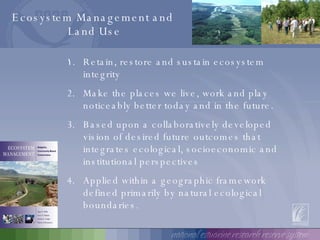
Retain, restore and sustain ecosystem integrity Make the places we live, work and play noticeably better today and in the future. Based upon a collaboratively developed vision of desired future outcomes that integrates ecological, socioeconomic and institutional perspectives Applied within a geographic framework defined primarily by natural ecological boundaries. Ecosystem Management and  Land Use
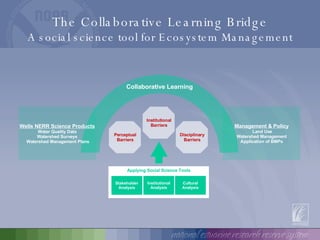
The Collaborative Learning Bridge A social science tool for Ecosystem Management Applying Social Science Tools Collaborative Learning Stakeholder Analysis Wells NERR Science Products Water Quality Data Watershed Surveys  Watershed Management Plans Management & Policy Land Use Watershed Management Application of BMPs Perceptual Barriers Disciplinary Barriers Institutional Barriers Institutional Analysis Cultural Analysis
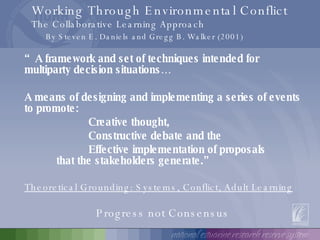
Working Through Environmental Conflict The Collaborative Learning Approach By Steven E. Daniels and Gregg B. Walker (2001) “ A framework and set of techniques intended for multiparty decision situations…  A means of designing and implementing a series of events to promote:  Creative thought,  Constructive debate and the  Effective implementation of proposals  that the stakeholders generate.” Theoretical Grounding: Systems, Conflict, Adult Learning Progress not Consensus
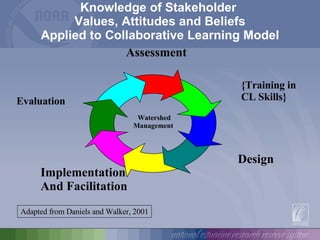
Knowledge of Stakeholder  Values, Attitudes and Beliefs Applied to Collaborative Learning Model Watershed Management Assessment {Training in CL Skills} Implementation And Facilitation Evaluation Adapted from Daniels and Walker, 2001 Design
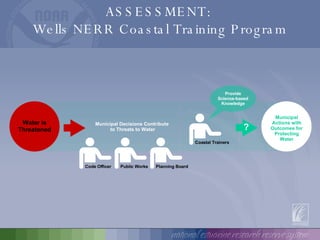
ASSESSMENT:  Wells NERR Coastal Training Program Water is Threatened Coastal Trainers Provide Science-based Knowledge Municipal Decisions Contribute  to Threats to Water Municipal Actions with Outcomes for Protecting Water Public Works Code Officer Planning Board ?
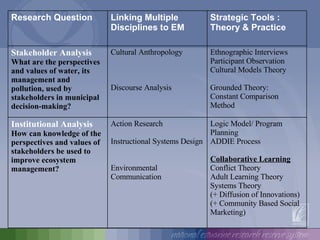
Logic Model/ Program  Planning ADDIE Process Collaborative Learning Conflict Theory Adult Learning Theory Systems Theory (+ Diffusion of Innovations)  (+ Community Based Social Marketing) Action Research Instructional Systems Design Environmental Communication Institutional Analysis How can knowledge of the perspectives and values of stakeholders be used to improve ecosystem management?  Ethnographic Interviews Participant Observation Cultural Models Theory Grounded Theory: Constant Comparison Method Cultural Anthropology Discourse Analysis Stakeholder Analysis What are the perspectives and values of water, its management and pollution, used by stakeholders in municipal decision-making? Strategic Tools :  Theory & Practice Linking Multiple Disciplines to EM Research Question
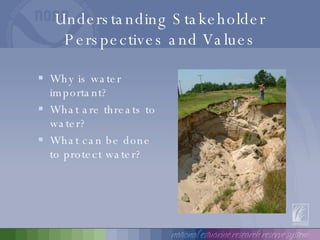
Understanding Stakeholder Perspectives and Values Why is water important? What are threats to water? What can be done to protect water?
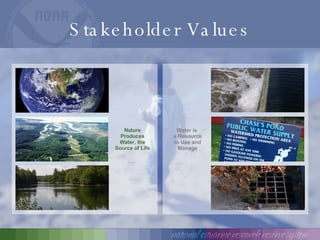
Stakeholder Values Nature Produces Water, the Source of Life Water is  a Resource to Use and Manage
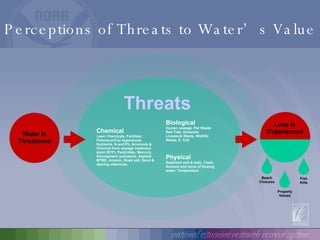
Perceptions of Threats to Water’s Value Water is Threatened Chemical Lawn Chemicals, Fertilizer, Petroleum/Car byproducts, Nutrients, N and Ph, Ammonia & Chlorine from sewage treatment plant (STP), Pesticides, Mercury, Atmospheric pollutants, Asphalt MTBE, Arsenic, Road salt, Sand & deicing chemicals  Biological Human sewage, Pet Waste Red Tide, Domestic Livestock Waste, Wildlife Waste, E. Coli Physical Sediment (silt & soil), Trash, Amount and force of flowing  water, Temperature Threats Loss is Experienced Beach Closures Property Values Fish Kills
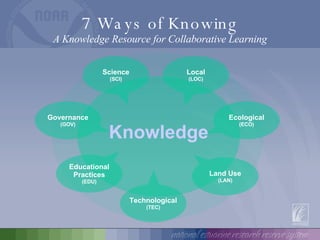
7 Ways of Knowing A Knowledge Resource for Collaborative Learning Governance (GOV) Science (SCI) Local (LOC) Ecological (ECO) Educational Practices (EDU) Technological (TEC) Land Use (LAN) Knowledge
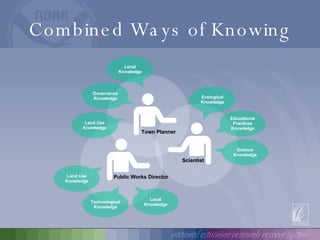
Combined Ways of Knowing Ecological Knowledge Public Works Director Educational Practices Knowledge Science Knowledge Local Knowledge Governance Knowledge Land Use Knowledge Land Use Knowledge Technological Knowledge Local Knowledge Town Planner Scientist
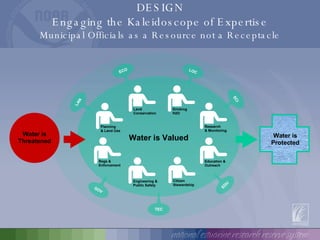
DESIGN Engaging the Kaleidoscope of Expertise Municipal Officials as a Resource not a Receptacle ECO Water is Threatened Water is Valued SCI LAN TEC GOV EDU LOC Water is Protected Planning & Land Use Land Conservation Drinking  H2O Research  & Monitoring Education & Outreach Regs & Enforcement Engineering & Public Safety Citizen  Stewardship
 
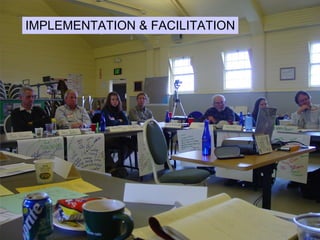
IMPLEMENTATION & FACILITATION
Assemble and activate the kaleidoscope of expertise  Shared missions - Watershed Management Plan linked to Comprehensive Plans  Elected official approval Municipal/State/Federal, NGO, water districts An experiment for a summer Meetings, field trips, breakfast at the Cockpit Café
Identify shared values of water and perceptions of threats as fuel for collaboration
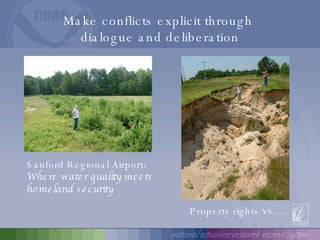
Make conflicts explicit through  dialogue and deliberation Sanford Regional Airport: Where water quality meets  homeland security Property rights  vs ….
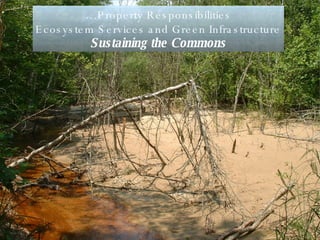
… Property Responsibilities Ecosystem Services and Green Infrastructure Sustaining the Commons
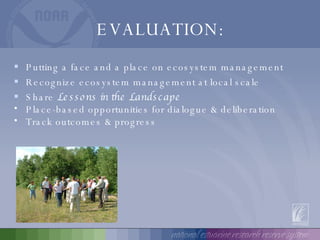
EVALUATION: Putting a face and a place on ecosystem management Recognize ecosystem management at local scale Share  Lessons in the Landscape Place-based opportunities for dialogue & deliberation Track outcomes & progress
Evaluation to Assessment  Action Research Multi-media Approach Progress on watershed action items Stakeholder consensus to continue Stakeholder survey Stakeholder interviews Elected official consensus to continue Grant funding for group generated projects
Christine Feurt  207.646.1555  x111 [email_address] Collaborative Learning Guide November 2008 EBM Tools Training Wells NERR Nov 19 & 20 CICEET Project Explorer –  Feurt/Final Report December 2008 http://www.ciceet.unh.edu/
Elements of Ecosystem Management With a Focus on Land Use A collaboratively developed vision of desired future outcomes Indicators of success and a mechanism for tracking progress Interdisciplinary science as a measure of ecosystem sustainability  Identification and engagement of stakeholders Place – a  workable  geographic boundary
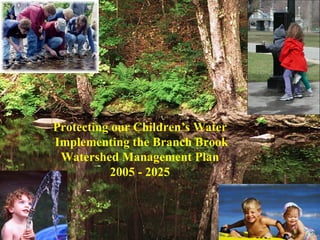
Selected References Bernard, H. ed. 1998.  Handbook of Methods in Cultural Anthropology . New York: Altamira Press. Daniels, S. and G. Walker. 2001.  Working Through Environmental Conflict: The Collaborative Learning Approach.  Westport, CT: Praeger Feurt, C. 2007. Protecting Our Children’s Water, Using Cultural Models to Frame and Implement Ecosystem Based Management. Ph.D. Dissertation, Antioch University New England. Keene, New Hampshire. Glaser, B. and A. Strauss. 1967.  The Discovery of Grounded   Theory . New York: Aldine de Gruyter. Greenwood, D and Levin, M. 1998.  Introduction to Action Research, Social Research for Social Change . Thousand Oaks, CA: Sage. Gunderson, L. and C. Holling, eds. 2001.  Panarchy: Understanding Transformations in Systems of Humans and Nature . Washington, D. C.: Island Press. Holland, D. and N. Quinn. 1987.  Cultural Models in Language and Thought . Cambridge, UK: Cambridge University Press.  Lubchenco, J. 1998. Entering the century of the environment: A new social contract for science.  Science  279: 491-497. Kempton, W., J. Boster and J. Hartley. 1995.  Environmental Values in American Culture.  Cambridge: MIT Press.
Krum, C. and C. Feurt. 2002. Wells National Estuarine Research Reserve, Coastal Training Program: Market Analysis and Needs Assessment. Wells NERR: Wells, ME. Lee, K. 1993.  Compass and Gyroscope. Integrating science and politics for the environment . Washington, D. C.: Island Press. Meffe, G., L. Nielsen, R. Knight, D. Schenborn. 2002.  Ecosystem Management, Adaptive, Community-Based Conservation . Washington, DC: Island Press. NRC. 2005. Decision Making for the Environment. DC: National Academies Press. Paolisso, M. 2002. Blue crabs and controversy on the Chesapeake Bay: A cultural model for understanding watermen’s reasoning about blue crab management.  Human Organization  61 (3): 226-239. Quinn, N. ed. 2005. Finding Culture in Talk, A Collection of Methods. New York: Palgrave Macmillan. Salafsky, N.,et al., 2001. Adaptive Management: A Tool For Conservation Practitioners. Available at www.fosonline.org Weiss, R. S. 1994.  Learning from Strangers, The Art and Method of Qualitative Interview Studies . New York: The Free Press.
 

Feurt Practice And Potential Of Ebm

  • 1.
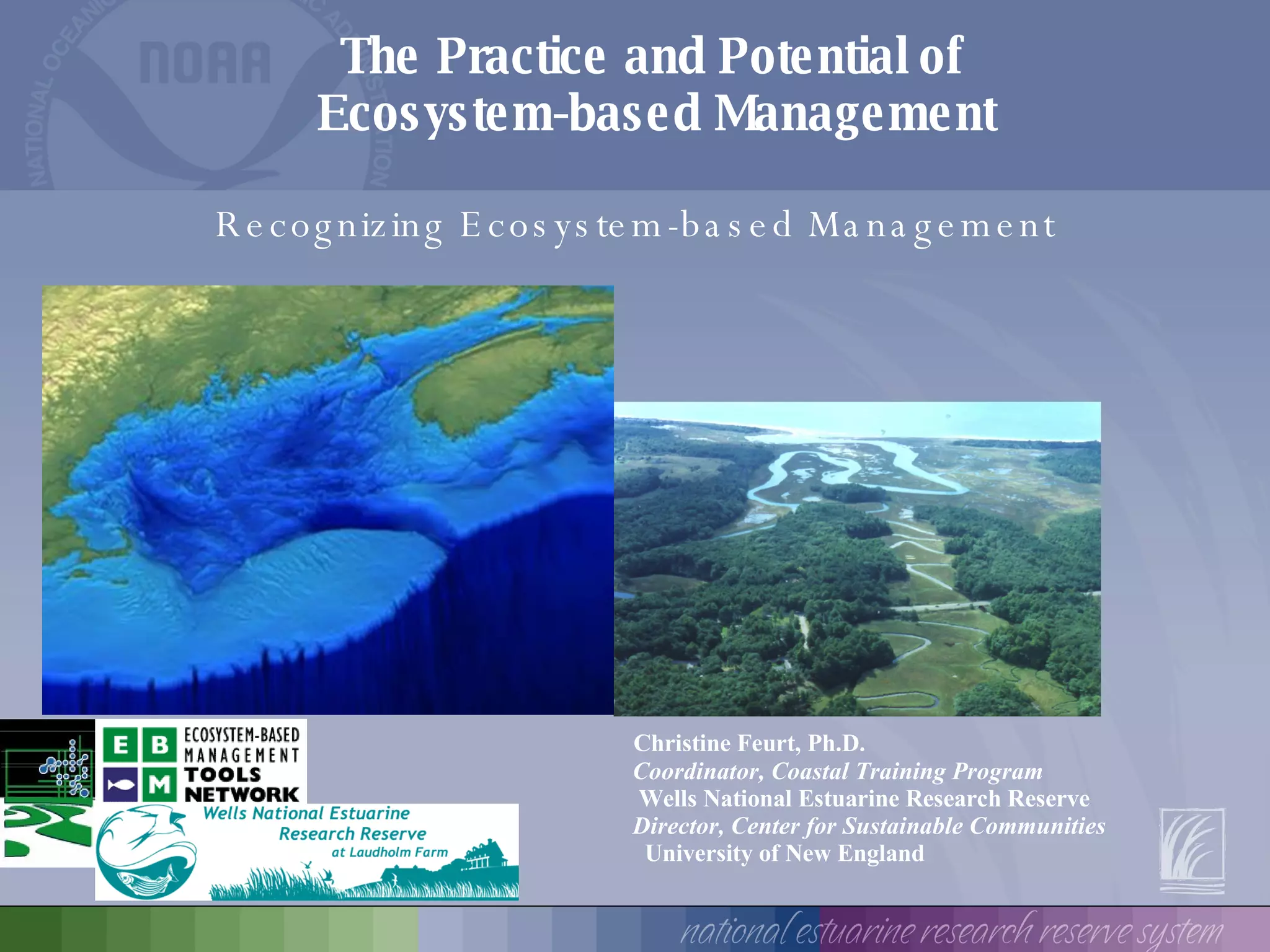
    The Practice andPotential of Ecosystem-based Management Christine Feurt, Ph.D. Coordinator, Coastal Training Program Wells National Estuarine Research Reserve Director, Center for Sustainable Communities University of New England Recognizing Ecosystem-based Management
  • 2.
    Ecosystem Management Meffeet al., 2002 Retain, restore and sustain ecosystem integrity Make the places we live, work and play noticeably better today and in the future. Based upon a collaboratively developed vision of desired future outcomes that integrates ecological, socioeconomic and institutional perspectives Applied within a geographic framework defined primarily by natural ecological boundaries.
  • 3.
    Overview of Today’sPresentations Watershed Management, Land Use Regulations, and Headwater Stream Conservation Steve Burns Coastal Resiliency, Science and Community Planning for Sea Level Rise and the Perfect Storm Pete Slovinsky Community Viz and Municipal Conservation Planning Judy Colby-George
  • 4.
    Overview of Today’sPresentations Beginning with Habitat: Challenges and Tools for Statewide Biodiversity Conservation Bethany Adkins A Model for Science, Stewardship and Adaptive Management in Taunton Bay John Sowles Collaborative Learning for Stakeholder Engagement-Social Science and Ecosystem Management Chris Feurt
  • 5.
    Elements of EcosystemManagement With a Focus on Land Use A collaboratively developed vision of desired future outcomes Indicators of success and a mechanism for tracking progress Interdisciplinary science as a measure of ecosystem sustainability Identification and engagement of stakeholders Place – a workable geographic boundary
  • 6.
    Collaborative Learning forStakeholder Engagement: Social Science and Ecosystem Management Challenges Overcoming barriers to: Watershed Management Plan implementation Science application to policy/management Adoption of best management practices
  • 7.
  • 8.
    Retain, restore andsustain ecosystem integrity Make the places we live, work and play noticeably better today and in the future. Based upon a collaboratively developed vision of desired future outcomes that integrates ecological, socioeconomic and institutional perspectives Applied within a geographic framework defined primarily by natural ecological boundaries. Ecosystem Management and Land Use
  • 9.
    The Collaborative LearningBridge A social science tool for Ecosystem Management Applying Social Science Tools Collaborative Learning Stakeholder Analysis Wells NERR Science Products Water Quality Data Watershed Surveys Watershed Management Plans Management & Policy Land Use Watershed Management Application of BMPs Perceptual Barriers Disciplinary Barriers Institutional Barriers Institutional Analysis Cultural Analysis
  • 10.
    Working Through EnvironmentalConflict The Collaborative Learning Approach By Steven E. Daniels and Gregg B. Walker (2001) “ A framework and set of techniques intended for multiparty decision situations… A means of designing and implementing a series of events to promote: Creative thought, Constructive debate and the Effective implementation of proposals that the stakeholders generate.” Theoretical Grounding: Systems, Conflict, Adult Learning Progress not Consensus
  • 11.
    Knowledge of Stakeholder Values, Attitudes and Beliefs Applied to Collaborative Learning Model Watershed Management Assessment {Training in CL Skills} Implementation And Facilitation Evaluation Adapted from Daniels and Walker, 2001 Design
  • 12.
    ASSESSMENT: WellsNERR Coastal Training Program Water is Threatened Coastal Trainers Provide Science-based Knowledge Municipal Decisions Contribute to Threats to Water Municipal Actions with Outcomes for Protecting Water Public Works Code Officer Planning Board ?
  • 13.
    Logic Model/ Program Planning ADDIE Process Collaborative Learning Conflict Theory Adult Learning Theory Systems Theory (+ Diffusion of Innovations) (+ Community Based Social Marketing) Action Research Instructional Systems Design Environmental Communication Institutional Analysis How can knowledge of the perspectives and values of stakeholders be used to improve ecosystem management? Ethnographic Interviews Participant Observation Cultural Models Theory Grounded Theory: Constant Comparison Method Cultural Anthropology Discourse Analysis Stakeholder Analysis What are the perspectives and values of water, its management and pollution, used by stakeholders in municipal decision-making? Strategic Tools : Theory & Practice Linking Multiple Disciplines to EM Research Question
  • 14.
    Understanding Stakeholder Perspectivesand Values Why is water important? What are threats to water? What can be done to protect water?
  • 15.
    Stakeholder Values NatureProduces Water, the Source of Life Water is a Resource to Use and Manage
  • 16.
    Perceptions of Threatsto Water’s Value Water is Threatened Chemical Lawn Chemicals, Fertilizer, Petroleum/Car byproducts, Nutrients, N and Ph, Ammonia & Chlorine from sewage treatment plant (STP), Pesticides, Mercury, Atmospheric pollutants, Asphalt MTBE, Arsenic, Road salt, Sand & deicing chemicals Biological Human sewage, Pet Waste Red Tide, Domestic Livestock Waste, Wildlife Waste, E. Coli Physical Sediment (silt & soil), Trash, Amount and force of flowing water, Temperature Threats Loss is Experienced Beach Closures Property Values Fish Kills
  • 17.
    7 Ways ofKnowing A Knowledge Resource for Collaborative Learning Governance (GOV) Science (SCI) Local (LOC) Ecological (ECO) Educational Practices (EDU) Technological (TEC) Land Use (LAN) Knowledge
  • 18.
    Combined Ways ofKnowing Ecological Knowledge Public Works Director Educational Practices Knowledge Science Knowledge Local Knowledge Governance Knowledge Land Use Knowledge Land Use Knowledge Technological Knowledge Local Knowledge Town Planner Scientist
  • 19.
    DESIGN Engaging theKaleidoscope of Expertise Municipal Officials as a Resource not a Receptacle ECO Water is Threatened Water is Valued SCI LAN TEC GOV EDU LOC Water is Protected Planning & Land Use Land Conservation Drinking H2O Research & Monitoring Education & Outreach Regs & Enforcement Engineering & Public Safety Citizen Stewardship
  • 20.
  • 21.
  • 22.
    Assemble and activatethe kaleidoscope of expertise Shared missions - Watershed Management Plan linked to Comprehensive Plans Elected official approval Municipal/State/Federal, NGO, water districts An experiment for a summer Meetings, field trips, breakfast at the Cockpit Café
  • 23.
    Identify shared valuesof water and perceptions of threats as fuel for collaboration
  • 24.
    Make conflicts explicitthrough dialogue and deliberation Sanford Regional Airport: Where water quality meets homeland security Property rights vs ….
  • 25.
    … Property ResponsibilitiesEcosystem Services and Green Infrastructure Sustaining the Commons
  • 26.
    EVALUATION: Putting aface and a place on ecosystem management Recognize ecosystem management at local scale Share Lessons in the Landscape Place-based opportunities for dialogue & deliberation Track outcomes & progress
  • 27.
    Evaluation to Assessment Action Research Multi-media Approach Progress on watershed action items Stakeholder consensus to continue Stakeholder survey Stakeholder interviews Elected official consensus to continue Grant funding for group generated projects
  • 28.
    Christine Feurt 207.646.1555 x111 [email_address] Collaborative Learning Guide November 2008 EBM Tools Training Wells NERR Nov 19 & 20 CICEET Project Explorer – Feurt/Final Report December 2008 http://www.ciceet.unh.edu/
  • 29.
    Elements of EcosystemManagement With a Focus on Land Use A collaboratively developed vision of desired future outcomes Indicators of success and a mechanism for tracking progress Interdisciplinary science as a measure of ecosystem sustainability Identification and engagement of stakeholders Place – a workable geographic boundary
  • 30.
    Selected References Bernard,H. ed. 1998. Handbook of Methods in Cultural Anthropology . New York: Altamira Press. Daniels, S. and G. Walker. 2001. Working Through Environmental Conflict: The Collaborative Learning Approach. Westport, CT: Praeger Feurt, C. 2007. Protecting Our Children’s Water, Using Cultural Models to Frame and Implement Ecosystem Based Management. Ph.D. Dissertation, Antioch University New England. Keene, New Hampshire. Glaser, B. and A. Strauss. 1967. The Discovery of Grounded Theory . New York: Aldine de Gruyter. Greenwood, D and Levin, M. 1998. Introduction to Action Research, Social Research for Social Change . Thousand Oaks, CA: Sage. Gunderson, L. and C. Holling, eds. 2001. Panarchy: Understanding Transformations in Systems of Humans and Nature . Washington, D. C.: Island Press. Holland, D. and N. Quinn. 1987. Cultural Models in Language and Thought . Cambridge, UK: Cambridge University Press. Lubchenco, J. 1998. Entering the century of the environment: A new social contract for science. Science 279: 491-497. Kempton, W., J. Boster and J. Hartley. 1995. Environmental Values in American Culture. Cambridge: MIT Press.
  • 31.
    Krum, C. andC. Feurt. 2002. Wells National Estuarine Research Reserve, Coastal Training Program: Market Analysis and Needs Assessment. Wells NERR: Wells, ME. Lee, K. 1993. Compass and Gyroscope. Integrating science and politics for the environment . Washington, D. C.: Island Press. Meffe, G., L. Nielsen, R. Knight, D. Schenborn. 2002. Ecosystem Management, Adaptive, Community-Based Conservation . Washington, DC: Island Press. NRC. 2005. Decision Making for the Environment. DC: National Academies Press. Paolisso, M. 2002. Blue crabs and controversy on the Chesapeake Bay: A cultural model for understanding watermen’s reasoning about blue crab management. Human Organization 61 (3): 226-239. Quinn, N. ed. 2005. Finding Culture in Talk, A Collection of Methods. New York: Palgrave Macmillan. Salafsky, N.,et al., 2001. Adaptive Management: A Tool For Conservation Practitioners. Available at www.fosonline.org Weiss, R. S. 1994. Learning from Strangers, The Art and Method of Qualitative Interview Studies . New York: The Free Press.
  • 32.

Editor's Notes

  • #2 Communication Consultation and Collaboration in service of Conservation