DRAINMOD Simulations in a Field
with Asymmetrical Drainage System
PhD Candidate
Negar Sharifi-Mood, McGill University
Shiv Prasher, McGill University
Ramesh Rudra, University of Guelph
Tiequan Zhang, Agriculture and Agri-food Canada
August 31, 2022
1
BACKGROUND
• Artificial drainage is a widely used agricultural water management
practice in humid regions of Canada to lower the water table,
improve trafficability, and increase crop production.
• In Central Canada, in some fields, the drainage systems have been
modified from symmetrical to asymmetrical by adding extra
laterals.
• Simulating flow in fields where the drainage system is not
symmetrically spaced, can be challenging.
• Models, such as DRAINMOD, have not traditionally been used for
these types of situations. 2
OBJECTIVE
To find the best way to simulate drain outflow using
DRAINMOD in a field with asymmetrical drainage system
3
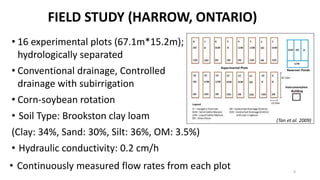
FIELD STUDY (HARROW, ONTARIO)
• 16 experimental plots (67.1m*15.2m);
hydrologically separated
• Conventional drainage, Controlled
drainage with subirrigation
• Corn-soybean rotation
• Soil Type: Brookston clay loam
(Clay: 34%, Sand: 30%, Silt: 36%, OM: 3.5%)
• Hydraulic conductivity: 0.2 cm/h
(Tan et al. 2009)
4
• Continuously measured flow rates from each plot
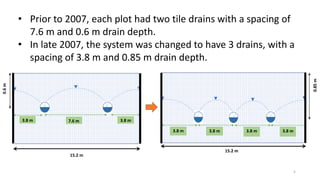
• Prior to 2007, each plot had two tile drains with a spacing of
7.6 m and 0.6 m drain depth.
• In late 2007, the system was changed to have 3 drains, with a
spacing of 3.8 m and 0.85 m drain depth.
7.6 m 3.8 m
3.8 m
15.2 m
0.6
m
5
3.8 m 3.8 m
3.8 m
3.8 m
15.2 m
0.85
m
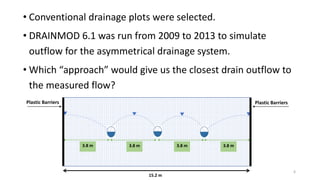
• Conventional drainage plots were selected.
• DRAINMOD 6.1 was run from 2009 to 2013 to simulate
outflow for the asymmetrical drainage system.
• Which “approach” would give us the closest drain outflow to
the measured flow?
6
3.8 m 3.8 m
3.8 m
3.8 m
15.2 m
Plastic Barriers Plastic Barriers
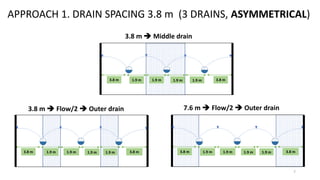
3.8 m  Middle drain
7.6 m  Flow/2  Outer drain
3.8 m  Flow/2  Outer drain
APPROACH 1. DRAIN SPACING 3.8 m (3 DRAINS, ASYMMETRICAL)
7
1.9 m 1.9 m
1.9 m 1.9 m
3.8 m 3.8 m
1.9 m 1.9 m
1.9 m 1.9 m
3.8 m 3.8 m 1.9 m 1.9 m
1.9 m 1.9 m
3.8 m 3.8 m
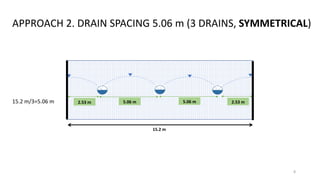
APPROACH 2. DRAIN SPACING 5.06 m (3 DRAINS, SYMMETRICAL)
15.2 m/3=5.06 m 5.06 m 2.53 m
2.53 m 5.06 m
15.2 m
8
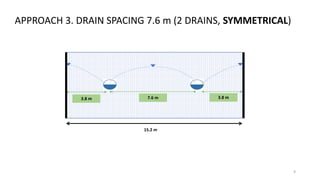
APPROACH 3. DRAIN SPACING 7.6 m (2 DRAINS, SYMMETRICAL)
7.6 m 3.8 m
3.8 m
15.2 m
9
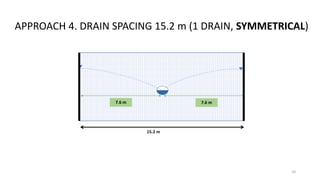
APPROACH 4. DRAIN SPACING 15.2 m (1 DRAIN, SYMMETRICAL)
7.6 m 7.6 m
15.2 m
10
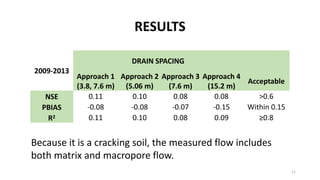
2009-2013
DRAIN SPACING
Approach 1
(3.8, 7.6 m)
Approach 2
(5.06 m)
Approach 3
(7.6 m)
Approach 4
(15.2 m)
Acceptable
NSE 0.11 0.10 0.08 0.08 >0.6
PBIAS -0.08 -0.08 -0.07 -0.15 Within 0.15
R2 0.11 0.10 0.08 0.09 ≥0.8
RESULTS
11
Because it is a cracking soil, the measured flow includes
both matrix and macropore flow.
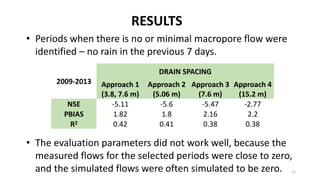
• Periods when there is no or minimal macropore flow were
identified – no rain in the previous 7 days.
• The evaluation parameters did not work well, because the
measured flows for the selected periods were close to zero,
and the simulated flows were often simulated to be zero.
RESULTS
2009-2013
DRAIN SPACING
Approach 1
(3.8, 7.6 m)
Approach 2
(5.06 m)
Approach 3
(7.6 m)
Approach 4
(15.2 m)
NSE -5.11 -5.6 -5.47 -2.77
PBIAS 1.82 1.8 2.16 2.2
R2 0.42 0.41 0.38 0.38
12
2009-2013
DRAIN SPACING
Approach 1
(3.8, 7.6 m)
Approach 2
(5.06 m)
Approach 3
(7.6 m)
Approach 4
(15.2 m)
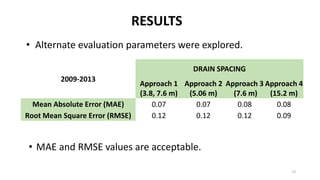
Mean Absolute Error (MAE) 0.07 0.07 0.08 0.08
Root Mean Square Error (RMSE) 0.12 0.12 0.12 0.09
• Alternate evaluation parameters were explored.
RESULTS
13
• MAE and RMSE values are acceptable.
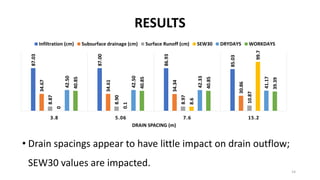
• Drain spacings appear to have little impact on drain outflow;
SEW30 values are impacted.
RESULTS
14
87.03
87.00
86.93
85.03
34.67
34.61
34.34
30.86
8.87
8.90
8.97
10.87
0
0.1
8.6
99.7
42.50
42.50
42.33
41.17
40.85
40.85
40.85
39.39
3.8 5.06 7.6 15.2
DRAIN SPACING (m)
Infiltration (cm) Subsurface drainage (cm) Surface Runoff (cm) SEW30 DRYDAYS WORKDAYS
15
Rainfall (mm)
2008 936
2009 851
2010 846
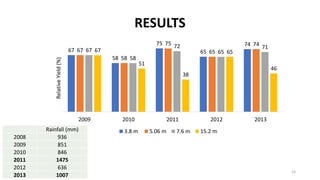
2011 1475
2012 636
2013 1007
67
58
75
65
74
67
58
75
65
74
67
58
72
65
71
67
51
38
65
46
2009 2010 2011 2012 2013
Relative
Yield
(%)
3.8 m 5.06 m 7.6 m 15.2 m
RESULTS
CONCLUSION
DRAINMOD can be used to simulate drain outflow in an
asymmetrical drainage system, with any recommended drain
spacing, for heavier soils with low hydraulic conductivities.
16
THANK YOU
Department of Bioresource Engineering
Liliane and David M. Stewart Fellowship in Water Resources

August 31 - 1116 - Shiv Prasher

  • 1.
    DRAINMOD Simulations ina Field with Asymmetrical Drainage System PhD Candidate Negar Sharifi-Mood, McGill University Shiv Prasher, McGill University Ramesh Rudra, University of Guelph Tiequan Zhang, Agriculture and Agri-food Canada August 31, 2022 1
  • 2.
    BACKGROUND • Artificial drainageis a widely used agricultural water management practice in humid regions of Canada to lower the water table, improve trafficability, and increase crop production. • In Central Canada, in some fields, the drainage systems have been modified from symmetrical to asymmetrical by adding extra laterals. • Simulating flow in fields where the drainage system is not symmetrically spaced, can be challenging. • Models, such as DRAINMOD, have not traditionally been used for these types of situations. 2
  • 3.
    OBJECTIVE To find thebest way to simulate drain outflow using DRAINMOD in a field with asymmetrical drainage system 3
  • 4.
    FIELD STUDY (HARROW,ONTARIO) • 16 experimental plots (67.1m*15.2m); hydrologically separated • Conventional drainage, Controlled drainage with subirrigation • Corn-soybean rotation • Soil Type: Brookston clay loam (Clay: 34%, Sand: 30%, Silt: 36%, OM: 3.5%) • Hydraulic conductivity: 0.2 cm/h (Tan et al. 2009) 4 • Continuously measured flow rates from each plot
  • 5.
    • Prior to2007, each plot had two tile drains with a spacing of 7.6 m and 0.6 m drain depth. • In late 2007, the system was changed to have 3 drains, with a spacing of 3.8 m and 0.85 m drain depth. 7.6 m 3.8 m 3.8 m 15.2 m 0.6 m 5 3.8 m 3.8 m 3.8 m 3.8 m 15.2 m 0.85 m
  • 6.
    • Conventional drainageplots were selected. • DRAINMOD 6.1 was run from 2009 to 2013 to simulate outflow for the asymmetrical drainage system. • Which “approach” would give us the closest drain outflow to the measured flow? 6 3.8 m 3.8 m 3.8 m 3.8 m 15.2 m Plastic Barriers Plastic Barriers
  • 7.
    3.8 m Middle drain 7.6 m  Flow/2  Outer drain 3.8 m  Flow/2  Outer drain APPROACH 1. DRAIN SPACING 3.8 m (3 DRAINS, ASYMMETRICAL) 7 1.9 m 1.9 m 1.9 m 1.9 m 3.8 m 3.8 m 1.9 m 1.9 m 1.9 m 1.9 m 3.8 m 3.8 m 1.9 m 1.9 m 1.9 m 1.9 m 3.8 m 3.8 m
  • 8.
    APPROACH 2. DRAINSPACING 5.06 m (3 DRAINS, SYMMETRICAL) 15.2 m/3=5.06 m 5.06 m 2.53 m 2.53 m 5.06 m 15.2 m 8
  • 9.
    APPROACH 3. DRAINSPACING 7.6 m (2 DRAINS, SYMMETRICAL) 7.6 m 3.8 m 3.8 m 15.2 m 9
  • 10.
    APPROACH 4. DRAINSPACING 15.2 m (1 DRAIN, SYMMETRICAL) 7.6 m 7.6 m 15.2 m 10
  • 11.
    2009-2013 DRAIN SPACING Approach 1 (3.8,7.6 m) Approach 2 (5.06 m) Approach 3 (7.6 m) Approach 4 (15.2 m) Acceptable NSE 0.11 0.10 0.08 0.08 >0.6 PBIAS -0.08 -0.08 -0.07 -0.15 Within 0.15 R2 0.11 0.10 0.08 0.09 ≥0.8 RESULTS 11 Because it is a cracking soil, the measured flow includes both matrix and macropore flow.
  • 12.
    • Periods whenthere is no or minimal macropore flow were identified – no rain in the previous 7 days. • The evaluation parameters did not work well, because the measured flows for the selected periods were close to zero, and the simulated flows were often simulated to be zero. RESULTS 2009-2013 DRAIN SPACING Approach 1 (3.8, 7.6 m) Approach 2 (5.06 m) Approach 3 (7.6 m) Approach 4 (15.2 m) NSE -5.11 -5.6 -5.47 -2.77 PBIAS 1.82 1.8 2.16 2.2 R2 0.42 0.41 0.38 0.38 12
  • 13.
    2009-2013 DRAIN SPACING Approach 1 (3.8,7.6 m) Approach 2 (5.06 m) Approach 3 (7.6 m) Approach 4 (15.2 m) Mean Absolute Error (MAE) 0.07 0.07 0.08 0.08 Root Mean Square Error (RMSE) 0.12 0.12 0.12 0.09 • Alternate evaluation parameters were explored. RESULTS 13 • MAE and RMSE values are acceptable.
  • 14.
    • Drain spacingsappear to have little impact on drain outflow; SEW30 values are impacted. RESULTS 14 87.03 87.00 86.93 85.03 34.67 34.61 34.34 30.86 8.87 8.90 8.97 10.87 0 0.1 8.6 99.7 42.50 42.50 42.33 41.17 40.85 40.85 40.85 39.39 3.8 5.06 7.6 15.2 DRAIN SPACING (m) Infiltration (cm) Subsurface drainage (cm) Surface Runoff (cm) SEW30 DRYDAYS WORKDAYS
  • 15.
    15 Rainfall (mm) 2008 936 2009851 2010 846 2011 1475 2012 636 2013 1007 67 58 75 65 74 67 58 75 65 74 67 58 72 65 71 67 51 38 65 46 2009 2010 2011 2012 2013 Relative Yield (%) 3.8 m 5.06 m 7.6 m 15.2 m RESULTS
  • 16.
    CONCLUSION DRAINMOD can beused to simulate drain outflow in an asymmetrical drainage system, with any recommended drain spacing, for heavier soils with low hydraulic conductivities. 16
  • 17.
    THANK YOU Department ofBioresource Engineering Liliane and David M. Stewart Fellowship in Water Resources