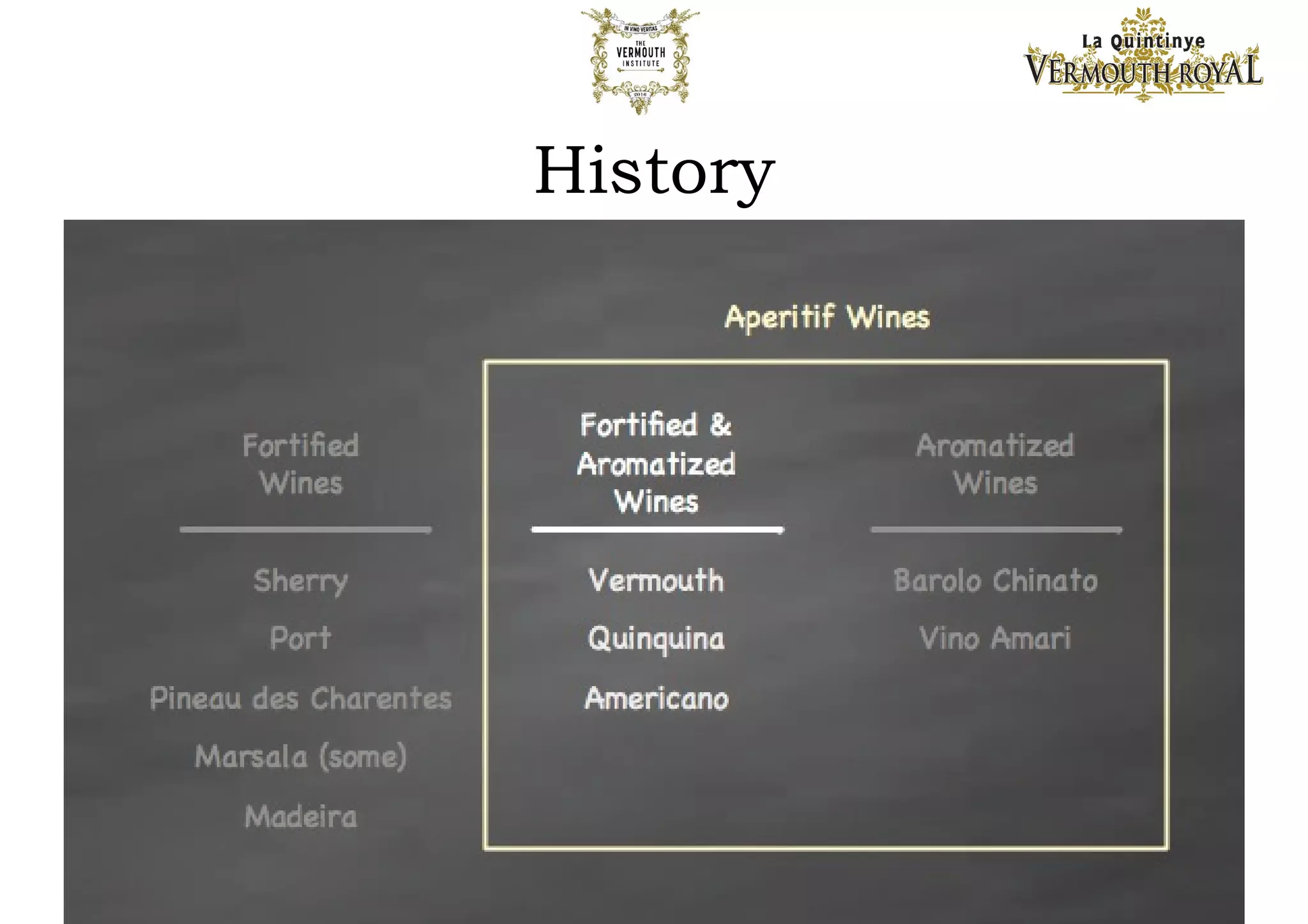
History
History
History
History
History
Production
- 1991: EU definition of vermouth, EU 1601/91:
- artemisia must be used
- must be fortified with alcohol
- can only be sweetened with sugar, sucrose or must
- must be 75% made of EU-compliant wine
- Min. ABV 14.5%, max. ABV 22%
Production
EU 1601 / 91:
Ingredients & Colouring
- Has to contain artemisia
Production
EU 1601 / 91: Sugar
Production
EU 1601 / 91: Alcohol
- Composed of at least 75% EU-defined wine
and/or grape must (whose fermentation has
been arrested with alcohol)
Production
USA (TTB) Federal Alcohol
Administration Act
“Vermouth is a type of aperitif wine:
- compounded from grape wine,
- having the taste, aroma, and characteristics
generally attributed to vermouth, and shall be so
designated.”
- Min. 7%, max. 24% alcohol
Production
EU 1601 / 91:
Ingredients & Colouring
- Has to contain artemisia
- May contain natural or
otherwise flavourings
Production
EU 1601 / 91:
Ingredients & Colouring
- Has to contain artemisia
- May contain natural or
otherwise flavourings
- May be coloured
with caramel
Production
EU regulations 251/2014:
Location
Vermouth di Torino must:
- Contain artemisia from Piemonte region
- Be produced and bottled in Turin / Piemonte
region.
Production
Wine
- Pineau des Charentes (La Quintinye)
–White: Ugni Blanc, Chenin Blanc, Colombard,
Folle Blanche, Muscadelle, Chardonnay,
Sauvignon Blanc,
–Red: Merlot, malbec, Cabernet Franc,
Cabernet Sauvignon
- Picpoul & Clairette (Noilly Prat)
Production
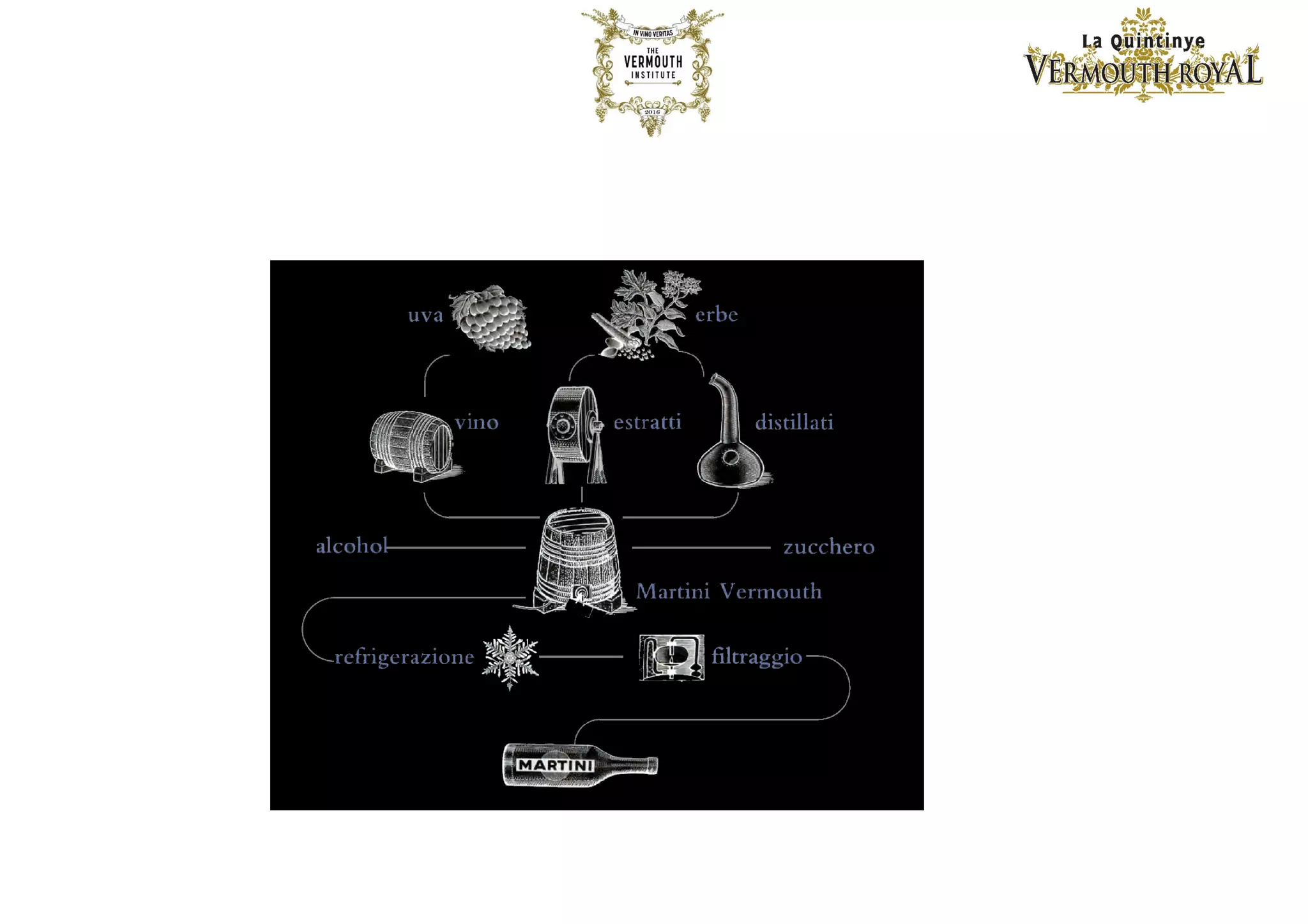
Maceration
Production
Percolation
Production
Distillation
Production
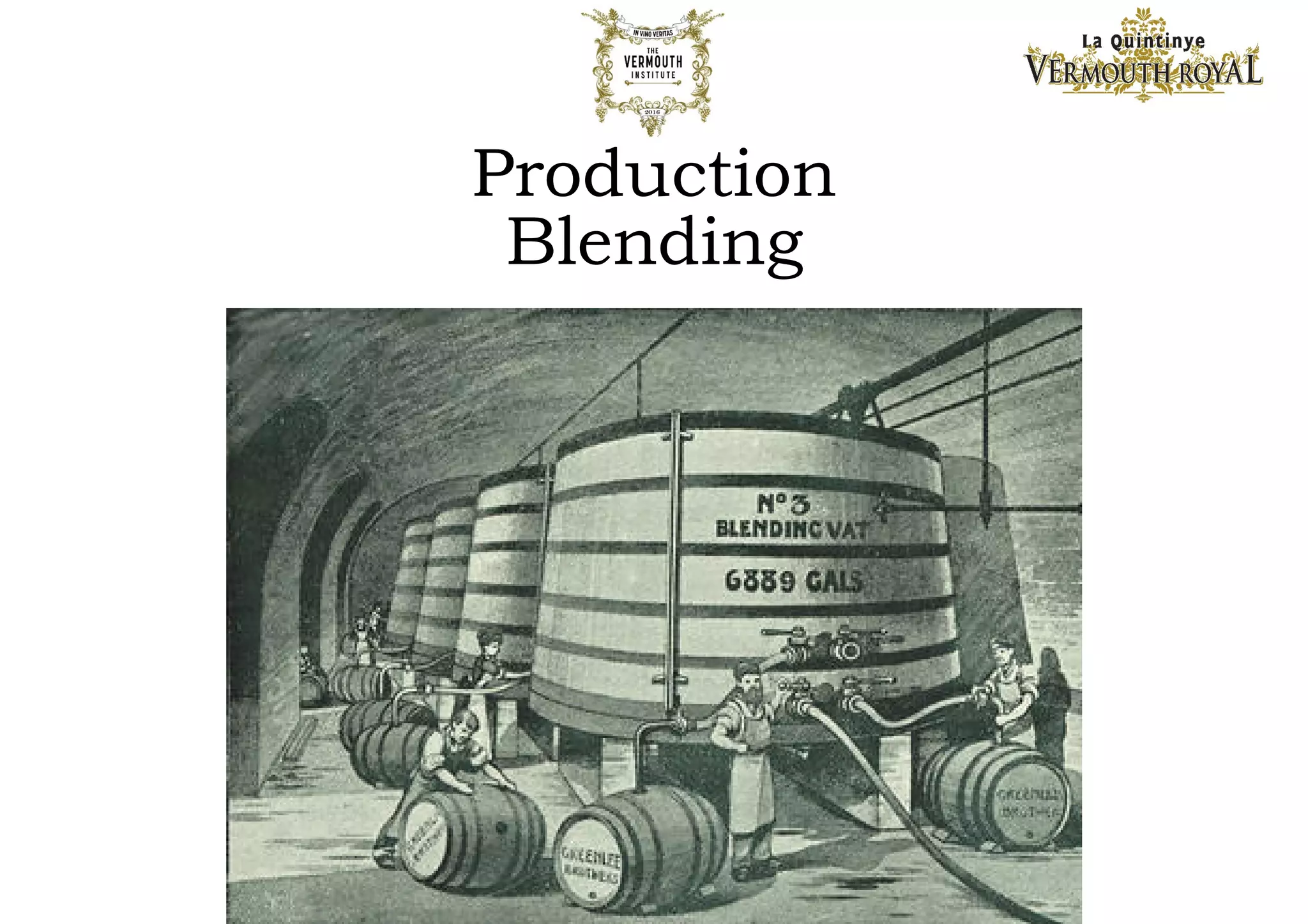
Blending
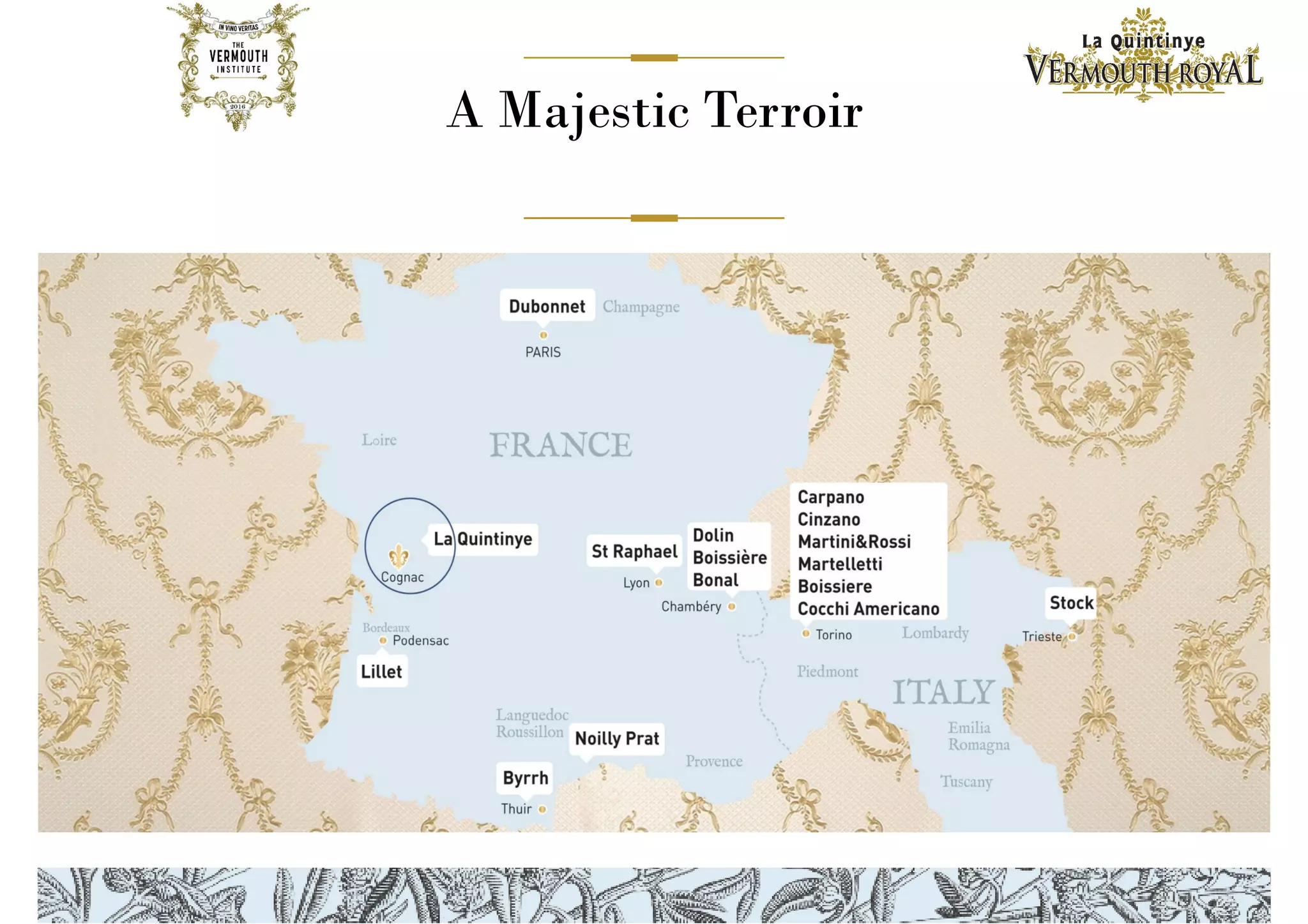
A Majestic Terroir
THE CHARENTE REGION
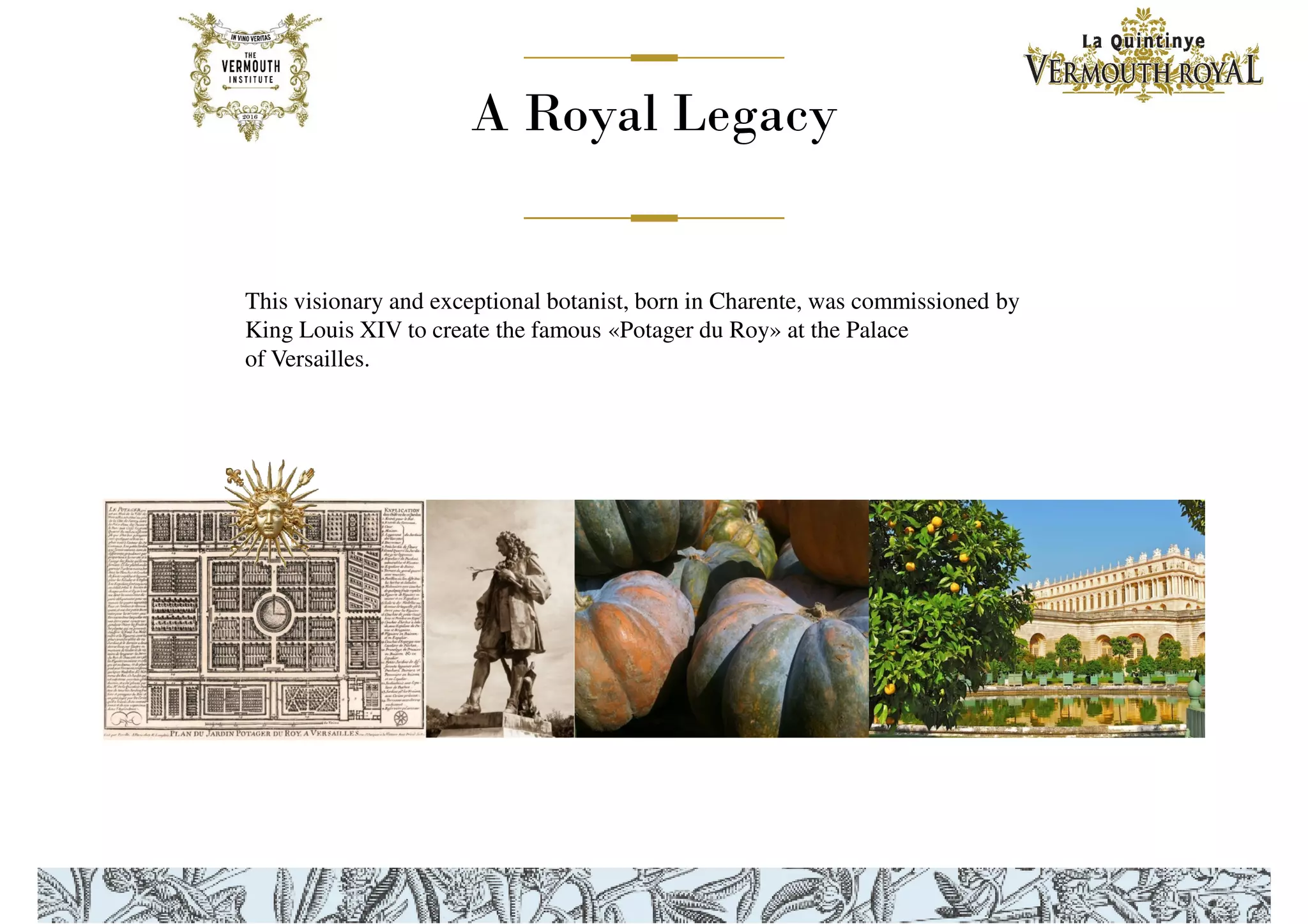
A Royal Legacy
A TRIBUTE TO THE EXCELLENCE
This visionary and exceptional botanist, born in Charente, was commissioned by
King Louis XIV to create the famous «Potager du Roy» at the Palace
of Versailles.
Rigorously selected for their purity and aromatic properties, 12 plants and spices
make up the palette shared by the range.
Each reference is then completed by a specific selection :
in total 28 plants and spices compose La Quintinye Rouge, 18 make the Blanc and
27 are used in La Quintinye Extra Dry.
OUR CORE
Botanicals
1-
2-
3-
4-
5-
6-
12-
11-
10-
9-
8-
7-
1- Artemisia - or wormwood - The essenti
alingredient in Vermouth, belonging to the
ab-sinthe family. 2- Angelica - Brings an in
itial sweetness which develops towards bitt
er- sweet notes./ 3- Cinnamon – The bar
k has warming and powerful properties./ 4-
Quassia Amara - Known for its intense bitt
erness. / 5- Ginger - Warm flavours that ar
e equallysweet and strong./ 6- Cardamom
- An aromatic plant with lemony fragrances
./ 7- Vine flower - The short-lived and rar
e flower withits subtle and delicate fragranc
e./ 8- Liquorice - A smooth flavo
ur also knownas the "sweet root"./ 9- Iris r
oot - Provides violet aromas and enhances
those of the other plants./ 10- Citrus Aura
ntium - or bitterorange - For its citrus bou
quet of fresh and fruity notes. 11- Nutmeg
– Smooth and acidic flavour.
History
In The Beginning...
History
- 7,000 BC: Middle East, Asian Eastern Europe, China
- 3,000 BC: Sumerians, Egypt, Israel: herb/spiced wines
- 1,250 BC: China -wormwood wine residue in rice wine
- 600 BC: Hippocratic (et al.) wines: wormwood, retsina
- 200 BC – 200 AD: The Roman Empire. Cicero:
absinthium vinum, wormwood wine
History
- 32 AD: Christ on cross offered wormwood-doused
sponge
- 77 AD: Pliny the Elder states that wormwood wine can
(also) be made by sowing wormwood around grape vines.
- 500 AD – 1300 AD: Monks & scientists
- 711 AD – 1492 AD: Arab invasion Europe, Reconquista
History
- 1300 AD– 1600 AD: The Renaissance
- 1310 AD: Catalan alchemist Arnaud de Villeneuve
includes wormwood wine recipe in Liber de vinum
- c. 1400 AD: “Wormwood” enters English language
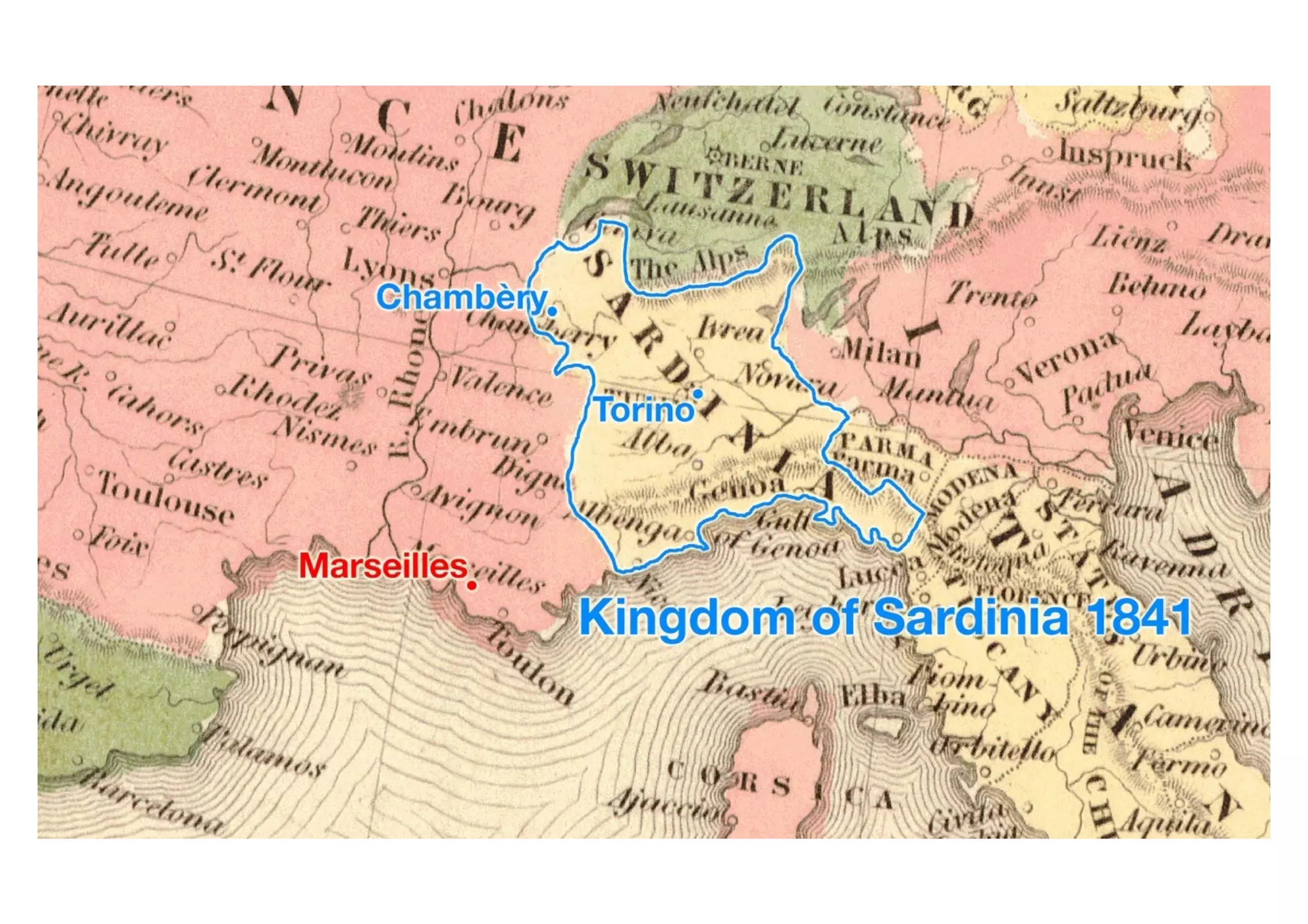
- Kingdom of Sardinia 1324 – 1460
- Duchy of Savoy, 1416 - 1861
History
- 1555 AD: I Secreti del reverend donno Allesio
Piemontese published, written by Jeronimo Ruscelli,
a.k.a. Alessio di Piemonte.
- 1562 AD: Capital of the Duchy of Savoy becomes Turin.
History
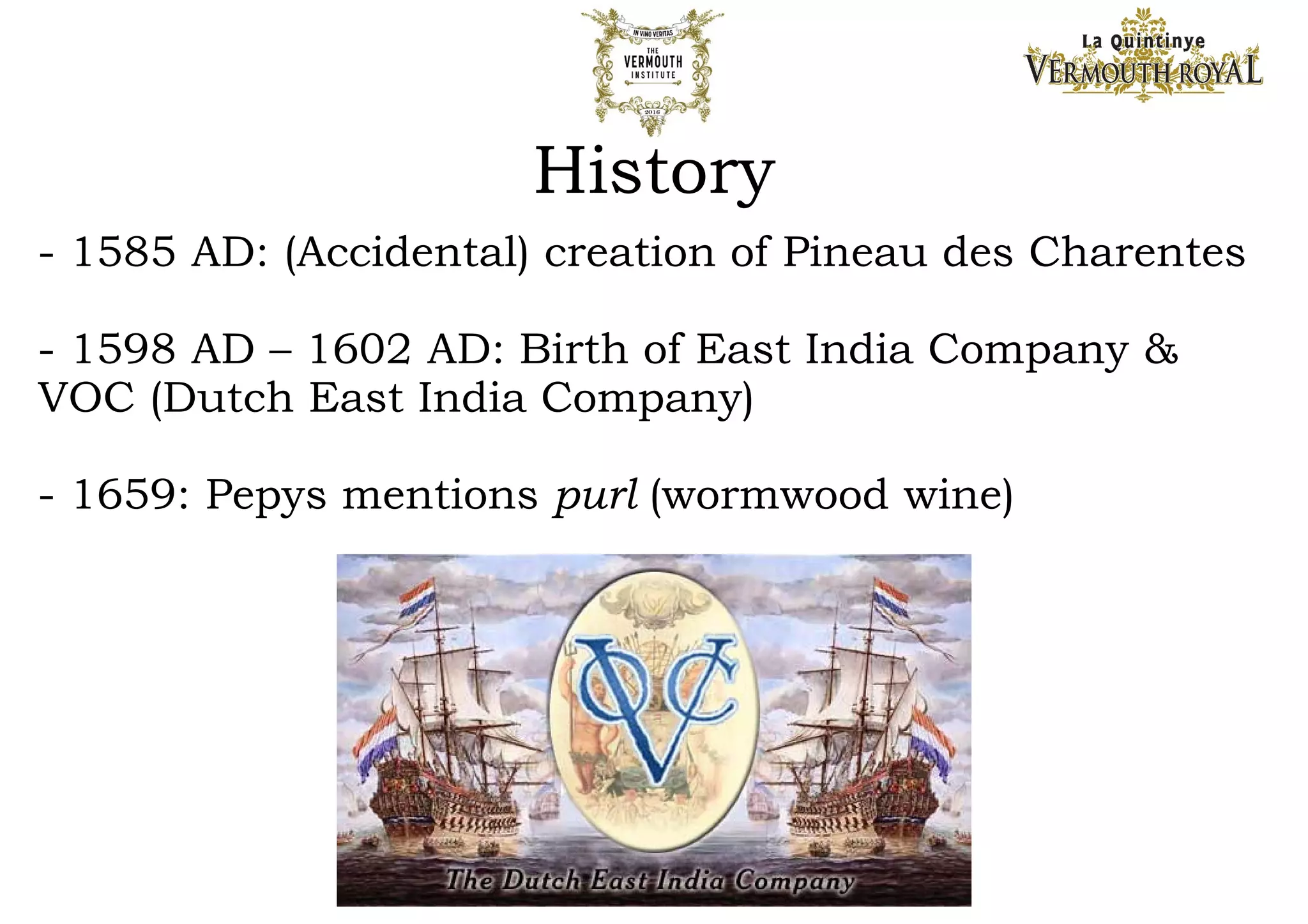
- 1585 AD: (Accidental) creation of Pineau des Charentes
- 1598 AD – 1602 AD: Birth of East India Company &
VOC (Dutch East India Company)
- 1659: Pepys mentions purl (wormwood wine)
History
- 1757 AD: Carl Stefano & Giovanni Giacomo Cinzano
become distillers in Pecetto, Italy, but not yet vermouth
makers.
- 1786: Antonio Benedetto Carpano creates first
commercial vermouth, but it cannot be sold outside the
limits of Turin. Named wermut as tribute to Duchy of
Savoy's links to Germany.
- 1806: ‘Vermouth’ enters English language.
- 1813: Noilly (Prat) French (dry) Vermouth created by
Joseph Noilly in Lyon.
History
- 1821: Joseph Chavasse (Dolin’s father-in-law), an
absinthe distiller, creates Vermouth de Chambéry, after
visiting Turin.
(-1830: Chavasse moves to Chambéry)
(-1843: Company becomes “Dolin”)
History
- 1838: Cora (1835, Italy) pioneers large-scale
commercial production, sends the first vermouths to USA
and South America.
- 1861: Chambéry is now officially in France, and Turin
is in what is now called Italy.
- 1862: How to Mix Drinks, or The Bon-Vivant’s
Companion by Jerry Thomas - none of the cocktail recipes
contained vermouth.
History
- c. 1865: Manhattan cocktail created
- 1867: Paris Exposition Universelle of 1867 did not
allow any absinthes to be judged, and highly praised the
potential for vermouths, which were looked to replace
absinthe as a ‘respected’ and healthy aperitif in France.
- 1870s: US demand for vermouths grows via cocktails,
US barmen go to France and England.
- 1879: Martini, Sola & Cia (orig. Distilleria National di
Spirito di Vino, 1840) changes name to Martini & Rossi.
History
- 1882: ‘Marguerite Cocktail’ published in Harry
Johnson's Bartender’s Manual calls for French vermouth.
- 1890: Martini & Rossi creates Extra Dry Vermouth,
which is made to compete with French dry vermouth.
Huge impact in USA.
- 1903: European phylloxera ends. Wine glut starts!
- 1910: Martini Bianco launched.
History
- 1912: Absinthe banned in USA. Ban does not affect
macerated artemisia absinthium products like vermouth.
- 1915: Absinthe banned in France. Doesn't affect
vermouth. Spirit aperitifs over 16% banned for war effort.
- 1919: Negroni invented in Florence. Probably. (See also:
Americano, Milano-Torino and Torino-Milano)
- 1919: Vogue for vermouth-cassis (Noilly advertising)
- 1920 – 1933: US Prohibition. Grape juice vermouth.
Vermouth smuggled in “perishable flower” crates.
History
- 1923: Absinthe banned Germany.
- 1926: Absinthe banned Italy.
- 1932: Vermouth de Chambéry receives AOC in France.
- 1933: US vermouth producers required to pay a triple
tax. Imports flourish.
- Gallo founded: a titan of US vermouth gets underway.
- 1936: Triple tax ends. US producers banned from
using brandy in vermouths: heavy, alcoholic, sweet-wine
vermouth style evolves. 1939: US: imports 1:7.
History
- 1938: Vermouth Industries of America founded.
- 1939: WWII stops imports. Domestic vermouth boom.
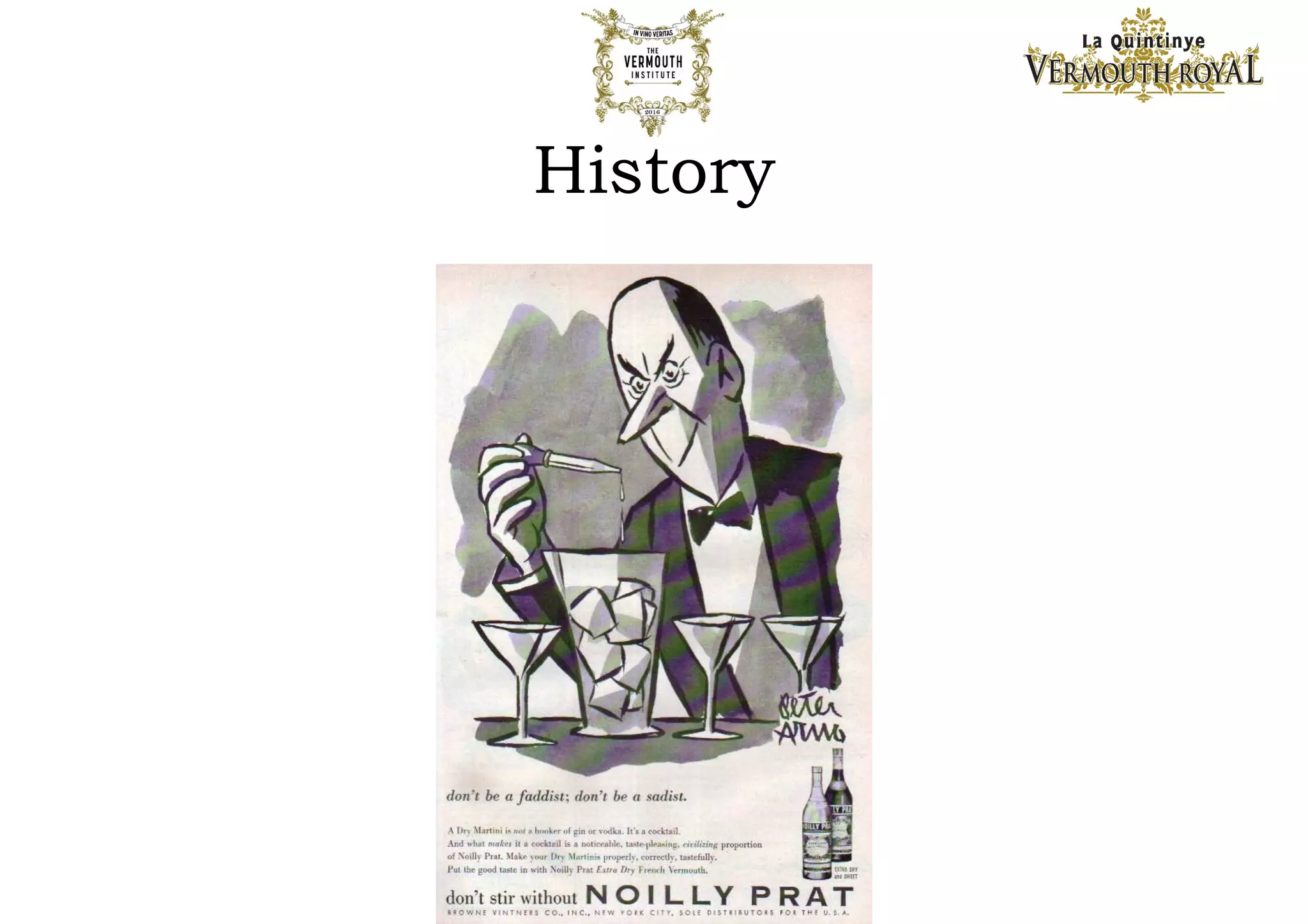
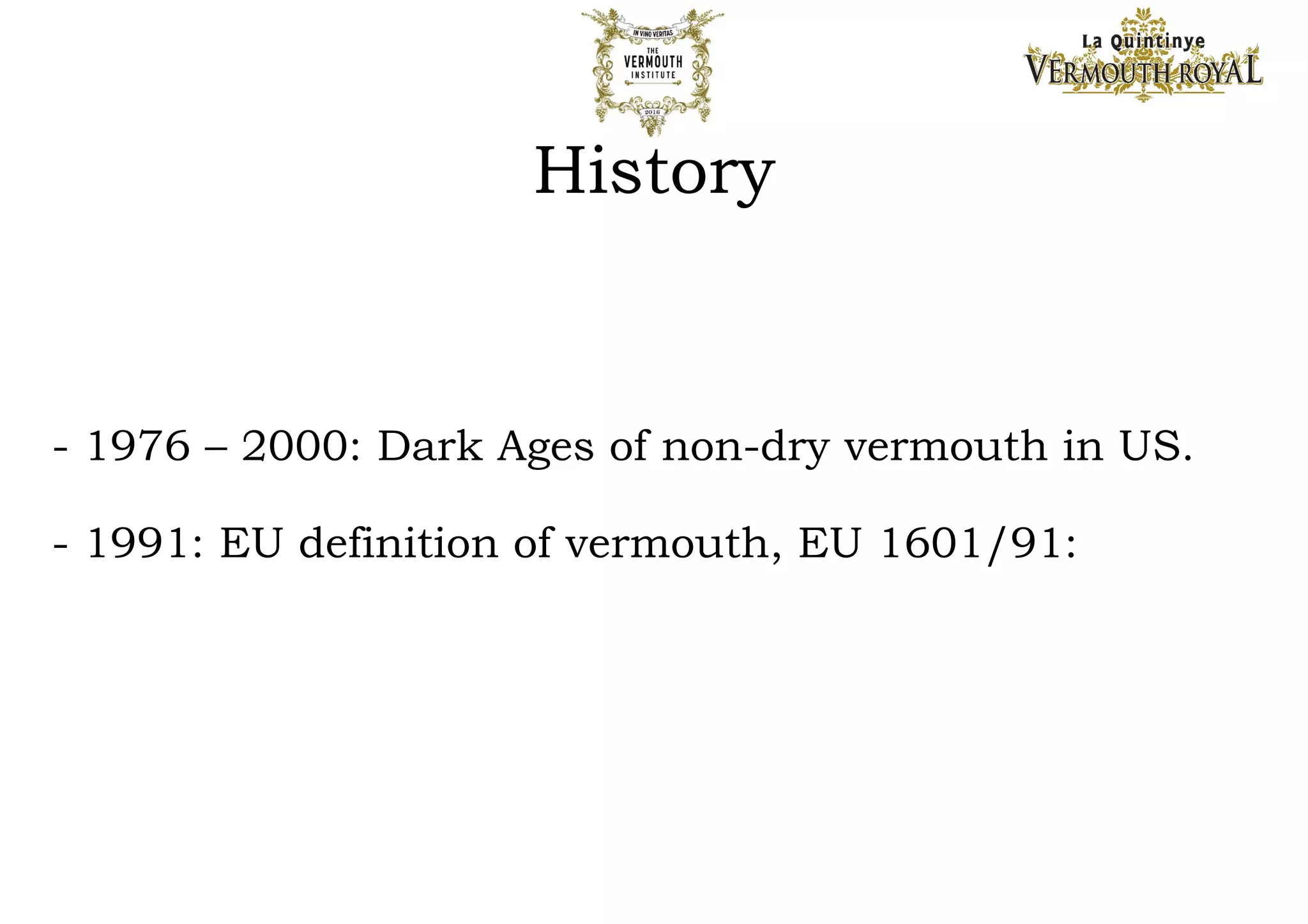
- 1960: Martini & Rossi ad campaigns culminate in J.
Bond adopting the Martini cocktail.
History
History
- 1976 – 2000: Dark Ages of non-dry vermouth in US.
- 1991: EU definition of vermouth, EU 1601/91:
History
- 1999: First New World vermouth produced – Vya.
- 2001: Carpano Antica Formula launched.
- 2013: La Quintinye Vermouth Royal launched.
Vermouth anno 2016
- Many new brands being created
- Everyone wants to emulate Carpano Antica
Formula (c. $24/750ml) but not Martini
($9/750ml).
Vermouth anno 2016
- Vermouth drinking declining,
vermouth cocktails rising.
- Low-alcohol cocktails popular.
Thank you!
www . slideshare . net / philipduff
www . laquintinyevermouthroyal . com
@philipduff
@philipsduff

The Vermouth Institute updated 2016

  • 2.
  • 3.
  • 4.
  • 5.
  • 6.
  • 7.
    Production - 1991: EUdefinition of vermouth, EU 1601/91: - artemisia must be used - must be fortified with alcohol - can only be sweetened with sugar, sucrose or must - must be 75% made of EU-compliant wine - Min. ABV 14.5%, max. ABV 22%
  • 8.
    Production EU 1601 /91: Ingredients & Colouring - Has to contain artemisia
  • 9.
  • 10.
    Production EU 1601 /91: Alcohol - Composed of at least 75% EU-defined wine and/or grape must (whose fermentation has been arrested with alcohol)
  • 11.
    Production USA (TTB) FederalAlcohol Administration Act “Vermouth is a type of aperitif wine: - compounded from grape wine, - having the taste, aroma, and characteristics generally attributed to vermouth, and shall be so designated.” - Min. 7%, max. 24% alcohol
  • 12.
    Production EU 1601 /91: Ingredients & Colouring - Has to contain artemisia - May contain natural or otherwise flavourings
  • 13.
    Production EU 1601 /91: Ingredients & Colouring - Has to contain artemisia - May contain natural or otherwise flavourings - May be coloured with caramel
  • 14.
    Production EU regulations 251/2014: Location Vermouthdi Torino must: - Contain artemisia from Piemonte region - Be produced and bottled in Turin / Piemonte region.
  • 15.
    Production Wine - Pineau desCharentes (La Quintinye) –White: Ugni Blanc, Chenin Blanc, Colombard, Folle Blanche, Muscadelle, Chardonnay, Sauvignon Blanc, –Red: Merlot, malbec, Cabernet Franc, Cabernet Sauvignon - Picpoul & Clairette (Noilly Prat)
  • 16.
  • 17.
  • 18.
  • 19.
  • 21.
    A Majestic Terroir THECHARENTE REGION
  • 22.
    A Royal Legacy ATRIBUTE TO THE EXCELLENCE This visionary and exceptional botanist, born in Charente, was commissioned by King Louis XIV to create the famous «Potager du Roy» at the Palace of Versailles.
  • 23.
    Rigorously selected fortheir purity and aromatic properties, 12 plants and spices make up the palette shared by the range. Each reference is then completed by a specific selection : in total 28 plants and spices compose La Quintinye Rouge, 18 make the Blanc and 27 are used in La Quintinye Extra Dry. OUR CORE Botanicals 1- 2- 3- 4- 5- 6- 12- 11- 10- 9- 8- 7- 1- Artemisia - or wormwood - The essenti alingredient in Vermouth, belonging to the ab-sinthe family. 2- Angelica - Brings an in itial sweetness which develops towards bitt er- sweet notes./ 3- Cinnamon – The bar k has warming and powerful properties./ 4- Quassia Amara - Known for its intense bitt erness. / 5- Ginger - Warm flavours that ar e equallysweet and strong./ 6- Cardamom - An aromatic plant with lemony fragrances ./ 7- Vine flower - The short-lived and rar e flower withits subtle and delicate fragranc e./ 8- Liquorice - A smooth flavo ur also knownas the "sweet root"./ 9- Iris r oot - Provides violet aromas and enhances those of the other plants./ 10- Citrus Aura ntium - or bitterorange - For its citrus bou quet of fresh and fruity notes. 11- Nutmeg – Smooth and acidic flavour.
  • 24.
  • 25.
    History - 7,000 BC:Middle East, Asian Eastern Europe, China - 3,000 BC: Sumerians, Egypt, Israel: herb/spiced wines - 1,250 BC: China -wormwood wine residue in rice wine - 600 BC: Hippocratic (et al.) wines: wormwood, retsina - 200 BC – 200 AD: The Roman Empire. Cicero: absinthium vinum, wormwood wine
  • 26.
    History - 32 AD:Christ on cross offered wormwood-doused sponge - 77 AD: Pliny the Elder states that wormwood wine can (also) be made by sowing wormwood around grape vines. - 500 AD – 1300 AD: Monks & scientists - 711 AD – 1492 AD: Arab invasion Europe, Reconquista
  • 27.
    History - 1300 AD–1600 AD: The Renaissance - 1310 AD: Catalan alchemist Arnaud de Villeneuve includes wormwood wine recipe in Liber de vinum - c. 1400 AD: “Wormwood” enters English language
  • 28.
    - Kingdom ofSardinia 1324 – 1460 - Duchy of Savoy, 1416 - 1861
  • 29.
    History - 1555 AD:I Secreti del reverend donno Allesio Piemontese published, written by Jeronimo Ruscelli, a.k.a. Alessio di Piemonte. - 1562 AD: Capital of the Duchy of Savoy becomes Turin.
  • 30.
    History - 1585 AD:(Accidental) creation of Pineau des Charentes - 1598 AD – 1602 AD: Birth of East India Company & VOC (Dutch East India Company) - 1659: Pepys mentions purl (wormwood wine)
  • 31.
    History - 1757 AD:Carl Stefano & Giovanni Giacomo Cinzano become distillers in Pecetto, Italy, but not yet vermouth makers. - 1786: Antonio Benedetto Carpano creates first commercial vermouth, but it cannot be sold outside the limits of Turin. Named wermut as tribute to Duchy of Savoy's links to Germany. - 1806: ‘Vermouth’ enters English language. - 1813: Noilly (Prat) French (dry) Vermouth created by Joseph Noilly in Lyon.
  • 32.
    History - 1821: JosephChavasse (Dolin’s father-in-law), an absinthe distiller, creates Vermouth de Chambéry, after visiting Turin. (-1830: Chavasse moves to Chambéry) (-1843: Company becomes “Dolin”)
  • 33.
    History - 1838: Cora(1835, Italy) pioneers large-scale commercial production, sends the first vermouths to USA and South America. - 1861: Chambéry is now officially in France, and Turin is in what is now called Italy. - 1862: How to Mix Drinks, or The Bon-Vivant’s Companion by Jerry Thomas - none of the cocktail recipes contained vermouth.
  • 34.
    History - c. 1865:Manhattan cocktail created - 1867: Paris Exposition Universelle of 1867 did not allow any absinthes to be judged, and highly praised the potential for vermouths, which were looked to replace absinthe as a ‘respected’ and healthy aperitif in France. - 1870s: US demand for vermouths grows via cocktails, US barmen go to France and England. - 1879: Martini, Sola & Cia (orig. Distilleria National di Spirito di Vino, 1840) changes name to Martini & Rossi.
  • 35.
    History - 1882: ‘MargueriteCocktail’ published in Harry Johnson's Bartender’s Manual calls for French vermouth. - 1890: Martini & Rossi creates Extra Dry Vermouth, which is made to compete with French dry vermouth. Huge impact in USA. - 1903: European phylloxera ends. Wine glut starts! - 1910: Martini Bianco launched.
  • 36.
    History - 1912: Absinthebanned in USA. Ban does not affect macerated artemisia absinthium products like vermouth. - 1915: Absinthe banned in France. Doesn't affect vermouth. Spirit aperitifs over 16% banned for war effort. - 1919: Negroni invented in Florence. Probably. (See also: Americano, Milano-Torino and Torino-Milano) - 1919: Vogue for vermouth-cassis (Noilly advertising) - 1920 – 1933: US Prohibition. Grape juice vermouth. Vermouth smuggled in “perishable flower” crates.
  • 37.
    History - 1923: Absinthebanned Germany. - 1926: Absinthe banned Italy. - 1932: Vermouth de Chambéry receives AOC in France. - 1933: US vermouth producers required to pay a triple tax. Imports flourish. - Gallo founded: a titan of US vermouth gets underway. - 1936: Triple tax ends. US producers banned from using brandy in vermouths: heavy, alcoholic, sweet-wine vermouth style evolves. 1939: US: imports 1:7.
  • 38.
    History - 1938: VermouthIndustries of America founded. - 1939: WWII stops imports. Domestic vermouth boom. - 1960: Martini & Rossi ad campaigns culminate in J. Bond adopting the Martini cocktail.
  • 39.
  • 40.
    History - 1976 –2000: Dark Ages of non-dry vermouth in US. - 1991: EU definition of vermouth, EU 1601/91:
  • 41.
    History - 1999: FirstNew World vermouth produced – Vya. - 2001: Carpano Antica Formula launched. - 2013: La Quintinye Vermouth Royal launched.
  • 42.
    Vermouth anno 2016 -Many new brands being created - Everyone wants to emulate Carpano Antica Formula (c. $24/750ml) but not Martini ($9/750ml).
  • 43.
    Vermouth anno 2016 -Vermouth drinking declining, vermouth cocktails rising. - Low-alcohol cocktails popular.
  • 44.
    Thank you! www .slideshare . net / philipduff www . laquintinyevermouthroyal . com @philipduff @philipsduff