Training Course – part 1
By Heru Setiawan
The Edge, 17 May 2012
ALCOHOLALCOHOL
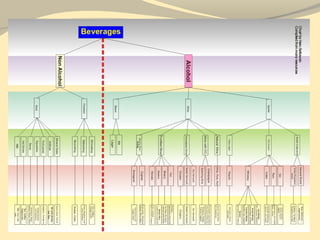
BEVERAGE MAIN CHARTBEVERAGE MAIN CHART
ALCOHOLALCOHOL
WINEWINE BEERBEER FUNCTIONSFUNCTIONSSPIRITSSPIRITS KINDSKINDS
BEVERAGE MAIN CHARTBEVERAGE MAIN CHART
SPIRITSSPIRITS
DRYDRY
SPIRITSSPIRITS
SWEETSWEET
SPIRITSSPIRITS
OTHEROTHER
SPIRITSSPIRITS
GINGIN VODKAVODKA RUMRUM WHISKEYWHISKEY
BEVERAGE MAIN CHARTBEVERAGE MAIN CHART
LIQUORS LIQUEURS
ALCOHOL BEVERAGEALCOHOL BEVERAGE
• Definition:
• Is a drink containing
ethanol, commonly
known as alcohol
• Ethanol?
• Ethanol: obtained by
fermented sugar
containing juicy
material
• C2H6O
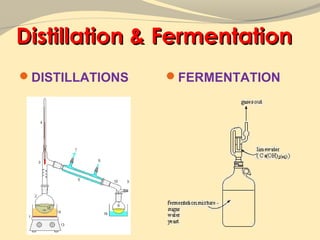
Distillation & FermentationDistillation & Fermentation
Distillation
the method of
separating a mixture
into its component
parts by use of the
difference in their
boiling points
Use heat as agent
Fermentation
fermentation is the
conversion of a
carbohydrate such as
sugar into an acid or
an alcohol
Use yeast as agent
Distillation & FermentationDistillation & Fermentation
DISTILLATIONS FERMENTATION
ALCOHOL BEVERAGEALCOHOL BEVERAGE
SPIRITS
WINE
BEER
SPIRITSSPIRITS
DRY SPIRITS (LIQUORS)
SWEET SPIRITS (CORDIAL/LIQUEURS)
OTHER SPIRITS
(Tequila)
DRY SPIRITSDRY SPIRITS
• drinkable liquid containing ethanol that is
produced by means of distilling fermented
grain, fruit, or vegetables
• NO SUGAR is ADDED during & after the
process
• Alcohol contents: 35% by volume
DRY SPIRITS: COMMON SAMPLEsDRY SPIRITS: COMMON SAMPLEs
1. Gin
2. Rum
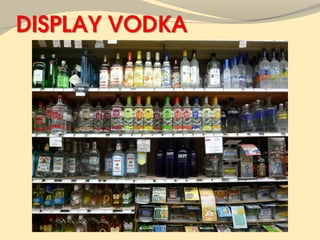
3. Vodka
4. Whisky
5. Tequila
GINGIN
• Obtained by distillation of
grain, barley or maize with
the additional of juniper
berries for flavor
• Gilbey’s, Gordon, Bombay
Sapphire, Beefeater,
Tanquery, Seagram
• Gin Tonic, Tom Collins,
Singapore Sling
Grain
Barley Maize
VODKAVODKA
• A neutral spirit distilled from grain (originally
potatoes)
• Filtered to remove any taste
• Colorless, no aroma or taste, no flavored
• Smirnoff, Stolichnaya, Absolut, Grey
Goose, Zubrowka
• Vodka Tonic, Caipiroska, Blue Lagoon,
Cosmopolitan, Sex on the beach, White
Russian
RUMRUM
Spirits obtained by
distilling a
fermented
sugarcane juice or
molasses
Molasses
Sugarcane
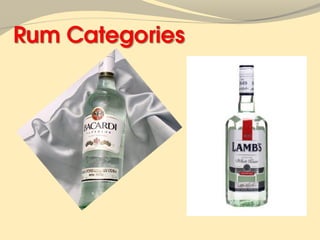
RUM CategoriesRUM Categories
Light
Aged in stainless steel pot
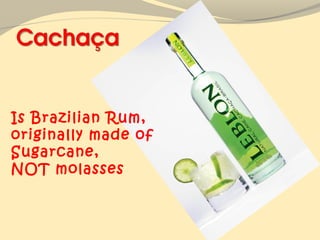
Bacardi, Lamb, Cachaça, Myers
Original Platinum, Appleton Estate
Dark
Aged in Oaks
Myers Dark, Appleton Estate 21 Years,
Angostura Dark
Is Brazilian Rum,
originally made of
Sugarcane,
NOT molasses
Common Cocktails with RUMCommon Cocktails with RUM
Cuba Libra (Dark Rum, Coca Cola, Lime)
Daiquiri
Long Island Tea
Mojito
Mai Tai
Caipirinha
WhiskeyWhiskey
Distilled from a
fermented mash of grain
(corn, rye, barley or
wheat) then it is placed
in oak barrels to age.
it is colorless at the
beginning
during the aging
process that whiskey
obtains its characteristic
amber color, flavor and
aroma
Category in WhiskeyCategory in Whiskey
Scotch
Whisky
Irish
Whisky
Canadian
Whisky
Bourbon
Whisky
Whiskey with “e” & without “e”Whiskey with “e” & without “e”
With “e”
Scotland, Wales,
Canada, Australia,
and Japan
Without “e”
Ireland & US
TequilaTequila
It is a mixture of
Blue Agave Plant
Juice and fermented
Blue Agave Plant
Juice
Fermented 2½ days
Then it is double
distilled
Tequila FactsTequila Facts
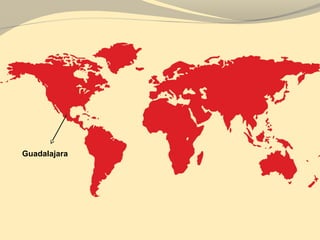
Can be produced only at the state of Jalisco, and
many other states (very limited only)
Mexico has claimed the exclusive international
right to the word "tequila", threatening legal actions
against manufacturers of distilled blue agave
spirits in other countries.
A one Littre bottle limited edition sold for $225,000
in July 2006 in Jalisco. The manufacturer received
a award for the most expensive spirit
Guadalajara
Tequila BrandsTequila Brands
Jose Cuervo (Black
Medallion, Classico
Silver, Especiale Gold)
Olmeca Gold
Pepe Lopez Gold
901
Common Tequila cocktailsCommon Tequila cocktails
Margarita
Long Island Iced Tea
Tequila Sunrise
Tequila Slammer
Mojito Diablo
Daiquiri
How to enjoy TequilaHow to enjoy Tequila
As a shooter
Twist e lemon on our forehand
Put some salt on it
Lick it
Immediately drink a shot of tequila
Followed by chew the remaining of lime wedge
Drinking TequilaDrinking Tequila
IN MEXICO
Drink straight, as a
single shot, NO lime,
NO salt
As side drink of
Sangrita (orange jc,
grenadine, hot chili)
Also Bandera cocktail
(3 shots glasses of
tequila, lime juice,
sangrita)
OUTSIDE MEXICO
Single shot served w/
lime & salt
Lime: to balances and
enhances the flavor
Salt: to lessen the
“burn”
Called: Tequila Cruda /
“lick sip suck” / “lick
shoot suck”
Moisten back of
hand w/ salt
Drink tequila
in one shoot
Immediately bite
the lemon/lime
Kapute!
BeerBeer
Definition:
is an alcoholic beverage
produced by the
fermentation of sugars
derived from starch-
based material
Starch = tepung pati
(bahasa Indonesia)
starchstarch
(C(C66HH1010OO55))nn
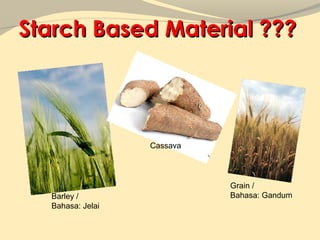
Starch Based Material ???Starch Based Material ???
Barley /
Bahasa: Jelai
Cassava
Grain /
Bahasa: Gandum
Wheat /
Bahasa: Gandum
Maize /
Bahasa: Jagung Manis
Sorgum/
Bahasa: Sorgum
Millet/
Bahasa: Jawawut
Rice
AnythingAnything
else?else?
What is Brewing? …What is Brewing? …
is the production of
beer through steeping
a starch source
(commonly cereal
grains) in water and
then fermenting with
yeast
Beer making process
Starch Sugar
contains
Alcohol
+ CO2
Malting Fermentation
Beer : Essential IngredientsBeer : Essential Ingredients
1. Malt
2. Water
3. Hops
4. Yeast
MaltMalt
Is barley that has been
placed in water, allowed
to begin to sprout, then
dried to stop germination
Malting process to
create enzyme (diastase)
That enzyme helps
starch in the grains turn
into sugar and eventually
alcohol
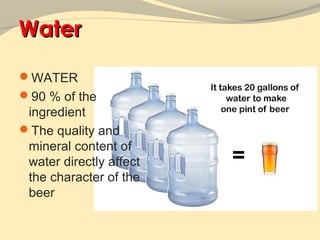
WaterWater
WATER
90 % of the
ingredient
The quality and
mineral content of
water directly affect
the character of the
beer
HopHop
From hop plant (called
Humulus lupulus)
Hop flowers have an
essential oil called lupulin,
which gives the hop the
bitter taste
prevent the brew from
going sour, enrich
characteristic bitter flavor
and an aroma to the beer
YeastYeast
Yeast is the catalyst,
facilitates the reaction which
converts sugar to alcohol
and CO2
Two type of yeast:
1. Sacchromyces
Cerevisiae
2. Sacchomyces
Carlsbergensis
Main process…Main process…
1. mashing
2. brewing
3. fermenting
4. Lagering / storing
a. Maturing
b. Aging
c. Conditioning
5. Packing
1. Mashing1. Mashing
converts starches into sugars
Malt, hot water, adjunct are
mixed and cooked together at
low temperatures (up to 76˚C)
malt enzymes are activated and
turn starches to sugars
Then the grain/malt is strained
out and the remaining liquid,
now called wort, is conveyed to
the brew kettle
1 to 6 hours
2. Brewing2. Brewing
boiling the wort with hops
In huge copper or stainless-
steel brew kettles, the wort-
plus-hops is kept at a rolling
boil (100˚C)
To sterilizes the wort and
protect beer from spoilage
1-2½ hours
After brewing, wort strained
out then cooled
3. Fermenting3. Fermenting
Converting sugar
inside the wort into
alcohol & CO2
Using YEAST
If the yeast settles to
the bottom of the
fermentation tank:
LARGER (bottom-
fermented)
If the yeast raise to
surface of fermentation
tank: ALE (top-
fermented)
3. Fermenting3. Fermenting (continuation)(continuation)
Fermenting period: 7-10 days
CO2 released and stored, to be added again
for later stage
4. Lagering/Storing4. Lagering/Storing
To mature or ripen the
beer, mellowing its flavor.
Some further slow
fermentation may also
take place
It is done at near-freezing
temperatures on in
stainless-steel or glass
lined tanks
may last several weeks
or several months
5. Packing5. Packing
After storage the beer is filtered and then
kegged, bottled, or canned
Canned and bottled beers are pasteurizing
By exposing them in the container to
temperatures of 60˚C to 66˚C) for 20 minutes to
an hour
ALE vs LAGERALE vs LAGER
ALE
1.using top fermenting yeast
2.fermented for a relatively
short time (1-2 weeks)
3.At warmer temperatures
4.Typically a darker, fruitier
brew, strong and bitter
5.Eg. Stouts, Porters and
Dubbels
LAGER
1.Using bottom fermenting
yeast
2.Fermenting several weeks
3.At cold temperature
4.Typically clearer, often
lighter colored and crisper
brew, less hoppy
5.Eg. Budweiser, Miller and
Coors
Beer: Other Common StylesBeer: Other Common Styles
Stout…...
A synonym for dark or black beer.
Made from dark roasted malt and bitter
in taste.
Can be made by top and bottom
fermentation.
Classic examples Guinness, Murphy’s,
Beamish….
Beer: CharacteristicBeer: Characteristic
1. Fermentation
a. Top fermented (Ales)
b. Bottom fermented (Lagers).
2. Colour
pale,
golden,
amber, copper, red, brown, black etc.
Beer: Characteristic cont.Beer: Characteristic cont.
3. Strength:
Depends on alcohol content
Strong
Medium
Light
4. Taste
Described as sweet, sour or bitter
Also: hoppy, toasty, fruity, roasty, flat, malty,
full bodied and empty
Beer: Characteristic cont.Beer: Characteristic cont.
5. Country of Origin
Where its originally production taken place
Denmark, Nederland, USA, Singapore, etc.
6. Season
Winter, summer, all year long, etc.
Beer ServiceBeer Service
Temperature
Cold (freeze): 4˚C – 7˚C
Glass:
Pilsner / Beer Goblet / Beer Mug / Tankard
Should be clean and free from grease or
dust.
Should be cold. (4˚C – 7˚C)
Basic Knowledge Glass BeerBasic Knowledge Glass Beer
A beer served in a glass will be properly
carbonated, while beer drunk straight from the
bottle is higher in carbonation.
No matter what the glass, it must be clean
Frosted glasses SHOULD NOT be used. Beer
gets diluted as soon as it hits the frosted surface
Lagers are often served in tall, tapered glasses,
called pilsner glasses because they came from
Pilzen in what is today the Czech Republic.
Beer handling after BreweryBeer handling after Brewery
1. time
2. storage conditions
3. temperature
4. light
5. vibration
6. strong smells
7. stacking
8. transport
WHISKY …WHISKY …
Definition:
Alcohol drink
obtained by distilled
a fermented mash of
grain (corn, rye,
barley or wheat)
then it is placed in
oak barrels to age.
Scotch
Whisky
Irish
Whisky
Canadian
Whisky
Bourbon
Whisky
Japanese
Whisky
Whisky: The History…Whisky: The History…
1100 – 1300
Distillation brought to from Italy to Ireland &
Scotland by monks
Since wine was not easily obtained in Ireland
and Scotland, barley beer was distilled into
liquor which became whisky
Alcohol limited usage for medicine for both
internal anesthetic use and as an external
antibiotic
Whisky: The History…Whisky: The History…
Word whisky:
From Gaelic Irish language: uisce beatha,
means “Water of Life”
(it was used for medicine, cure to a diseases:
such as the treatment of colic, palsy, and
smallpox)
Whisky: the history…Whisky: the history…
IrelandIreland
ScotlandScotland

Basicbeverageknowledgeheru

  • 1.
    Training Course –part 1 By Heru Setiawan The Edge, 17 May 2012
  • 3.
  • 4.
    ALCOHOLALCOHOL WINEWINE BEERBEER FUNCTIONSFUNCTIONSSPIRITSSPIRITSKINDSKINDS BEVERAGE MAIN CHARTBEVERAGE MAIN CHART
  • 5.
  • 6.
    ALCOHOL BEVERAGEALCOHOL BEVERAGE •Definition: • Is a drink containing ethanol, commonly known as alcohol • Ethanol? • Ethanol: obtained by fermented sugar containing juicy material • C2H6O
  • 7.
    Distillation & FermentationDistillation& Fermentation Distillation the method of separating a mixture into its component parts by use of the difference in their boiling points Use heat as agent Fermentation fermentation is the conversion of a carbohydrate such as sugar into an acid or an alcohol Use yeast as agent
  • 8.
    Distillation & FermentationDistillation& Fermentation DISTILLATIONS FERMENTATION
  • 9.
  • 10.
    SPIRITSSPIRITS DRY SPIRITS (LIQUORS) SWEETSPIRITS (CORDIAL/LIQUEURS) OTHER SPIRITS (Tequila)
  • 11.
    DRY SPIRITSDRY SPIRITS •drinkable liquid containing ethanol that is produced by means of distilling fermented grain, fruit, or vegetables • NO SUGAR is ADDED during & after the process • Alcohol contents: 35% by volume
  • 12.
    DRY SPIRITS: COMMONSAMPLEsDRY SPIRITS: COMMON SAMPLEs 1. Gin 2. Rum 3. Vodka 4. Whisky 5. Tequila
  • 13.
    GINGIN • Obtained bydistillation of grain, barley or maize with the additional of juniper berries for flavor • Gilbey’s, Gordon, Bombay Sapphire, Beefeater, Tanquery, Seagram • Gin Tonic, Tom Collins, Singapore Sling
  • 14.
  • 17.
    VODKAVODKA • A neutralspirit distilled from grain (originally potatoes) • Filtered to remove any taste • Colorless, no aroma or taste, no flavored • Smirnoff, Stolichnaya, Absolut, Grey Goose, Zubrowka • Vodka Tonic, Caipiroska, Blue Lagoon, Cosmopolitan, Sex on the beach, White Russian
  • 19.
    RUMRUM Spirits obtained by distillinga fermented sugarcane juice or molasses Molasses Sugarcane
  • 20.
    RUM CategoriesRUM Categories Light Agedin stainless steel pot Bacardi, Lamb, Cachaça, Myers Original Platinum, Appleton Estate Dark Aged in Oaks Myers Dark, Appleton Estate 21 Years, Angostura Dark
  • 23.
    Is Brazilian Rum, originallymade of Sugarcane, NOT molasses
  • 24.
    Common Cocktails withRUMCommon Cocktails with RUM Cuba Libra (Dark Rum, Coca Cola, Lime) Daiquiri Long Island Tea Mojito Mai Tai Caipirinha
  • 25.
    WhiskeyWhiskey Distilled from a fermentedmash of grain (corn, rye, barley or wheat) then it is placed in oak barrels to age. it is colorless at the beginning during the aging process that whiskey obtains its characteristic amber color, flavor and aroma
  • 26.
    Category in WhiskeyCategoryin Whiskey Scotch Whisky Irish Whisky Canadian Whisky Bourbon Whisky
  • 27.
    Whiskey with “e”& without “e”Whiskey with “e” & without “e” With “e” Scotland, Wales, Canada, Australia, and Japan Without “e” Ireland & US
  • 28.
    TequilaTequila It is amixture of Blue Agave Plant Juice and fermented Blue Agave Plant Juice Fermented 2½ days Then it is double distilled
  • 29.
    Tequila FactsTequila Facts Canbe produced only at the state of Jalisco, and many other states (very limited only) Mexico has claimed the exclusive international right to the word "tequila", threatening legal actions against manufacturers of distilled blue agave spirits in other countries. A one Littre bottle limited edition sold for $225,000 in July 2006 in Jalisco. The manufacturer received a award for the most expensive spirit
  • 30.
  • 31.
    Tequila BrandsTequila Brands JoseCuervo (Black Medallion, Classico Silver, Especiale Gold) Olmeca Gold Pepe Lopez Gold 901
  • 32.
    Common Tequila cocktailsCommonTequila cocktails Margarita Long Island Iced Tea Tequila Sunrise Tequila Slammer Mojito Diablo Daiquiri
  • 33.
    How to enjoyTequilaHow to enjoy Tequila As a shooter Twist e lemon on our forehand Put some salt on it Lick it Immediately drink a shot of tequila Followed by chew the remaining of lime wedge
  • 34.
    Drinking TequilaDrinking Tequila INMEXICO Drink straight, as a single shot, NO lime, NO salt As side drink of Sangrita (orange jc, grenadine, hot chili) Also Bandera cocktail (3 shots glasses of tequila, lime juice, sangrita) OUTSIDE MEXICO Single shot served w/ lime & salt Lime: to balances and enhances the flavor Salt: to lessen the “burn” Called: Tequila Cruda / “lick sip suck” / “lick shoot suck”
  • 35.
    Moisten back of handw/ salt Drink tequila in one shoot Immediately bite the lemon/lime Kapute!
  • 36.
    BeerBeer Definition: is an alcoholicbeverage produced by the fermentation of sugars derived from starch- based material Starch = tepung pati (bahasa Indonesia) starchstarch (C(C66HH1010OO55))nn
  • 37.
    Starch Based Material???Starch Based Material ??? Barley / Bahasa: Jelai Cassava Grain / Bahasa: Gandum
  • 38.
    Wheat / Bahasa: Gandum Maize/ Bahasa: Jagung Manis
  • 39.
  • 40.
  • 41.
  • 42.
    What is Brewing?…What is Brewing? … is the production of beer through steeping a starch source (commonly cereal grains) in water and then fermenting with yeast Beer making process
  • 43.
  • 44.
    Beer : EssentialIngredientsBeer : Essential Ingredients 1. Malt 2. Water 3. Hops 4. Yeast
  • 45.
    MaltMalt Is barley thathas been placed in water, allowed to begin to sprout, then dried to stop germination Malting process to create enzyme (diastase) That enzyme helps starch in the grains turn into sugar and eventually alcohol
  • 46.
    WaterWater WATER 90 % ofthe ingredient The quality and mineral content of water directly affect the character of the beer
  • 47.
    HopHop From hop plant(called Humulus lupulus) Hop flowers have an essential oil called lupulin, which gives the hop the bitter taste prevent the brew from going sour, enrich characteristic bitter flavor and an aroma to the beer
  • 48.
    YeastYeast Yeast is thecatalyst, facilitates the reaction which converts sugar to alcohol and CO2 Two type of yeast: 1. Sacchromyces Cerevisiae 2. Sacchomyces Carlsbergensis
  • 50.
    Main process…Main process… 1.mashing 2. brewing 3. fermenting 4. Lagering / storing a. Maturing b. Aging c. Conditioning 5. Packing
  • 51.
    1. Mashing1. Mashing convertsstarches into sugars Malt, hot water, adjunct are mixed and cooked together at low temperatures (up to 76˚C) malt enzymes are activated and turn starches to sugars Then the grain/malt is strained out and the remaining liquid, now called wort, is conveyed to the brew kettle 1 to 6 hours
  • 52.
    2. Brewing2. Brewing boilingthe wort with hops In huge copper or stainless- steel brew kettles, the wort- plus-hops is kept at a rolling boil (100˚C) To sterilizes the wort and protect beer from spoilage 1-2½ hours After brewing, wort strained out then cooled
  • 53.
    3. Fermenting3. Fermenting Convertingsugar inside the wort into alcohol & CO2 Using YEAST If the yeast settles to the bottom of the fermentation tank: LARGER (bottom- fermented) If the yeast raise to surface of fermentation tank: ALE (top- fermented)
  • 54.
    3. Fermenting3. Fermenting(continuation)(continuation) Fermenting period: 7-10 days CO2 released and stored, to be added again for later stage
  • 55.
    4. Lagering/Storing4. Lagering/Storing Tomature or ripen the beer, mellowing its flavor. Some further slow fermentation may also take place It is done at near-freezing temperatures on in stainless-steel or glass lined tanks may last several weeks or several months
  • 56.
    5. Packing5. Packing Afterstorage the beer is filtered and then kegged, bottled, or canned Canned and bottled beers are pasteurizing By exposing them in the container to temperatures of 60˚C to 66˚C) for 20 minutes to an hour
  • 58.
    ALE vs LAGERALEvs LAGER ALE 1.using top fermenting yeast 2.fermented for a relatively short time (1-2 weeks) 3.At warmer temperatures 4.Typically a darker, fruitier brew, strong and bitter 5.Eg. Stouts, Porters and Dubbels LAGER 1.Using bottom fermenting yeast 2.Fermenting several weeks 3.At cold temperature 4.Typically clearer, often lighter colored and crisper brew, less hoppy 5.Eg. Budweiser, Miller and Coors
  • 59.
    Beer: Other CommonStylesBeer: Other Common Styles Stout…... A synonym for dark or black beer. Made from dark roasted malt and bitter in taste. Can be made by top and bottom fermentation. Classic examples Guinness, Murphy’s, Beamish….
  • 61.
    Beer: CharacteristicBeer: Characteristic 1.Fermentation a. Top fermented (Ales) b. Bottom fermented (Lagers). 2. Colour pale, golden, amber, copper, red, brown, black etc.
  • 62.
    Beer: Characteristic cont.Beer:Characteristic cont. 3. Strength: Depends on alcohol content Strong Medium Light 4. Taste Described as sweet, sour or bitter Also: hoppy, toasty, fruity, roasty, flat, malty, full bodied and empty
  • 63.
    Beer: Characteristic cont.Beer:Characteristic cont. 5. Country of Origin Where its originally production taken place Denmark, Nederland, USA, Singapore, etc. 6. Season Winter, summer, all year long, etc.
  • 64.
    Beer ServiceBeer Service Temperature Cold(freeze): 4˚C – 7˚C Glass: Pilsner / Beer Goblet / Beer Mug / Tankard Should be clean and free from grease or dust. Should be cold. (4˚C – 7˚C)
  • 68.
    Basic Knowledge GlassBeerBasic Knowledge Glass Beer A beer served in a glass will be properly carbonated, while beer drunk straight from the bottle is higher in carbonation. No matter what the glass, it must be clean Frosted glasses SHOULD NOT be used. Beer gets diluted as soon as it hits the frosted surface Lagers are often served in tall, tapered glasses, called pilsner glasses because they came from Pilzen in what is today the Czech Republic.
  • 69.
    Beer handling afterBreweryBeer handling after Brewery 1. time 2. storage conditions 3. temperature 4. light 5. vibration 6. strong smells 7. stacking 8. transport
  • 72.
    WHISKY …WHISKY … Definition: Alcoholdrink obtained by distilled a fermented mash of grain (corn, rye, barley or wheat) then it is placed in oak barrels to age.
  • 74.
  • 75.
    Whisky: The History…Whisky:The History… 1100 – 1300 Distillation brought to from Italy to Ireland & Scotland by monks Since wine was not easily obtained in Ireland and Scotland, barley beer was distilled into liquor which became whisky Alcohol limited usage for medicine for both internal anesthetic use and as an external antibiotic
  • 76.
    Whisky: The History…Whisky:The History… Word whisky: From Gaelic Irish language: uisce beatha, means “Water of Life” (it was used for medicine, cure to a diseases: such as the treatment of colic, palsy, and smallpox)
  • 77.
    Whisky: the history…Whisky:the history… IrelandIreland ScotlandScotland